Systems Engineer Cover Letter Example (2026)
By FindAJobAI Team Updated How we built this page
Systems engineer ads list a familiar stack: Linux, Windows Server, a hypervisor, Ansible or Terraform, some cloud. Your resume already covers those words. The letter is where you show how you think about a platform: one environment you designed or automated, the failure or cost that pushed you to do it, and what is different now because of your work. These cover letter examples show three ways to do that.
Systems Engineer cover letter template
This letter as a one-page template: an opening that names the job and your strongest fact, proof that answers the ad, a reason for this employer and a short close.
After you sign up, FindAJobAI drafts your own letter for a real job from your CV in this format, and you edit it before you send it.
Example 1 · Experienced
Systems engineer applying to a payments company's infrastructure team
Wendell automates server builds for an insurer. The ad asks for Ansible, VMware and someone who can own disaster recovery.
Example letter · fictional
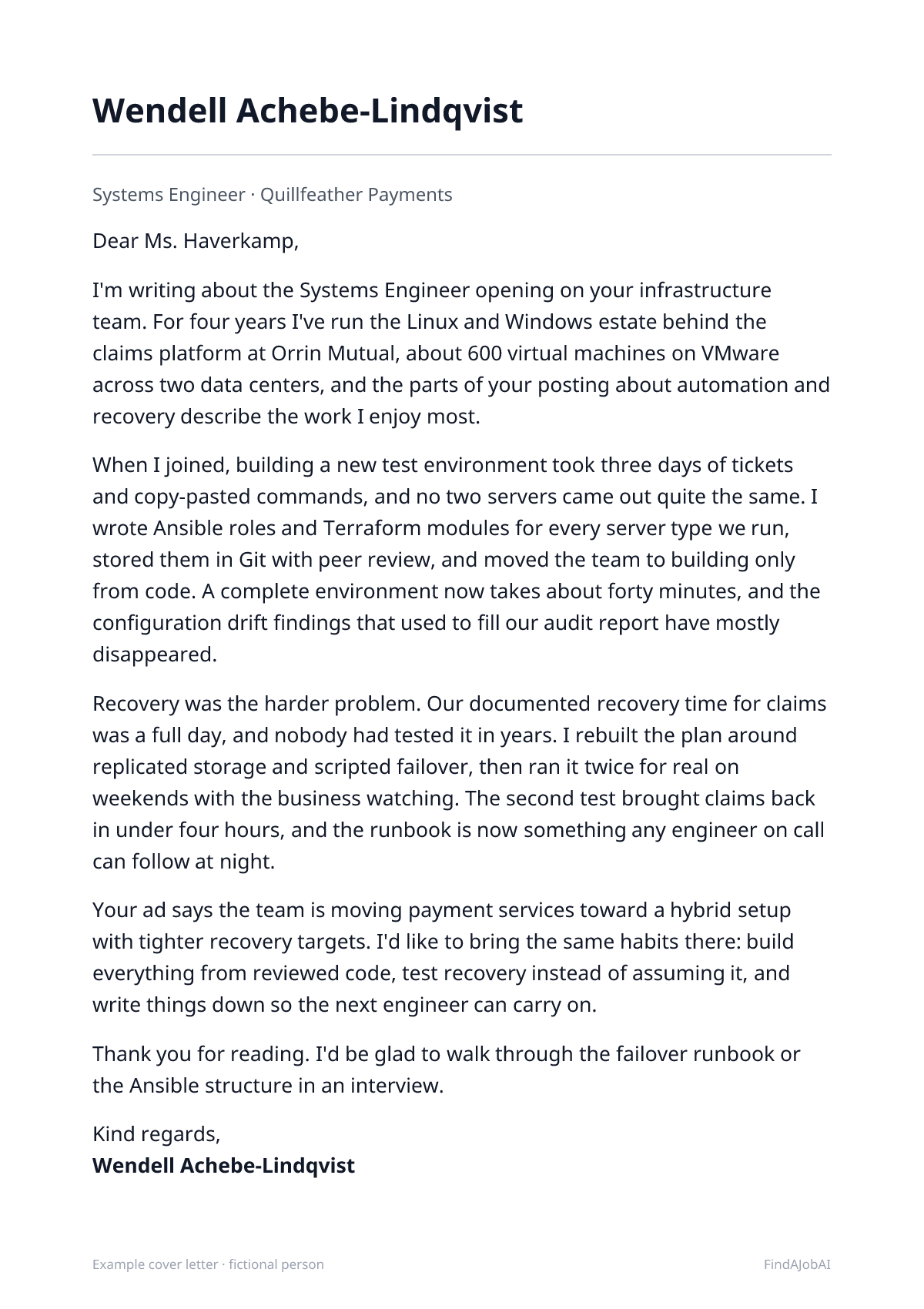
Dear Ms. Haverkamp,
I'm writing about the Systems Engineer opening on your infrastructure team. For four years I've run the Linux and Windows estate behind the claims platform at Orrin Mutual, about 600 virtual machines on VMware across two data centers, and the parts of your posting about automation and recovery describe the work I enjoy most.
When I joined, building a new test environment took three days of tickets and copy-pasted commands, and no two servers came out quite the same. I wrote Ansible roles and Terraform modules for every server type we run, stored them in Git with peer review, and moved the team to building only from code. A complete environment now takes about forty minutes, and the configuration drift findings that used to fill our audit report have mostly disappeared.
Recovery was the harder problem. Our documented recovery time for claims was a full day, and nobody had tested it in years. I rebuilt the plan around replicated storage and scripted failover, then ran it twice for real on weekends with the business watching. The second test brought claims back in under four hours, and the runbook is now something any engineer on call can follow at night.
Your ad says the team is moving payment services toward a hybrid setup with tighter recovery targets. I'd like to bring the same habits there: build everything from reviewed code, test recovery instead of assuming it, and write things down so the next engineer can carry on.
Thank you for reading. I'd be glad to walk through the failover runbook or the Ansible structure in an interview.
Kind regards,
Wendell Achebe-Lindqvist
Example 2 · Career changer
Systems administrator stepping up to a first systems engineer role
Paloma has run a hospital's servers for three years and started automating them on her own. The ad wants scripting and project ownership.
Example letter · fictional
Dear Mr. Oyelowo,
I'd like to be considered for the Systems Engineer role at Larchmont Clinical Labs. I've been a systems administrator at Kestrel Valley Hospital for three years, looking after 140 Windows and Linux servers, and over the last year more of my week has gone into building things rather than only keeping them running.
It started with patching. Every month two of us spent most of a week patching servers by hand, and a missed reboot once left the lab results interface down for a morning. I wrote PowerShell and Ansible scripts that patch servers in three groups, check each service afterwards, and stop the run if a check fails. Monthly patching now takes about a day, compliance went from roughly seventy percent to ninety-six, and we haven't had a patch-related outage since the scripts went live.
That project taught me how much I like design work: deciding how a process should behave when something fails, testing it on non-critical servers first, and writing a runbook my colleagues actually use. I've also passed the RHCSA exam on my own time. I haven't yet designed a virtualization cluster from scratch or owned a cloud environment, and I'd want to learn both alongside your senior engineers.
Your posting mentions lab systems that can't go down during working hours. After three years in a hospital, I understand that pressure, and I'd like to spend my time removing the causes of outages instead of only responding to them.
Thank you for considering my application. I'm happy to share the patching scripts, with hospital details removed.
Best wishes,
Paloma Iwasaki-Byrne
Example 3 · Senior or lead
Infrastructure lead applying to lead a platform team through a data center exit
Ignatius leads four engineers at a logistics company. The ad is for a senior engineer to plan and lead a move out of an aging data center.
Example letter · fictional
Dear Dr. Vasquez-Holm,
Your posting for a Senior Systems Engineer to lead the exit from your Dallas data center caught my attention because I finished almost exactly that project eight months ago. At Corvane Logistics I lead four systems engineers responsible for roughly 1,200 servers, and I spent the last fourteen months moving most of them out of a building our lease was about to end on.
The technical work was the easier half. The hard part was deciding what not to move. I ran a full inventory with application owners and found that about a fifth of our servers had no clear owner or no recent traffic at all. We retired those instead of migrating them, moved the rest to colocation and AWS in waves of about fifty, and rehearsed every wave in advance with a written rollback. We finished two months early, and the company now expects to save about a million dollars over three years.
Along the way I set one build standard for every Linux server, based on golden images and Ansible, so the engineers who join after me inherit something consistent. I also started a short weekly review where whoever handled an incident walks the team through it, which has made our runbooks noticeably better and our on-call nights calmer. I haven't run a migration involving mainframe workloads, which your ad hints at, and I'd want to plan that part carefully with the people who know those systems.
I'd welcome a conversation about where your exit plan stands today, which applications worry you most, and how your team is staffed for it.
Sincerely,
Ignatius Fairbanks-Oduya
All three letters, and the short version below, are fictional: the people, employers and numbers are invented. Borrow the structure, never the facts.
- Prefer to write it yourself? Use the free cover letter template.
- Check your CV against the job first: the free CV score shows the missing keywords.
Why the first letter works, paragraph by paragraph
Paragraph 1: Opening
States the size of the estate (600 VMs, two data centers) and links it to the two parts of the ad that matter most: automation and recovery.
Paragraph 2: The automation story
Starts from a real pain (three-day builds, drifting servers), names the tools inside the story, and ends with two results: forty-minute builds and fewer audit findings.
Paragraph 3: The recovery story
Shows engineering judgment, not just tooling: an untested plan was rebuilt and then proven twice, with a measured recovery time.
Paragraph 4: Why this company
Picks up the ad's hybrid move and recovery targets and connects them to three working habits rather than generic enthusiasm.
Paragraph 5: Close
Offers concrete material to discuss, the runbook and the code layout, which invites a technical conversation.
What the career changer's letter does differently
The administrator's letter builds the whole case on one project, patching automation, and tells it from the outage that started it to the measured result. It names a certification earned on her own time and is plain about what she hasn't done yet (cluster design, cloud), which makes the rest of the letter easier to trust.
What the senior letter does differently
A senior letter is judged on decisions and outcomes across a whole estate. Here the strongest line is about what the writer chose not to migrate, which shows judgment, followed by the delivery method (waves, rehearsals, rollbacks) and a cost result. The team habit and the honest mainframe gap round out a picture of someone who leads, not only builds.
Short systems engineer cover letter: an email-ready version
Many applications arrive as an email or a small text box, and a full page doesn't fit. This version runs 120 to 150 words and keeps only what a reader needs to decide whether to reply. A systems engineer replies by email to a recruiter's message about a contract-to-hire role at a university research computing group.
Short version · email · fictional124 words
Subject: Systems Engineer, Research Computing – Linux and Ansible – Saoirse Mbatha-Kowalczyk
Hi Mr. Delacroix-Amadi,
Thanks for reaching out about the Systems Engineer role with your research computing group. I've spent five years running Linux servers for a biotech company, most recently a 90-node compute cluster that scientists use for sequencing analysis around the clock.
The project closest to your role was rebuilding how that cluster is managed. Every node had been set up by hand, so I moved the whole cluster to Ansible and a shared image, which cut the time to add or replace a node from a day to about an hour.
I'd enjoy supporting researchers again in a university setting. My resume is attached, and I'm free for a call most afternoons this week if that suits you.
Thanks again,
Saoirse Mbatha-Kowalczyk
A recruiter's email needs a fast answer, so the reply confirms interest, gives one relevant project with a clear before and after, and offers times to talk. The cluster story speaks directly to research computing, which does more than a list of tools would.
Opening lines that work for systems engineer cover letters
The first sentence decides whether the second gets read. Here are six openings, one for each situation you might be in. Pick the one that matches yours and swap in your own facts: every name and number below is invented.
1. You have a standout result
Building a full test environment used to take my team three days of tickets. After I moved our builds to Ansible and Terraform, it takes about forty minutes, and I'd like to bring that approach to your infrastructure team.
2. The ad names a problem you've solved
Your posting mentions a recovery plan nobody has tested in a while. I rebuilt ours and ran it for real twice, bringing recovery for our main platform from a full day to under four hours.
3. Someone referred you
Rashida Okafor-Brandt, who leads your security team, and I worked through a hardening project together at a previous employer. She mentioned you need an engineer who treats patching as a system rather than a chore, and that is exactly the work I've been doing.
4. You admire what they build
I've spent three years keeping 140 hospital servers running, and the past year automating the work that used to cause our outages. I'd like to make that engineering work my whole job.
5. You're new to the field or switching into it
Eight months ago I finished leading a team of four through a data center exit of about 1,200 servers. Your ad describes the same move, and I'd like to help you avoid the mistakes we learned from.
6. You have senior scope or a specialism
The most useful thing I built last year was not a new system but a patching process that checks itself and stops when something breaks. It ended a run of patch-related outages, and it's the kind of work I'd like to do at your company.
How to write a systems engineer cover letter
Five steps, in the order you'd write them. The shape stays the same for every job (a short opening, proof, a reason for this employer, a close), and what goes into each part is what changes with the role.
Find the platform problem in the ad
Systems engineer ads usually hint at what is hurting: slow builds, a migration, a recovery target, patching debt or a move to cloud. Read the responsibilities closely and pick the one that matches a project you have actually delivered, so your letter answers a real need.
Lead with the project, not the toolset
Open with what you built or changed and why. Mention Ansible, vSphere or Terraform inside that story. A hiring manager learns far more from one well-told project than from a list of fifteen tools copied from your skills section.
Give before and after numbers
Build time, recovery time, patch compliance, outages per quarter or hours saved each week are easy to understand and easy to check in an interview. If you can't share an exact figure, describe the change in plain terms, such as from days to under an hour.
Show how you handle failure
Infrastructure breaks, and managers want to know how you think when it does. Mention a rollback plan, a recovery test, a check that stops a bad change, or what you changed after an incident. This tells the reader you design for failure rather than hoping it won't happen.
Be honest about the gaps
If the ad asks for something you haven't done, such as a specific cloud provider or cluster design, say so briefly and connect it to something close you have done. Plain honesty makes your stronger claims more believable and sets up a fair interview conversation.
Systems Engineer cover letter do's and don'ts
Do
- Pick one platform or process you designed or automated, and explain why it needed changing.
- Give before and after numbers: build time, recovery time, patch compliance, hours saved.
- Name the tools inside the story (Ansible, vSphere, Terraform) instead of listing them in a block.
Don't
- Don't copy your skills section into the letter; the resume already holds the tool list.
- Don't claim disaster recovery ownership unless you can describe a real test and its result.
- Don't share hostnames, IP ranges or internal diagrams from your current employer.
Common systems engineer cover letter mistakes
Each one is easy to make and quick to fix before you send the letter.
Repeating the resume's skills list
A paragraph of tool names adds nothing the resume doesn't already say. Use the space for one project that shows how you used those tools to solve a problem.
Describing operations as engineering
Closing tickets and applying patches matter, but they read as administration. If you're applying for an engineering role, show design and automation: something you built that changed how the team works.
Results with no baseline
Saying you improved reliability or sped up builds means little without a starting point. Give the before and after, even roughly, so the reader can judge the size of the change.
Ignoring the company's environment
A letter that could go to any employer suggests you didn't read the ad. Mention their stated migration, platform or recovery goal and connect it to your own experience.
Overstating cloud or architecture experience
Claiming deep AWS or architecture experience from a short course invites a hard technical interview you can't pass. Describe exactly what you've built and what you're ready to learn.
Email subject lines for systems engineer applications
Applying by email? Put the job title, any reference number and your name in the subject line.
- Systems Engineer application – Ansible and VMware, 600-VM estate – Wendell Achebe-Lindqvist
- Systems Engineer – sysadmin with patch automation and RHCSA – Paloma Iwasaki-Byrne
- Application: Systems Engineer, Infrastructure (Req. 5127) – Wendell Achebe-Lindqvist
Everything for Systems Engineers
- Systems Engineer resume exampleA full resume, plus bullet and summary examples
- Systems Engineer interview questions30 questions with sample answers
- Systems Engineer job descriptionDuties, skills and requirements
- Career change cover letter: template + examples
Other cover letter examples
Systems Engineer cover letter FAQ
What should a systems engineer cover letter include?
One or two projects where you designed, automated or rebuilt part of an infrastructure, the problem that made it necessary, and the measured result. Connect them to something specific in the job ad, such as a migration or a recovery target.
How do I write a systems engineer cover letter as a systems administrator?
Lead with the project work you've done beyond tickets: a script that removed manual effort, a migration you planned, a process you redesigned. Say what you haven't done yet, such as cluster design or cloud ownership, and show you're ready to learn it.
How technical should a systems engineer cover letter be?
Technical enough that another engineer can follow the story and see your reasoning, but without configuration details or long tool lists. Explain the problem, the approach and the result in plain sentences.
Should I mention on-call experience in the letter?
Yes, if the ad mentions on-call or incident response. Describe one incident briefly, what you did, and what you changed afterwards so it wouldn't happen the same way again.
How we built this page
The FindAJobAI team wrote the three example letters, the short email version, the opening lines and the advice for systems engineer roles. The people, employers and numbers in the letters are invented; the structure, the kind of evidence and the order of the paragraphs are the parts to copy.
Once we track enough live systems engineer job ads, this page also shows the skills they ask for most, counted the same way as our in-demand skills report.
Last reviewed on November 1, 2026.