Transcriptionist Cover Letter Example (2026)
By FindAJobAI Team Updated How we built this page
Hiring managers reading a transcriptionist cover letter want proof of three things: you hear accurately, you type fast and you never miss a deadline. Skip general claims about being detail-oriented. Give your audit score, the audio you handle and how you deal with crosstalk, accents and confidential recordings.
Transcriptionist cover letter template
This letter as a one-page template: an opening that names the job and your strongest fact, proof that answers the ad, a reason for this employer and a short close.
After you sign up, FindAJobAI drafts your own letter for a real job from your CV in this format, and you edit it before you send it.
Example 1 · Experienced
Legal transcriptionist applying to a court reporting agency
Delphine has typed depositions and hearings remotely for six years and wants a full-time role with a larger legal agency.
Example letter · fictional
Dear Ms. Ferreira-Lindgren,
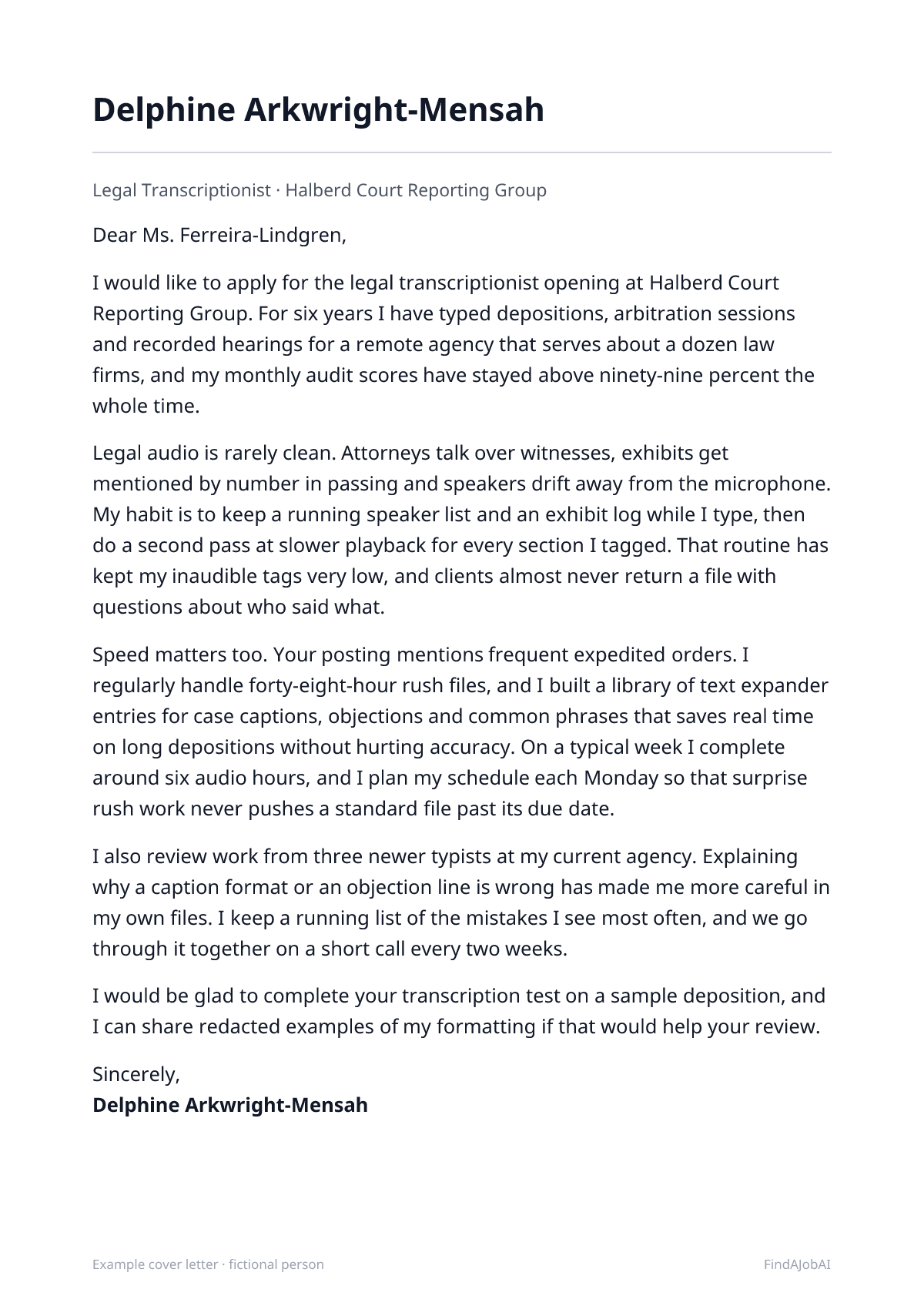
I would like to apply for the legal transcriptionist opening at Halberd Court Reporting Group. For six years I have typed depositions, arbitration sessions and recorded hearings for a remote agency that serves about a dozen law firms, and my monthly audit scores have stayed above ninety-nine percent the whole time.
Legal audio is rarely clean. Attorneys talk over witnesses, exhibits get mentioned by number in passing and speakers drift away from the microphone. My habit is to keep a running speaker list and an exhibit log while I type, then do a second pass at slower playback for every section I tagged. That routine has kept my inaudible tags very low, and clients almost never return a file with questions about who said what.
Speed matters too. Your posting mentions frequent expedited orders. I regularly handle forty-eight-hour rush files, and I built a library of text expander entries for case captions, objections and common phrases that saves real time on long depositions without hurting accuracy. On a typical week I complete around six audio hours, and I plan my schedule each Monday so that surprise rush work never pushes a standard file past its due date.
I also review work from three newer typists at my current agency. Explaining why a caption format or an objection line is wrong has made me more careful in my own files. I keep a running list of the mistakes I see most often, and we go through it together on a short call every two weeks.
I would be glad to complete your transcription test on a sample deposition, and I can share redacted examples of my formatting if that would help your review.
Sincerely,
Delphine Arkwright-Mensah
Example 2 · Career changer
Office assistant moving into transcription work
Cosima spent five years as a law office receptionist and recently finished a general transcription certificate.
Example letter · fictional
Dear Mr. Pembleton-Okafor,
I am applying for the transcriptionist position at Clearsound Media Transcripts. After five years at the front desk of a small family law office, I completed a general transcription certificate this spring, and I now type seventy-eight words per minute at ninety-seven percent accuracy on timed tests.
My office work prepared me for this change more than I first expected. I took dozens of phone messages every day, often from upset callers who spoke quickly, and I learned to write down names, numbers and dates exactly the first time. I also typed short dictated letters for the two attorneys, which is where I discovered that I enjoy careful listening and clean formatting. When the office switched to a new case system, I also retyped about four hundred client contact records, checking each one against the paper file before shredding it.
Since finishing the course I have transcribed about seventy audio hours of podcasts and interviews as a freelancer. Every order followed a client style guide with speaker labels and timestamps, and I delivered each one on time, including several overnight requests.
I know media files bring challenges I have not faced at scale yet, such as music beds, fast banter and guests with strong accents. Your listing mentions a training period with editor feedback, and that is exactly the kind of structure I want while I build speed on longer files.
I would be happy to take your skills test or transcribe a short sample episode so you can judge my work directly.
Kind regards,
Cosima Whitlock-Adeyemi
Example 3 · Senior or lead
Transcription team lead applying to run a production team
Marisol leads fifteen typists at a regional agency and is applying to manage transcription production at a research services firm.
Example letter · fictional
Dear Dr. Abernathy-Salo,
I am writing about the Transcription Production Manager role at Northgate Qualitative Research. I have worked in transcription for thirteen years, and for the last six I have led a team of fifteen typists and three editors who produce roughly nine hundred audio hours each month for legal, academic and media clients.
Your posting says turnaround has slipped as interview volume grew. We had the same problem when two large university clients joined in one quarter. Long focus group files were sitting with single typists for days. I started splitting recordings over ninety minutes into segments, assigning them in parallel and having one editor merge and harmonize speaker labels at the end. Average turnaround dropped by about a third within two months, and audit scores held steady.
Quality is the other half of the job. I built a monthly audit that samples a tenth of every typist's files, with short written notes and a quick call when a pattern appears. Typists see their own trend over time, which motivates them more than a single score does. I also pair each new hire with an experienced editor for the first month, so questions get answered in minutes instead of piling up.
I have mostly served legal and media clients, so research consent rules and anonymization standards would be new territory for me. I would plan to learn them from your research leads in my first weeks, before changing any workflow.
I would welcome a conversation about your volume forecasts, the tools your team uses now and where projects are getting stuck today.
Best regards,
Marisol Okonkwo-Tremblay
All three letters, and the short version below, are fictional: the people, employers and numbers are invented. Borrow the structure, never the facts.
- Prefer to write it yourself? Use the free cover letter template.
- Check your CV against the job first: the free CV score shows the missing keywords.
Why the first letter works, paragraph by paragraph
Paragraph 1: Opening
Names the role, the audio type, years and an audit score, which are the first things a transcription manager checks.
Paragraph 2: Difficult audio routine
Shows a concrete method for crosstalk and exhibits, proving accuracy instead of claiming it.
Paragraph 3: Rush deadlines
Links the posting's need for expedited orders to a specific speed habit.
Paragraph 4: Reviewing others
Mentoring newer typists signals deep knowledge of formats and trust from the employer.
Paragraph 5: Close
Offers a sample test, which is how most agencies make their decision.
What the career changer's letter does differently
The career changer uses phone messages and dictated letters as proof of careful listening, adds freelance audio hours for real transcription evidence and names the gaps she still needs to close, tying them to the employer's training period.
What the senior letter does differently
A team lead's letter is about systems: splitting long files, a regular audit with feedback and steady output, each tied to a result. It names research consent rules as an honest gap and explains how she would learn them before making changes.
Short transcriptionist cover letter: an email-ready version
Many applications arrive as an email or a small text box, and a full page doesn't fit. This version runs 120 to 150 words and keeps only what a reader needs to decide whether to reply. A transcriptionist emails an agency owner after seeing a post asking for typists who can handle multi-speaker business meetings.
Short version · email · fictional128 words
Subject: Multi-speaker meeting transcription – 4 years, 99% audit average – Evander Lockridge-Asante
Hi Ms. Brackenridge-Oyo,
I saw your post looking for typists who can handle board meetings and conference calls with many speakers. I have transcribed business audio for four years, including earnings calls, committee meetings and internal town halls with up to twelve voices.
My audit average over the past year is ninety-nine percent, and I usually work through about six audio hours a week. I keep a speaker sheet with voice notes for every recurring client, which makes labeling much faster on weekly meetings and keeps names consistent from one month to the next.
My resume and a short redacted sample are attached. I am happy to complete a paid or unpaid test file this week so you can check my formatting and accuracy directly.
Best,
Evander Lockridge-Asante
The short email answers what an agency owner needs: the audio type, years, an audit score, weekly capacity and one practical method. It ends with a sample and an offer to take a test file.
Opening lines that work for transcriptionist cover letters
The first sentence decides whether the second gets read. Here are six openings, one for each situation you might be in. Pick the one that matches yours and swap in your own facts: every name and number below is invented.
1. You have a standout result
My monthly audit scores have stayed above ninety-nine percent for six years of deposition and hearing work, and I would like to bring that accuracy to your legal team.
2. The ad names a problem you've solved
Your posting asks for a typist comfortable with focus groups. Most of my recent files had eight or more speakers talking over each other.
3. Someone referred you
Your senior editor, Lucinda Prestwick, and I worked together on a large university interview project, and she suggested I apply for this opening.
4. You admire what they build
After five years taking careful phone messages at a law office, I trained as a transcriptionist and now type seventy-eight words per minute.
5. You're new to the field or switching into it
I have delivered over a hundred overnight rush files in the past two years without missing a deadline.
6. You have senior scope or a specialism
As a transcription team lead, I cut our average turnaround by about a third without lowering audit scores. I would like to do the same for your production team.
How to write a transcriptionist cover letter
Five steps, in the order you'd write them. The shape stays the same for every job (a short opening, proof, a reason for this employer, a close), and what goes into each part is what changes with the role.
Lead with accuracy and speed
Open with the two numbers transcription managers check first: your typing speed and your accuracy or audit score. Add the type of audio you handle, such as legal, research or media files, so the reader can match you to their workload within the first few lines of the letter.
Describe how you handle hard audio
Explain one routine you use for crosstalk, accents, background noise or poor phone recordings, such as keeping a speaker sheet or doing a second pass at slower playback. A concrete method convinces a manager far more than calling yourself detail-oriented or a careful listener.
Show you meet deadlines
Mention standard and rush turnaround times you deliver, plus how many files or audio hours you complete in a typical week. Agencies juggle client deadlines constantly, so evidence that you deliver on time is often as important to them as your accuracy rate.
Mention how you protect recordings
Many recordings involve legal cases, patients or private business discussions. State that you work under nondisclosure agreements, use secure platforms and never name clients. Keep this to one or two sentences, but do include it, because a breach is a serious risk for any agency.
Offer a test file
Close by offering to take the employer's transcription test or type a short sample. Most agencies hire on test results, so showing you welcome a test signals confidence. Keep your letter itself free of typos, since it is the first sample of your work they see.
Transcriptionist cover letter do's and don'ts
Do
- State your typing speed, accuracy and the audio you handle in the first paragraph.
- Describe one routine you use for difficult recordings.
- Mention turnaround times and rush work you deliver.
- Offer to take a transcription test or type a sample file.
Don't
- Don't rely on the phrase detail-oriented without evidence.
- Don't name confidential clients or cases.
- Don't ignore the content type, such as legal, medical or media, in the posting.
Common transcriptionist cover letter mistakes
Each one is easy to make and quick to fix before you send the letter.
Calling yourself detail-oriented with no proof
Every applicant says it. Replace the phrase with an audit score, a low correction rate or a review routine.
No words-per-minute figure anywhere
Give a recent words-per-minute result with accuracy, since managers screen for both before reading further.
Naming confidential clients
Describe clients by type, such as law firms or research teams, to show you understand confidentiality.
Typos in a transcription letter
An error in your own letter suggests errors in transcripts. Read it aloud and check every name twice.
One letter for every content type
Legal, medical and media work need different strengths. Match your examples to the audio in the posting.
Email subject lines for transcriptionist applications
Applying by email? Put the job title, any reference number and your name in the subject line.
- Legal Transcriptionist – 6 years, 99% audit scores – Delphine Arkwright-Mensah
- Transcriptionist – certified, 78 WPM, freelance interview work – Cosima Whitlock-Adeyemi
- Application: Legal Transcriptionist, Halberd Court Reporting Group – Delphine Arkwright-Mensah
Everything for Transcriptionists
- Transcriptionist resume exampleA full resume, plus bullet and summary examples
- Transcriptionist interview questions30 questions with sample answers
- Transcriptionist job descriptionDuties, skills and requirements
- Career change cover letter: template + examples
Other cover letter examples
Transcriptionist cover letter FAQ
Does a transcriptionist need a cover letter?
Often yes, especially for agency and in-house roles. A short letter is also a quick writing sample, so keep it clean, accurate and well formatted.
What should I include in a transcriptionist cover letter?
Your typing speed and accuracy, the content you transcribe, an audit score or on-time rate, how you handle difficult audio and an offer to take a transcription test.
How do I write a transcriptionist cover letter with no experience?
Use a certificate, typing test results and any freelance or volunteer files as proof. Link past jobs that needed careful listening or typing, and say how you will build speed.
How we built this page
The FindAJobAI team wrote the three example letters, the short email version, the opening lines and the advice for transcriptionist roles. The people, employers and numbers in the letters are invented; the structure, the kind of evidence and the order of the paragraphs are the parts to copy.
Once we track enough live transcriptionist job ads, this page also shows the skills they ask for most, counted the same way as our in-demand skills report.
Last reviewed on November 1, 2026.