Nuclear Medicine Technologist Resume Example (2026)
By FindAJobAI Team Updated How we built this page
Nuclear medicine job ads list credentials first (CNMT or ARRT(N), often CT), then the modalities, such as PET/CT, SPECT/CT and cardiac stress imaging, and phrases like "radiopharmaceutical preparation" and "ALARA". A resume that only says "performed nuclear medicine scans" doesn't tell a chief technologist how many patients you handle or how carefully you work with radioactive material.
The sample below is a nuclear medicine technologist with seven years in hospital and outpatient imaging. Each bullet names the study type or task, the method and a number a department manager checks: patients per day, repeat scans, dose errors, quality control results, wait times or personal dosimeter readings.
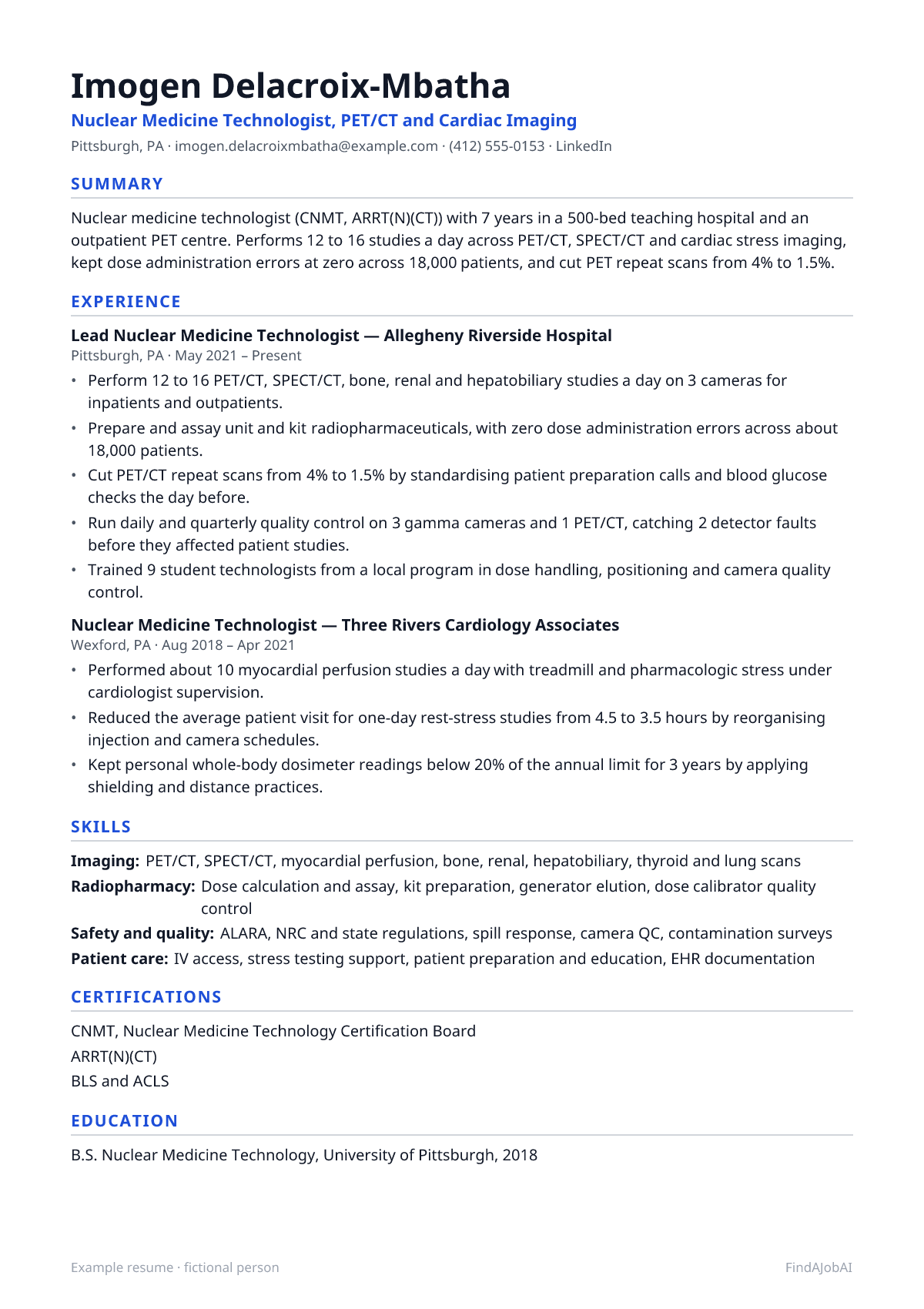
Nuclear Medicine Technologist resume template
This example as a one-page template: one column, standard headings and plain text, the format applicant tracking systems read most reliably.
After you sign up, Create my CV builds your own resume in this same one-column layout, from your real experience.
Mid-level nuclear medicine technologist resume example
A complete one-page example for a fictional nuclear medicine technologist: every bullet pairs an action with what changed because of it.
Example resume · fictional person
Imogen Delacroix-Mbatha
Nuclear Medicine Technologist, PET/CT and Cardiac Imaging
Pittsburgh, PA · [email protected] · (412) 555-0153 · LinkedIn
Summary
Nuclear medicine technologist (CNMT, ARRT(N)(CT)) with 7 years in a 500-bed teaching hospital and an outpatient PET centre. Performs 12 to 16 studies a day across PET/CT, SPECT/CT and cardiac stress imaging, kept dose administration errors at zero across 18,000 patients, and cut PET repeat scans from 4% to 1.5%.
Experience
Lead Nuclear Medicine Technologist, Allegheny Riverside Hospital
Pittsburgh, PA · May 2021 – Present
- Perform 12 to 16 PET/CT, SPECT/CT, bone, renal and hepatobiliary studies a day on 3 cameras for inpatients and outpatients.
- Prepare and assay unit and kit radiopharmaceuticals, with zero dose administration errors across about 18,000 patients.
- Cut PET/CT repeat scans from 4% to 1.5% by standardising patient preparation calls and blood glucose checks the day before.
- Run daily and quarterly quality control on 3 gamma cameras and 1 PET/CT, catching 2 detector faults before they affected patient studies.
- Trained 9 student technologists from a local program in dose handling, positioning and camera quality control.
Nuclear Medicine Technologist, Three Rivers Cardiology Associates
Wexford, PA · Aug 2018 – Apr 2021
- Performed about 10 myocardial perfusion studies a day with treadmill and pharmacologic stress under cardiologist supervision.
- Reduced the average patient visit for one-day rest-stress studies from 4.5 to 3.5 hours by reorganising injection and camera schedules.
- Kept personal whole-body dosimeter readings below 20% of the annual limit for 3 years by applying shielding and distance practices.
Skills
- Imaging: PET/CT, SPECT/CT, myocardial perfusion, bone, renal, hepatobiliary, thyroid and lung scans
- Radiopharmacy: Dose calculation and assay, kit preparation, generator elution, dose calibrator quality control
- Safety and quality: ALARA, NRC and state regulations, spill response, camera QC, contamination surveys
- Patient care: IV access, stress testing support, patient preparation and education, EHR documentation
Certifications
- CNMT, Nuclear Medicine Technology Certification Board
- ARRT(N)(CT)
- BLS and ACLS
Education
- B.S. Nuclear Medicine Technology, University of Pittsburgh, 2018
Fictional example by the FindAJobAI team: the person, employers and numbers are invented. Keep the structure; use your own work and numbers you can explain in an interview.
Entry-level nuclear medicine technologist resume example
A new graduate with fresh certification and clinical rotations. Education and credentials lead, and the bullets count the studies assisted and the supervised tasks completed during training.
Entry-level example resume · fictional person
Caspian Oyebanji-Ferrante
Nuclear Medicine Technologist (Entry Level), CNMT
Rochester, MN · [email protected] · (507) 555-0197 · LinkedIn
Summary
Newly certified nuclear medicine technologist (CNMT) with 1,400 clinical hours in a hospital department and an outpatient PET centre. Assisted with about 600 studies, including bone, cardiac and PET/CT, and prepared doses under supervision with full accuracy.
Education
- B.S. Nuclear Medicine Technology, Winona State University, 2025
Experience
Clinical Rotation, Nuclear Medicine, Zumbro Valley Medical Center
Rochester, MN · Sep 2024 – Apr 2025
- Assisted with about 450 studies, including bone scans, myocardial perfusion, renal and thyroid imaging.
- Drew up and assayed over 300 doses under supervision with no discrepancies against prescriptions.
- Performed daily camera uniformity and dose calibrator checks on 2 cameras for 4 months of the rotation.
- Started about 150 IV lines for injections, with a first-attempt success rate near 90%.
Clinical Rotation, PET/CT, Southern Minnesota Imaging Center
Mankato, MN · Jan 2025 – Apr 2025
- Assisted with about 150 oncology PET/CT scans, including patient preparation and glucose checks.
- Helped revise the patient prep handout, which the centre adopted for 2 types of studies.
Skills
- Imaging: Bone, cardiac, renal, thyroid and PET/CT studies, SPECT acquisition
- Radiopharmacy: Dose drawing and assay, kit preparation basics, dose calibrator checks
- Patient care and radiation safety: IV access, patient education, ALARA, contamination surveys, BLS
Certifications
- CNMT, Nuclear Medicine Technology Certification Board
- BLS
Senior nuclear medicine technologist resume example
A chief technologist fourteen years in, managing staff across several sites. The bullets move from studies performed to staffing, safety compliance, new services and inspections.
Senior example resume · fictional person
Seraphina Haugland-Adeyemi
Chief Nuclear Medicine Technologist
Richmond, VA · [email protected] · (804) 555-0157 · LinkedIn
Summary
Chief nuclear medicine technologist with 14 years in hospital imaging, managing 11 technologists across 2 hospitals and a PET centre. Leads radiation safety compliance with the RSO, launched a theranostics service now treating about 300 patients a year, and passed 3 state inspections without findings.
Experience
Chief Nuclear Medicine Technologist, Fall Line Health System
Richmond, VA · Aug 2019 – Present
- Manage 11 technologists across 2 hospitals and a PET centre performing about 14,000 studies a year.
- Launched a theranostics service with radiation oncology and the RSO, now treating about 300 patients a year.
- Passed 3 state radioactive materials inspections without findings by running quarterly internal audits.
- Cut PET/CT wait times for oncology patients from 12 days to 5 by adding an evening session and cross-training 3 staff.
- Led the replacement of 2 SPECT cameras with SPECT/CT systems, finishing installs and staff training with 4 days of downtime.
Senior Nuclear Medicine Technologist, Tidewater Regional Hospital
Norfolk, VA · Jun 2014 – Jul 2019
- Performed about 14 studies a day and coordinated the department schedule for 6 technologists.
- Wrote 20 updated protocols for SPECT/CT studies after the department added hybrid imaging.
- Served as clinical instructor for 12 students from 2 accredited programs.
Nuclear Medicine Technologist, Chesapeake Imaging Partners
Chesapeake, VA · Jun 2011 – May 2014
- Performed general and cardiac nuclear medicine studies in a busy outpatient centre.
- Handled 2 minor radioactive spills by following procedure, with surveys confirming no exposure above limits.
Skills
- Leadership: Staff scheduling and hiring, budgeting, protocol writing, clinical instruction
- Imaging modalities: PET/CT, SPECT/CT, cardiac stress imaging, theranostics, general nuclear medicine
- Licensing and safety compliance: NRC and state licensing, RSO collaboration, audits, ALARA programs
- Projects: Equipment replacement, service launches, workflow redesign, accreditation
Certifications
- CNMT
- ARRT(N)(CT)
- NMTCB PET
- BLS and ACLS
Education
- B.S. Nuclear Medicine Technology, Old Dominion University, 2011
How to write a nuclear medicine technologist resume
Five steps, in the order a recruiter reads the page. The format around them stays plain for every job: one column, standard headings, newest role first.
Header: name, target title and links
Match the ad's title and put your credentials after your name or in the headline, for example "Nuclear Medicine Technologist, CNMT, ARRT(N)(CT)". Add the modalities you focus on, such as PET/CT or cardiac imaging.
Summary: what you do and your best proof
Give your years, credentials, settings and modalities, then one or two measured results such as daily volume, dose accuracy or repeat rates. Avoid phrases like "dedicated healthcare professional" that every applicant uses.
Experience: newest first, a result in every bullet
Start each bullet with the study type or task, then the method and the number: patients, studies, errors, QC results or time saved. Put your most important safety or quality result near the top under each job.
Skills: grouped, in the ad's words
Group skills into imaging, radiopharmacy, safety and quality, and patient care. Name specific studies, equipment checks and regulations rather than writing "nuclear medicine procedures."
Education and certifications
List your nuclear medicine degree or certificate program, the year and your clinical sites if you're a new graduate. Put certifications and licences in their own section near the top.
Skills to put on a nuclear medicine technologist resume
Hard skills are the tools and methods of the job; soft skills are how you work with people. Each comes with one way to prove it, because a skill named only in a list counts for little. Add the ones you really have.
Hard skills
- PET/CT imaging
- Give daily or yearly volume, study types and any repeat rate or wait time you improved.
- SPECT and SPECT/CT acquisition
- Name the studies you perform and the cameras you run.
- Myocardial perfusion imaging
- Mention stress methods, daily volume and any change to patient visit times.
- Radiopharmaceutical preparation
- State dose counts and your error record, plus kit or generator work.
- Dose calculation and assay
- Describe how you verify doses and any process you improved.
- Camera and dose calibrator QC
- Name the checks you run and any fault QC caught.
- Radiation safety and ALARA
- Give dosimeter readings, survey routines or spill responses handled.
- IV access
- Mention lines started and first-attempt success if you track it.
- Theranostics and therapy support
- Name the treatments you supported and patient counts.
- CT operation on hybrid systems
- Show your CT credential and the CT protocols you run.
- Regulatory documentation
- Mention records you keep and inspection results.
Soft skills
- Reassuring nervous patients
- Describe how you explain radiation and procedures to worried patients.
- Attention to detail
- Link it to dose accuracy or quality control results.
- Teamwork with physicians and physicists
- Give an example of working with a radiologist, cardiologist or RSO.
- Juggling isotope and patient timing
- Show how you handled isotope timing and patient flow on a busy day.
- Teaching students
- Count the students you trained and what you taught them.
- Composure during emergencies
- Mention a spill, patient reaction or code you handled by procedure.
Nuclear Medicine Technologist resume bullet examples: weak vs strong
The same work, written two ways. The strong version names the tool, the scope and a result; the numbers are examples, yours must be real.
Weak: Performed PET scans.
Strong: Lowered PET/CT repeat scans from 4% to 1.5% with structured prep calls and glucose checks the day before each appointment.
Repeat rate is a direct measure of quality and patient experience.
Weak: Handled radiopharmaceuticals.
Strong: Prepared and assayed every dose for roughly 18,000 patients with no administration errors.
Dose accuracy is the most safety-critical part of the job, so state it plainly with scale.
Weak: Did quality control on equipment.
Strong: Ran daily and quarterly QC on 3 gamma cameras and a PET/CT, spotting 2 detector faults before any patient scan was affected.
Shows QC as a real safeguard, with a result, not just a routine.
Weak: Worked in cardiac imaging.
Strong: Completed about 10 myocardial perfusion studies daily with treadmill and pharmacologic stress alongside the cardiologist.
Gives volume and the stress methods, which cardiac employers look for.
Weak: Improved patient flow.
Strong: Reorganised injection and camera schedules for rest-stress studies, shortening the average visit from 4.5 to 3.5 hours.
Patient time is an outcome managers and patients both notice.
Weak: Helped with student training.
Strong: Taught 9 student technologists dose handling, positioning and camera QC during their clinical rotations.
Shows trust from the department and a skill useful for lead roles.
15 more nuclear medicine technologist resume bullet examples
Grouped by area of the job, so you can find the ones closest to your work. Keep the shape (action, scope, result) and replace the invented numbers with your own.
Imaging and patient flow
- Performed about 3,200 PET/CT scans a year for oncology and neurology referrals.
- Added same-day bone scan slots that reduced the outpatient waiting list from 3 weeks to 6 days.
- Adjusted thyroid uptake scheduling around isotope delivery, cutting cancellations by 40%.
- Introduced a pre-scan checklist for diabetic PET patients that halved glucose-related reschedules.
Radiopharmacy and dose safety
- Eluted and tested a technetium generator daily for 2 years with no failed quality checks.
- Double-checked 100% of therapy doses with a second technologist, recorded in a shared log.
- Reorganised the hot lab layout with added shielding, lowering technologist hand doses by about 25%.
- Tracked dose waste each month and adjusted unit dose orders, saving about $30,000 a year.
QC, inspections and compliance
- Wrote a QC calendar for 4 cameras and 2 dose calibrators that kept every check on schedule for 2 years.
- Prepared records for 2 accreditation reviews, both passed with no technologist-related findings.
- Ran weekly wipe tests and area surveys across 6 rooms with every result inside action levels.
Teaching and teamwork
- Trained 5 CT technologists to support PET/CT acquisition during staff shortages.
- Created 12 one-page patient guides for common studies, reducing preparation errors by about a third.
- Joined a 4-person team that rewrote cardiac stress protocols with cardiology, cutting average stress lab time by 20 minutes.
- Mentored 3 new hires through their first 90 days, with all 3 working independently within 2 months.
Nuclear Medicine Technologist resume summary examples
Two or three lines on what you do and your strongest proof. Start from the one closest to your level and use your own facts.
Newly certified nuclear medicine technologist (CNMT) with 1,400 clinical hours across a hospital department and an outpatient PET centre. Assisted with about 600 studies, including bone, cardiac and PET/CT, and prepared doses under supervision with full accuracy.
Nuclear medicine technologist with 7 years in hospital and outpatient imaging, certified CNMT and ARRT(N)(CT). Performs PET/CT, SPECT/CT and cardiac studies, has zero dose errors across 18,000 patients and cut PET repeats to 1.5%.
Chief nuclear medicine technologist managing 11 technologists across 2 hospitals and a PET centre. Leads radiation safety compliance with the RSO, introduced a theranostics service for 300 patients a year, and passed 3 state inspections without findings.
Common nuclear medicine technologist resume mistakes
Each one is easy to make and quick to fix before you apply.
Licences listed only at the end
Put CNMT, ARRT(N), CT and state licences in your headline or near the top, since recruiters screen on them first.
No study types or volume
List the studies you perform and your daily or yearly volume so managers can judge your experience.
Radiation safety described only as a keyword
Give evidence: zero dose errors, low dosimeter readings, inspections passed or spills handled correctly.
Leaving out patient care skills
IV access, stress testing support and patient education are part of the job. Show them in your bullets.
Ignoring hybrid CT work
If you run CT on PET/CT or SPECT/CT systems, say so and list your CT credential.
ATS tips for a nuclear medicine technologist resume
Applicant tracking systems turn your file into text that recruiters search, mostly for the skills and titles in the ad. They rarely reject a resume on their own; one that parses badly or misses the ad's words just doesn't come up.
- List CNMT or ARRT(N), CT and any PET credentials at the top, since many systems filter on them.
- Name the modalities and study types you perform and your daily volume.
- Give safety figures such as dose errors, dosimeter readings or inspection results.
- Show quality control work with the equipment you maintain and any problems it caught.
- Mention patient care skills like IV access and stress testing, which hiring managers look for.
For the format itself, run the free ATS resume checklist.
Everything for Nuclear Medicine Technologists
- Nuclear Medicine Technologist cover letter examplesThree example letters and a short email version
- Nuclear Medicine Technologist interview questions30 questions with sample answers
- Nuclear Medicine Technologist job descriptionDuties, skills and requirements
- How to tailor your resume without lying
Other resume examples
Nuclear Medicine Technologist resume FAQ
What certifications should a nuclear medicine technologist list on a resume?
List CNMT from the NMTCB or ARRT(N), plus your state licence where required. Add CT, PET (NMTCB PET) and BLS or ACLS if you hold them, since PET/CT and cardiac roles often ask for them.
How do I show radiation safety experience on a resume?
Give concrete results: dose error records, personal dosimeter readings well below limits, survey routines, spill responses handled correctly and inspection outcomes. Mention ALARA practices in a bullet rather than only listing the term.
Should a new graduate nuclear medicine technologist list clinical rotations?
Yes. Put clinical rotations under experience with hours, sites and the number and type of studies you assisted with, as this is your main evidence of hands-on skill.
Is CT certification important for nuclear medicine technologists?
Increasingly. Most PET and SPECT cameras are hybrid CT systems, and many employers prefer or require ARRT(CT) or a state CT credential. If you have it, show it in your headline or summary.
How we built this page
The FindAJobAI team wrote the three example resumes, the bullets, the skills and the advice for nuclear medicine technologist roles. The people, employers and numbers in the examples are invented; the structure, the tools and the way each bullet is built are the parts to copy.
Once we track enough live nuclear medicine technologist job ads, this page also shows the skills they ask for most, counted the same way as our in-demand skills report.
Last reviewed on November 1, 2026.