Systems Engineer Resume Example (2026)
By FindAJobAI Team Updated How we built this page
Systems engineer postings ask for the same core stack again and again: Linux or Windows Server, a virtualization platform, a configuration tool and a scripting language. Hiring managers skim past the tool list quickly. What makes them stop is a bullet showing a platform you designed or automated and the number that moved because of it: build time, patch compliance, recovery time or cost.
The example below covers seven years across an insurance company and a regional university. Every bullet names the system, the change and the measured result, instead of a duty such as "maintained servers."
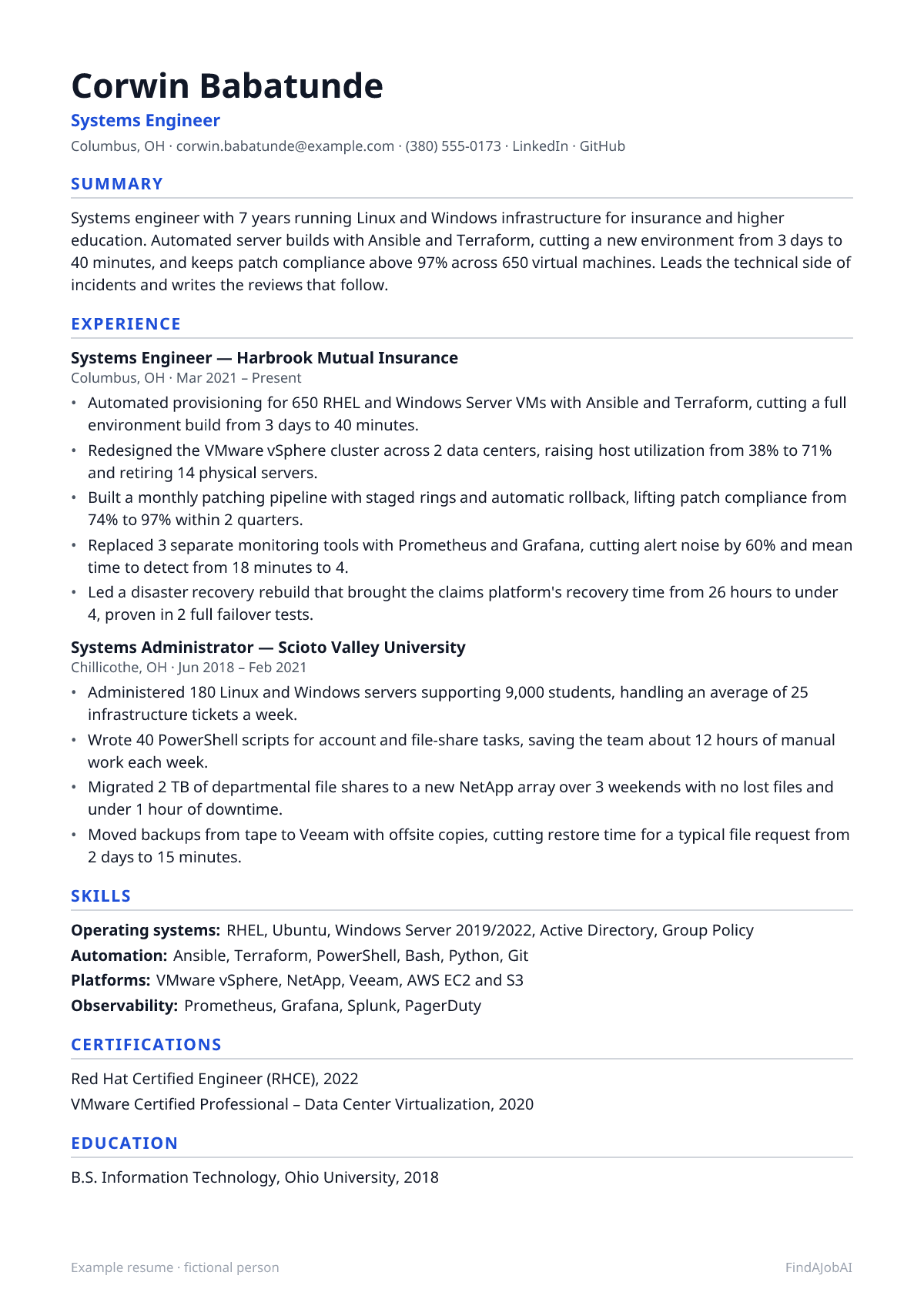
Systems Engineer resume template
This example as a one-page template: one column, standard headings and plain text, the format applicant tracking systems read most reliably.
After you sign up, Create my CV builds your own resume in this same one-column layout, from your real experience.
Mid-level systems engineer resume example
A complete one-page example for a fictional systems engineer: every bullet pairs an action with what changed because of it.
Example resume · fictional person
Corwin Babatunde
Systems Engineer
Columbus, OH · [email protected] · (380) 555-0173 · LinkedIn · GitHub
Summary
Systems engineer with 7 years running Linux and Windows infrastructure for insurance and higher education. Automated server builds with Ansible and Terraform, cutting a new environment from 3 days to 40 minutes, and keeps patch compliance above 97% across 650 virtual machines. Leads the technical side of incidents and writes the reviews that follow.
Experience
Systems Engineer, Harbrook Mutual Insurance
Columbus, OH · Mar 2021 – Present
- Automated provisioning for 650 RHEL and Windows Server VMs with Ansible and Terraform, cutting a full environment build from 3 days to 40 minutes.
- Redesigned the VMware vSphere cluster across 2 data centers, raising host utilization from 38% to 71% and retiring 14 physical servers.
- Built a monthly patching pipeline with staged rings and automatic rollback, lifting patch compliance from 74% to 97% within 2 quarters.
- Replaced 3 separate monitoring tools with Prometheus and Grafana, cutting alert noise by 60% and mean time to detect from 18 minutes to 4.
- Led a disaster recovery rebuild that brought the claims platform's recovery time from 26 hours to under 4, proven in 2 full failover tests.
Systems Administrator, Scioto Valley University
Chillicothe, OH · Jun 2018 – Feb 2021
- Administered 180 Linux and Windows servers supporting 9,000 students, handling an average of 25 infrastructure tickets a week.
- Wrote 40 PowerShell scripts for account and file-share tasks, saving the team about 12 hours of manual work each week.
- Migrated 2 TB of departmental file shares to a new NetApp array over 3 weekends with no lost files and under 1 hour of downtime.
- Moved backups from tape to Veeam with offsite copies, cutting restore time for a typical file request from 2 days to 15 minutes.
Skills
- Operating systems: RHEL, Ubuntu, Windows Server 2019/2022, Active Directory, Group Policy
- Automation: Ansible, Terraform, PowerShell, Bash, Python, Git
- Platforms: VMware vSphere, NetApp, Veeam, AWS EC2 and S3
- Observability: Prometheus, Grafana, Splunk, PagerDuty
Certifications
- Red Hat Certified Engineer (RHCE), 2022
- VMware Certified Professional – Data Center Virtualization, 2020
Education
- B.S. Information Technology, Ohio University, 2018
Fictional example by the FindAJobAI team: the person, employers and numbers are invented. Keep the structure; use your own work and numbers you can explain in an interview.
Entry-level systems engineer resume example
A recent graduate with an IT internship and a home lab. Education sits under the summary, and the lab project shows automation and recovery work with numbers rather than a list of tools.
Entry-level example resume · fictional person
Summary
Entry-level systems engineer with a B.S. in Computer Information Systems and CompTIA Linux+. Built a 6-node Proxmox home lab managed entirely with Ansible, and supported 300 users during a year-long IT internship. Looking for a first systems engineer or junior infrastructure role.
Education
- B.S. Computer Information Systems, University of Wisconsin–Madison, 2026
Experience
IT Infrastructure Intern, Yahara Medical Group
Madison, WI · Jun 2025 – May 2026
- Built 24 Windows Server VMs from templates and joined them to Active Directory, following the team's change process for each one.
- Wrote a PowerShell script that reported disk usage on 90 servers each morning, catching 3 volumes close to full before they caused outages.
- Ran weekly backup restore tests on 10 file servers and logged results, helping the team pass an internal audit with no findings.
Student Help Desk Technician, University of Wisconsin campus IT
Madison, WI · Sep 2023 – May 2025
- Resolved about 15 tickets a shift on accounts, VPN access and lab machines for 4,000 students.
- Reimaged 120 lab computers before each semester using a documented checklist that cut setup time by a third.
Skills
- Operating systems: Ubuntu, Rocky Linux, Windows Server 2022, Active Directory basics
- Automation: Ansible, Bash, PowerShell, Git
- Platforms: Proxmox, VMware Workstation, basic AWS EC2
Certifications
- CompTIA Linux+, 2025
- CompTIA Network+, 2024
Projects
- Home lab (Proxmox, Ansible, Git): 6 nodes with every VM built from Ansible playbooks stored in Git, so the whole lab rebuilds from scratch in 25 minutes.
- Backup and restore drill (Restic, Bash): scripted nightly encrypted backups to object storage and restored 3 services in a timed test under 10 minutes.
Senior systems engineer resume example
A systems engineer twelve years in, now setting architecture and leading a small team. The bullets move from building single servers to exiting a data center, setting standards and owning budgets, and the summary names the estate size and the savings.
Senior example resume · fictional person
Ambrose Takahashi-Reyes
Senior Systems Engineer
Nashville, TN · [email protected] · (629) 555-0194 · LinkedIn
Summary
Senior systems engineer with 12 years in healthcare and logistics infrastructure, leading 5 engineers across a 1,400-server hybrid estate. Led a data center exit to colocation and AWS that saved $1.2M over 3 years, and set the build and patching standards the whole team uses. Comfortable owning budgets, vendor contracts and incident command.
Experience
Senior Systems Engineer, Cumberland Health Network
Nashville, TN · Jan 2020 – Present
- Lead 5 systems engineers supporting 1,400 servers across 3 data centers and AWS, setting priorities, on-call rotation and design reviews.
- Led the exit from a leased data center, moving 520 workloads to colocation and AWS in 14 months and saving $1.2M over 3 years.
- Set a single golden-image and Ansible baseline for all Linux builds, cutting configuration drift findings from 300 a quarter to 20.
- Negotiated hardware and support renewals worth $900K, securing a 17% reduction while extending coverage on 2 critical storage arrays.
Systems Engineer, Ridgeline Freight Systems
Memphis, TN · Apr 2016 – Dec 2019
- Designed a 12-host vSphere cluster for the dispatch platform, holding 99.98% uptime over 3 years of 24/7 operations.
- Automated Windows patching for 400 servers with SCCM and maintenance windows, cutting monthly patch effort from 5 days to 1.
- Built a warm standby site that passed 4 failover tests with a recovery time under 2 hours.
Systems Administrator, Ridgeline Freight Systems
Memphis, TN · Jul 2014 – Mar 2016
- Supported 150 servers and 900 users, closing an average of 30 infrastructure tickets a week.
- Documented 60 recovery procedures in a shared runbook that the team still uses for outages.
Skills
- Architecture: Hybrid infrastructure, VMware vSphere, AWS, colocation design, disaster recovery
- Automation: Ansible, Terraform, Packer, SCCM, Python
- Leadership: Team leadership, budgets, vendor negotiation, incident command
Certifications
- AWS Certified Solutions Architect – Associate, 2021
- Red Hat Certified Engineer (RHCE), 2017
Education
- B.S. Computer Science, Middle Tennessee State University, 2014
How to write a systems engineer resume
Five steps, in the order a recruiter reads the page. The format around them stays plain for every job: one column, standard headings, newest role first.
Header: name, target title and links
Use “Systems Engineer” as the headline if your work matches it, even if your title was Systems Administrator or Infrastructure Engineer. Add a GitHub link only when it shows real scripts or configuration code.
Summary: what you do and your best proof
State years of experience, your main operating systems and platforms, and one or two measured results such as build time cut or patch compliance raised. Skip filler like “results-driven professional.”
Experience: newest first, a result in every bullet
Start each bullet with the system or project, then the change and the number that moved: hosts automated, hours saved, recovery time reduced, cost avoided. Keep pure ticket work to one bullet per job at most.
Skills: grouped, in the ad's words
Group into operating systems, automation, platforms and observability. Use exact product names (RHEL, vSphere, Ansible, Terraform) and mirror the wording in the posting where it is true for you.
Education and certifications
List your degree and year, then certifications with years, since RHCE, VCP and cloud certificates expire or get new versions. Without full-time experience, add a Projects section with a home lab or automation project.
Skills to put on a systems engineer resume
Hard skills are the tools and methods of the job; soft skills are how you work with people. Each comes with one way to prove it, because a skill named only in a list counts for little. Add the ones you really have.
Hard skills
- Linux administration (RHEL, Ubuntu)
- Give the server count and one problem you solved at the OS level, such as a kernel or storage issue.
- Windows Server and Active Directory
- Mention the domain size and a cleanup, policy or migration you led.
- VMware vSphere or Hyper-V
- State host and VM counts plus a utilization, consolidation or cost result.
- Ansible
- Name what the playbooks built or fixed and how many hosts they reached.
- Terraform
- Describe the environment you codified and how build time changed.
- PowerShell and Bash scripting
- Count the scripts or hours saved per week.
- Patch management
- Give compliance before and after, or outages avoided by a staged process.
- Backup and disaster recovery
- State the recovery time achieved in a real test, not just the backup product.
- Monitoring (Prometheus, Grafana, Splunk)
- Show a detection time improvement or a failure caught early.
- Storage (NetApp, SAN, NFS)
- Mention capacity managed and a migration or performance fix.
- Cloud (AWS, Azure)
- Name the services you ran and the workloads you moved or built.
- Security hardening
- Point to CIS or audit findings you closed and how many hosts the change covered.
Soft skills
- Incident leadership
- Describe one outage you led, with time to restore and the follow-up change.
- Documentation
- Name the runbooks or design documents you wrote and who uses them.
- Working with developers
- Give an example of solving a performance or deployment problem with an app team.
- Prioritization
- Show how you balanced project work against tickets and outages.
- Change discipline
- Mention change reviews, rollback plans or maintenance windows you planned.
- Mentoring
- Count the engineers you trained and what they now handle alone.
- Vendor management
- Describe a renewal, escalation or support case you drove to a result.
Systems Engineer resume bullet examples: weak vs strong
The same work, written two ways. The strong version names the tool, the scope and a result; the numbers are examples, yours must be real.
Weak: Maintained servers.
Strong: Ran a fleet of 420 Linux servers for an online retailer, holding monthly uptime at 99.96% across a peak holiday season.
Scale, platform and a measured result replace a vague duty.
Weak: Automated tasks with scripts.
Strong: Wrote an Ansible role for web server hardening applied to 210 hosts, closing 35 CIS benchmark findings in one change window.
Names the tool, the count and the security outcome.
Weak: Handled patching.
Strong: Introduced a 3-ring patch schedule with test, pilot and production groups, cutting patch-related outages from 5 a year to 0.
Shows the process change and its effect, not just the chore.
Weak: Worked on virtualization.
Strong: Consolidated 60 aging physical servers onto a 6-host Hyper-V cluster, saving about $48K a year in power and support contracts.
A consolidation with a cost figure proves design work.
Weak: Fixed performance problems.
Strong: Traced a recurring nightly slowdown to a backup job saturating shared storage, and rescheduling it removed 30 weekly user complaints.
The diagnosis and the measured fix carry the bullet.
Weak: Set up monitoring.
Strong: Deployed disk and memory trend alerts on 300 hosts that flagged 11 servers heading for failure before any user noticed.
Monitoring tied to specific saves, not just a tool name.
15 more systems engineer resume bullet examples
Grouped by area of the job, so you can find the ones closest to your work. Keep the shape (action, scope, result) and replace the invented numbers with your own.
Automation and builds
- Codified 3 staging environments in Terraform, letting developers create a full test stack in 30 minutes instead of filing a 2-week ticket.
- Built Packer templates for 4 operating system images, cutting new VM setup from 2 hours of manual steps to 10 minutes.
- Wrote an Ansible role for user and SSH key management across 260 hosts, removing 45 stale accounts in the first run.
- Automated certificate renewal for 80 internal services, ending the 3 to 4 expired-certificate outages the team saw each year.
Reliability and recovery
- Rebuilt backup policies for 350 VMs with tiered retention, cutting storage use by 30% while meeting a 30-day restore requirement.
- Ran quarterly failover tests for 6 critical applications, reducing measured recovery time from 9 hours to 90 minutes over a year.
- Added redundant power and network paths to 2 storage arrays, ending a pattern of 2 unplanned outages a year.
- Tuned database host memory and storage settings, cutting nightly batch runtime from 5 hours to 2.
Security and compliance
- Applied CIS hardening baselines to 500 servers through configuration code, closing 120 audit findings in one quarter.
- Rolled out centralized logging for 700 hosts to meet a SOC 2 control, passing the audit with no infrastructure exceptions.
- Cut critical vulnerability age from 45 days to 9 by tying patch rings to the weekly scan report.
Cost and capacity
- Right-sized 140 oversized VMs using 90 days of usage data, freeing enough capacity to delay a $200K hardware purchase by a year.
- Tracked license use for 300 Windows servers and dropped 40 unused licenses, saving about $22K a year.
- Moved 25 TB of cold data to cheaper object storage, saving about $36K a year.
- Built a monthly capacity report for leadership that tracked 4 clusters and justified 1 planned expansion with real growth data.
Systems Engineer resume summary examples
Two or three lines on what you do and your strongest proof. Start from the one closest to your level and use your own facts.
Systems engineer with a B.S. in Computer Information Systems and CompTIA Linux+. Ran a 6-node home lab with Proxmox and Ansible, and supported 300 users in an IT internship covering Windows Server, Active Directory and backups.
Systems engineer with 7 years in insurance and higher education, working in RHEL, Windows Server, VMware and Ansible. Cut environment build time from days to under an hour and keeps patch compliance near 97% across 650 VMs.
Senior systems engineer with 12 years designing infrastructure for healthcare and logistics. Owns a 1,400-server hybrid estate across 3 data centers and AWS, leads 5 engineers, and led a data center exit that saved $1.2M over 3 years.
Common systems engineer resume mistakes
Each one is easy to make and quick to fix before you apply.
A wall of tool names
Twenty acronyms with no context tell a hiring manager nothing about depth. Keep the skills list grouped and prove the main tools in your bullets.
Only operations, no engineering
If every bullet is about tickets and patching, you read as an administrator. Add the projects: builds you automated, platforms you designed, migrations you led.
Estate size left out
Running 20 servers and running 2,000 are different jobs. Give server, VM, site or user counts in your summary and bullets.
Automation with no result
“Wrote Ansible playbooks” is a task. Say what the playbooks built and how much time or risk they removed.
Recovery claims without a test
Saying you “owned disaster recovery” is weak. Give the recovery time from an actual failover test.
ATS tips for a systems engineer resume
Applicant tracking systems turn your file into text that recruiters search, mostly for the skills and titles in the ad. They rarely reject a resume on their own; one that parses badly or misses the ad's words just doesn't come up.
- Name the operating systems, hypervisor and automation tools exactly as the job ad writes them; ATS filters often match on RHEL, vSphere or Terraform by name.
- Give the size of what you ran: server count, VM count, data centers or users supported.
- Turn automation into time saved or build time reduced, since that is the result managers care about.
- Include one reliability number, such as uptime, recovery time or patch compliance.
- Link a GitHub profile only if it holds real scripts or infrastructure code you'd be happy to discuss.
For the format itself, run the free ATS resume checklist.
Everything for Systems Engineers
- Systems Engineer cover letter examplesThree example letters and a short email version
- Systems Engineer interview questions30 questions with sample answers
- Systems Engineer job descriptionDuties, skills and requirements
- How to tailor your resume without lying
Other resume examples
Systems Engineer resume FAQ
What should a systems engineer resume focus on?
Design and automation results: environments you built, processes you automated and reliability you improved, each with a number. Day-to-day operations matter, but they shouldn't fill every bullet.
Which certifications help a systems engineer resume?
RHCE for Linux-heavy roles, VMware VCP for virtualization, and a cloud associate certificate such as AWS SysOps or Azure Administrator for hybrid teams. List the year next to each.
How do I move from systems administrator to systems engineer on a resume?
Lead with the projects, not the tickets: a migration, a new cluster, a script that removed manual work. Use the target title in your headline if the work matches it.
How we built this page
The FindAJobAI team wrote the three example resumes, the bullets, the skills and the advice for systems engineer roles. The people, employers and numbers in the examples are invented; the structure, the tools and the way each bullet is built are the parts to copy.
Once we track enough live systems engineer job ads, this page also shows the skills they ask for most, counted the same way as our in-demand skills report.
Last reviewed on November 1, 2026.