Business Analyst Cover Letter Example (2026)
By FindAJobAI team Updated How we built this page
Business analysts sit between the business and the delivery team, so hiring managers read cover letters for both sides: requirements work (user stories, process maps, acceptance testing) and data skills (SQL, Excel, a BI tool). The best letters show one requirement turned into a shipped change and one analysis that changed a decision.
Business Analyst cover letter template
This letter as a one-page template: an opening that names the job and your strongest fact, proof that answers the ad, a reason for this employer and a short close.
After you sign up, FindAJobAI drafts your own letter for a real job from your CV in this format, and you edit it before you send it.
Example 1 · Experienced
Senior business analyst applying to an insurer
Natalie leads analysis for lending operations at a bank. The ad mentions modernizing claims systems with an agile delivery team.
Example letter · fictional
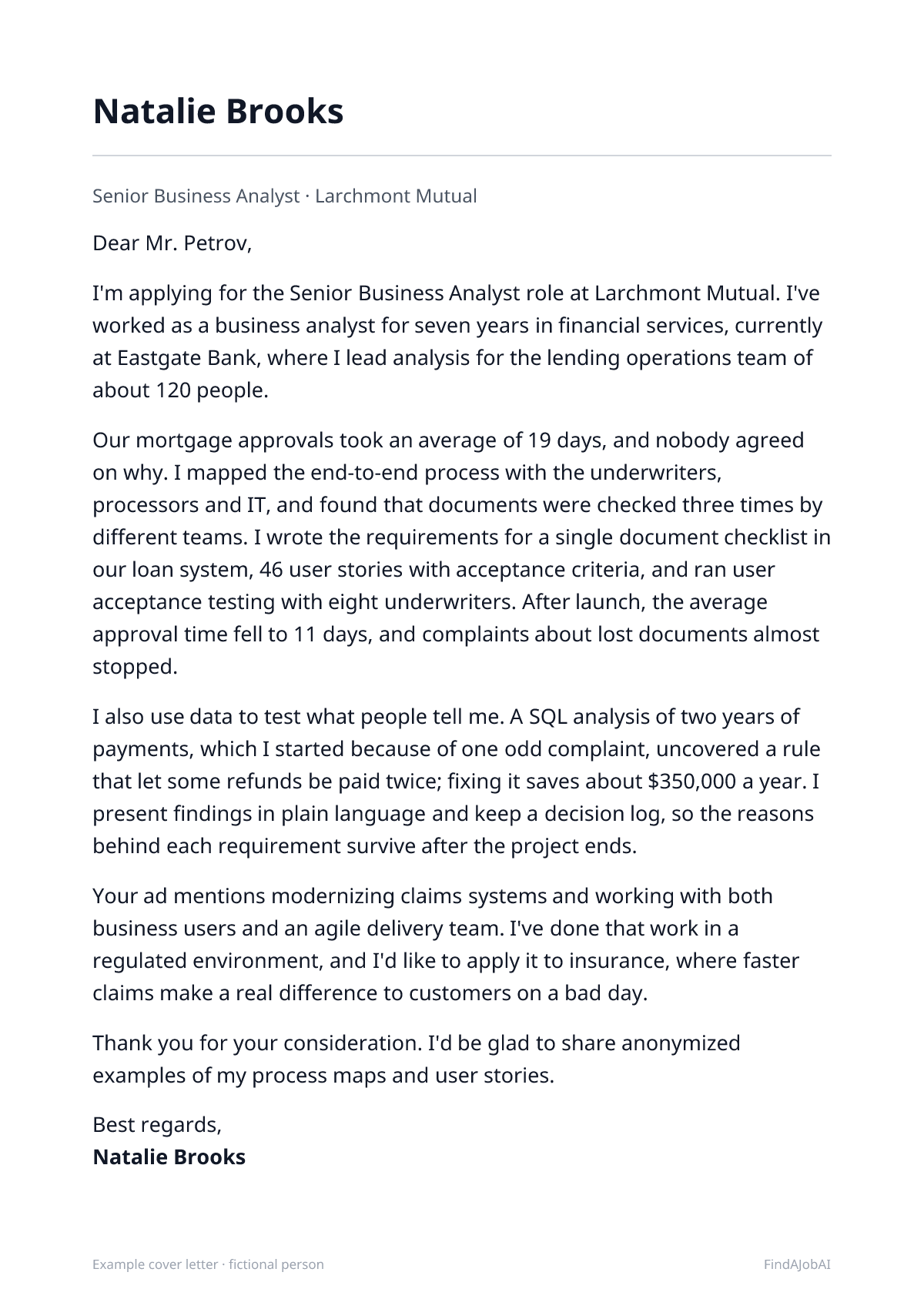
Dear Mr. Petrov,
I'm applying for the Senior Business Analyst role at Larchmont Mutual. I've worked as a business analyst for seven years in financial services, currently at Eastgate Bank, where I lead analysis for the lending operations team of about 120 people.
Our mortgage approvals took an average of 19 days, and nobody agreed on why. I mapped the end-to-end process with the underwriters, processors and IT, and found that documents were checked three times by different teams. I wrote the requirements for a single document checklist in our loan system, 46 user stories with acceptance criteria, and ran user acceptance testing with eight underwriters. After launch, the average approval time fell to 11 days, and complaints about lost documents almost stopped.
I also use data to test what people tell me. A SQL analysis of two years of payments, which I started because of one odd complaint, uncovered a rule that let some refunds be paid twice; fixing it saves about $350,000 a year. I present findings in plain language and keep a decision log, so the reasons behind each requirement survive after the project ends.
Your ad mentions modernizing claims systems and working with both business users and an agile delivery team. I've done that work in a regulated environment, and I'd like to apply it to insurance, where faster claims make a real difference to customers on a bad day.
Thank you for your consideration. I'd be glad to share anonymized examples of my process maps and user stories.
Best regards,
Natalie Brooks
Example 2 · Career changer
Medical billing specialist moving into business analysis
Jasmine cut claim denials in half by fixing a process. The ad asks for healthcare knowledge and work with clinicians and developers.
Example letter · fictional
Dear Hiring Manager,
I'm applying for the Business Analyst role at Pinecrest Health Partners. I've worked in medical billing for four years at a group of outpatient clinics, and the most valuable part of my job has become fixing the processes behind our billing errors rather than the errors themselves.
Our clinics had a claim denial rate of 12%, and each denied claim took about 40 minutes to rework. I tracked every denial for three months in Excel, grouped them by cause, and found that most came from two fields missed at patient check-in. I wrote up the problem with the evidence, proposed changes to the check-in screen, and tested them with front-desk staff before IT built them. Denials fell to 6%, saving the billing team about 25 hours a week.
Since then I've learned SQL to pull data myself, built Power BI reports for our practice managers, and completed the coursework for the IIBA's ECBA certification. I'm comfortable writing user stories and process maps, and I join our IT team's sprint reviews for the billing system. I haven't yet led the requirements for a large project from start to finish.
Your posting asks for healthcare knowledge, strong analysis and the ability to talk to both clinicians and developers. I've spent four years translating between front-desk staff, physicians and IT, and I'd bring that to your revenue cycle projects, along with a habit of measuring before and after every change.
Thank you for considering my application. I'd welcome the chance to talk about the denials project.
Kind regards,
Jasmine Wu
Example 3 · Referral or internal move
Business analyst applying on a former sponsor's referral
Farah worked with a project sponsor who now leads operations at the credit union. The ad asks for requirements work on a new loan-servicing system.
Example letter · fictional
Dear Mr. Castellano,
I'm applying for the Business Analyst role on the loan-servicing project at Riverbend Credit Union. Gwen Pruitt, your head of operations, suggested I apply. She sponsored the collections project I analyzed at Tenway Finance, and she said you're about to start requirements work. I'd like the letter to make the case on its own.
For five years I've analyzed lending and collections processes. On the Tenway project I interviewed 22 staff, mapped 14 processes and found that agents handled one account type through four screens and two spreadsheets. My requirements document replaced the screens with one workflow, and I wrote 63 user stories with acceptance criteria that the developers built from. Average handling time fell from 11 minutes to seven.
I also care about what happens after launch. I worked with the team lead to define five measures before go-live, including calls per account and promises kept, and I reviewed them with her each week for two months. That review found a confusing status label, which we renamed, and promises kept rose from 71% to 82%.
I query data myself. I write SQL to check whether a pain point is common or rare, and I've built the reports that operations still use to track it. I haven't worked with a core banking platform on this scale, so I'd want to spend my first weeks with your servicing team and your vendor to understand its constraints.
I'm happy to talk through the loan-servicing scope and the people I'd need to meet first, including the collections team who will use it daily.
Kind regards,
Farah Siddiqui
All three letters, and the short version below, are fictional: the people, employers and numbers are invented. Borrow the structure, never the facts.
- Prefer to write it yourself? Use the free cover letter template.
- Check your CV against the job first: the free CV score shows the missing keywords.
Why the first letter works, paragraph by paragraph
Paragraph 1: Opening
Names the industry (financial services) and the business area the writer supports. BA roles are domain-heavy, so matching the domain early earns attention.
Paragraph 2: Requirements to result
The full BA cycle: mapping a process, finding the root cause, writing user stories with acceptance criteria, running UAT and measuring the result (19 days to 11).
Paragraph 3: Data and communication
A SQL analysis that found real money proves the data side. The decision log is a small detail that shows the writer thinks about the people who come after them.
Paragraph 4: Why this company
Mirrors the ad's project and delivery model, and adds a customer-focused reason that fits the industry.
Paragraph 5: Close
Offers work samples, which BA hiring managers often ask for anyway.
What the career changer's letter does differently
The billing specialist does business analysis before the title: tracking denials, finding the root cause, proposing a change and measuring the saving. SQL, Power BI and certification coursework fill in the toolkit, and the honest gap is leading a large project's requirements.
What the referral letter does differently
The referral is disclosed with its source and the sponsor's role in the earlier project, then dropped in favor of evidence: interviews, process maps and user stories on a real system. Post-launch measures show the analyst works past the requirements document, and the platform gap is named.
Short business analyst cover letter: an email-ready version
Many applications arrive as an email or a small text box, and a full page doesn't fit. This version runs 120 to 150 words and keeps only what a reader needs to decide whether to reply. A business analyst replies to a pension provider's hiring contact who asked for 'a few paragraphs on your analysis approach'. The reply stays brief.
Short version · email · fictional129 words
Subject: Business Analyst (process and data) – Claire Dumont
Hello Mr. Ferreira,
My approach starts with the people doing the work: I interview them, watch the process once, then check what I heard against the data. I'm applying for the Business Analyst role at Castlemere Pensions with four years of that work in insurance.
At Corran Insurance I analyzed how change-of-address requests moved between departments. They passed through five hands and took nine days. I wrote the requirements for a single online form with automatic routing, and the average is now two days with far fewer follow-up calls from members chasing updates.
Pensions run on accuracy and clear communication, both of which I enjoy, and members' questions are where process problems show first. I've attached my resume, and I can send an anonymized process map.
Best,
Claire Dumont
The note answers the contact's question about approach first, then proves it on one process where each number is easy to verify: five hands, nine days to two. Offering an anonymized process map is a low-pressure way to invite a deeper look.
Opening lines that work for business analyst cover letters
The first sentence decides whether the second gets read. Here are six openings, one for each situation you might be in. Pick the one that matches yours and swap in your own facts: every name and number below is invented.
1. You have a standout result
A mortgage approval process that took 19 days now takes 11, after I removed two hand-offs. I'd like to apply that kind of analysis to your lending operation.
2. The ad names a problem you've solved
Staff use four screens and two spreadsheets for one task, your ad says. I mapped the same problem for our claims team last year, and a single workflow cut handling time by a third.
3. Someone referred you
Ilse Brandt, who runs your member services team, suggested I apply. We untangled a complaints process together on a client engagement, and she said you need an analyst who can talk to both agents and developers.
4. You admire what they build
I read your published service charter for members, and the commitment to answer within two days is one I'd enjoy helping the team keep; it's the reason I'm writing.
5. You're new to the field or switching into it
Six years in medical billing, and a halved denial rate after I documented and fixed a broken process, have convinced me to move into business analysis full time.
6. You have senior scope or a specialism
Eleven years of business analysis for banking operations, including a claims modernization with a team of six analysts, lead me to look for a lead role in a regulated business.
How to write a business analyst cover letter
Five steps, in the order you'd write them. The shape stays the same for every job (a short opening, proof, a reason for this employer, a close), and what goes into each part is what changes with the role.
Identify the domain and the system in the ad
Business analyst ads are tied to domains such as lending, claims or healthcare billing, and often to a system or a program. Read for both. Choose a project of yours in the same domain or with a similar kind of process, and lead with it.
Open with the process you improved
Name the process, the people involved and what was wrong: handoffs, rework, wait time. Business analysts are hired to find waste, so start with the waste you found and say how you found it, whether by interview, observation or data.
Show the requirements you wrote, in numbers
Mention the deliverables: process maps, user stories, acceptance criteria, a decision table. Give counts and say who built from them. Then give the result, such as handling time or approval days. Developers' trust in your requirements is part of the evidence.
Include the data work
Add one sentence on how you check what stakeholders tell you: SQL queries, a sample of cases, a report you built. It shows you are not just a note-taker, and managers look for analysts who can say whether a problem is common or rare.
Show you work past the document
Describe what you did after launch: measures you set, reviews you held, a fix you made. Close with a question about the people you'd meet first, which shows you start from stakeholders and not from templates.
Keywords employers use for business analyst roles
The skills named most often in the 489 newest business analyst job ads we track (out of 1,624 live postings), with the share of ads that mention each:
- Requirements gathering 36%
- Agile 34%
- SQL 28%
- Process improvement 24%
- Process mapping 23%
- User stories 23%
- Excel 22%
- Jira 21%
Don't list them in your letter: pick the two or three the ad repeats and back each with one sentence of evidence. Full list: Business Analyst resume keywords.
From live job ads · updated November 2, 2026
Business Analyst cover letter do's and don'ts
Do
- Show one requirement you turned into a shipped change: the process, the stories, the testing, the result.
- Name your data tools inside an example (SQL, Excel, Power BI, Tableau).
- Say who you work between: which business teams, which delivery team, and how.
Don't
- Don't list the documents you produce (BRDs, FRDs) without what they changed.
- Don't call yourself a "bridge between business and IT" without an example of crossing it.
- Don't skip domain knowledge when the ad stresses an industry; it's often the deciding factor.
Common business analyst cover letter mistakes
Each one is easy to make and quick to fix before you send the letter.
Listing tools instead of results
Jira, Visio, SQL and Confluence are what every analyst uses. Mention the ones the ad names, but spend the paragraph on a process you changed and the number that moved afterwards.
Calling yourself a liaison between business and IT
It's the default description of the job and says little. Show a moment when you translated: a vague request turned into 63 stories, or a developer's constraint explained to a manager in plain terms.
Describing process changes with no measure
'Streamlined the approval process' leaves the reader guessing. Give the time before and after, the number of steps removed or the rework avoided, and say how you measured it.
Ignoring the domain
A generic analyst letter could be for any industry. Show that you understand the rules and the vocabulary of this one, such as lending, claims or billing, and one thing that makes its processes hard.
Producing documents nobody uses
A requirements document is only useful if people build from it. Say who used yours, how many questions they came back with and what you changed after the first release.
Email subject lines for business analyst applications
Applying by email? Put the job title, any reference number and your name in the subject line.
- Senior Business Analyst application – lending process redesign, SQL – Natalie Brooks
- Business Analyst – billing specialist with process and data results – Jasmine Wu
- Application: Business Analyst, Claims Modernization (Ref BA-61) – Natalie Brooks
Everything for Business Analysts
- Business Analyst jobs1,624 open roles, updated hourly
- Business Analyst salary in the United StatesAdvertised pay in real job ads
- Business Analyst resume exampleA full resume, plus bullet and summary examples
- Business Analyst interview questions30 questions with sample answers
- Business Analyst resume keywordsThe skills job ads ask for most
- Business Analyst job descriptionDuties, skills and requirements
- Career change cover letter: template + examples
Other cover letter examples
Business Analyst cover letter FAQ
What should a business analyst cover letter include?
One example of requirements work (a process you mapped, the user stories, the testing, the result) and one of data analysis that changed a decision. Mention the industry you know and the delivery method you've worked in, such as Scrum or waterfall.
How do I become a business analyst without experience?
Look for process problems in your current job, measure them, propose a fix and track the result. Add SQL and a BI tool, and consider an entry certification such as the ECBA. Your domain knowledge is often your biggest advantage.
How is a business analyst cover letter different from a data analyst one?
A business analyst letter centers on processes and requirements and on working with delivery teams; a data analyst letter centers on analysis, dashboards and the decisions they changed. Many roles need both, so show both if you have them.
How we built this page
The FindAJobAI team wrote the three example letters, the short email version, the opening lines and the advice for business analyst roles. The people, employers and numbers in the letters are invented; the structure, the kind of evidence and the order of the paragraphs are the parts to copy.
The live keyword section is based on 489 business analyst job ads analysed, the newest we track, with the same deterministic skill matcher as our in-demand skills report: no AI model reads the postings. It was last computed on November 2, 2026 and refreshes daily.
Last reviewed on November 1, 2026.