Claims Adjuster Cover Letter Example (2026)
By FindAJobAI Team Updated How we built this page
Claims managers hire adjusters who can carry a caseload, apply coverage correctly and treat people fairly after a loss. A claims adjuster cover letter should name your license and line of business, then tell one claim story that shows investigation, judgment and a result such as faster cycle time, an accurate reserve or a recovery.
Claims Adjuster cover letter template
This letter as a one-page template: an opening that names the job and your strongest fact, proof that answers the ad, a reason for this employer and a short close.
After you sign up, FindAJobAI drafts your own letter for a real job from your CV in this format, and you edit it before you send it.
Example 1 · Experienced
Property adjuster applying to a national carrier
Isadora handles homeowners claims at a regional mutual. The ad asks for a licensed property adjuster with Xactimate and water loss experience.
Example letter · fictional
Dear Ms. Holloway-Banerjee,
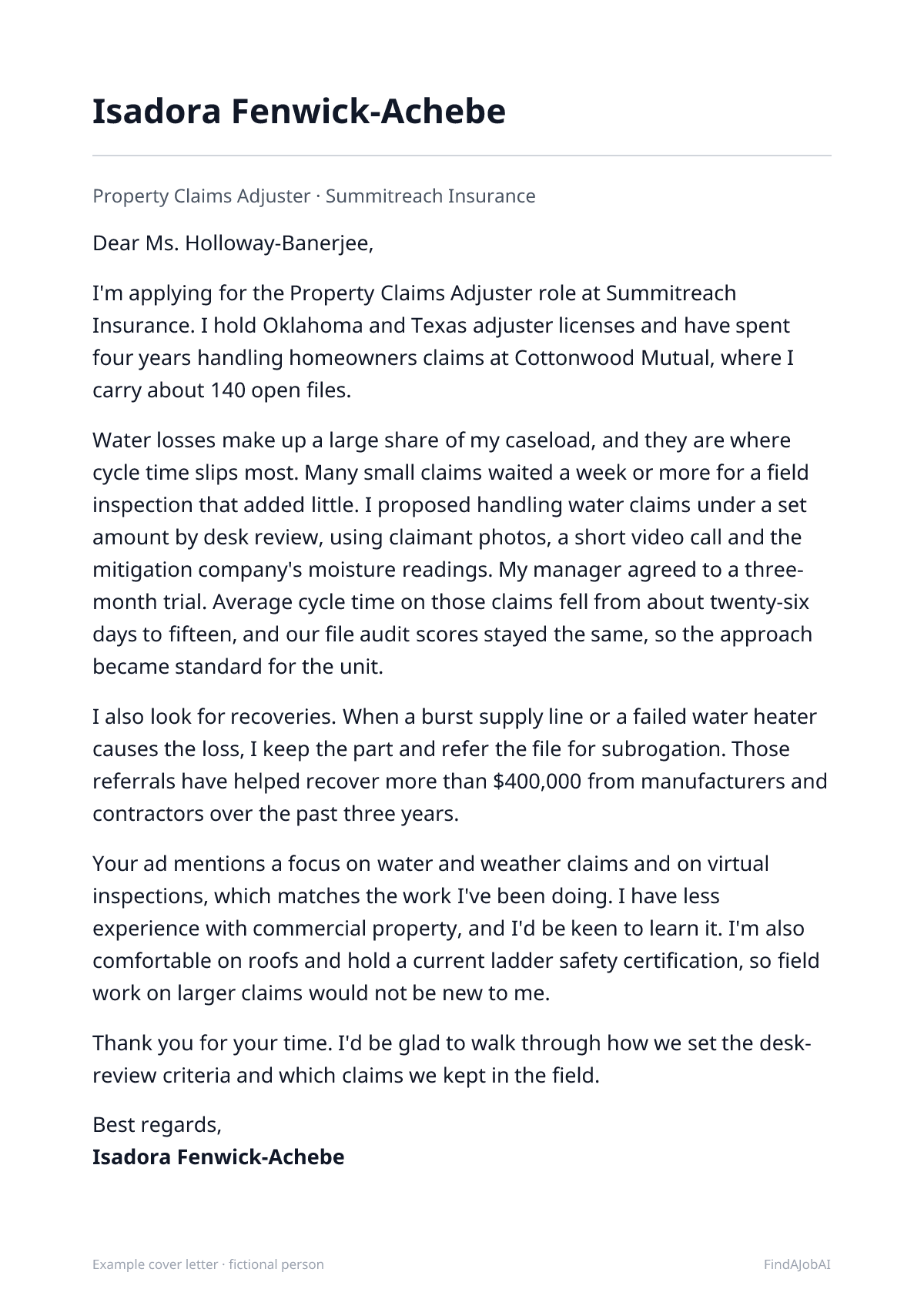
I'm applying for the Property Claims Adjuster role at Summitreach Insurance. I hold Oklahoma and Texas adjuster licenses and have spent four years handling homeowners claims at Cottonwood Mutual, where I carry about 140 open files.
Water losses make up a large share of my caseload, and they are where cycle time slips most. Many small claims waited a week or more for a field inspection that added little. I proposed handling water claims under a set amount by desk review, using claimant photos, a short video call and the mitigation company's moisture readings. My manager agreed to a three-month trial. Average cycle time on those claims fell from about twenty-six days to fifteen, and our file audit scores stayed the same, so the approach became standard for the unit.
I also look for recoveries. When a burst supply line or a failed water heater causes the loss, I keep the part and refer the file for subrogation. Those referrals have helped recover more than $400,000 from manufacturers and contractors over the past three years.
Your ad mentions a focus on water and weather claims and on virtual inspections, which matches the work I've been doing. I have less experience with commercial property, and I'd be keen to learn it. I'm also comfortable on roofs and hold a current ladder safety certification, so field work on larger claims would not be new to me.
Thank you for your time. I'd be glad to walk through how we set the desk-review criteria and which claims we kept in the field.
Best regards,
Isadora Fenwick-Achebe
Example 2 · Career changer
Auto body estimator moving into claims adjusting
Gideon has written collision repair estimates at a body shop for seven years. The ad is for an entry-level auto damage adjuster.
Example letter · fictional
Dear Mr. Petrakis-Lund,
I'm writing about the Auto Damage Adjuster opening at Lakefront Casualty. For seven years I've been the estimator at Ridgeway Collision, writing repair estimates in CCC ONE and working with insurance adjusters on nearly every job.
I've sat on the other side of most supplement conversations, so I know where estimates go wrong. Hidden damage behind bumpers and in structural areas is the usual cause of supplements and delays. At our shop I started photographing teardown findings in a standard order and sending them with every supplement request. Adjusters told me it made approvals faster, and our average supplement approval time dropped from several days to about one.
To make the move into claims, I earned my Illinois adjuster license this year and completed a course on auto policy coverage, including liability, collision and comprehensive. I also know the repair process well enough to spot when an estimate includes work that was not caused by the loss. For example, I can usually tell old frame damage from new by the paint, filler and rust patterns, which matters when a claimant reports a recent accident on a vehicle that has been repaired before. That knowledge protects both the claimant and the insurer from paying for the wrong repair.
Your ad says you want adjusters who can write accurate first estimates and work well with shops. That is the work I've done every day, and I'd bring a repair-side view to your team that helps reduce supplements and rental days.
I'd welcome the chance to talk, and I'm happy to review a sample estimate during an interview.
Kind regards,
Gideon Marchetti-Owusu
Example 3 · Senior or lead
Senior liability adjuster applying to handle complex litigated claims
Marisol handles complex general liability claims at a regional insurer. The ad is for a senior adjuster managing litigated commercial claims.
Example letter · fictional
Dear Mr. Greenhalgh-Mensah,
I'm applying for the Senior Liability Claims Adjuster role at Harborpoint Specialty Insurance. I've spent thirteen years in claims, the last six handling complex general liability files at Pinecrest Mutual with settlement authority up to $250,000.
Your ad mentions rising legal costs on litigated claims. We faced the same issue, and when I reviewed our unit's files I found that many cases drifted for months after suit before anyone agreed a strategy with defense counsel. I started requiring a written case plan within thirty days of suit, covering liability, damages, likely verdict range and a target resolution date, and I review each plan with counsel by phone. Legal spend on our litigated files fell by about eighteen percent over two years, and more cases resolved at early mediation.
I also mentor five adjusters on coverage analysis and reserving. Two have since moved into senior roles, and the unit's audit scores have improved each year. I hold an Associate in Claims designation and the CPCU, and I still review a sample of my own files each quarter against the audit checklist, because senior adjusters should be held to the same standard as everyone else. That habit also keeps my coverage letters consistent with the guidance I give the team.
I haven't handled many construction defect claims with multiple insurers and additional insured disputes, which your ad lists, and I'd expect to spend time learning how your team allocates those losses.
I'd be glad to discuss how you currently manage counsel and where you see the most cost on litigated files.
Sincerely,
Marisol Thackeray-Nwosu
All three letters, and the short version below, are fictional: the people, employers and numbers are invented. Borrow the structure, never the facts.
- Prefer to write it yourself? Use the free cover letter template.
- Check your CV against the job first: the free CV score shows the missing keywords.
Why the first letter works, paragraph by paragraph
Paragraph 1: Opening
States licenses, line of business and caseload in two sentences, which answers a claims manager's first screening questions.
Paragraph 2: The process change
Shows the writer spotted a cycle-time problem, proposed a controlled trial and measured both speed and audit quality, which proves judgment as well as effort.
Paragraph 3: Recoveries
Subrogation shows the writer protects the company's money, not just pays claims, with a dollar figure to back it up.
Paragraph 4: Why this company
Links the ad's focus on water losses and virtual inspections to the writer's work and names one honest gap.
Paragraph 5: Close
Offers to explain the desk-review criteria, a useful topic that invites a real conversation.
What the career changer's letter does differently
The career changer's letter turns body shop work into adjuster evidence: deep knowledge of estimates, a process that sped up supplement approvals, and an understanding of where repair costs hide. The new license and coverage course close the gap, and the close ties his repair-side view to the carrier's goals.
What the senior letter does differently
A senior adjuster letter focuses on control of cost and outcomes: a diagnosed problem (drifting litigated files), a simple discipline (case plans within thirty days), a measured result in legal spend, and mentoring that improves the whole unit. The gap is named plainly and tied to learning.
Short claims adjuster cover letter: an email-ready version
Many applications arrive as an email or a small text box, and a full page doesn't fit. This version runs 120 to 150 words and keeps only what a reader needs to decide whether to reply. An independent adjuster answers a catastrophe staffing firm's email call for adjusters ahead of hurricane season.
Short version · email · fictional132 words
Subject: Catastrophe Adjuster – licensed FL/TX, Xactimate Level 3 – Leopold Adeyinka-Strand
Hello Ms. Arbuthnot,
I'm responding to your call for catastrophe adjusters for the coming season. I hold Florida and Texas licenses and Xactimate Level 3 certification, and I've worked four storm deployments with independent firms.
On my last deployment I inspected about 300 wind and water losses in eleven weeks, with a 96% first-review acceptance rate from carrier desk examiners. I keep my estimates, photo reports and file notes consistent, so reviewers rarely have to send files back for missing details or unclear scope.
I'm available to deploy on short notice and have my own equipment, including a ladder, harness and drone. My resume and license numbers are attached, and I can complete onboarding paperwork this week. Thank you for considering me. I look forward to hearing from you.
Best,
Leopold Adeyinka-Strand
The short email gives a staffing firm exactly what it screens for: licenses, certification, deployment history, file quality and availability, in three tight paragraphs.
Opening lines that work for claims adjuster cover letters
The first sentence decides whether the second gets read. Here are six openings, one for each situation you might be in. Pick the one that matches yours and swap in your own facts: every name and number below is invented.
1. You have a standout result
Last year I cut the cycle time on our small water claims from twenty-six days to fifteen without lowering audit scores. I'd like to bring that approach to your property team.
2. The ad names a problem you've solved
Your ad mentions rising legal spend on litigated claims. I reduced it by about eighteen percent on my unit's files by agreeing case plans with counsel early.
3. Someone referred you
Your claims supervisor, Fenella Ruiz-Hartmann, and I worked the same hurricane deployment in 2025. She told me your team needs adjusters comfortable with high volume, which is why I'm writing.
4. You admire what they build
I've had my home insured with your company for ten years, and the way your adjuster handled my own storm claim is part of why I want to do this work for you.
5. You're new to the field or switching into it
For seven years I've written collision estimates at a body shop and negotiated with adjusters daily. Now I want to work on the claims side.
6. You have senior scope or a specialism
I've handled complex liability claims for thirteen years and mentored five adjusters, and I'm looking for a role focused on litigated commercial files.
How to write a claims adjuster cover letter
Five steps, in the order you'd write them. The shape stays the same for every job (a short opening, proof, a reason for this employer, a close), and what goes into each part is what changes with the role.
Lead with license and line of business
Claims managers often filter on license and experience type first. In your opening, state the states where you are licensed, your line of business such as auto, property or liability, and your typical caseload, so the reader can place you within seconds.
Tell one claim or process story
Pick a story that shows investigation and judgment: a coverage question you resolved, a fraud indicator you spotted, or a change that sped up claims. Keep details anonymous, and explain what you did step by step in two or three sentences.
Use the numbers claims managers track
Cycle time, files closed per month, reserve accuracy, audit scores, recoveries and satisfaction scores all mean something to a claims manager. Use one or two that you can explain in an interview, and say over what period they changed.
Show fairness as well as cost control
Good adjusters protect both the claimant and the insurer. Add a sentence on how you communicate during a stressful loss, such as quick first contact or plain-language letters, so the reader sees you can handle people as well as files.
Close with a relevant offer
Offer to talk through an estimate, a coverage letter or a process you built. It gives the interviewer a natural topic and shows you are comfortable having your work examined, which matters in a role that is audited regularly.
Claims Adjuster cover letter do's and don'ts
Do
- Name your license states and line of business in the first paragraph.
- Tell one claim or process story with a measured result, such as cycle time or recoveries.
- Show fairness to claimants alongside care for the company's money.
Don't
- Don't describe adjusting as just processing paperwork; show investigation and judgment.
- Don't share any real claimant details; keep stories general and anonymous.
- Don't claim authority levels or designations you don't hold.
Common claims adjuster cover letter mistakes
Each one is easy to make and quick to fix before you send the letter.
Leaving out the license
Many adjuster roles require a license before the start date. State yours clearly, or explain when you expect to have it.
Describing duties instead of results
Every adjuster investigates and settles claims. Show what improved because of how you did it, with a number where possible.
Sharing identifiable claim details
Keep names, addresses and exact amounts out of your stories. Describe the type of loss and your approach instead.
Sounding adversarial toward claimants
Talking only about denials and fraud can sound harsh. Balance it with how you help legitimate claims move quickly.
Ignoring the line of business in the ad
A letter about auto claims sent for a liability role misses the point. Choose the example closest to the role and explain how your skills carry over.
Email subject lines for claims adjuster applications
Applying by email? Put the job title, any reference number and your name in the subject line.
- Property Claims Adjuster application – licensed OK/TX, water losses – Isadora Fenwick-Achebe
- Auto Damage Adjuster – collision estimator, Illinois licensed – Gideon Marchetti-Owusu
- Application: Claims Adjuster, Property Unit (Req. 5832) – Isadora Fenwick-Achebe
Everything for Claims Adjusters
- Claims Adjuster resume exampleA full resume, plus bullet and summary examples
- Claims Adjuster interview questions30 questions with sample answers
- Claims Adjuster job descriptionDuties, skills and requirements
- Career change cover letter: template + examples
Other cover letter examples
Claims Adjuster cover letter FAQ
What should I write in a claims adjuster cover letter?
State your license, line of business and caseload, then describe one claim or improvement with a result such as shorter cycle time, an accurate reserve, a recovery or a fraud referral outcome. Add a line on how you communicate with claimants.
How do I write a claims adjuster cover letter with no experience?
Use related work such as claims customer service, auto repair estimating, contracting or insurance sales. Describe a task close to adjusting, mention your license or the steps you are taking to get one, and connect your background to the line of business.
Should I mention catastrophe experience in a cover letter?
Yes, if the role involves storms or high volume. Give the number of deployments or claims handled and your file acceptance rate, since it shows you can stay accurate under pressure.
How we built this page
The FindAJobAI team wrote the three example letters, the short email version, the opening lines and the advice for claims adjuster roles. The people, employers and numbers in the letters are invented; the structure, the kind of evidence and the order of the paragraphs are the parts to copy.
Once we track enough live claims adjuster job ads, this page also shows the skills they ask for most, counted the same way as our in-demand skills report.
Last reviewed on November 1, 2026.