Dietitian Cover Letter Example (2026)
By FindAJobAI team Updated How we built this page
Dietitian ads ask for an RD credential and some clinical hours, so most applicants clear that bar. The cover letter is where you show how you actually work with patients: the counseling approach you use, a case where a plan changed because of something you noticed, and how you document and follow up.
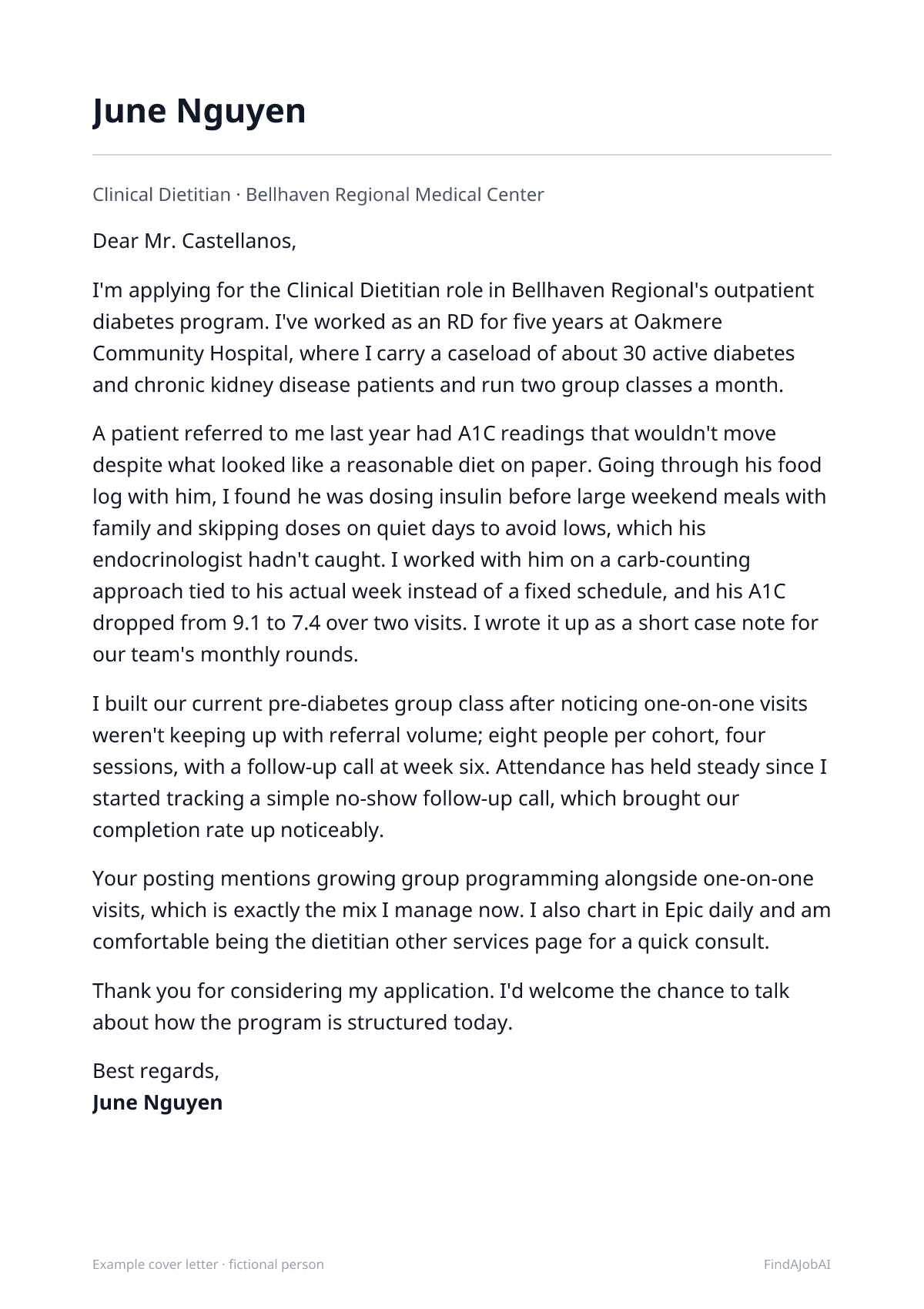
Dietitian cover letter template
This letter as a one-page template: an opening that names the job and your strongest fact, proof that answers the ad, a reason for this employer and a short close.
After you sign up, FindAJobAI drafts your own letter for a real job from your CV in this format, and you edit it before you send it.
Example 1 · Experienced
Clinical dietitian applying to a hospital's outpatient diabetes program
June manages a caseload of diabetes and renal patients at a community hospital. The ad asks for group class experience.
Example letter · fictional
Dear Mr. Castellanos,
I'm applying for the Clinical Dietitian role in Bellhaven Regional's outpatient diabetes program. I've worked as an RD for five years at Oakmere Community Hospital, where I carry a caseload of about 30 active diabetes and chronic kidney disease patients and run two group classes a month.
A patient referred to me last year had A1C readings that wouldn't move despite what looked like a reasonable diet on paper. Going through his food log with him, I found he was dosing insulin before large weekend meals with family and skipping doses on quiet days to avoid lows, which his endocrinologist hadn't caught. I worked with him on a carb-counting approach tied to his actual week instead of a fixed schedule, and his A1C dropped from 9.1 to 7.4 over two visits. I wrote it up as a short case note for our team's monthly rounds.
I built our current pre-diabetes group class after noticing one-on-one visits weren't keeping up with referral volume; eight people per cohort, four sessions, with a follow-up call at week six. Attendance has held steady since I started tracking a simple no-show follow-up call, which brought our completion rate up noticeably.
Your posting mentions growing group programming alongside one-on-one visits, which is exactly the mix I manage now. I also chart in Epic daily and am comfortable being the dietitian other services page for a quick consult.
Thank you for considering my application. I'd welcome the chance to talk about how the program is structured today.
Best regards,
June Nguyen
Example 2 · Career changer
Personal trainer and nutrition coach moving into clinical dietetics
Dominic finished his dietetic internship after years coaching clients informally on food. The ad is for a new-grad RD role.
Example letter · fictional
Dear Hiring Manager,
I'm applying for the Clinical Dietitian I role at Juniper Valley Health. I spent six years as a personal trainer, where clients increasingly asked me for food guidance I wasn't credentialed to give, which is what pushed me to complete my dietetic internship and sit for the RD exam this spring.
During my internship rotation at Fairholt General, I was assigned a patient recovering from bariatric surgery who kept regaining weight she'd lost before the procedure. Her chart showed three prior nutrition consults with the same generic handout. I spent a session mapping her actual day, found she was grazing on toddler leftovers between her own small meals and not counting it, and built a plan around protein-first snacks she could eat standing at the counter. At her follow-up, she'd lost four pounds and said it was the first plan that fit her kitchen.
Coaching taught me how to get someone talking honestly about what they actually eat, not what they think they should say, and I bring that into intake interviews now. I completed rotations in clinical, community and food service settings and am comfortable with the MNT process and documentation in Cerner.
Your posting for a new graduate role matches where I am: credentialed, trained, and ready for a full caseload with supervision as I build it. I'd bring both the clinical training and several years of reading people's real habits rather than their stated ones.
Thank you for your time. I'm available for an interview at your convenience and can start as soon as licensing clears.
Sincerely,
Dominic Reyes
Example 3 · Senior or lead
Lead dietitian applying to run nutrition services at a rehab hospital
Yusra supervises four dietitians at a long-term care network. The ad is for a first lead role setting protocols and training.
Example letter · fictional
Dear Dr. Ferber,
I'm applying for the Lead Dietitian role at Marlowe Rehabilitation Hospital. For the past three years I've supervised a team of four dietitians across two long-term care facilities at Haverstock Senior Living, and before that I spent seven years as a staff clinical dietitian.
Your posting mentions inconsistent weight-loss screening between units. We had the same issue at Haverstock: three facilities flagged unintended weight loss using three different thresholds, so some residents went months before anyone intervened. I wrote a single screening protocol tied to our EHR's weight trends, trained the team on it in one session, and set a rule that any flagged resident gets a note within 48 hours. Unplanned weight loss incidents reaching the severe category dropped noticeably within two quarters, and the protocol is now used at all three of our sites.
The harder problem was turnover. I inherited a team with constant callouts for coverage and no shared documentation shortcuts, so visit notes varied wildly in quality and speed. I built a set of note templates for our five most common consult types and ran a monthly case review where we discuss one hard case as a group. Note completion time fell, and two of my dietitians have told me the case reviews are the reason they stayed when a nearby facility recruited them.
I haven't managed a food service or kitchen budget directly, and Marlowe's posting mentions working with your contracted food service vendor on texture-modified menus, which would be new territory for me. I'd want to spend real time with that vendor early on to understand what's already working.
I'd welcome a conversation about which screening or documentation gaps are costing your team the most time right now, and where you'd want a lead dietitian to start.
Sincerely,
Yusra Haidari
All three letters, and the short version below, are fictional: the people, employers and numbers are invented. Borrow the structure, never the facts.
- Prefer to write it yourself? Use the free cover letter template.
- Check your CV against the job first: the free CV score shows the missing keywords.
Why the first letter works, paragraph by paragraph
Paragraph 1: Opening
States the caseload size and patient population (diabetes and CKD) plus group class experience, which answers the ad's specific ask before anything else.
Paragraph 2: The case that moved a number
A concrete finding (insulin timing missed by the endocrinologist), the intervention, and a measured result (A1C from 9.1 to 7.4), which shows clinical judgment, not just rapport.
Paragraph 3: Building a program
Shows initiative beyond the caseload: noticing a gap, designing a group class around it, and tracking a simple metric (completion via follow-up calls) to keep it running.
Paragraph 4: Why this role
Mirrors the ad's emphasis on group programming and adds a concrete system detail (Epic, covering other services) that signals readiness to start.
Paragraph 5: Close
A plain, low-pressure invitation to discuss the program, appropriate for a clinical role where overselling reads oddly.
What the career changer's letter does differently
The career changer's letter leads with why he got credentialed (clients asking for guidance he couldn't ethically give), then grounds the internship in one specific patient case with a measured result (a four-pound loss and a plan that finally fit her routine) instead of general enthusiasm for nutrition. It also names the gap honestly: new graduate, ready for supervision, not claiming senior judgment.
What the senior letter does differently
A lead dietitian letter reports what changed across a team, not one patient: one screening protocol across three sites, note templates for five consult types, and a retention story tied to case reviews. It also names a real gap (no food service budget experience) rather than implying full readiness for every part of the job.
Short dietitian cover letter: an email-ready version
Many applications arrive as an email or a small text box, and a full page doesn't fit. This version runs 120 to 150 words and keeps only what a reader needs to decide whether to reply. A dietitian answers a pediatric clinic's short online application question because the portal only allows a 150-word response, not a full letter.
Short version · email · fictional129 words
Subject: Pediatric Dietitian application – feeding therapy background – Mira Dhillon
Hello Ms. Okonjo,
I'm applying for the Pediatric Dietitian role at Hartwell Children's Clinic. I've worked for four years as an RD in a pediatric feeding clinic, where I co-treat with occupational therapists on tube-to-oral transitions and picky eating cases.
A recent case involved a four-year-old refusing all textured foods after a long NICU stay. Working alongside his OT on desensitization, I built a stepped food-exposure plan his parents could run at home, and he was eating age-appropriate textures within three months.
I'd like to bring that same co-treatment approach to your clinic. My resume is attached, and I'm happy to share the stepped-exposure template I use. I can also send a de-identified example of the home plan and the parent handout that goes with it.
Best,
Mira Dhillon
The short version keeps one case with a clear before-and-after (textured food refusal to eating age-appropriate textures) and the collaborative detail the clinic likely cares about, co-treating with OTs, cutting the caseload numbers and credential history that a full letter would include.
Opening lines that work for dietitian cover letters
The first sentence decides whether the second gets read. Here are six openings, one for each situation you might be in. Pick the one that matches yours and swap in your own facts: every name and number below is invented.
1. You have a standout result
A carb-timing change I made for one patient brought his A1C down from 9.1 to 7.4 in two visits. I'd like to bring that kind of case-by-case problem-solving to your outpatient team.
2. The ad names a problem you've solved
Your ad mentions long wait times for initial nutrition consults. At my current clinic I built a 20-minute intake triage that gets straightforward cases started same-day, and our backlog has stopped growing.
3. Someone referred you
Your clinical coordinator, Elvira Soto, supervised one of my internship rotations and suggested I apply, since she said your team needed someone comfortable with tube-feeding transitions.
4. You admire what they build
I've referred two family members to your clinic's diabetes program over the years, and the way your dietitians explained carb counting stuck with me enough that I'd like to do that work myself.
5. You're new to the field or switching into it
I spent six years coaching clients on nutrition without the credential to go further, which is what pushed me to complete my dietetic internship and apply for roles like this one.
6. You have senior scope or a specialism
As the dietitian who built our hospital's current pre-diabetes group program from scratch, I'm looking for a role where I can do that kind of program design again, at a larger scale.
How to write a dietitian cover letter
Five steps, in the order you'd write them. The shape stays the same for every job (a short opening, proof, a reason for this employer, a close), and what goes into each part is what changes with the role.
Match your case to the ad's population
Dietitian ads name a population: renal, diabetes, pediatric, oncology, bariatric. Pick one case from your experience with that same or a closely related population, and lead with it instead of a general statement about your background.
Open with what you found, not your credentials
Your RD license and degree are already on your resume. Open instead with something specific you noticed in a patient's history or habits that changed their plan, which shows clinical attention before you list any qualifications.
Give one measurable result from one case
An A1C that dropped, weight that stabilized, a feeding milestone reached. State the before and after numbers or outcome plainly, and say over what time frame, so the claim reads as something you tracked rather than something you're estimating.
Name the systems and settings you've used
If the ad names a charting system, counseling model, or group program format, say you've used it or something similar. Mention caseload size or visit volume if it's comparable, since it tells the reader you can handle their pace.
Close with how you'd fit the team, not just the role
One sentence on how you work with other clinicians, such as physicians, OTs, or nurses, since dietitians rarely work alone. Offer a concrete next step, like sharing a case write-up or template, rather than a general statement of interest.
Dietitian cover letter do's and don'ts
Do
- Describe one patient or client case: what you found that wasn't obvious from the chart, what you changed, and the result.
- Name the setting and caseload type the ad asks for (renal, diabetes, pediatric, oncology, weight management) using your own experience.
- Mention the charting system or MNT process you use if the ad names one; it signals you can start without a learning curve.
Don't
- Don't write "passionate about helping people eat healthier"; describe one person you actually helped and what changed.
- Don't list every certification you hold; pick the one or two relevant to this population and explain how you've used them.
- Don't share identifying patient details; change names, settings or exact numbers enough to protect privacy while keeping the story true.
Common dietitian cover letter mistakes
Each one is easy to make and quick to fix before you send the letter.
Writing a general statement of care instead of a case
"I care deeply about my patients' wellbeing" says nothing a reader can act on. Replace it with one patient's actual situation and what you changed, which demonstrates the same care through a specific decision.
Using real client names, ages or lab values in a case
Real names, exact ages, or specific dates can violate patient privacy even in a job application. Change enough details, such as age range or exact numbers, to protect identity while keeping the clinical story accurate.
Naming each credential with no example
A long string of credentials (CDE, CSSD, CSOWM) reads as padding if none connect to the job. Choose the one or two relevant to this ad and say briefly how you've used that specialty in practice.
Treating all dietitian roles as interchangeable
A letter written for any RD job reads as generic. Reference the specific setting, such as outpatient, inpatient acute care, or long-term care, and what's different about counseling in that setting.
Leaving out how you work with other clinicians
Dietitians rarely work in isolation. Mention how you coordinate with physicians, nurses, or therapists on a shared case, since ads for team-based clinics are often screening for this specifically.
Email subject lines for dietitian applications
Applying by email? Put the job title, any reference number and your name in the subject line.
- Clinical Dietitian application – diabetes and CKD caseload – June Nguyen
- Clinical Dietitian I – new RD, dietetic internship complete – Dominic Reyes
- Application: Outpatient Dietitian, Oncology Nutrition (Req. 2240) – June Nguyen
Everything for Dietitians
- Dietitian resume exampleA full resume, plus bullet and summary examples
- Dietitian interview questions30 questions with sample answers
- Dietitian job descriptionDuties, skills and requirements
- Career change cover letter: template + examples
Other cover letter examples
Dietitian cover letter FAQ
What should I include in a dietitian cover letter?
One patient or client case: what you noticed, what you changed about the plan, and the result. Name the population you've worked with (diabetes, renal, pediatric, bariatric) if it matches the ad, and the charting system if one is named.
How do I write a dietitian cover letter with no clinical experience yet?
Use a case from your dietetic internship rotations or prior work, such as coaching or food service, that shows you can read what someone actually eats. Name your rotations and say you're ready for a full caseload with supervision.
Should a dietitian cover letter mention a specific diet philosophy?
Only if the ad asks for one, such as a renal or ketogenic protocol. Otherwise focus on your process for building a plan around what a patient will realistically do, which matters more than a single philosophy.
How we built this page
The FindAJobAI team wrote the three example letters, the short email version, the opening lines and the advice for dietitian roles. The people, employers and numbers in the letters are invented; the structure, the kind of evidence and the order of the paragraphs are the parts to copy.
Once we track enough live dietitian job ads, this page also shows the skills they ask for most, counted the same way as our in-demand skills report.
Last reviewed on November 1, 2026.