.NET Developer Cover Letter Example (2026)
By FindAJobAI team Updated How we built this page
.NET developer ads mostly ask for the same stack: C#, Entity Framework, maybe Azure. The cover letter is where you show what you actually shipped with it: a slow query you fixed, a migration you ran without downtime, a feature a real team now depends on.
.NET Developer cover letter template
This letter as a one-page template: an opening that names the job and your strongest fact, proof that answers the ad, a reason for this employer and a short close.
After you sign up, FindAJobAI drafts your own letter for a real job from your CV in this format, and you edit it before you send it.
Example 1 · Experienced
Senior .NET developer applying to an insurance claims platform
Owen maintains a claims processing system in C# and Entity Framework at a regional insurer. The ad asks for experience modernizing a legacy codebase.
Example letter · fictional
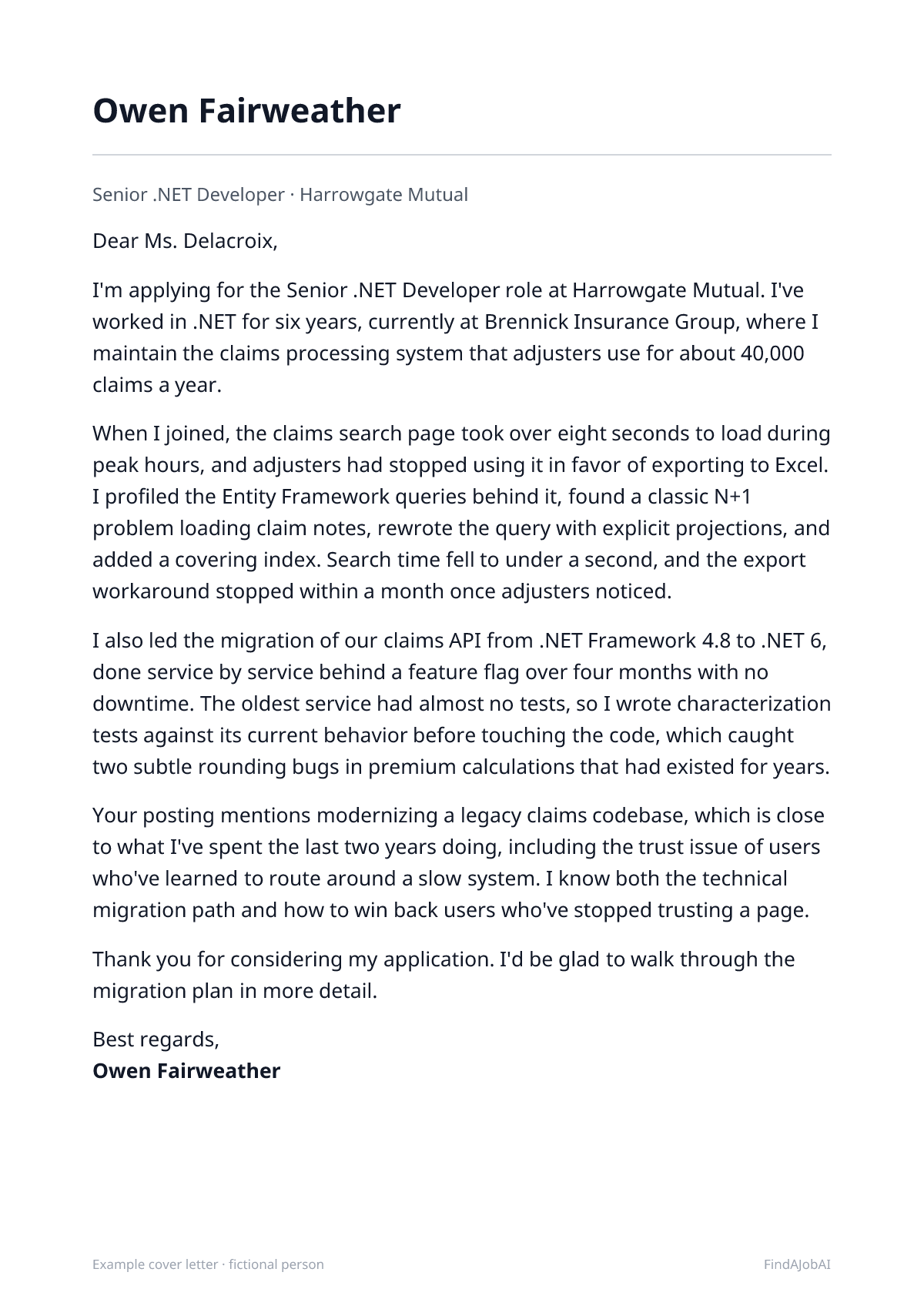
Dear Ms. Delacroix,
I'm applying for the Senior .NET Developer role at Harrowgate Mutual. I've worked in .NET for six years, currently at Brennick Insurance Group, where I maintain the claims processing system that adjusters use for about 40,000 claims a year.
When I joined, the claims search page took over eight seconds to load during peak hours, and adjusters had stopped using it in favor of exporting to Excel. I profiled the Entity Framework queries behind it, found a classic N+1 problem loading claim notes, rewrote the query with explicit projections, and added a covering index. Search time fell to under a second, and the export workaround stopped within a month once adjusters noticed.
I also led the migration of our claims API from .NET Framework 4.8 to .NET 6, done service by service behind a feature flag over four months with no downtime. The oldest service had almost no tests, so I wrote characterization tests against its current behavior before touching the code, which caught two subtle rounding bugs in premium calculations that had existed for years.
Your posting mentions modernizing a legacy claims codebase, which is close to what I've spent the last two years doing, including the trust issue of users who've learned to route around a slow system. I know both the technical migration path and how to win back users who've stopped trusting a page.
Thank you for considering my application. I'd be glad to walk through the migration plan in more detail.
Best regards,
Owen Fairweather
Example 2 · Career changer
Help desk technician moving into .NET development
Yusra built an internal ticket-routing tool in C# before she had a developer title. The ad mentions a small team maintaining internal business tools.
Example letter · fictional
Dear Hiring Manager,
I'm applying for the Junior .NET Developer role at Pemberton Logistics. For three years I've worked on the help desk at Corvallen Freight, and the project that pulled me toward development was a small C# tool I built to fix a routing problem nobody else had time for.
Our ticket queue assigned tickets round-robin regardless of topic, so network issues often landed with someone who knew nothing about networking. I taught myself enough C# and SQL to build a console app that read ticket categories from our database and reassigned them by technician specialty, then turned it into a small ASP.NET page so my team could adjust the rules themselves. Average time to first response on network tickets dropped from about four hours to under one, and two other help desk teams in the company have since asked to use it.
I completed a C# and ASP.NET Core course alongside that project, and I've since built a second small app, a shift-swap tracker for our team, using Entity Framework and a SQL Server backend. I'm comfortable with C#, basic LINQ queries, and Git, and I'm currently learning more about dependency injection and unit testing.
Your posting mentions a small team maintaining internal business tools, which is exactly the kind of work the routing tool came from. I'd bring both the growing technical skill and a help desk's sense of which small tool actually saves a team time.
Thank you for your time. I'd welcome the chance to talk about the routing tool or anything else on my resume.
Kind regards,
Yusra Khatib
Example 3 · Senior or lead
Engineering lead applying to grow a small .NET team
Astrid leads a team of five .NET developers at a logistics software company. The ad is for a lead who will set standards and mentor two new hires.
Example letter · fictional
Dear Mr. Obuya,
I'm applying for the Engineering Lead role at Northfell Systems. For the past three years I've led a team of five .NET developers at Vesterholm Logistics, and before that I spent seven years as a senior developer across two companies.
Your posting says the team has grown quickly and code review has become inconsistent, with some pull requests merged same-day and others sitting for a week. We had the same drift at Vesterholm. I wrote a short pull request checklist, split reviews by risk level so small fixes could merge fast while schema changes got two reviewers, and set a rotating on-call reviewer so nothing waited more than a day. Average review time fell from almost a week to under a day, and our production incident count from unreviewed edge cases dropped noticeably over the following two quarters.
Leadership earns trust through the decisions a team makes without you, not through code you personally ship. When our order-processing service kept timing out under load, I didn't fix it myself; I paired two developers on a load test, which found a missing index everyone had assumed was there, and let them own the fix and the postmortem. That pattern, pairing rather than rescuing, is now how we handle most production issues.
I've mentored two developers into mid-level roles, but I haven't managed hiring end-to-end the way this role asks, and I'd want to lean on your recruiting team closely for the two new hires you mentioned.
A conversation about where review and ownership feel inconsistent on your team right now would be a good place to start.
Sincerely,
Astrid Dahlqvist
All three letters, and the short version below, are fictional: the people, employers and numbers are invented. Borrow the structure, never the facts.
- Prefer to write it yourself? Use the free cover letter template.
- Check your CV against the job first: the free CV score shows the missing keywords.
Why the first letter works, paragraph by paragraph
Paragraph 1: Opening
Names the system maintained and its real scale (40,000 claims a year), which tells a hiring manager the writer has operated at production scale, not just in a tutorial.
Paragraph 2: The performance fix
States the specific problem (an N+1 query), the before-and-after load time, and the behavioral evidence that it mattered: adjusters stopped exporting to Excel once the page was fast again.
Paragraph 3: The migration
Names the exact versions, the approach (feature-flagged, service by service), the safety net (characterization tests) and an unexpected finding, which shows judgment beyond just following a migration guide.
Paragraph 4: Why this company
Mirrors the ad's specific phrase about legacy modernization and adds the less obvious part of that work: rebuilding user trust in a system they've learned to avoid.
Paragraph 5: Close
Offers to go deeper on the migration plan, a concrete and low-risk next step.
What the career changer's letter does differently
The career changer's letter starts from a real tool built to fix a help desk's own routing problem, before any developer title. A measurable result (response time down from about four hours to under one) and adoption by other teams show the tool worked, and two self-taught courses plus a second project show the skills are developing on purpose, not just as a one-off.
What the senior letter does differently
An engineering lead letter reports a team's habits, not a single fix: one review checklist, a review time that fell from almost a week to under a day, an incident count that dropped. The production example shows the writer building ownership in others rather than being the hero, and the gap, hiring end-to-end, is named plainly.
Short .NET developer cover letter: an email-ready version
Many applications arrive as an email or a small text box, and a full page doesn't fit. This version runs 120 to 150 words and keeps only what a reader needs to decide whether to reply. A .NET developer answers a healthcare scheduling company's short online application field, sent as an email after a recruiter asked for a quick note.
Short version · email · fictional122 words
Subject: .NET Developer (C#, EF Core) – scheduling platform – Teodor Wiśniewski
Hello Ms. Fontaine,
I'm applying for the .NET Developer role at Larkmere Health Systems. I have four years of C# and EF Core experience on a patient scheduling platform at a clinic network, where I'm one of three developers maintaining the booking service.
My most useful project was fixing a double-booking bug that let two patients claim the same appointment slot under load. I added a database-level unique constraint and a retry-with-backoff on conflict, and the bug hasn't recurred across six months of production traffic since.
Scheduling systems reward getting the edge cases right, and that's the part of the work I enjoy most. My resume is attached, and I'm happy to walk through the fix in more detail.
Best,
Teodor Wiśniewski
A short note keeps one concrete bug, its real-world consequence (double-booked patients), and a measured period without recurrence, since scheduling software readers care most about reliability under load. The closing line signals willingness to go deeper without padding the email itself.
Opening lines that work for .NET developer cover letters
The first sentence decides whether the second gets read. Here are six openings, one for each situation you might be in. Pick the one that matches yours and swap in your own facts: every name and number below is invented.
1. You have a standout result
One bug I fixed last year let two patients double-book the same appointment slot under load; the fix held for six months in production. I'd like to bring that same care for edge cases to your scheduling platform.
2. The ad names a problem you've solved
Your ad mentions inconsistent code review as the team has grown. At my current company I rebuilt our review process by risk level and cut average review time from almost a week to under a day.
3. Someone referred you
Your senior developer, Marguerite Soucy, worked with me on a migration project two years ago and suggested I apply, since she knew I'd pushed hard on test coverage before any code shipped.
4. You admire what they build
I've used your company's patient portal for two years as a patient myself, and a small scheduling quirk I noticed made me curious about the system behind it; I'd like to help maintain it.
5. You're new to the field or switching into it
I spent three years on a help desk building small internal tools in C# to fix problems nobody else had time for. Development is where I'd like to keep solving problems like that, formally.
6. You have senior scope or a specialism
As engineering lead for a five-developer .NET team for three years, I rebuilt our review process from scratch. I'm looking for a team ready to grow past its current size.
How to write a .NET developer cover letter
Five steps, in the order you'd write them. The shape stays the same for every job (a short opening, proof, a reason for this employer, a close), and what goes into each part is what changes with the role.
Match your example to the ad's actual stack depth
Some .NET ads want framework breadth, others want deep EF Core or Azure experience. Read for which the ad emphasizes, then pick a project where you went deep in that specific area rather than a broad tour of everything you've used.
Open with the bug or feature, not the technology list
Say what broke or what was needed before naming C#, EF Core, or Azure. A reader who sees a real problem in your first sentence will trust the technical detail that follows, rather than skimming past another list of acronyms.
Give the before-and-after in numbers you can stand behind
A load time, an error rate, a response time: state the starting point and the change, even roughly. 'Faster' or 'more reliable' without a number reads like every other applicant's letter and gives the reader nothing to evaluate.
Name the exact versions and tools involved
'.NET Framework 4.8 to .NET 6,' 'EF Core migrations,' 'Azure DevOps pipelines': specific versions and tools show you've handled real complexity, especially around migrations, rather than only working in a single modern stack from day one.
Close with how you handle risk or legacy code
Production systems carry risk: untested code, tight deadlines, systems nobody fully understands anymore. One sentence on how you reduce that risk, such as characterization tests or a feature flag rollout, shows you can be trusted with a real system, not just a greenfield one.
.NET Developer cover letter do's and don'ts
Do
- Name a specific bug or performance problem, the fix in C#/.NET terms, and the measured before-and-after.
- Mention the exact framework version and tools the ad names (.NET 6, EF Core, Azure DevOps) inside a real example.
- Show evidence a fix mattered: users who came back, a team that adopted your tool, a process that got faster.
Don't
- Don't write "passionate about clean code"; show one piece of code you simplified or one bug you fixed.
- Don't list every library you've ever imported; name the ones central to a story you actually tell.
- Don't share your current employer's internal system names or exact traffic figures; round or anonymize them.
Common .NET developer cover letter mistakes
Each one is easy to make and quick to fix before you send the letter.
Listing frameworks instead of a project
'C#, ASP.NET, EF Core, Azure, SQL Server' tells the reader what you've touched, not what you built. Pick one project and let the technologies appear inside that story instead of in a standalone list.
Claiming a fix without a measurement
'Improved performance significantly' could mean anything. Give the load time, error rate, or response time before and after, even approximately, so the claim is something a reader could actually evaluate.
Hiding a legacy background as a weakness
Experience with .NET Framework or older codebases is valuable, not embarrassing, especially for companies modernizing their own systems. Frame it as migration and maintenance experience rather than skipping past it toward only recent tools.
Describing a team project as entirely solo work
Claiming full credit for a team effort is easy to spot and easy to question in an interview. Say what you specifically owned, such as the query optimization or the test suite, and credit the rest of the team for the parts they handled.
Writing "passionate about clean code" with no example
Nearly every developer's letter includes some version of this line. Replace it with one piece of code you refactored or one bug you prevented through a specific practice, and let that stand in for the claim.
Email subject lines for .NET developer applications
Applying by email? Put the job title, any reference number and your name in the subject line.
- Senior .NET Developer application – EF Core and legacy migration – Owen Fairweather
- Junior .NET Developer – help desk background with a C# routing tool – Yusra Khatib
- Application: .NET Developer, Platform Team (Req. DEV-331) – Owen Fairweather
Everything for .NET Developers
- .NET Developer resume exampleA full resume, plus bullet and summary examples
- .NET Developer interview questions30 questions with sample answers
- .NET Developer job descriptionDuties, skills and requirements
- Career change cover letter: template + examples
Other cover letter examples
.NET Developer cover letter FAQ
What should I write in a .NET developer cover letter?
One bug or performance problem you fixed in C#/.NET, with the before-and-after measurement, and one sentence on who relied on the fix. Your framework and tool list is already on your resume, so the letter should show judgment, not repeat it.
How do I write a .NET developer cover letter with no experience?
Use a small tool you built to solve a real problem, even an internal or personal one, name the C# and .NET pieces involved, and add a course or certificate that formalizes what you taught yourself. One measured result matters more than a long skills list.
Should I mention specific .NET versions like .NET Framework vs .NET 6 or 8?
Yes, if the ad or your experience involves a migration or a specific runtime. Naming exact versions signals you've handled the real complexity of moving between them, not just read about it.
How long should a .NET developer cover letter be?
Around 300 words is enough for one clear example and a short close. A longer letter should still center on one or two concrete projects rather than a tour of every technology you've touched.
How we built this page
The FindAJobAI team wrote the three example letters, the short email version, the opening lines and the advice for .NET developer roles. The people, employers and numbers in the letters are invented; the structure, the kind of evidence and the order of the paragraphs are the parts to copy.
Once we track enough live .NET developer job ads, this page also shows the skills they ask for most, counted the same way as our in-demand skills report.
Last reviewed on November 1, 2026.