Financial Advisor Cover Letter Example (2026)
By FindAJobAI team Updated How we built this page
Financial advisor ads mostly ask for a license and a sales number, so applicants sound interchangeable. The cover letter is where you show how you actually earn a client's trust: a plan you built, an account you kept through a bad year, or a book of business you grew by referral rather than by cold-calling.
Financial Advisor cover letter template
This letter as a one-page template: an opening that names the job and your strongest fact, proof that answers the ad, a reason for this employer and a short close.
After you sign up, FindAJobAI drafts your own letter for a real job from your CV in this format, and you edit it before you send it.
Example 1 · Experienced
Wealth management advisor applying to a regional firm
Kofi manages retirement and brokerage accounts for 90 households at a bank-affiliated practice. The ad stresses client retention during market downturns.
Example letter · fictional
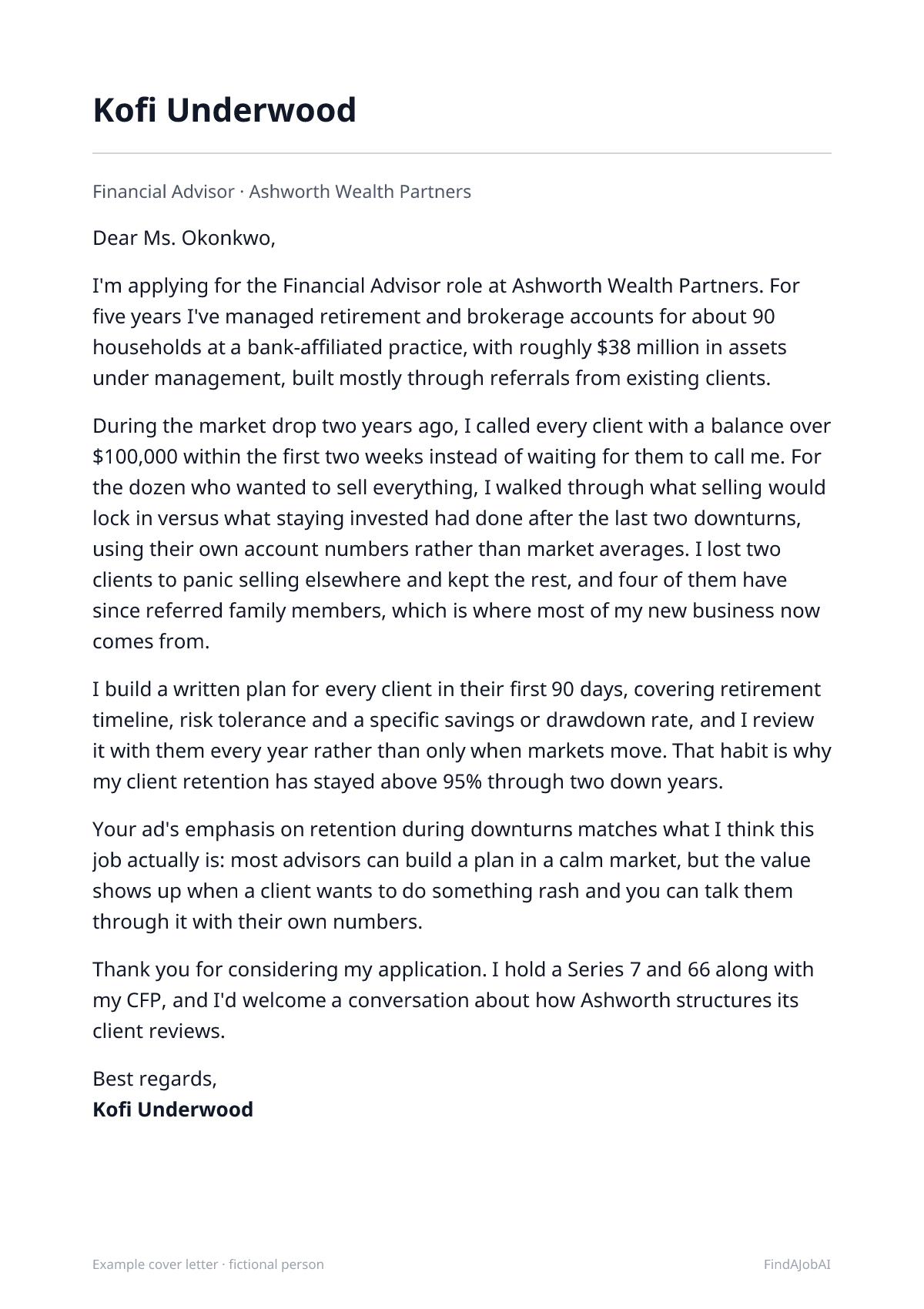
Dear Ms. Okonkwo,
I'm applying for the Financial Advisor role at Ashworth Wealth Partners. For five years I've managed retirement and brokerage accounts for about 90 households at a bank-affiliated practice, with roughly $38 million in assets under management, built mostly through referrals from existing clients.
During the market drop two years ago, I called every client with a balance over $100,000 within the first two weeks instead of waiting for them to call me. For the dozen who wanted to sell everything, I walked through what selling would lock in versus what staying invested had done after the last two downturns, using their own account numbers rather than market averages. I lost two clients to panic selling elsewhere and kept the rest, and four of them have since referred family members, which is where most of my new business now comes from.
I build a written plan for every client in their first 90 days, covering retirement timeline, risk tolerance and a specific savings or drawdown rate, and I review it with them every year rather than only when markets move. That habit is why my client retention has stayed above 95% through two down years.
Your ad's emphasis on retention during downturns matches what I think this job actually is: most advisors can build a plan in a calm market, but the value shows up when a client wants to do something rash and you can talk them through it with their own numbers.
Thank you for considering my application. I hold a Series 7 and 66 along with my CFP, and I'd welcome a conversation about how Ashworth structures its client reviews.
Best regards,
Kofi Underwood
Example 2 · Career changer
Insurance agent moving into financial advising
Erica has sold life and disability insurance for six years and already holds a Series 65. The ad mentions building a book of business from scratch.
Example letter · fictional
Dear Hiring Manager,
I'm applying for the Financial Advisor role at Correnti Financial Group. For six years I've sold life and disability insurance independently, building a client base of around 150 policyholders almost entirely through referrals and community events rather than cold calls. I earned my Series 65 last year because I wanted to offer clients more than insurance.
Two years ago a longtime client, a small business owner, asked me why his insurance agent couldn't also help him think about his retirement accounts. I couldn't answer that honestly at the time, and it's the reason I started studying for the Series 65. Since passing, I've built three sample financial plans using real but anonymized client numbers, covering retirement savings rate, insurance coverage gaps and basic portfolio allocation, which I can walk through in an interview.
What I already have is the harder skill to teach: six years of building trust with people about money during life events like a new child, a disability claim, or a death in the family. I know how to have those conversations calmly and how to ask the next question instead of pitching a product.
Your posting mentions building a book of business from scratch, which is exactly what I did in insurance with no existing network to draw on. I'd bring that same approach, plus a genuine interest in financial planning rather than product sales alone.
Thank you for your time. I'd welcome the chance to discuss how my client relationships would transfer to advisory work.
Kind regards,
Erica Dubois
Example 3 · Senior or lead
Advisory team lead applying to grow a firm's next office
Brooke leads a team of three advisors inside a larger practice and is applying to open and run a satellite office for a growing regional firm.
Example letter · fictional
Dear Mr. Fennimore,
I'm applying for the Senior Financial Advisor and Team Lead role at Larkspur Capital Advisors. For the past three years I've led a team of three advisors inside a larger practice, managing about $95 million in combined assets, and before that I spent seven years building my own book from the ground up.
Your ad describes opening a new office in a market Larkspur hasn't served directly before. I did something similar four years ago when my firm expanded into a neighboring county with no existing client base. I spent the first six months on local referral partnerships, mainly with two CPAs and an estate attorney, before writing a single financial plan there. That office now manages $22 million in assets after three years, almost entirely through those referral relationships rather than advertising.
Leading the team has meant teaching the habits that built my own book: a written plan in the first 90 days, annual reviews that happen whether or not the client calls first, and calling clients proactively when markets move rather than waiting. One advisor I mentored went from managing $4 million to $19 million in two years using that approach, and I review client retention and referral sources with the team monthly, not just production numbers.
I haven't opened an office in a market with no prior firm presence at all, which your ad describes, and I haven't yet managed a P&L for a physical location. I'd want to understand how Larkspur typically budgets a new office's first two years before committing to a timeline.
I'd welcome a conversation about which referral relationships or local institutions you see as most important to this market, since that's where I'd start.
Sincerely,
Brooke Adeyemi
All three letters, and the short version below, are fictional: the people, employers and numbers are invented. Borrow the structure, never the facts.
- Prefer to write it yourself? Use the free cover letter template.
- Check your CV against the job first: the free CV score shows the missing keywords.
Why the first letter works, paragraph by paragraph
Paragraph 1: Opening
States the size of the practice (90 households, $38 million AUM) and how it was built (referrals), since advisory roles care as much about how you grow a book as how big it already is.
Paragraph 2: The downturn story
A specific, high-pressure situation, the writer's actual behavior (calling clients first, using their own numbers), and a measurable retention outcome, which is the moment that separates advisors who keep clients from those who don't.
Paragraph 3: The planning habit
A concrete process (a written plan within 90 days, annual reviews) tied to a retention statistic, showing the result isn't luck but a repeatable habit.
Paragraph 4: Why this role
Directly answers the ad's stated priority (retention during downturns) and reframes it as the real test of the job, which shows the writer understands what the posting is actually asking for.
Paragraph 5: Close
Lists relevant licenses and credentials (Series 7, 66, CFP) and asks a specific question about how the firm runs reviews, rather than a generic request for a meeting.
What the career changer's letter does differently
The career changer's letter starts from a specific client question the writer couldn't yet answer, which motivated the Series 65, and uses sample financial plans built on real but anonymized numbers to show the new skill is already being practiced. It explicitly names what's transferable (trust-building during life events) and what's new (planning itself).
What the senior letter does differently
A team-lead letter reports what an organization and its people grew into: an office built from zero to $22 million through named referral partnerships, and a mentee's book that grew from $4 million to $19 million under the writer's coaching. The specific gap, running a P&L for a new physical location, is named rather than glossed over.
Short financial advisor cover letter: an email-ready version
Many applications arrive as an email or a small text box, and a full page doesn't fit. This version runs 120 to 150 words and keeps only what a reader needs to decide whether to reply. A financial advisor answers a boutique firm's application question asking for five sentences on why they'd fit, sent by email after the portal rejected the file.
Short version · email · fictional127 words
Subject: Financial Advisor (Series 65, $31M book) – Lorenzo Hendricks
Hello Ms. Carvalho,
I'm applying for the Financial Advisor role at Thornbury Private Wealth. I manage about $31 million in assets for 60 households, built mostly through client referrals over five years.
During last year's market volatility, I called clients proactively rather than waiting for them to call me, and kept every account open while most of the firm saw some attrition; three of those clients have since referred family members. I also write each client a one-page summary after every review so nothing depends on memory.
I hold a Series 65 and a CFP, and I'd like to bring that same proactive approach to a smaller, relationship-focused firm. My resume is attached, and I'm glad to discuss my planning process on a call.
Best,
Lorenzo Hendricks
Five sentences force one proof point instead of three, so the short version keeps the proactive-calling story and its retention result, since that's the moment that distinguishes advisors most clearly, and drops the detailed planning process for a follow-up call.
Opening lines that work for financial advisor cover letters
The first sentence decides whether the second gets read. Here are six openings, one for each situation you might be in. Pick the one that matches yours and swap in your own facts: every name and number below is invented.
1. You have a standout result
Last year's market volatility cost most of my firm some client attrition, but I called every client proactively and kept 100% of my accounts; three have since referred family members. I would bring that same method to your client base.
2. The ad names a problem you've solved
Your ad mentions building a book from scratch in a new market. I did exactly that four years ago, growing an office from zero to $22 million in assets almost entirely through local referral partnerships.
3. Someone referred you
Your advisor Teodoro Salcedo and I worked together on a joint client case last year and he suggested I apply when this opening came up.
4. You admire what they build
I've been a client of a firm much like yours for eight years, and the way my own advisor handled a hard conversation about my portfolio during a downturn is part of why I wanted to do this work myself.
5. You're new to the field or switching into it
I spent six years selling life and disability insurance, building trust with clients through some of the hardest conversations people have about money, and earned my Series 65 because I wanted to help with more than insurance.
6. You have senior scope or a specialism
As the advisor who grew a satellite office from zero to $22 million in assets through local referral partnerships, I'm looking for a role where I can do that again for a firm ready to expand.
How to write a financial advisor cover letter
Five steps, in the order you'd write them. The shape stays the same for every job (a short opening, proof, a reason for this employer, a close), and what goes into each part is what changes with the role.
Identify what kind of book the ad is asking you to build or keep
Some advisor roles want you to grow a book from scratch, others to retain and expand an existing one, others to join a team with warm leads. Read the ad for which situation it describes, then lead with the matching experience rather than a general sales pitch.
Open with a client moment, not your license list
Describe one specific situation, a downturn, a hard question, a life event, and what you did, in one or two sentences. Your Series 65 or CFP belongs later, attached to how you used it, not in the opening line.
Quantify your book and one result, not your activity
Give a number for assets under management, households served, or retention rate, and tie one result to a specific action you took, such as proactive calls during a downturn. Avoid counting meetings held or calls made without an outcome attached.
Explain how you actually got clients
Referrals, community events, a prior career's network, or a firm's existing book each say something different about what you'd bring. State which one built your current book and be specific, such as naming the kind of referral partner (a CPA, an estate attorney) rather than saying 'networking.'
Show your process, then ask one real question
One sentence on a repeatable habit, like a written plan in the first 90 days or annual reviews that happen on schedule, shows the result isn't luck. Close by asking something specific about how the firm runs reviews or compensates referrals, so the reader sees you've thought about fit.
Financial Advisor cover letter do's and don'ts
Do
- Describe one client relationship or difficult moment (a downturn, a life event, a hard question) and exactly what you did, not just that you're 'client-focused.'
- Give a number for your book: households, assets under management, or retention rate, and say how it was built.
- Name your licenses (Series 7, 65, 66, CFP) in the context of what you used them for, not as a standalone list.
Don't
- Don't promise investment returns or assure outcomes; describe your process and judgment instead.
- Don't share real client names, account numbers or exact portfolio values from a current book; use rounded or anonymized figures.
- Don't lean on 'passionate about helping people reach their financial goals' as your main pitch; show one client story instead.
Common financial advisor cover letter mistakes
Each one is easy to make and quick to fix before you send the letter.
Leading with licenses instead of a client story
A first paragraph that's just a list of Series 7, 65, 66 and CFP reads like a resume restated. Open with what you did for a client, then mention credentials where they're relevant to that story.
Promising returns or assuring outcomes
Language like 'I will grow your portfolio by 10 percent a year' is both unrealistic and a compliance problem. Describe your process and judgment, and let a measured past result, like a retention rate, speak for itself.
Counting activity instead of results
'Made 500 cold calls' or 'held 200 client meetings' says nothing about outcomes. Replace with what a specific round of outreach led to: accounts retained, referrals earned, or assets added.
Being vague about how the book was built
'I'm great at building relationships' could mean anything. Name the actual channel, referrals from two CPAs, a prior insurance client base, a firm-assigned list, so the reader knows what kind of growth to expect from you.
Sharing identifiable client details
Using a real client's name, exact account balance, or specific life event without permission is both a trust problem and a compliance risk. Round numbers and remove identifying details, even in an interview.
Email subject lines for financial advisor applications
Applying by email? Put the job title, any reference number and your name in the subject line.
- Financial Advisor application – wealth management, $38M AUM – Kofi Underwood
- Financial Advisor – insurance agent with Series 65, book-building experience – Erica Dubois
- Application: Financial Advisor, Retirement Planning Team (Req. 3104) – Kofi Underwood
Everything for Financial Advisors
- Financial Advisor resume exampleA full resume, plus bullet and summary examples
- Financial Advisor interview questions30 questions with sample answers
- Financial Advisor job descriptionDuties, skills and requirements
- Career change cover letter: template + examples
Other cover letter examples
Financial Advisor cover letter FAQ
What should I write in a financial advisor cover letter?
One specific client situation, such as a downturn, a life event, or a hard financial question, and exactly what you did and what resulted: a client retained, a plan built, a referral earned. Name your licenses in context rather than as a list.
How do I write a financial advisor cover letter with no book of business yet?
Use trust-building experience from another client-facing role, such as insurance, banking, or sales, then add your licenses (Series 65 or similar) and a sample financial plan or two you've built on anonymized numbers. Say plainly what transfers and what you're newly trained in.
Should I mention assets under management or client retention numbers?
Yes, rounded. A figure like $38 million in AUM or a retention rate above 95 percent gives a hiring manager something concrete to evaluate, as long as it's accurate and doesn't reveal identifiable client details.
How we built this page
The FindAJobAI team wrote the three example letters, the short email version, the opening lines and the advice for financial advisor roles. The people, employers and numbers in the letters are invented; the structure, the kind of evidence and the order of the paragraphs are the parts to copy.
Once we track enough live financial advisor job ads, this page also shows the skills they ask for most, counted the same way as our in-demand skills report.
Last reviewed on November 1, 2026.