Food Scientist Cover Letter Example (2026)
By FindAJobAI Team Updated How we built this page
R&D managers read food scientist cover letters for evidence that your recipes work outside the test kitchen. A strong letter names the categories you know, one product you carried from bench to plant, and how you handled shelf life, cost or a scale-up surprise. It should read like a practical developer describing real launches, not a list of ingredients and lab tests.
Food Scientist cover letter template
This letter as a one-page template: an opening that names the job and your strongest fact, proof that answers the ad, a reason for this employer and a short close.
After you sign up, FindAJobAI drafts your own letter for a real job from your CV in this format, and you edit it before you send it.
Example 1 · Experienced
Snack product developer applying to a frozen breakfast brand
Marguerite develops baked snacks at a regional manufacturer. The ad is for a food scientist on a frozen breakfast team at a national brand.
Example letter · fictional
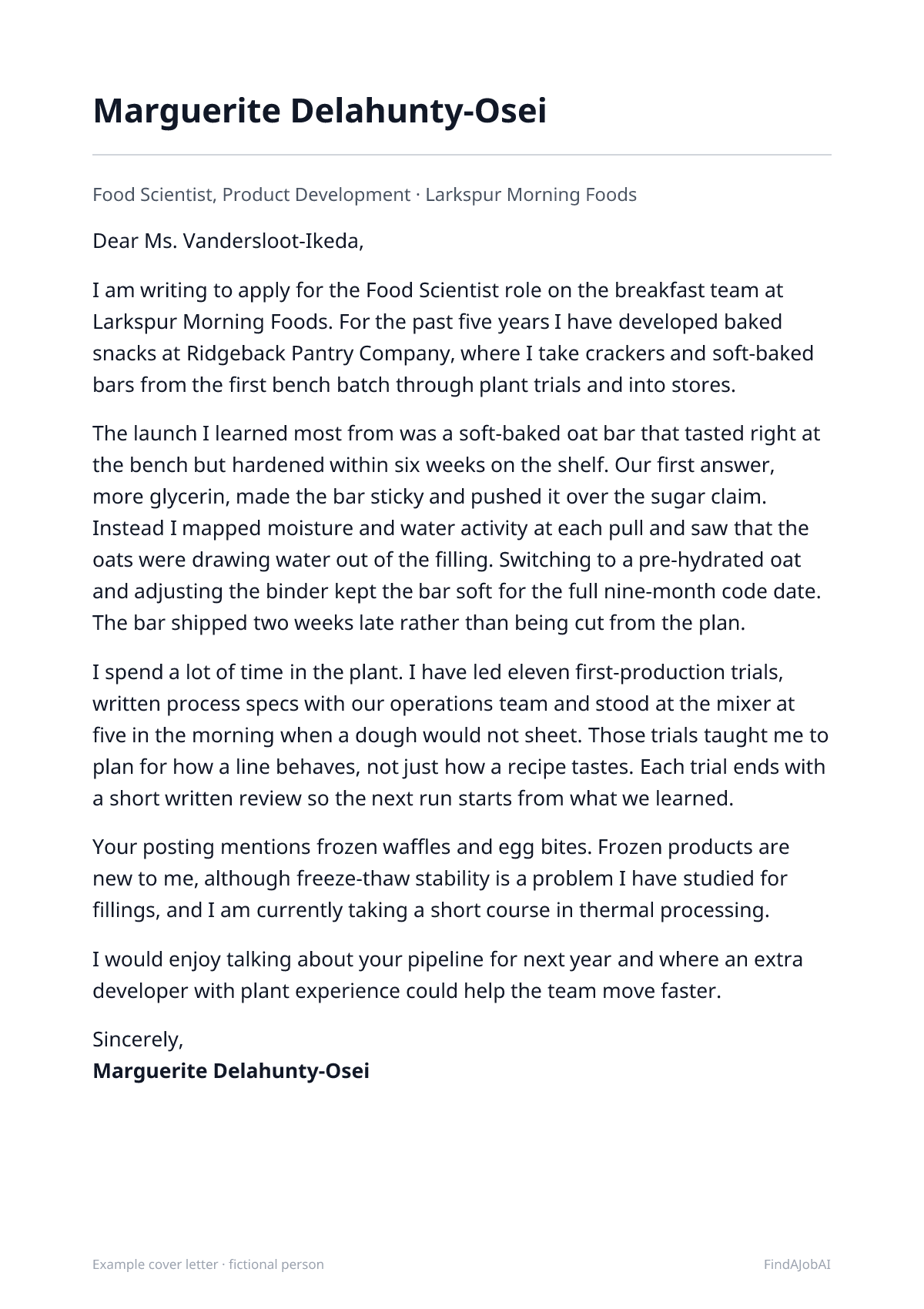
Dear Ms. Vandersloot-Ikeda,
I am writing to apply for the Food Scientist role on the breakfast team at Larkspur Morning Foods. For the past five years I have developed baked snacks at Ridgeback Pantry Company, where I take crackers and soft-baked bars from the first bench batch through plant trials and into stores.
The launch I learned most from was a soft-baked oat bar that tasted right at the bench but hardened within six weeks on the shelf. Our first answer, more glycerin, made the bar sticky and pushed it over the sugar claim. Instead I mapped moisture and water activity at each pull and saw that the oats were drawing water out of the filling. Switching to a pre-hydrated oat and adjusting the binder kept the bar soft for the full nine-month code date. The bar shipped two weeks late rather than being cut from the plan.
I spend a lot of time in the plant. I have led eleven first-production trials, written process specs with our operations team and stood at the mixer at five in the morning when a dough would not sheet. Those trials taught me to plan for how a line behaves, not just how a recipe tastes. Each trial ends with a short written review so the next run starts from what we learned.
Your posting mentions frozen waffles and egg bites. Frozen products are new to me, although freeze-thaw stability is a problem I have studied for fillings, and I am currently taking a short course in thermal processing.
I would enjoy talking about your pipeline for next year and where an extra developer with plant experience could help the team move faster.
Sincerely,
Marguerite Delahunty-Osei
Example 2 · Entry level
Food science graduate applying for an associate role in dairy R&D
Benedikt finished a BS in food science with a dairy internship and a capstone product. The ad is for an associate food scientist at a cultured dairy company.
Example letter · fictional
Dear Mr. Halvorsen-Tchakarova,
I am applying for the Associate Food Scientist opening at Clearwater Creamery Collective. I completed my bachelor's degree in food science at Michigan State University this spring, and my favorite work during those four years happened in dairy, both in the pilot plant and during a summer internship.
During the internship at a yogurt maker I prepared bench samples for a reduced-sugar project and measured pH, viscosity and syneresis on each one. One week our samples began weeping whey after only a few days. I went back through the batch records and noticed the mix had been held warmer than the procedure stated before culturing. When I raised it, my mentor helped me rerun the batch at the right temperature, and the problem disappeared. The project lead asked me to add a hold-temperature check to the bench sheet. It was a small catch, but it taught me to read batch records before blaming the formula.
My capstone team built a high-protein drinkable yogurt, and I handled the stability testing. We learned that protein level and homogenization pressure had to be balanced, and our final batch stayed smooth through its whole test period. I also wrote the shelf-life summary our team presented to faculty and two visiting industry judges.
I know a company setting moves faster than a classroom, and that labels, specs and safety records matter as much as taste. I have completed HACCP coursework and I enjoy careful record keeping. I am also happy to work early plant shifts.
I would be glad to meet your team and learn how new scientists are trained on your products.
Best regards,
Benedikt Saarinen-Mbeki
Example 3 · Senior or lead
R&D manager applying to direct product development at a plant-based brand
Ingeborg manages a product development team at a sauce and soup maker. The ad is for a director of product development at a growing plant-based food company.
Example letter · fictional
Dear Mr. Okafor-Brandvold,
I am applying for the Director of Product Development position at Verdant Fold Kitchens. I have worked in packaged foods for sixteen years, and for the last six I have led a team of nine scientists at Harrowgate Soup Works, covering shelf-stable soups, sauces and broths sold in the US and three European markets.
When I took over the team, too many projects changed formula after the plant trial, which pushed launches back and frustrated our operations partners. I introduced a short technical review before any pilot run in which the developer, a plant engineer and a quality lead walked through ingredients, process limits and shelf-life risks together. Late formula changes dropped from most projects to a handful a year, and launch dates became something sales could plan around. Operations now joins every review, and the pilot plant schedule is far easier to keep.
I have also led clean-label reformulation across more than twenty products, removing modified starches and artificial colors while keeping texture and repeat purchase steady. That work taught me how to balance marketing claims against what the ingredients and the process can actually deliver. I also kept the cost of each change visible, so marketing could weigh claims against price.
Verdant Fold is expanding from refrigerated products into shelf-stable meals. I would spend my first months learning your current pipeline, agreeing scale-up standards with your operations lead and making sure each scientist sees how their project fits the launch calendar.
I would welcome a conversation about your plans for the next two years and how the development team can support them. I am glad to share examples of our review templates.
Kind regards,
Ingeborg Mazibuko-Fairclough
All three letters, and the short version below, are fictional: the people, employers and numbers are invented. Borrow the structure, never the facts.
- Prefer to write it yourself? Use the free cover letter template.
- Check your CV against the job first: the free CV score shows the missing keywords.
Why the first letter works, paragraph by paragraph
Paragraph 1: Opening
Names the role, the current employer, the product category and the full bench-to-plant scope in two sentences, which answers the R&D manager's first question.
Paragraph 2: The oat bar story
Walks through a shelf-life failure in order: the first fix that failed, the data collected, the real cause, the change and a measured outcome.
Paragraph 3: Plant experience
Proves scale-up skill with a count of trials and a concrete picture of working on the line.
Paragraph 4: The frozen gap
Admits the missing category experience honestly and points to related freeze-thaw work and current training.
Paragraph 5: Close
Keeps the focus on the team's pipeline and offers a specific way the writer would help.
What the entry-level letter does differently
The graduate's letter turns an internship into R&D language: bench samples, measured properties, a defect traced to a process step and a procedure change. It shows the writer understands that records and specs matter in industry.
What the senior letter does differently
A senior food scientist letter is about the team and the pipeline: review processes, launch reliability, reformulation programs and work with operations. It ties the writer's plan to the company's next growth step.
Short food scientist cover letter: an email-ready version
Many applications arrive as an email or a small text box, and a full page doesn't fit. This version runs 120 to 150 words and keeps only what a reader needs to decide whether to reply. A beverage scientist replies by email to an R&D lead who posted an opening for a flavor applications scientist.
Short version · email · fictional133 words
Subject: Flavor Applications Scientist – 4 years beverage R&D – Leocadia Pemberton-Huang
Hi Ms. Abernathy-Kowal,
I am writing about the Flavor Applications Scientist role at Brightsprig Flavor House. For four years I have developed ready-to-drink teas and sparkling waters, building flavor systems and testing them through pasteurization and shelf life.
My strength is helping customers see a flavor in their own base. Last year I matched 14 customer briefs in carbonated and still drinks, and 9 moved to commercial trial. I also run our triangle tests and present the results to customer teams. Two of those trials became launched products, and I still support them with quarterly shelf-life checks.
I can start with three weeks' notice and would be happy to talk at any time that suits you. My resume is attached, and samples of my work are available on request.
Thank you,
Leocadia Pemberton-Huang
The short email leads with the beverage categories and the applications work the role needs, then gives one conversion result. A busy R&D lead can judge fit in under a minute.
Opening lines that work for food scientist cover letters
The first sentence decides whether the second gets read. Here are six openings, one for each situation you might be in. Pick the one that matches yours and swap in your own facts: every name and number below is invented.
1. You have a standout result
I take baked snacks from the first bench batch to the production line, and I would like to bring that plant experience to your breakfast team.
2. The ad names a problem you've solved
Your posting asks for a scientist who can solve shelf-life problems, and my most useful launch started with a bar that hardened in six weeks.
3. Someone referred you
After a summer measuring yogurt samples in an R&D lab, I am ready to start my career in cultured dairy development.
4. You admire what they build
Your senior scientist, Cornelius Abara-Westergaard, suggested I apply after we met at a regional food technologists' meeting last month.
5. You're new to the field or switching into it
Every product I launch has passed a plant trial, a shelf-life study and a sensory panel before it reaches a store.
6. You have senior scope or a specialism
As an R&D manager leading nine scientists, I have learned that most launch delays begin with formula changes after the pilot run.
How to write a food scientist cover letter
Five steps, in the order you'd write them. The shape stays the same for every job (a short opening, proof, a reason for this employer, a close), and what goes into each part is what changes with the role.
Lead with category and scope
In the first two sentences, name the product categories you develop and whether your work covers bench, pilot plant and production. R&D managers sort letters by category fit and scale-up experience, so put both where a quick reader will see them.
Tell one product story
Choose a launch where something went wrong, such as texture loss, separation or a cost overrun. Explain the data you gathered, the cause you found and what the product achieved afterward. A clear sequence shows food science judgment better than a list of skills.
Prove you can scale up
Mention plant trials you led, process specs you wrote and a problem you solved on the line. Many managers have hired strong bench developers who struggled in production, so evidence of plant work makes your letter stand out from other applicants.
Show safety and compliance habits
Add a sentence on HACCP, PCQI, allergen control or labeling work. Food companies carry real recall risk, and a candidate who treats specs and labels as part of development needs less training and earns trust faster.
Close on the company's products
End by linking your experience to the brand's pipeline, a category it is entering or a launch it announced. Offer a conversation and stop there, so the reader finishes on your strongest evidence. A brief, confident close also leaves room for the interview to cover the details.
Food Scientist cover letter do's and don'ts
Do
- Name the product categories you know and where in the process you work, from bench to plant.
- Tell one product story with a problem, the data you gathered and the result.
- Mention food safety training such as HACCP or PCQI, because many roles require it.
Don't
- Don't list every ingredient system you have read about; managers will ask about any you name.
- Don't describe recipes only by taste; R&D leaders want shelf life, cost and plant results too.
- Don't skip the category gap if the posting names products you have not worked on.
Common food scientist cover letter mistakes
Each one is easy to make and quick to fix before you send the letter.
Writing about a love of cooking
Keep passion to one line and spend the letter on products, data and launches that prove your skill.
Leaving out shelf life and scale-up
Add at least one example of a stability study or plant trial, because these decide whether products reach stores.
Copying the posting's ingredient list
Name only the ingredient systems you have used and give one real example of how you used them.
Forgetting the business side
Mention a cost saving, a launch date met or a sales result so the reader sees your commercial impact.
Email subject lines for food scientist applications
Applying by email? Put the job title, any reference number and your name in the subject line.
- Food Scientist application – 5 years snack development, 11 plant trials – Marguerite Delahunty-Osei
- Associate Food Scientist – BS Food Science 2025, dairy internship – Benedikt Saarinen-Mbeki
- Director of Product Development – 16 years packaged foods – Ingeborg Mazibuko-Fairclough
Everything for Food Scientists
- Food Scientist resume exampleA full resume, plus bullet and summary examples
- Food Scientist interview questions30 questions with sample answers
- Food Scientist job descriptionDuties, skills and requirements
- Cover letter with no experience: templates
Other cover letter examples
Food Scientist cover letter FAQ
What should a food scientist cover letter include?
The categories you develop, one product you took from bench to launch with a result, your shelf-life and scale-up experience, food safety training and why the employer's products interest you. Keep it to one page.
How do I write a food scientist cover letter with no industry experience?
Use internships, capstone products and pilot plant courses. Describe what you made, what you measured and one problem you solved, and show you know that industry work needs accurate specs and records.
Should a food scientist cover letter mention sensory work?
Yes, briefly. A sentence on the panels you ran and how the results shaped a product decision shows you design food for consumers, not only for the lab bench.
How we built this page
The FindAJobAI team wrote the three example letters, the short email version, the opening lines and the advice for food scientist roles. The people, employers and numbers in the letters are invented; the structure, the kind of evidence and the order of the paragraphs are the parts to copy.
Once we track enough live food scientist job ads, this page also shows the skills they ask for most, counted the same way as our in-demand skills report.
Last reviewed on November 1, 2026.