Java Developer Cover Letter Example (2026)
By FindAJobAI team Updated How we built this page
Java ads lean on a wall of frameworks: Spring Boot, Hibernate, Kafka, sometimes a cloud platform. The cover letter isn't the place to repeat that wall. It's where you show a system you built or fixed, what broke before you touched it, and what changed once you did.
Java Developer cover letter template
This letter as a one-page template: an opening that names the job and your strongest fact, proof that answers the ad, a reason for this employer and a short close.
After you sign up, FindAJobAI drafts your own letter for a real job from your CV in this format, and you edit it before you send it.
Example 1 · Experienced
Backend engineer applying to a logistics platform
Edith maintains a Spring Boot order-routing service at a shipping startup. The ad asks for experience with high-throughput systems and Kafka.
Example letter · fictional
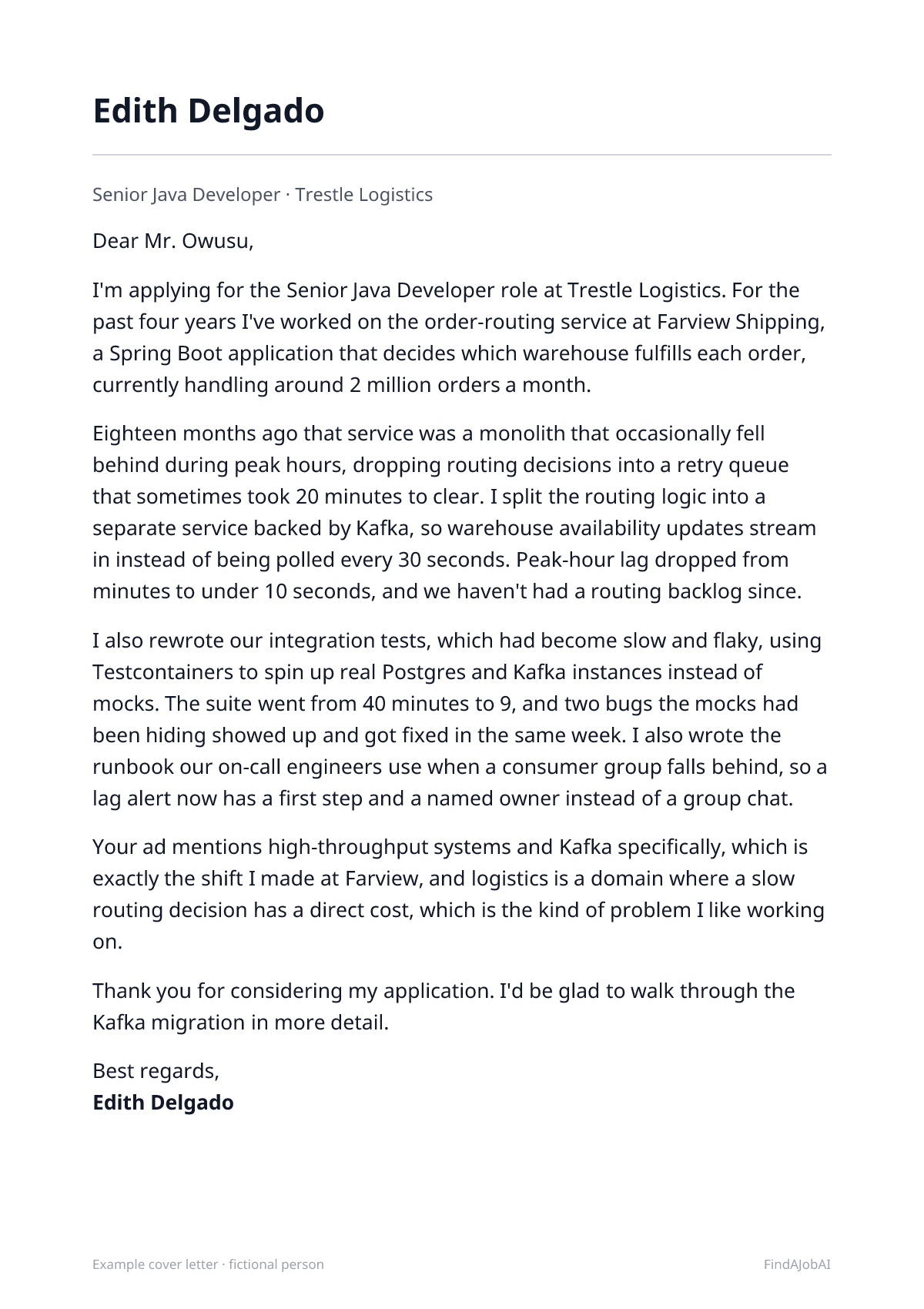
Dear Mr. Owusu,
I'm applying for the Senior Java Developer role at Trestle Logistics. For the past four years I've worked on the order-routing service at Farview Shipping, a Spring Boot application that decides which warehouse fulfills each order, currently handling around 2 million orders a month.
Eighteen months ago that service was a monolith that occasionally fell behind during peak hours, dropping routing decisions into a retry queue that sometimes took 20 minutes to clear. I split the routing logic into a separate service backed by Kafka, so warehouse availability updates stream in instead of being polled every 30 seconds. Peak-hour lag dropped from minutes to under 10 seconds, and we haven't had a routing backlog since.
I also rewrote our integration tests, which had become slow and flaky, using Testcontainers to spin up real Postgres and Kafka instances instead of mocks. The suite went from 40 minutes to 9, and two bugs the mocks had been hiding showed up and got fixed in the same week. I also wrote the runbook our on-call engineers use when a consumer group falls behind, so a lag alert now has a first step and a named owner instead of a group chat.
Your ad mentions high-throughput systems and Kafka specifically, which is exactly the shift I made at Farview, and logistics is a domain where a slow routing decision has a direct cost, which is the kind of problem I like working on.
Thank you for considering my application. I'd be glad to walk through the Kafka migration in more detail.
Best regards,
Edith Delgado
Example 2 · Career changer
IT support technician moving into Java development
Sebastian automated a ticket-routing problem with Java before he had a developer title. The ad mentions a junior role on a claims-processing team.
Example letter · fictional
Dear Hiring Manager,
I'm applying for the Junior Java Developer role at Birchall Insurance. For three years I've worked in IT support at a regional bank, and the work that pulled me toward development was a small Java tool I built to fix a routing problem nobody else wanted to touch.
Our support tickets were assigned by a script that just rotated through staff, regardless of ticket type, so network issues sometimes landed with someone who only handled password resets. I wrote a Java Spring Boot service that matched ticket categories to the right technician's recent resolution history, pulling data from our ticketing system's API. Average time to first response dropped from 6 hours to under 90 minutes, and it's still running in production, now maintained by our small IT team.
Since then I've completed a Java and Spring course, built a REST API with a Postgres backend for a personal budgeting app, and I'm working through a book on data structures and algorithms to shore up the fundamentals I didn't get from a CS degree. I'm comfortable with Java, SQL and Git, and learning JUnit and Docker.
Your posting mentions claims processing, which like my ticket-routing problem is really about getting the right case to the right person quickly and tracking it reliably. That's the part of the job I already have some instinct for.
Thank you for your time. My GitHub is linked on my resume, and I'd welcome the chance to talk about the routing tool.
Kind regards,
Sebastian Iyer
Example 3 · Senior or lead
Staff engineer applying to lead a legacy migration
Hana leads a team of six Java developers at a payments processor. The ad is for a staff engineer who will lead the move off a 15-year-old monolith.
Example letter · fictional
Dear Mr. Calloway,
I'm applying for the Staff Java Developer role at Ledgerstone Payments. For the last three years I've led a team of six developers at Varnick Financial, where we're midway through moving a 15-year-old Java monolith to a set of services, and before that I spent seven years as a senior engineer on the same codebase.
Your ad says the monolith handles both authorization and settlement, and that teams are afraid to touch the authorization code. We had the same fear at Varnick: a single 40,000-line class handled both. I started by adding characterization tests around the authorization path before changing anything, which took six weeks but meant we could refactor without guessing. We've since extracted authorization into its own service behind a strangler pattern, and it now handles the same transaction volume with half the on-call pages it used to generate.
The hardest part wasn't the code, it was sequencing. I built a dependency map of which downstream teams called which parts of the monolith, and we moved the lowest-risk callers first so we had working proof before touching settlement, which nobody wanted to be the first to change. That map is still how the team plans each quarter's migration slice.
I haven't run a migration this size with a regulated settlement system attached, and I'd expect compliance sign-off to shape our sequencing more than it did at Varnick, which is something I'd want to understand clearly in the first weeks.
A conversation about which part of your monolith teams are most afraid to touch, and why, would be a good place to start.
Sincerely,
Hana Kowalski
All three letters, and the short version below, are fictional: the people, employers and numbers are invented. Borrow the structure, never the facts.
- Prefer to write it yourself? Use the free cover letter template.
- Check your CV against the job first: the free CV score shows the missing keywords.
Why the first letter works, paragraph by paragraph
Paragraph 1: Opening
Names the specific service (order-routing) and its scale (2 million orders a month), which tells the reader what kind of system the writer has actually operated, not just coded in a tutorial.
Paragraph 2: The system that changed
A concrete before-and-after: a monolith with a 20-minute backlog, a Kafka-based fix, and a measured result (lag under 10 seconds). This is the paragraph that proves the writer can diagnose and fix a real production problem.
Paragraph 3: Quality and testing
Fixing a flaky test suite and naming the tool (Testcontainers) shows engineering judgment beyond feature work, and the detail that bugs surfaced once mocks were removed adds credibility.
Paragraph 4: Why this company
Mirrors the ad's own language (high-throughput, Kafka) and connects the writer's experience to what makes the domain's problems costly when done poorly.
Paragraph 5: Close
Offers a concrete next step, a deeper walkthrough of the migration, rather than a generic thank-you.
What the career changer's letter does differently
The career changer's letter opens with a specific tool built to solve a real workplace problem (ticket routing) before any job title changed, with a measurable result (first response time from 6 hours to 90 minutes). Courses and a personal project show the skills are now deliberate, and the letter draws a direct line between the old problem and the ad's claims-processing focus.
What the senior letter does differently
A staff engineer letter reports organizational habits, not just code: a fear named directly (nobody wants to touch authorization), a sequencing method (a dependency map) that outlives the project, and a measured operational result (half the on-call pages). The gap, no regulated settlement experience, is named plainly rather than smoothed over.
Short Java developer cover letter: an email-ready version
Many applications arrive as an email or a small text box, and a full page doesn't fit. This version runs 120 to 150 words and keeps only what a reader needs to decide whether to reply. A Java developer answers a healthtech company's short 'why you' field, sent as an email because the ad asked candidates to reach out directly.
Short version · email · fictional128 words
Subject: Java Developer (Spring Boot, HL7) – appointment scheduling – Omar Siddiqui
Hello Dr. Mbeki,
I'm applying for the Java Developer role at Clearpath Health. I have four years of Spring Boot experience on a scheduling platform at a clinic network, where I'm the developer who handles our HL7 integration work.
My most useful project was rebuilding our appointment-conflict checker, which was double-booking providers about once a week. I rewrote it to check calendars in real time against a Postgres lock instead of a nightly batch job, and double-bookings dropped to zero over the following three months.
Scheduling reliability matters most in healthcare, where a double-booked slot means a patient waits longer, and I'd like to bring that focus to your team. My resume is attached, and I can walk through the conflict-checker rebuild on a call.
Best,
Omar Siddiqui
A short email keeps one bug fixed and its result (double-bookings to zero), in the domain the employer cares about, and ties it to why reliability matters in healthcare specifically rather than in general terms.
Opening lines that work for Java developer cover letters
The first sentence decides whether the second gets read. Here are six openings, one for each situation you might be in. Pick the one that matches yours and swap in your own facts: every name and number below is invented.
1. You have a standout result
One scheduling bug I fixed last year cut double-bookings from weekly to zero over three months. I'd like to bring that same attention to your appointment platform.
2. The ad names a problem you've solved
Your ad says developers lose a day a week to flaky integration tests. At my current company I replaced our mocked test suite with Testcontainers, and our suite time dropped from 40 minutes to 9.
3. Someone referred you
Your engineering manager, Felix Adeyemi, worked with me for two years on a Kafka migration before he moved to your team. He mentioned you need someone comfortable owning a messy legacy service, which is what prompted this application.
4. You admire what they build
I've used your scheduling app as a patient for two years, and a recurring double-booking bug made me curious about the backend behind it, which is part of why I'm applying.
5. You're new to the field or switching into it
I spent three years in IT support, then built a Java tool to fix a ticket-routing problem that was costing my team hours each week. Backend development is where I'd like to keep solving problems like that.
6. You have senior scope or a specialism
As the senior Java developer on a payments monolith for seven years, I led the team that extracted its first service out from under live transaction volume. I'm looking for a role where I can lead that kind of migration from the start.
How to write a Java developer cover letter
Five steps, in the order you'd write them. The shape stays the same for every job (a short opening, proof, a reason for this employer, a close), and what goes into each part is what changes with the role.
Identify the kind of system the ad is protecting
Java jobs range from high-throughput backend services to regulated systems like payments or healthcare, where correctness matters more than speed. Read the ad for which pressure it's under, then pick a project of yours under similar pressure.
Open with the problem the system had, not its tech stack
Say what was failing: a backlog, a flaky test suite, a double-booking bug. The Spring Boot or Kafka detail belongs in the explanation of the fix, not the first sentence. A reader who sees a real problem in your opening keeps reading.
Quantify the fix, not the code written
Tie one change to a measurable result: lag reduced, test suite time cut, bugs caught, incidents avoided. Avoid counting lines of code or pull requests. If you can't measure it precisely, describe what stopped happening once the fix shipped.
Name frameworks inside the story of what you built
Work Spring Boot, Hibernate, Kafka or Testcontainers into the explanation of a specific system, with enough detail (data volume, request rate) that the reader can judge the scale. Tools named in a list are forgettable; tools named while solving a problem aren't.
Show how you handle risk in someone else's code
One sentence on how you approach a system you didn't write: tests added before refactoring, a migration sequenced by risk, a rollback plan. Close by naming a part of their system you'd want to understand first, so the reader sees you respect what's already there.
Java Developer cover letter do's and don'ts
Do
- Name a system you built or fixed, what was wrong with it, and the metric that moved once you changed it.
- Mention the specific framework or tool the ad names (Spring Boot, Hibernate, Kafka) inside a real example, not as a list.
- Show scale: requests per second, data volume, or team size, so the reader knows what kind of systems you've actually touched.
Don't
- Don't list every Java version and framework you've ever opened; name the ones you used for the story you're telling.
- Don't describe tickets closed or features shipped as a count; describe one that mattered and why.
- Don't claim ownership of systems you only maintained; say clearly whether you built, fixed, or kept something running.
Common Java developer cover letter mistakes
Each one is easy to make and quick to fix before you send the letter.
Listing every Java framework and version like a changelog
A paragraph naming Spring, Hibernate, Kafka, Maven and Gradle back to back reads like a resume restated in sentences. Pick the one or two tools central to your best story and let the rest live on your resume.
Describing features shipped instead of problems solved
'Shipped 12 features for the checkout team' says nothing about difficulty or impact. Pick the one feature or fix that mattered, and say what was broken before and what changed after.
Giving a performance number with no baseline
'Improved response time by 40 percent' is unverifiable without a starting point. State the before and after numbers, what you measured them with, and what specifically caused the change.
Treating testing as an afterthought sentence
A single generic line like 'I write clean, tested code' convinces no one. Name a real testing problem you fixed, such as flaky tests or missing coverage on a risky path, and what it cost before you fixed it.
Overstating ownership of a legacy system
Saying you 'built' a system you joined and maintained is easy to catch out in an interview. Be precise about what you inherited, what you changed, and what you added from scratch.
Email subject lines for Java developer applications
Applying by email? Put the job title, any reference number and your name in the subject line.
- Senior Java Developer application – Kafka and high-throughput routing – Edith Delgado
- Junior Java Developer – IT support background, Spring Boot project – Sebastian Iyer
- Application: Java Developer, Platform Team (Req. 2240) – Edith Delgado
Everything for Java Developers
- Java Developer resume exampleA full resume, plus bullet and summary examples
- Java Developer interview questions30 questions with sample answers
- Java Developer job descriptionDuties, skills and requirements
- Career change cover letter: template + examples
Other cover letter examples
Java Developer cover letter FAQ
What should I write in a Java developer cover letter?
One system you built or fixed: what was wrong with it, what you changed, and the result, in numbers if you have them. Then a sentence on testing or code quality. Your framework list belongs on your resume, not repeated in prose.
How do I write a Java developer cover letter with no experience?
Use a personal project or a workplace problem you solved with code before you had the title, then add a course and one project with a clear write-up. Name the frameworks you used and what the project actually does.
Should I mention specific Java frameworks in the cover letter?
Yes, but inside an example, not as a standalone list. Naming Spring Boot or Hibernate while describing what you built with them is more convincing than listing both separately from any project.
How we built this page
The FindAJobAI team wrote the three example letters, the short email version, the opening lines and the advice for Java developer roles. The people, employers and numbers in the letters are invented; the structure, the kind of evidence and the order of the paragraphs are the parts to copy.
Once we track enough live Java developer job ads, this page also shows the skills they ask for most, counted the same way as our in-demand skills report.
Last reviewed on November 1, 2026.