Licensed Practical Nurse Cover Letter Example (2026)
By FindAJobAI team Updated How we built this page
LPN ads almost always name the setting, long-term care, a clinic, home health, and that setting is where your letter should live too. Name the kind of patient you care for most often and one moment where your judgment or steadiness mattered, since licenses and shifts worked are already on your resume.
Licensed Practical Nurse cover letter template
This letter as a one-page template: an opening that names the job and your strongest fact, proof that answers the ad, a reason for this employer and a short close.
After you sign up, FindAJobAI drafts your own letter for a real job from your CV in this format, and you edit it before you send it.
Example 1 · Experienced
LPN applying to a larger long-term care facility
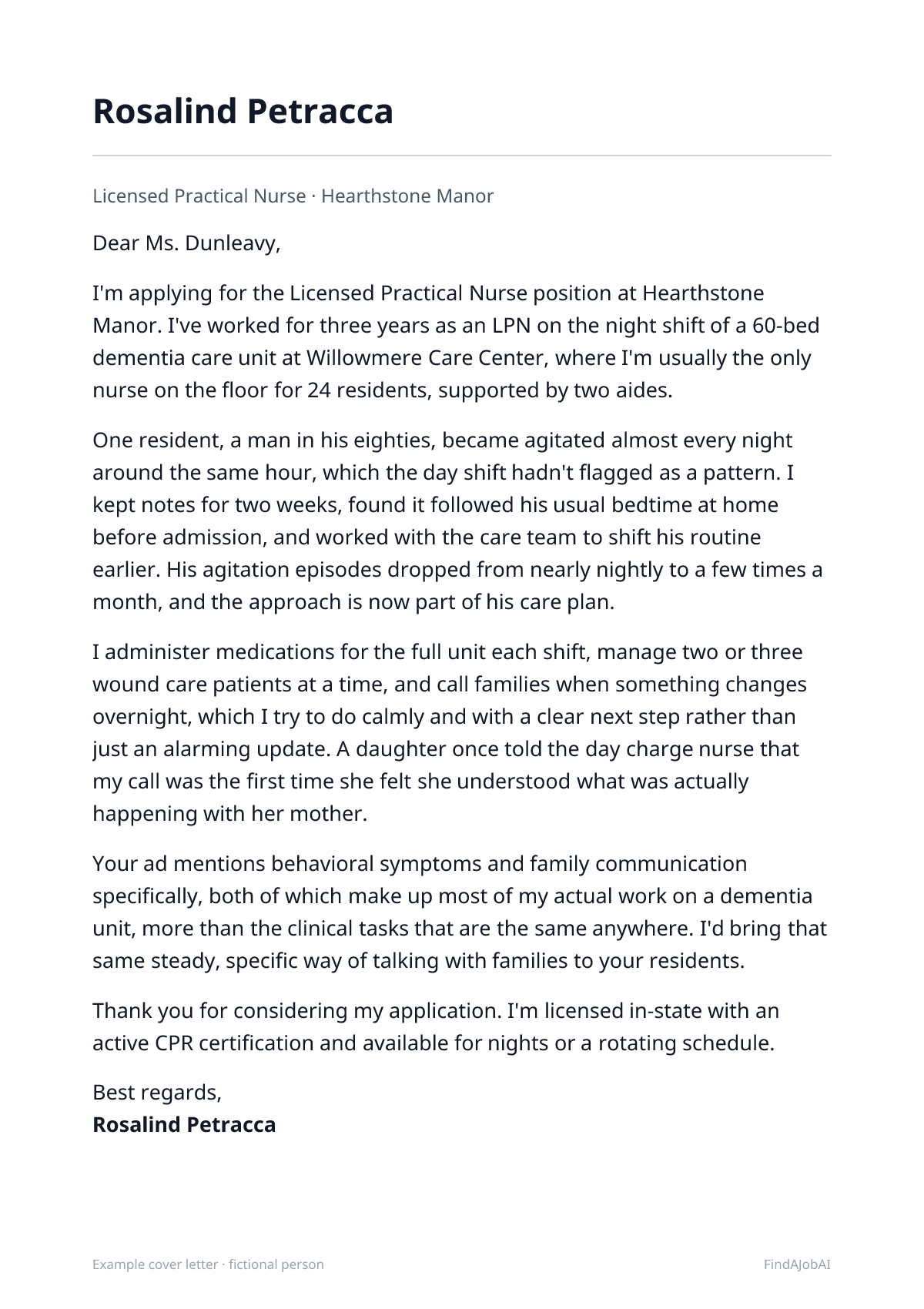
Rosalind works nights on a dementia care unit at a 60-bed facility. The ad asks for LPNs comfortable with behavioral symptoms and family communication.
Example letter · fictional
Dear Ms. Dunleavy,
I'm applying for the Licensed Practical Nurse position at Hearthstone Manor. I've worked for three years as an LPN on the night shift of a 60-bed dementia care unit at Willowmere Care Center, where I'm usually the only nurse on the floor for 24 residents, supported by two aides.
One resident, a man in his eighties, became agitated almost every night around the same hour, which the day shift hadn't flagged as a pattern. I kept notes for two weeks, found it followed his usual bedtime at home before admission, and worked with the care team to shift his routine earlier. His agitation episodes dropped from nearly nightly to a few times a month, and the approach is now part of his care plan.
I administer medications for the full unit each shift, manage two or three wound care patients at a time, and call families when something changes overnight, which I try to do calmly and with a clear next step rather than just an alarming update. A daughter once told the day charge nurse that my call was the first time she felt she understood what was actually happening with her mother.
Your ad mentions behavioral symptoms and family communication specifically, both of which make up most of my actual work on a dementia unit, more than the clinical tasks that are the same anywhere. I'd bring that same steady, specific way of talking with families to your residents.
Thank you for considering my application. I'm licensed in-state with an active CPR certification and available for nights or a rotating schedule.
Best regards,
Rosalind Petracca
Example 2 · Career changer
CNA moving into practical nursing after earning her LPN license
Berenike worked as a CNA for four years, then completed her LPN program and passed the NCLEX-PN. The ad is for a clinic LPN role.
Example letter · fictional
Dear Hiring Manager,
I'm applying for the Licensed Practical Nurse position at Marlowe Family Clinic. I worked as a CNA for four years at a skilled nursing facility, then completed my LPN program while working nights, and I passed the NCLEX-PN last month. I'm now looking for my first role as a licensed nurse.
As a CNA I was often the one who noticed something was off before it showed up on a chart, a resident's color, their breathing, a change in how they answered questions, and I learned to report it clearly and quickly rather than waiting to be asked. During clinical rotations in my LPN program, I worked a pediatric vaccination clinic and handled the room on my own for two full shifts under supervision, including explaining the process to anxious parents in plain terms.
I'm comfortable with vital signs, basic wound care, and medication administration under a protocol, and my clinical instructor noted that I stayed calm during a child's fainting episode after a vaccine, got her seated and monitored, and reported it correctly without needing prompting. I'm also used to working as part of a team that includes CNAs, since I was one, which I think helps me ask for help from them the right way.
A clinic setting appeals to me because I like the variety of a full day rather than one unit, and your ad's mention of pediatric and family visits matches the clinical rotation I most enjoyed.
Thank you for your time. I'm available to start as soon as my facility clears my credentialing, and I'd welcome the chance to discuss my clinical experience further.
Sincerely,
Berenike Soltau
Example 3 · Senior or lead
Charge nurse LPN applying to lead a unit's nursing staff
Thaddeus is a charge LPN overseeing four other LPNs at a rehab facility. The ad is for a charge nurse role at a facility rebuilding its night shift team.
Example letter · fictional
Dear Ms. Calloway,
I'm applying for the Charge Nurse position at Greywolf Rehabilitation Center. I've worked as a charge LPN for two years at a 45-bed rehab facility, overseeing four other LPNs and a rotating group of aides on the night shift, after four years as a floor LPN there.
Your ad mentions rebuilding a night shift team after recent turnover. I inherited a similar situation: three new LPNs within one year and a shift that had stopped running consistent rounds. I built a simple rounding and handoff checklist, paired each new nurse with a more experienced one for the first month, and started a short end-of-shift huddle so problems got named before the next shift started cold. Medication errors on our shift dropped noticeably, and two of the nurses I trained have since become charge nurses themselves at other facilities.
The hardest call I've had to make was pulling a nurse off the floor mid-shift after I noticed she was making small documentation errors that didn't match her usual work. It turned out she was dealing with a family emergency she hadn't mentioned. I covered her patients myself for the rest of the shift and connected her with our EAP the next day. She's still with us and has thanked me for catching it before it became something worse.
I haven't yet managed a shift through a survey or state inspection as the charge nurse of record, though I've supported two as a floor nurse, and I'd want to walk through your facility's survey history and prep routine early on.
I'd like to talk about where your night shift currently stands and what you'd want stabilized first.
Sincerely,
Thaddeus Mbeki-Voss
All three letters, and the short version below, are fictional: the people, employers and numbers are invented. Borrow the structure, never the facts.
- Prefer to write it yourself? Use the free cover letter template.
- Check your CV against the job first: the free CV score shows the missing keywords.
Why the first letter works, paragraph by paragraph
Paragraph 1: Opening
States the setting, shift and ratio (24 residents, two aides) so the reader immediately knows the writer has handled a similar patient load and environment.
Paragraph 2: A pattern noticed and addressed
A specific resident, a tracked pattern over two weeks, and a care plan change with a measurable drop in agitation show clinical observation and follow-through, not just task completion.
Paragraph 3: Daily responsibility and family communication
Naming medication administration, wound care caseload and a specific family interaction shows the breadth of the shift and the tone the writer brings to difficult calls.
Paragraph 4: Why this setting
Directly answers the ad's two named priorities, behavioral symptoms and family communication, with the writer's own account of what the job actually involves.
Paragraph 5: Close
States license status and schedule availability plainly, which long-term care hiring managers need early and often ask about first.
What the career changer's letter does differently
The career changer's letter leans on CNA experience as clinical judgment already in practice, observation and reporting, rather than treating it as unrelated work. The pediatric clinical rotation gives one concrete, supervised moment with a measurable skill (staying calm during a fainting episode), and the letter is upfront about being newly licensed and available once credentialing clears.
What the senior letter does differently
The charge nurse letter reports what changed across a shift rather than a single patient: a rounding checklist, a mentoring pairing for new hires, a drop in medication errors, and a judgment call about pulling a struggling nurse off the floor. It names the one gap, leading a shift through a survey, honestly.
Short licensed practical nurse cover letter: an email-ready version
Many applications arrive as an email or a small text box, and a full page doesn't fit. This version runs 120 to 150 words and keeps only what a reader needs to decide whether to reply. An LPN responds to a home health agency's short online application after a recruiter reached out directly, sent by email that evening.
Short version · email · fictional127 words
Subject: LPN application – home health, wound care – Idris Falcone
Hello Ms. Nakashima,
I'm applying for the Licensed Practical Nurse role at Everdene Home Health, following up on your recruiter Soren Haugland's message about the opening. I've worked as an LPN for two years in a skilled nursing facility, with a focus on wound care for about 15 patients at a time.
One of my patients had a slow-healing pressure wound that three prior treatment changes hadn't helped. I suggested a different dressing protocol to the wound care nurse practitioner, we adjusted it, and the wound closed within six weeks.
Home health appeals to me because I like working closely with one patient at a time, and I'm licensed in-state with a reliable vehicle. I've attached my resume and can begin within two weeks.
Best,
Idris Falcone
The short version keeps one wound care result with a timeframe instead of a percentage, since the field felt informal, and states license, transportation and start date plainly, the three things a home health recruiter checks first.
Opening lines that work for licensed practical nurse cover letters
The first sentence decides whether the second gets read. Here are six openings, one for each situation you might be in. Pick the one that matches yours and swap in your own facts: every name and number below is invented.
1. You have a standout result
A pressure wound on one of my patients hadn't responded to three prior treatment changes. After I suggested a different dressing protocol, it closed within six weeks, and wound care has become the part of nursing I focus on most.
2. The ad names a problem you've solved
Your ad mentions a night shift that's seen heavy turnover this year. I rebuilt a similar shift at my current facility with a rounding checklist and new-nurse mentoring, and medication errors dropped noticeably as a result.
3. Someone referred you
Your unit manager, Perpetua Oyelaran, precepted me during clinical rotations and mentioned you're looking for an LPN comfortable with dementia care. That's the unit I currently work on, which is why I'm applying.
4. You admire what they build
My grandmother was a resident at your facility for two years, and the way her night nurse handled her confusion with patience stuck with me. I'd like to bring that same steadiness to your residents.
5. You're new to the field or switching into it
I worked as a CNA for four years before earning my LPN license, which taught me to notice small changes in a patient before they show up on a chart. I'd like to bring that same attentiveness to this role.
6. You have senior scope or a specialism
As a charge LPN overseeing four nurses on a rehab unit, I've spent the last two years building the kind of shift structure I understand your night team currently lacks.
How to write a licensed practical nurse cover letter
Five steps, in the order you'd write them. The shape stays the same for every job (a short opening, proof, a reason for this employer, a close), and what goes into each part is what changes with the role.
Match your example to the ad's setting
Long-term care, home health, a clinic and rehab each involve different daily work even under the same license. Pick the one real example from your experience, a resident, a patient, a clinical rotation, that most resembles the setting and patient population the ad describes.
Open with a moment of clinical judgment
Say what you noticed and what you did about it in your first two sentences, rather than opening with your license or years of experience. A specific moment shows how you'll actually act on a shift, which matters more to a hiring nurse manager than a title.
State your license and certifications plainly
Name your license status, state, and any certifications like CPR, IV therapy or wound care early or near the close. Facilities often scan for this first, so don't make a hiring coordinator search for it inside a paragraph.
Describe the outcome for the patient or family
A dropped infection rate or a calmer resident matters because of what it meant for the person involved. Add one sentence on how a patient or family member responded, which shows the human side of the clinical result.
Address schedule and setting fit directly
Night shift, weekend rotation, travel between home health visits, say what you're available for and why the specific setting suits you. This answers a practical hiring concern before it has to be asked in an interview.
Licensed Practical Nurse cover letter do's and don'ts
Do
- Name the setting and patient population the ad lists (dementia care, pediatrics, med-surg) and match it with your closest real experience.
- Describe one moment of clinical judgment, noticing a change and acting on it, not just a list of tasks you're competent in.
- State your license status, any certifications (CPR, IV therapy), and shift availability plainly since facilities need this early.
Don't
- Don't write "compassionate and dedicated nurse"; describe one patient interaction that shows it.
- Don't share real patient details, even de-identified specifics can be too recognizable; keep examples general enough to protect privacy.
- Don't bury your license and certification status at the end; hiring coordinators often look for it first.
Common licensed practical nurse cover letter mistakes
Each one is easy to make and quick to fix before you send the letter.
Calling yourself "caring and dedicated"
Every applicant writes this. Describe one patient or family interaction that actually shows the quality, with what you did and what happened.
Including identifiable patient details
Even without a name, specifics like a rare diagnosis or exact room number can identify a real patient. Keep examples general enough to protect privacy while still being concrete about your actions.
Burying license and certification status
Hiring coordinators often check this first. State your license type, state and key certifications plainly near the top or close rather than leaving them for the resume alone.
Listing tasks instead of a judgment call
Naming vitals, medication administration and charting describes the job description, not you. Pick one moment where you noticed something and acted, which shows judgment beyond task completion.
Ignoring the setting's specific demands
A letter that could apply to any LPN job misses what the ad actually needs, like behavioral symptoms, pediatric visits or wound care caseloads. Match your example to the setting named in the ad.
Email subject lines for licensed practical nurse applications
Applying by email? Put the job title, any reference number and your name in the subject line.
- LPN application – dementia care, night shift – Rosalind Petracca
- Licensed Practical Nurse – newly licensed, CNA background – Berenike Soltau
- Application: LPN, Memory Care Unit (Req. 3391) – Rosalind Petracca
Everything for Licensed Practical Nurses
- Licensed Practical Nurse resume exampleA full resume, plus bullet and summary examples
- Licensed Practical Nurse interview questions30 questions with sample answers
- Licensed Practical Nurse job descriptionDuties, skills and requirements
- Career change cover letter: template + examples
Other cover letter examples
Licensed Practical Nurse cover letter FAQ
What should I write in an LPN cover letter?
One moment of clinical judgment in the setting the ad names, long-term care, a clinic, home health, plus your license status and schedule availability. Keep patient details general enough to protect privacy.
How do I write an LPN cover letter with no experience as a licensed nurse?
Use CNA work or clinical rotations as real evidence of judgment and skill, naming a specific supervised moment. State clearly that you're newly licensed and when you can start.
Should an LPN cover letter mention certifications like CPR or IV therapy?
Yes, briefly and plainly, ideally near the start or end where a hiring coordinator can find it quickly, since facilities often check this before reading further.
How we built this page
The FindAJobAI team wrote the three example letters, the short email version, the opening lines and the advice for licensed practical nurse roles. The people, employers and numbers in the letters are invented; the structure, the kind of evidence and the order of the paragraphs are the parts to copy.
Once we track enough live licensed practical nurse job ads, this page also shows the skills they ask for most, counted the same way as our in-demand skills report.
Last reviewed on November 1, 2026.