Paramedic Cover Letter Example (2026)
By FindAJobAI team Updated How we built this page
Paramedic ads mostly list the same certifications, so a cover letter earns its place by describing calls: what you found, what you did under protocol, and what happened to the patient. Reviewers are checking whether you stay steady and communicate clearly when a scene is not textbook.
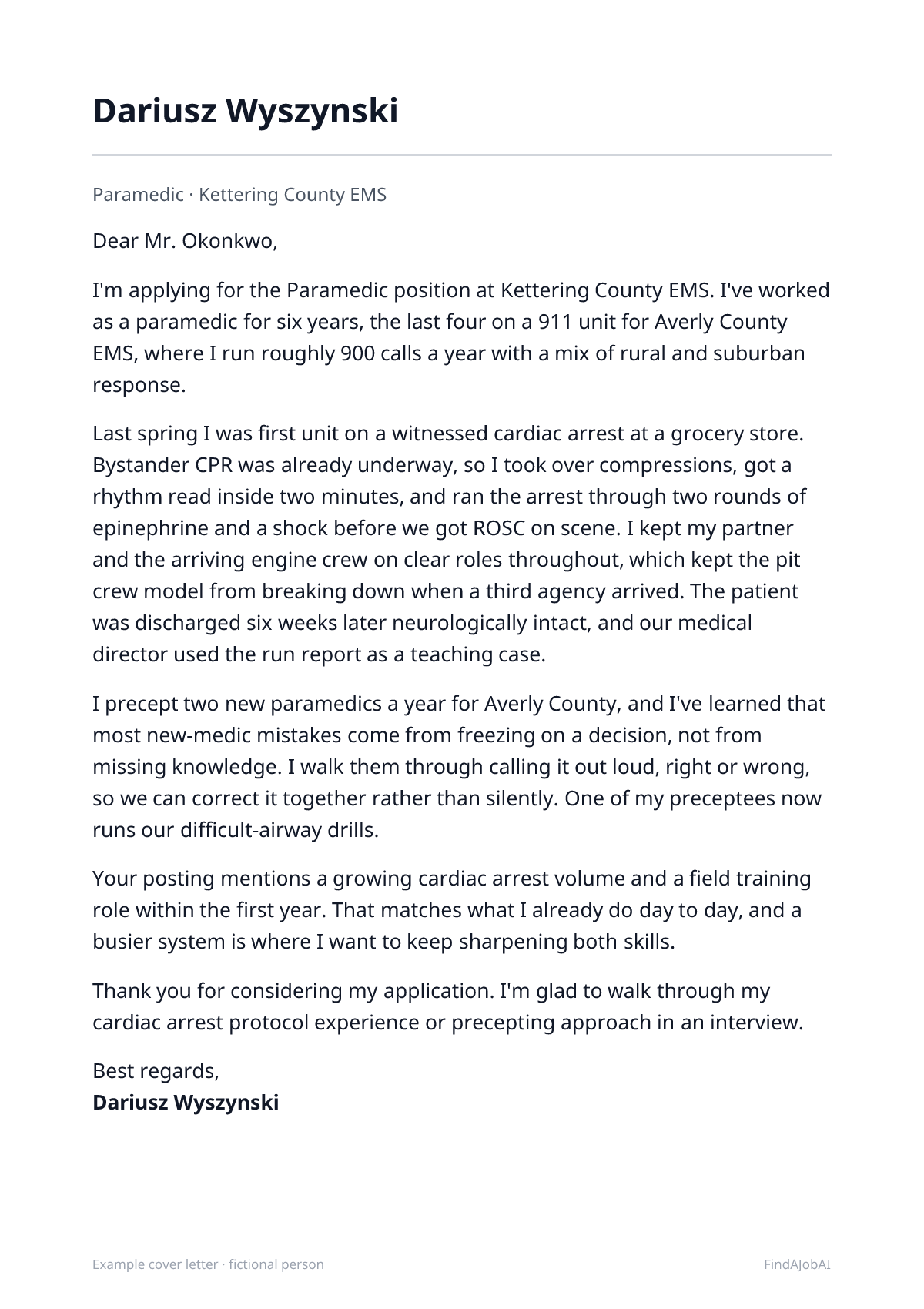
Paramedic cover letter template
This letter as a one-page template: an opening that names the job and your strongest fact, proof that answers the ad, a reason for this employer and a short close.
After you sign up, FindAJobAI drafts your own letter for a real job from your CV in this format, and you edit it before you send it.
Example 1 · Experienced
911 system paramedic applying to a busier county service
Dariusz runs a two-person unit on a mid-volume 911 contract. The ad asks for cardiac arrest and field leadership experience.
Example letter · fictional
Dear Mr. Okonkwo,
I'm applying for the Paramedic position at Kettering County EMS. I've worked as a paramedic for six years, the last four on a 911 unit for Averly County EMS, where I run roughly 900 calls a year with a mix of rural and suburban response.
Last spring I was first unit on a witnessed cardiac arrest at a grocery store. Bystander CPR was already underway, so I took over compressions, got a rhythm read inside two minutes, and ran the arrest through two rounds of epinephrine and a shock before we got ROSC on scene. I kept my partner and the arriving engine crew on clear roles throughout, which kept the pit crew model from breaking down when a third agency arrived. The patient was discharged six weeks later neurologically intact, and our medical director used the run report as a teaching case.
I precept two new paramedics a year for Averly County, and I've learned that most new-medic mistakes come from freezing on a decision, not from missing knowledge. I walk them through calling it out loud, right or wrong, so we can correct it together rather than silently. One of my preceptees now runs our difficult-airway drills.
Your posting mentions a growing cardiac arrest volume and a field training role within the first year. That matches what I already do day to day, and a busier system is where I want to keep sharpening both skills.
Thank you for considering my application. I'm glad to walk through my cardiac arrest protocol experience or precepting approach in an interview.
Best regards,
Dariusz Wyszynski
Example 2 · Career changer
EMT moving up to paramedic at a hospital-based service
Shantelle has run a BLS unit for three years and just finished paramedic school. The ad wants strong assessment skills on a hospital transport contract.
Example letter · fictional
Dear Hiring Manager,
I'm applying for the Paramedic position at Harrow Ridge Medical Transport. I've worked as an EMT-Basic for three years on a 911 and transfer contract, and I finished paramedic school and passed my National Registry exam last month.
As an EMT, I ran a BLS unit that handled a lot of inter-facility transfers, including patients on monitors and drips managed by the sending nurse. On one transfer, a patient's oxygen saturation dropped mid-route; I recognized a kinked nasal cannula line before assuming a worse cause, fixed it, and radioed the receiving facility with an accurate update instead of a false alarm. That habit of ruling out the simple explanation first is something my paramedic instructors said carried over well into my clinical rotations.
During ride time, I ran a full code as team lead under a preceptor's supervision, managed an asthma patient with escalating respiratory distress, and handled a diabetic emergency that turned out to be a stroke mimic, catching the facial droop my partner had missed. My preceptor signed off early on airway management and medication calculations.
Your posting emphasizes strong assessment on patients who are often already being managed by a nurse or physician. That's exactly the transfer work I already know, now with paramedic-level tools to back it up. I'm also comfortable giving a clear, short handoff report to the receiving nurse, which I practice on every transfer.
Thank you for your time. I can start as soon as my state paramedic license is issued, which I expect within two weeks.
Sincerely,
Shantelle Beaumont
Example 3 · Senior or lead
Flight paramedic lead applying to start a new air base
Yevgenia leads a flight crew at an established base. The ad is for a lead paramedic opening a new base with two aircraft.
Example letter · fictional
Dear Dr. Nkemelu,
I'm applying for the Lead Flight Paramedic role at Stillwater Air Medical. I've flown as a critical care flight paramedic for seven years, the last three as crew lead at a single-aircraft base for Tallgrass Air Rescue, and I'd like to help open your new base.
Your posting mentions standing up protocols and a training program for two new aircraft crews at once. At Tallgrass, I was part of the original three-person crew that opened our base, and I wrote our blood product administration protocol after our medical director identified a gap in trauma transport. I also built our monthly simulation schedule, rotating difficult airway, OB emergency and ECMO transport scenarios, which cut our average time-to-stable-vitals on post-arrest transports from eighteen minutes to twelve.
On the clinical side, I've run transports most ground crews can't, including a 34-week preterm delivery mid-flight where I delivered the infant and stabilized both patients before landing, and a prone ECMO transfer that required coordinating with two receiving hospitals on patient positioning. Both are now case studies in our new-hire training.
I haven't opened a two-aircraft base simultaneously or built a program from zero rather than three people. At Stillwater I'd expect to lean on your medical director and base manager early to sequence hiring, equipment, and protocol sign-off correctly. I'd also ask to review your current training records first.
I'd welcome a conversation about which protocols you want in place before the first flight, and how you're thinking about crew pairing for two new bases.
Sincerely,
Yevgenia Marchetti
All three letters, and the short version below, are fictional: the people, employers and numbers are invented. Borrow the structure, never the facts.
- Prefer to write it yourself? Use the free cover letter template.
- Check your CV against the job first: the free CV score shows the missing keywords.
Why the first letter works, paragraph by paragraph
Paragraph 1: Opening
States years as a paramedic, the current service, and a concrete call volume, which tells a reviewer how much live decision-making the writer actually carries.
Paragraph 2: The call that mattered
A specific cardiac arrest, the writer's actions under protocol, how a multi-agency scene stayed organized, and the patient outcome. Field leadership is shown, not claimed.
Paragraph 3: Teaching and team habits
Precepting new medics and naming a real habit (calling out decisions loud) shows judgment under pressure, the quality that separates a senior paramedic from someone who just has the certification.
Paragraph 4: Why this service
Matches the ad's stated need, a growing arrest volume and a training role, to experience already described above.
Paragraph 5: Close
Offers to discuss two specific things named in the letter, which gives the interviewer an easy next question.
What the career changer's letter does differently
The EMT-to-paramedic letter leans on transfer experience and one specific catch (a kinked cannula line, a missed facial droop) instead of a long resume, since the title is new. Naming that a preceptor signed off early on two skills stands in for work history the writer doesn't have yet, and the close removes any doubt about licensing timing.
What the senior letter does differently
The lead flight paramedic letter reports program-level work: writing a protocol, running a simulation schedule with a real time improvement, and two transports now used as training cases. It states plainly what's new about this role (two bases at once) and names who the writer would lean on, which reads as planning, not bravado.
Short paramedic cover letter: an email-ready version
Many applications arrive as an email or a small text box, and a full page doesn't fit. This version runs 120 to 150 words and keeps only what a reader needs to decide whether to reply. A paramedic applies to a combined fire-based EMS department using the department's short online form, which caps the cover note at a few sentences.
Short version · email · fictional131 words
Subject: Paramedic/Firefighter application – dual-role, cardiac arrest lead – Teodoro Villanueva
Hello Chief Okafor,
I'm applying for the Paramedic/Firefighter position at Brackenfield Fire-Rescue. I've spent five years as a paramedic on a fire-based 911 system, and I hold Firefighter II certification alongside my paramedic license.
Last year I led a cardiac arrest resuscitation on a residential fire scene while also assisting with scene safety for the engine crew, a dual-role situation your ad specifically mentions wanting experience with. The patient regained a pulse before transport, and our chief used the run as a training example for coordinating medical and fire operations on one scene.
I'm comfortable moving between fire suppression support and advanced patient care on the same call, and I'd like to bring that to a department that runs both functions together. My resume and certifications are attached.
Best,
Teodoro Villanueva
The short version keeps the one detail that matches a dual-role department exactly, a cardiac arrest run while supporting scene safety, and drops the teaching and precepting material that wouldn't fit. It still names both certifications up front since the role requires proof of both.
Opening lines that work for paramedic cover letters
The first sentence decides whether the second gets read. Here are six openings, one for each situation you might be in. Pick the one that matches yours and swap in your own facts: every name and number below is invented.
1. You have a standout result
Last month I led a cardiac arrest resuscitation that achieved ROSC on scene, coordinating two additional agencies as they arrived. I'd like to bring that kind of scene leadership to your 911 unit.
2. The ad names a problem you've solved
Your posting mentions a rising call volume with a small full-time medic roster. At my current service, I've helped train three new paramedics while still running a full shift schedule, and I can start contributing to a stretched team right away.
3. Someone referred you
Your EMS coordinator, Iolanthe Preciado, worked alongside me at a mutual-aid incident last year and suggested I apply, which is what brought this posting to my attention.
4. You admire what they build
I've watched your department's community CPR program grow over the past two years, and the way it's run made me want to work somewhere that treats prevention as part of the job, not an afterthought.
5. You're new to the field or switching into it
I spent four years as a wildland firefighter before becoming an EMT, then a paramedic, and I'm looking for a service where that fireground background is actually useful on scene.
6. You have senior scope or a specialism
As a flight paramedic who has helped open one base from scratch, I'm looking for a role where I can build training and protocols for a growing program rather than just fly shifts.
How to write a paramedic cover letter
Five steps, in the order you'd write them. The shape stays the same for every job (a short opening, proof, a reason for this employer, a close), and what goes into each part is what changes with the role.
Lead with the call, not the certification list
Your NREMT-P, ACLS, and PALS cards are already on your resume. Open instead with a specific call that shows what you did with those certifications under real conditions, so the reviewer sees judgment before they see an acronym.
Match your call volume and unit type to the ad
A rural single-medic unit, a busy urban 911 contract, and a hospital transfer service ask for different strengths. State your current unit type and rough call volume early, then pick a call example that fits the kind of work the ad describes.
Describe the outcome, carefully
Say what happened to the patient in general terms, such as regained a pulse or was discharged weeks later, without identifying details. An outcome shows the result of your actions and is more convincing than describing the actions alone.
Show how you work with a team or other agencies
Scenes often involve a partner, an engine crew, or a second agency. One sentence on how you kept roles clear or communicated under pressure shows field leadership, which many ads ask for separately from clinical skill.
Address licensing and start date directly
If you're newly certified or licensing in another state, say exactly where that process stands and when you expect to be clear to work. Removing that uncertainty for the reviewer often matters as much as the clinical content above it.
Paramedic cover letter do's and don'ts
Do
- Describe one call in enough detail that a medic reading it could picture the scene: presentation, your actions under protocol, and the outcome.
- Name your current call volume or unit type so the reviewer knows what kind of system you're used to.
- If you're new, use ride-time or precepted calls and say clearly what your preceptor signed off on.
Don't
- Don't write "works well under pressure"; a cardiac arrest or a multi-casualty scene described in two sentences proves it.
- Don't include a patient's identifying details; describe the presentation and your actions, not who they were.
- Don't list every certification card you hold; name the one or two the ad actually asks for.
Common paramedic cover letter mistakes
Each one is easy to make and quick to fix before you send the letter.
Listing certifications instead of a call
A row of acronyms (ACLS, PALS, NRP, ITLS) tells the reviewer what classes you took, not how you perform. Replace the list with one call where you used two of them, and let the certifications sit on your resume.
Putting identifying patient or call details in the letter
Names, addresses, or details that could identify a patient don't belong in a cover letter even in a fictional or anonymized form; describe the presentation and your actions instead, which is both safer and more useful to the reader.
Vague claims about working well under pressure
"I perform well in high-stress situations" is what every applicant writes. A two-sentence description of a chaotic scene and how you organized it shows the same thing without asking the reader to take your word for it.
Leaving licensing status unclear
If your license is pending, in another state, or about to expire, say so plainly with a timeline. An employer who has to guess will often move on to a candidate who didn't leave the question open.
Treating every call as equally worth mentioning
Not every transport needs a story. Pick the one or two calls that show the specific skill the ad asks about, such as cardiac arrest leadership or pediatric assessment, rather than summarizing a typical shift.
Email subject lines for paramedic applications
Applying by email? Put the job title, any reference number and your name in the subject line.
- Paramedic application – 911 system, cardiac arrest lead – Dariusz Wyszynski
- Paramedic – new NREMT-P, EMT transfer background – Shantelle Beaumont
- Application: Paramedic, Station 14 (Req. 2290) – Dariusz Wyszynski
Everything for Paramedics
- Paramedic resume exampleA full resume, plus bullet and summary examples
- Paramedic job descriptionDuties, skills and requirements
- Career change cover letter: template + examples
Other cover letter examples
Paramedic cover letter FAQ
What should a paramedic cover letter focus on?
One call that shows your decision-making under protocol: what you found, what you did, and the outcome. Add your call volume or unit type, then a sentence on how you handle teaching or working with other agencies on scene.
How do I write a paramedic cover letter with no paid experience yet?
Use ride-time or precepted calls from clinical rotations, name what your preceptor signed off on, and state your licensing or certification timeline clearly so the employer knows when you can start.
Should I describe patient outcomes in a paramedic cover letter?
Yes, in general terms without identifying details. An outcome, such as a patient discharged neurologically intact, shows the result of your actions, not just the actions themselves.
How we built this page
The FindAJobAI team wrote the three example letters, the short email version, the opening lines and the advice for paramedic roles. The people, employers and numbers in the letters are invented; the structure, the kind of evidence and the order of the paragraphs are the parts to copy.
Once we track enough live paramedic job ads, this page also shows the skills they ask for most, counted the same way as our in-demand skills report.
Last reviewed on November 1, 2026.