Petroleum Engineer Cover Letter Example (2026)
By FindAJobAI Team Updated How we built this page
Operators and service companies hire petroleum engineers to move a number: barrels a day, lifting cost, days per well or reserves booked. A strong petroleum engineer cover letter picks one well program or project, explains the engineering decision behind it and gives the result in the units the hiring manager already tracks, then connects that experience to the basin or asset in the ad.
Petroleum Engineer cover letter template
This letter as a one-page template: an opening that names the job and your strongest fact, proof that answers the ad, a reason for this employer and a short close.
After you sign up, FindAJobAI drafts your own letter for a real job from your CV in this format, and you edit it before you send it.
Example 1 · Experienced
Production engineer applying to a Delaware Basin operator
Rosalind runs artificial lift for 140 Midland Basin wells. The ad asks for lift optimization, surveillance and workover planning.
Example letter · fictional
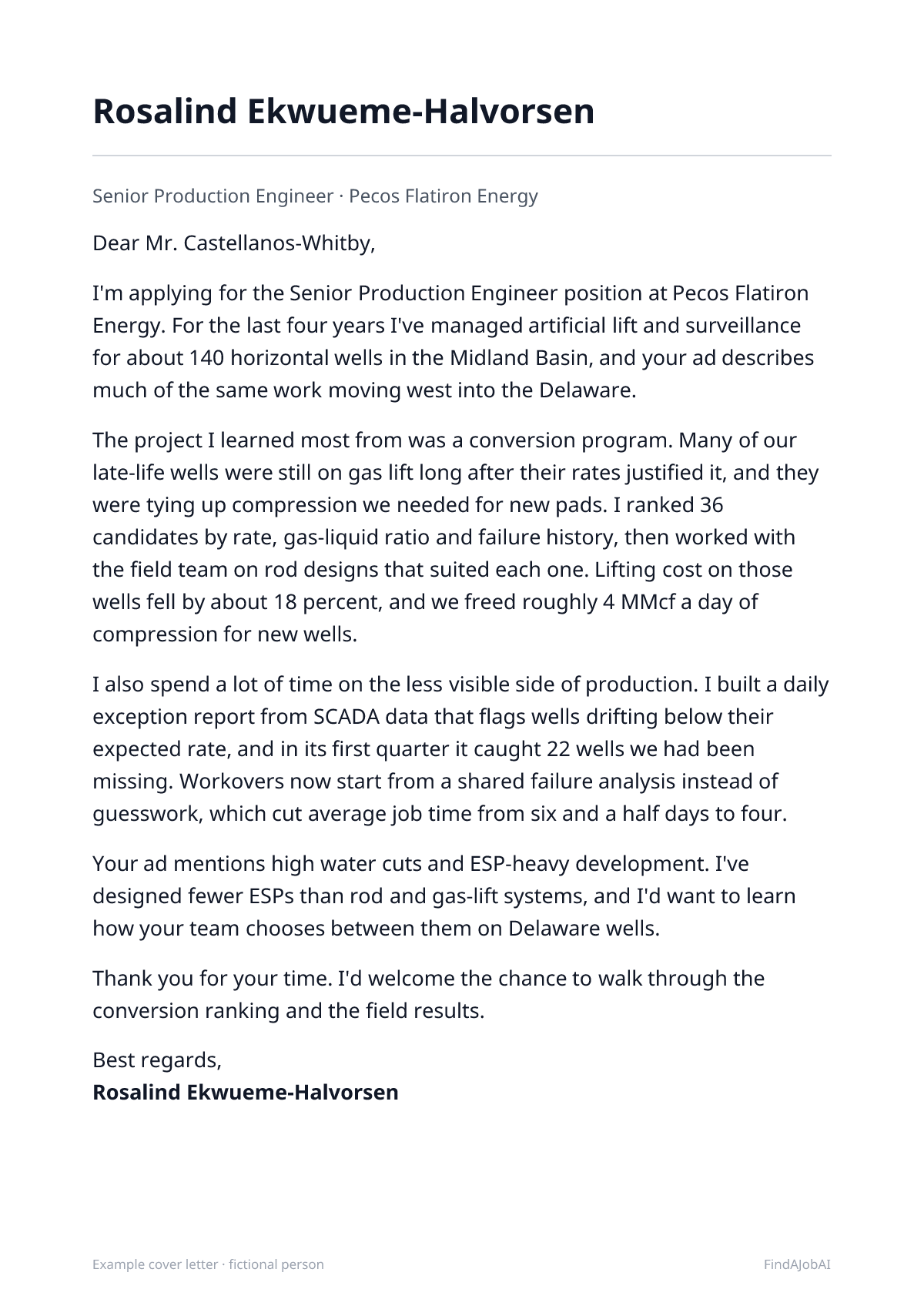
Dear Mr. Castellanos-Whitby,
I'm applying for the Senior Production Engineer position at Pecos Flatiron Energy. For the last four years I've managed artificial lift and surveillance for about 140 horizontal wells in the Midland Basin, and your ad describes much of the same work moving west into the Delaware.
The project I learned most from was a conversion program. Many of our late-life wells were still on gas lift long after their rates justified it, and they were tying up compression we needed for new pads. I ranked 36 candidates by rate, gas-liquid ratio and failure history, then worked with the field team on rod designs that suited each one. Lifting cost on those wells fell by about 18 percent, and we freed roughly 4 MMcf a day of compression for new wells.
I also spend a lot of time on the less visible side of production. I built a daily exception report from SCADA data that flags wells drifting below their expected rate, and in its first quarter it caught 22 wells we had been missing. Workovers now start from a shared failure analysis instead of guesswork, which cut average job time from six and a half days to four.
Your ad mentions high water cuts and ESP-heavy development. I've designed fewer ESPs than rod and gas-lift systems, and I'd want to learn how your team chooses between them on Delaware wells.
Thank you for your time. I'd welcome the chance to walk through the conversion ranking and the field results.
Best regards,
Rosalind Ekwueme-Halvorsen
Example 2 · Career changer
Mechanical engineer moving into oilfield completions
Joaquin designs pumps at an industrial manufacturer and has supported frac fleet equipment. The ad is for an entry completions engineer role.
Example letter · fictional
Dear Hardpan Ridge Engineering Team,
I'm writing about the Completions Engineer I opening at Hardpan Ridge Operating. I'm a mechanical engineer with five years at a pump manufacturer, and for the last two I've worked directly with pressure pumping fleets that use our high-pressure fluid ends.
That work pulled me toward the oilfield. Fleet managers kept sending us cracked fluid ends, and our first answer was always a material change. I asked to visit three frac sites to see how the pumps were actually run. The pattern was clear once I saw it: failures clustered on stages with long periods at maximum rate and pressure. I worked with one fleet to change how pumps were rotated during those stages, and their fluid-end replacements dropped by about a third over the next six months.
Since then I've completed an online petroleum engineering certificate covering well completions, reservoir basics and economics, and I passed the SafeLand course. I also spent two weeks shadowing a completions engineer for one of our customers, sitting in on stage design and pressure reviews.
Your ad asks for someone who can read treating pressure charts and work closely with service crews. I already know how the equipment behaves under load and what crews need from engineers, and I want to learn stage design from the operator side, where the decisions about rate, fluid and spacing are actually made.
I'd be glad to share the fluid-end failure study and talk about how it changed my view of completions work.
Kind regards,
Joaquin Raszewski-Obi
Example 3 · Senior or lead
Senior reservoir engineer applying to lead an enhanced recovery team
Philippa leads waterflood planning at a Permian operator. The ad is for a reservoir engineering lead to grow a CO2 flood.
Example letter · fictional
Dear Dr. Abernathy-Osei,
I'm applying for the Reservoir Engineering Lead role at Caprock Juniper Petroleum. I've spent fifteen years in reservoir work on the Gulf of Mexico shelf and in the Permian, and for the last six I've led a team of five engineers on two mature waterfloods.
Your ad says the CO2 flood has reached the point where expansion needs a stronger case. I've been through that exact step. Our first pilot looked good on paper, but the response was uneven, and management was not ready to fund more patterns. Instead of arguing from the best wells, we went back and mapped injection conformance pattern by pattern, then rebuilt the simulation model around the zones that actually took CO2. The revised nine-pattern pilot raised oil rate by about a quarter in its first year and gave the board a case it could approve.
I also own year-end reserves for the asset, and our differences with the third-party auditor have stayed small for five years. I think that discipline matters as much as the flood design, because expansion money depends on numbers people trust. When the board asks how confident we are, I want the answer to rest on history it has already seen hold up.
Most of my CO2 experience is on carbonate floods, and I'd expect your sandstone reservoir to behave differently in sweep and breakthrough. I would spend my first weeks with your surveillance data before proposing any change.
I'd like to hear where your flood stands today and what the last expansion review asked for.
Sincerely,
Philippa Mbatha-Kowalczyk
All three letters, and the short version below, are fictional: the people, employers and numbers are invented. Borrow the structure, never the facts.
- Prefer to write it yourself? Use the free cover letter template.
- Check your CV against the job first: the free CV score shows the missing keywords.
Why the first letter works, paragraph by paragraph
Paragraph 1: Opening
States the job, the size of the well count and the basin, which tells an operator in a nearby basin that the writer can start fast.
Paragraph 2: The conversion program
One project with a clear reason, a ranking method, a cost result and a capacity gain. That is the evidence a production manager actually weighs.
Paragraph 3: Surveillance and workovers
Shows daily habits, such as an exception report and failure analysis, which matter more over time than one big project.
Paragraph 4: Honest gap
Admitting less ESP experience while asking how the team chooses lift types reads as confident and curious rather than weak.
Paragraph 5: Close
Offers a specific conversation about the ranking and results, so the interviewer has an obvious first question.
What the career changer's letter does differently
The career changer's letter turns pump design into completions knowledge by telling one field story: site visits, a pattern in the failures and a measured drop in replacements. The certificate, SafeLand and shadowing show deliberate preparation, and the close names exactly what he wants to learn.
What the senior letter does differently
A senior letter talks about method and trust: a pilot that disappointed, a better way to read the data, and reserves discipline that gives management confidence. The honest note about carbonate versus sandstone shows judgment about where her experience transfers.
Short petroleum engineer cover letter: an email-ready version
Many applications arrive as an email or a small text box, and a full page doesn't fit. This version runs 120 to 150 words and keeps only what a reader needs to decide whether to reply. A completions engineer replies to an operations manager at a small private operator who posted the role in an industry group with an email address.
Short version · email · fictional120 words
Subject: Completions Engineer – Eagle Ford pad design and frac supervision – Leopold Adeyemi-Strand
Hi Ms. Thibodeaux,
I saw your post for a completions engineer at Ironweed Basin Partners. I've spent five years designing and supervising frac jobs in the Eagle Ford, most recently on four-well pads for a mid-size operator.
Last year I planned a zipper-frac pad of 168 stages that finished three days early with no recordable incidents. I also ran a proppant loading trial on nine wells that let us cut sand volume on later pads without losing six-month production.
Your post mentions a small team that needs one engineer to cover design and field supervision. That matches how I've worked for the last two years. My resume is attached, and I can talk any weekday this week.
Thanks,
Leopold Adeyemi-Strand
The short email keeps two results with clear figures and links them directly to the manager's stated need for one engineer who designs and supervises, which is all a busy operations manager needs to reply.
Opening lines that work for petroleum engineer cover letters
The first sentence decides whether the second gets read. Here are six openings, one for each situation you might be in. Pick the one that matches yours and swap in your own facts: every name and number below is invented.
1. You have a standout result
Last year I led a lift conversion program on 36 Midland Basin wells that cut lifting cost by about 18 percent. I'd like to bring that work to your Delaware asset.
2. The ad names a problem you've solved
Your ad says your waterflood response has flattened. I rebalanced injection on a similar flood and raised oil rate within five months without drilling a new well.
3. Someone referred you
Your drilling superintendent, Callum Ferreira-Nakamura, and I worked the same rig program for two years. He told me your team needs a completions engineer who likes field work, which is why I'm writing.
4. You admire what they build
I've followed your company's SPE papers on long-lateral completions, and I used your published stage-spacing approach on a pad of my own last spring.
5. You're new to the field or switching into it
After five years designing high-pressure pumps for frac fleets, I want to move to the operator side and design the completions those pumps serve.
6. You have senior scope or a specialism
I've led reservoir planning for two mature waterfloods and a CO2 pilot, and I'm looking to guide an enhanced recovery expansion from its first review.
How to write a petroleum engineer cover letter
Five steps, in the order you'd write them. The shape stays the same for every job (a short opening, proof, a reason for this employer, a close), and what goes into each part is what changes with the role.
Match your discipline to the role
Petroleum engineering covers drilling, completions, production and reservoir work, and each ad leans toward one. Say which you practice in the first paragraph, along with the basin or field you know, so the reader can place you at once.
Tell one well or field story
Choose a project with a clear problem, such as rising failures, a flattening decline or high cost per foot. Explain how you analyzed it and what you changed, in two or three sentences a manager can follow without a model in front of them.
Report results in operator units
Use the numbers the hiring manager already tracks: barrels or BOE a day, lifting cost per barrel, days from spud to release, run life or reserves booked. Give the period and the baseline so the figure holds up when someone asks about it.
Show you can work on location
Add a sentence about field rotations, rig or frac supervision, workovers or safety training. Operators want engineers who understand how crews work and who will make sound calls when a job does not go to plan.
Close on their asset
Name one feature of the company's wells or reservoir from the ad, such as high water cut or long laterals, and say what you would want to learn about it first. This gives the reader a natural question to open the interview.
Petroleum Engineer cover letter do's and don'ts
Do
- Pick one well program, give the engineering reason and report the result in barrels, days or dollars.
- Name the basin, formation or lift type so the reader can map your experience onto their asset.
- Mention field time and safety, since most petroleum roles involve work on location.
Don't
- Don't list every software package; keep the one that matters to your main story.
- Don't claim production gains without saying over what period and against what baseline.
- Don't hide a gap in a discipline the ad stresses; name it and show how you would close it.
Common petroleum engineer cover letter mistakes
Each one is easy to make and quick to fix before you send the letter.
Writing about the industry instead of your wells
Paragraphs on energy demand or price cycles take space without showing skill. Spend those lines on one project and its measured result.
Vague production claims
Saying output improved invites doubt. Give the barrels a day, the number of wells and the months it took, and say how you measured it.
Mixing disciplines without focus
Listing drilling, completions and reservoir equally makes it hard to place you. Lead with the discipline the ad wants and mention the others briefly.
Leaving safety out of the letter
Field roles screen for safety habits. One line on incident-free work, training or a stop-work decision shows you take it seriously.
A software list in place of a story
Package names belong on the resume. In the letter, mention the one tool that made your main result possible and what it showed you.
Email subject lines for petroleum engineer applications
Applying by email? Put the job title, any reference number and your name in the subject line.
- Senior Production Engineer – Midland Basin lift and surveillance – Rosalind Ekwueme-Halvorsen
- Completions Engineer I – mechanical engineer with frac fleet experience – Joaquin Raszewski-Obi
- Application: Reservoir Engineering Lead (Req. 2208) – Waterflood and CO2 EOR
Everything for Petroleum Engineers
- Petroleum Engineer resume exampleA full resume, plus bullet and summary examples
- Petroleum Engineer interview questions30 questions with sample answers
- Petroleum Engineer job descriptionDuties, skills and requirements
- Career change cover letter: template + examples
Other cover letter examples
Petroleum Engineer cover letter FAQ
What should I write in a petroleum engineer cover letter?
Choose one project, such as a lift conversion, completion design or reserves study. Explain the problem, the method and the result in units the operator tracks, then add one line on field or safety experience and tie it to the basin in the ad.
How do I write a petroleum engineer cover letter with no oilfield experience?
Use related engineering work, such as pump, pipeline or process design, and show how it connects to wells. Add any petroleum coursework, field visits or safety training, and say clearly which part of the job you are ready to learn.
Should I mention oil prices in a petroleum engineer cover letter?
Only if it explains your story, for example cutting lifting cost during a downturn. Avoid general market commentary; hiring managers care about how you handled wells and budgets, not your price forecast.
How we built this page
The FindAJobAI team wrote the three example letters, the short email version, the opening lines and the advice for petroleum engineer roles. The people, employers and numbers in the letters are invented; the structure, the kind of evidence and the order of the paragraphs are the parts to copy.
Once we track enough live petroleum engineer job ads, this page also shows the skills they ask for most, counted the same way as our in-demand skills report.
Last reviewed on November 1, 2026.