Research Analyst Cover Letter Example (2026)
By FindAJobAI team Updated How we built this page
Research analyst ads ask for the same handful of skills, data gathering, modeling or synthesis, and clear writing, so most cover letters sound interchangeable. Name the question your research answered, how you found the answer when the obvious sources didn't have it, and who acted on what you found.
Research Analyst cover letter template
This letter as a one-page template: an opening that names the job and your strongest fact, proof that answers the ad, a reason for this employer and a short close.
After you sign up, FindAJobAI drafts your own letter for a real job from your CV in this format, and you edit it before you send it.
Example 1 · Experienced
Equity research associate applying to a mid-cap focused fund
Aaron covers industrials for a sell-side research team. The ad wants an associate who can build models and write client-ready notes independently.
Example letter · fictional
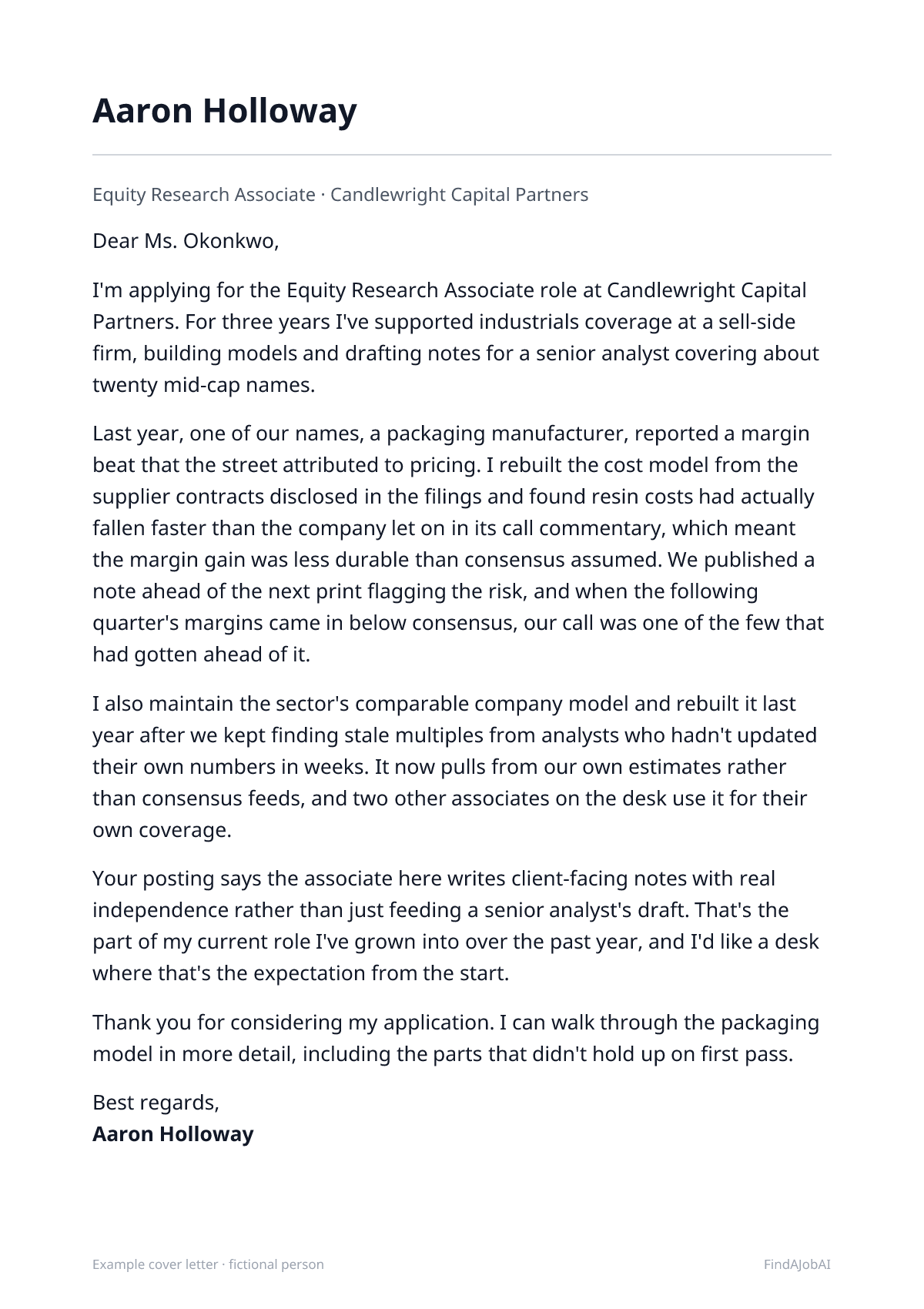
Dear Ms. Okonkwo,
I'm applying for the Equity Research Associate role at Candlewright Capital Partners. For three years I've supported industrials coverage at a sell-side firm, building models and drafting notes for a senior analyst covering about twenty mid-cap names.
Last year, one of our names, a packaging manufacturer, reported a margin beat that the street attributed to pricing. I rebuilt the cost model from the supplier contracts disclosed in the filings and found resin costs had actually fallen faster than the company let on in its call commentary, which meant the margin gain was less durable than consensus assumed. We published a note ahead of the next print flagging the risk, and when the following quarter's margins came in below consensus, our call was one of the few that had gotten ahead of it.
I also maintain the sector's comparable company model and rebuilt it last year after we kept finding stale multiples from analysts who hadn't updated their own numbers in weeks. It now pulls from our own estimates rather than consensus feeds, and two other associates on the desk use it for their own coverage.
Your posting says the associate here writes client-facing notes with real independence rather than just feeding a senior analyst's draft. That's the part of my current role I've grown into over the past year, and I'd like a desk where that's the expectation from the start.
Thank you for considering my application. I can walk through the packaging model in more detail, including the parts that didn't hold up on first pass.
Best regards,
Aaron Holloway
Example 2 · Career changer
Business journalist moving into research analysis
Naledi spent six years reporting on retail earnings and checking company claims in spreadsheets. The ad is for a junior research analyst at an asset manager.
Example letter · fictional
Dear Hiring Manager,
I'm applying for the Junior Research Analyst role at Birchfen Asset Management. For six years I've covered retail earnings as a business reporter, and the part of that job I was best at, checking a company's numbers against what it actually told investors, is the work I'd like to do full time now.
Two years ago, a retailer I covered claimed same-store sales growth that didn't match the foot traffic data I'd been tracking from a third-party vendor for a separate story. I built a spreadsheet comparing their reported growth against foot traffic and average ticket size across eight quarters, found the gap was being driven by a change in how they counted online order pickups as store visits, and published a piece on it. Two sell-side analysts cited the discrepancy in their own notes the following week.
Since then I've completed a financial modeling course and built three valuation models on public companies as a portfolio, including a discounted cash flow model on a grocery chain that I stress-tested against three different margin scenarios. I'm comfortable in Excel and have started learning Python for pulling and cleaning larger datasets.
Reporting trained me to find the number that contradicts the official story and to write it so a reader who isn't an expert still understands why it matters. I think that combination, skepticism plus clear writing, is useful on a research desk, even without a finance title behind my name yet.
Thank you for your time. My portfolio models are linked on my resume, and I'd welcome the chance to discuss them.
Sincerely,
Naledi Mahlangu
Example 3 · Senior or lead
Research director applying to build out a new sector team
Avery leads a four-analyst consumer research team. The ad is for a director to build a new industrials research team from two junior hires.
Example letter · fictional
Dear Mr. Lindqvist,
I'm applying for the Director of Research role at Ashgrove Capital Management. I've led a four-analyst consumer research team at Farrowmere Investments for the past three years, after seven years as a senior analyst, and I'd like to build the industrials team you're describing from its first two hires.
Your ad mentions that research output today is inconsistent, some analysts write deep single-name notes, others produce thin sector overviews, with no shared standard. I inherited a similar gap at Farrowmere: four analysts, four different note formats, and a portfolio manager who complained he couldn't compare conviction levels across names. I built a one-page thesis template requiring a stated catalyst, a variant view from consensus, and a named risk to the call, and required it on every initiated name. Within a year, the PM told me he could finally rank conviction across the team's names at a glance, and two analysts who previously wrote vague overviews were producing some of the sharpest notes on the desk.
The call that mattered most during my time there was a specialty retailer the team had rated a buy on store growth alone. I pushed the covering analyst to model unit economics store by store rather than in aggregate, which surfaced that a third of the growth was coming from a store format already underperforming in its oldest markets. We downgraded two months before the stock fell on a guidance cut, ahead of most of the sell side.
I haven't built a sector team from a two-person base before; at Farrowmere I inherited an existing team and reshaped its standards rather than hiring from scratch. I'd want to understand your view on how quickly you want initiated coverage versus how much time you want spent on hiring and training in the first two quarters.
I'd welcome a conversation about your current coverage gaps in industrials and what you'd want the first initiated name to be.
Sincerely,
Avery Archer
All three letters, and the short version below, are fictional: the people, employers and numbers are invented. Borrow the structure, never the facts.
- Prefer to write it yourself? Use the free cover letter template.
- Check your CV against the job first: the free CV score shows the missing keywords.
Why the first letter works, paragraph by paragraph
Paragraph 1: Opening
States the sector covered, the team structure, and the number of names supported, so the reader immediately places the writer's level and scope.
Paragraph 2: The research that changed a call
Names the question (was the margin beat durable), the method (rebuilding the cost model from primary disclosures), the finding, and the outcome measured against what the street actually did next quarter.
Paragraph 3: A tool the rest of the team relies on
Rebuilding a shared comparable model that other associates now use is a concrete sign of initiative and technical skill beyond covering one's own names.
Paragraph 4: Why this desk
Responds directly to the ad's stated expectation, independent client-facing writing, with evidence the writer has already been moving toward that.
Paragraph 5: Close
Offers a specific next step, walking through the model including where it was wrong at first, which signals intellectual honesty rather than a polished pitch.
What the career changer's letter does differently
The career changer's letter is built from a reporting habit, checking a company's claims against outside data, applied to a real discrepancy with a measurable outcome (two analysts citing her finding). Course completion and a three-model portfolio make the technical skills concrete, and the letter names the specific combination, skepticism and clear writing, the desk would be getting instead of apologizing for the missing title.
What the senior letter does differently
A research director letter reports what the writer built across a team's standards, not one analyst's coverage: a shared thesis template, a measured change in how a PM compares conviction, two analysts whose output improved under the new standard. The downgrade example shows judgment applied through someone else's coverage, and the gap, building a team from scratch rather than reshaping one, is named directly.
Short research analyst cover letter: an email-ready version
Many applications arrive as an email or a small text box, and a full page doesn't fit. This version runs 120 to 150 words and keeps only what a reader needs to decide whether to reply. A research analyst answers a boutique asset manager's short online application form after seeing the posting on a job board.
Short version · email · fictional131 words
Subject: Research Analyst application – healthcare coverage – Edvin Castellan
Hello Ms. Farraday,
I'm applying for the Research Analyst role at Thornquist Capital. I have four years covering mid-cap healthcare names at a long-only fund, building models and drafting initiation notes for our portfolio manager.
Last year I flagged a medical device maker's inventory buildup, visible in the filings two quarters before the street noticed, as a sign of slowing demand rather than restocking. We trimmed the position before a guidance cut, avoiding a decline of roughly 18 percent that hit holders who stayed in.
I'd like to bring that same attention to filings to your healthcare coverage. My resume is attached, and I'm glad to discuss the inventory analysis by phone. I can also send a short note on how I read the inventory and receivables lines.
Best,
Edvin Castellan
A short application form rewards one checkable claim over several vague ones, so this version keeps the inventory call and its concrete outcome, a position trimmed ahead of a guidance cut, instead of summarizing four years of general coverage.
Opening lines that work for research analyst cover letters
The first sentence decides whether the second gets read. Here are six openings, one for each situation you might be in. Pick the one that matches yours and swap in your own facts: every name and number below is invented.
1. You have a standout result
An inventory buildup I flagged in a medical device maker's filings last year led our fund to trim the position two quarters before a guidance cut, avoiding a decline of roughly 18 percent. I'd like to bring that same attention to detail to your healthcare coverage.
2. The ad names a problem you've solved
Your ad says analysts here cover twice as many names as a typical sell-side seat. I've worked at that pace for two years and have learned which parts of a name deserve deep modeling and which deserve a lighter touch.
3. Someone referred you
Your senior analyst, Haakon Lindvik, and I worked together on an industry panel last year. He mentioned you're looking for someone who can write independently without heavy editing, which is why I'm writing.
4. You admire what they build
I've followed your fund's public commentary on consumer names for two years as an outside reader, and a call you made on a grocery chain last year prompted this application.
5. You're new to the field or switching into it
I spent six years as a business reporter checking companies' numbers against outside data before I started building valuation models of my own. Research analysis is where I'd like to keep doing that work.
6. You have senior scope or a specialism
As the senior analyst behind eleven initiated names and a template the rest of my desk now uses, I'm looking for a seat where I help set research standards rather than just follow them.
How to write a research analyst cover letter
Five steps, in the order you'd write them. The shape stays the same for every job (a short opening, proof, a reason for this employer, a close), and what goes into each part is what changes with the role.
Identify the sector and seniority the ad wants
Research ads vary by sector, equity, credit, macro, or sector-specific like healthcare or industrials, and by how independently the analyst is expected to write. Read for both, then choose a project in a similar sector or at a similar level of independence to open with.
Open with the question your research answered
State what the market or your team assumed, and what you found that was different, in one or two sentences before naming your tools. A reader who sees a real variant view in your first paragraph keeps reading past the resume-restating opener.
Show your method, especially when the obvious source was wrong
Describe where you actually found the answer, a supplier contract, a foot traffic dataset, a store-by-store model, when the company's own disclosures or the consensus view didn't hold up. This is what separates research from repeating a press release.
Tie the finding to an outcome someone acted on
A call that changed a position, a note that got cited, a model other analysts now use. If you can't share the exact financial outcome due to confidentiality, describe the decision that followed in specific but non-material terms.
Name your tools inside the research, not as a list
Excel, Bloomberg, FactSet, or a coding language earn more credibility attached to what you built with them, such as a cost model or a comparable company screen, than listed on their own at the end of a paragraph.
Research Analyst cover letter do's and don'ts
Do
- Name the specific question you investigated and how you found the answer when the obvious source didn't have it.
- Mention the tools the ad names, Excel, Bloomberg, FactSet or Python, inside the story of one piece of research.
- State who used your finding and what they did differently: a call that changed, a note that got cited, a decision that moved.
Don't
- Don't claim a stock call's outcome without noting it was one view among several; overstating a track record is checkable.
- Don't share material nonpublic information or anything under embargo from a current employer, even as an example.
- Don't write "strong analytical skills" as a standalone claim; show the analysis instead and let the skill speak for itself.
Common research analyst cover letter mistakes
Each one is easy to make and quick to fix before you send the letter.
Restating consensus instead of a variant view
Summarizing what the market already believes about a name shows you can read, not that you can research. Name the one place your view diverged from consensus and why, even if the call was eventually wrong.
Overstating a call's track record
Claiming a prediction was certain or unanimous is checkable and easy to doubt. Note that the call was one view among several and describe the actual outcome plainly, which reads as more credible, not less.
Citing a stat with no source or period
'Grew same-store sales analysis accuracy by a wide margin' means nothing without the baseline, the period, and the method. Give the comparison you ran, the data behind it, and what changed because of it.
Sharing confidential or embargoed information
Using a current employer's unpublished research or nonpublic client data as an example, even anonymized, can create real problems. Describe the type of analysis and an approximate, non-material outcome instead.
Listing data sources with no analysis attached
Naming Bloomberg, FactSet, and three data vendors in a row says you have access, not that you know what to do with it. Attach each tool to the specific question it helped you answer.
Email subject lines for research analyst applications
Applying by email? Put the job title, any reference number and your name in the subject line.
- Equity Research Associate application – industrials coverage – Aaron Holloway
- Junior Research Analyst – business reporter with modeling portfolio – Naledi Mahlangu
- Application: Research Analyst, Consumer Sector (Req. 2041) – Aaron Holloway
Everything for Research Analysts
- Research Analyst resume exampleA full resume, plus bullet and summary examples
- Research Analyst interview questions30 questions with sample answers
- Research Analyst job descriptionDuties, skills and requirements
- Career change cover letter: template + examples
Other cover letter examples
Research Analyst cover letter FAQ
What should I write in a research analyst cover letter?
One piece of research that changed a call or decision: the question, how you found the answer, and what happened once someone acted on it. Then a sentence on a tool or model you built that others on the team now rely on.
How do I write a research analyst cover letter with no finance experience?
Use analytical work from another field, journalism, consulting, or a technical role, where you checked a claim against outside data, add a modeling course and a small portfolio, and name the specific skill combination you'd bring instead of apologizing for the missing title.
Should I mention a specific stock call or prediction?
Yes, if you can describe it honestly, including that it was one view among several and what the actual outcome was. A verifiable, modest claim is more convincing than an overstated track record.
What tools should a research analyst cover letter mention?
Whatever the ad names, often Excel, Bloomberg, FactSet, or a coding language for larger datasets, but only inside the story of a specific analysis, not as a standalone list.
How we built this page
The FindAJobAI team wrote the three example letters, the short email version, the opening lines and the advice for research analyst roles. The people, employers and numbers in the letters are invented; the structure, the kind of evidence and the order of the paragraphs are the parts to copy.
Once we track enough live research analyst job ads, this page also shows the skills they ask for most, counted the same way as our in-demand skills report.
Last reviewed on November 1, 2026.