Surgical Technologist Cover Letter Example (2026)
By FindAJobAI team Updated How we built this page
Surgical technologist ads list the same certifications and case types, so most letters sound interchangeable. Yours reads differently when it names a specific case, what you anticipated before the surgeon asked, and how the room ran because of it.
Surgical Technologist cover letter template
This letter as a one-page template: an opening that names the job and your strongest fact, proof that answers the ad, a reason for this employer and a short close.
After you sign up, FindAJobAI drafts your own letter for a real job from your CV in this format, and you edit it before you send it.
Example 1 · Experienced
Orthopedic OR tech applying to a surgery center
Tomasz scrubs in on joint replacement cases at a hospital. The ad wants a tech experienced with total joint trays and quick turnover.
Example letter · fictional
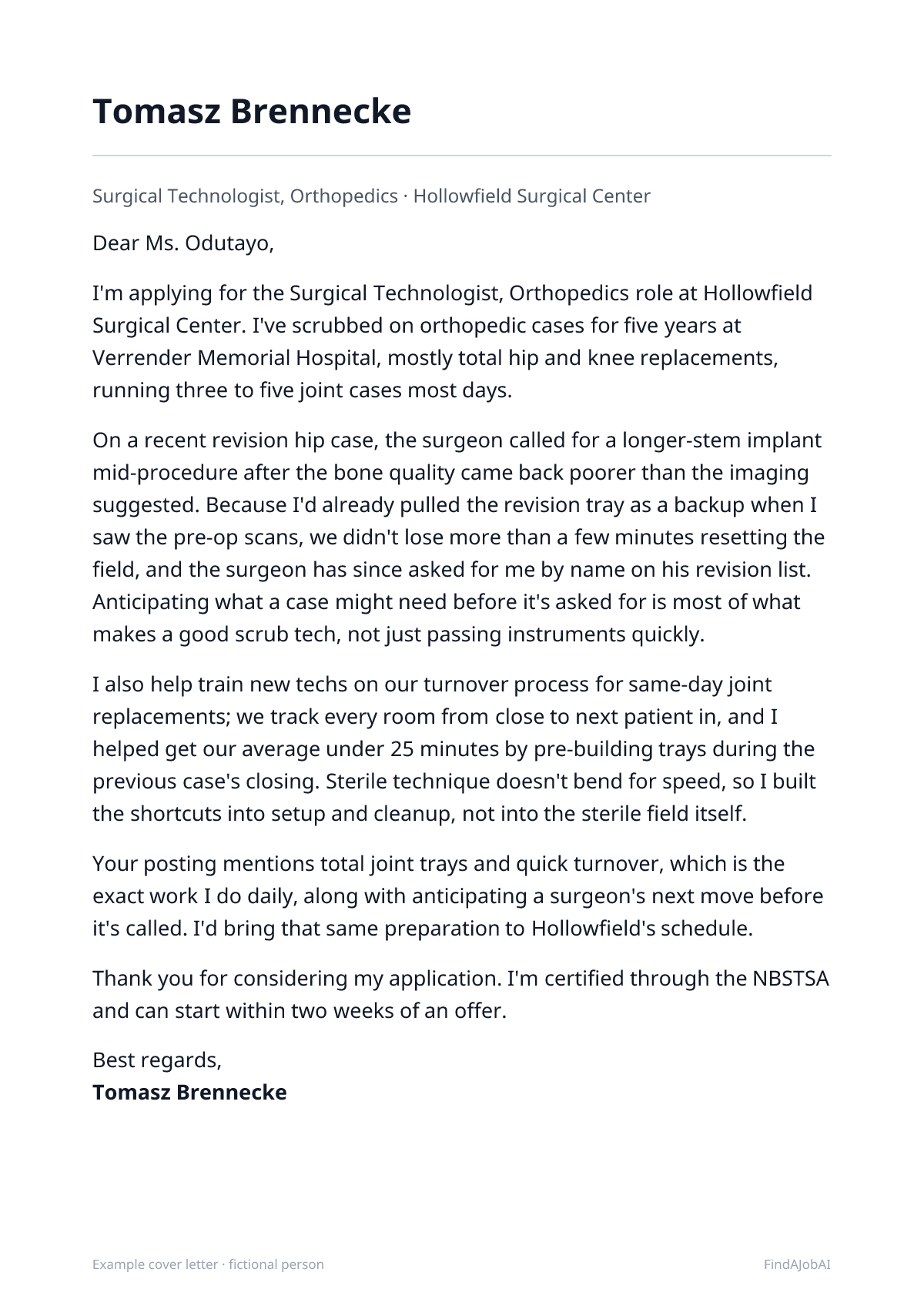
Dear Ms. Odutayo,
I'm applying for the Surgical Technologist, Orthopedics role at Hollowfield Surgical Center. I've scrubbed on orthopedic cases for five years at Verrender Memorial Hospital, mostly total hip and knee replacements, running three to five joint cases most days.
On a recent revision hip case, the surgeon called for a longer-stem implant mid-procedure after the bone quality came back poorer than the imaging suggested. Because I'd already pulled the revision tray as a backup when I saw the pre-op scans, we didn't lose more than a few minutes resetting the field, and the surgeon has since asked for me by name on his revision list. Anticipating what a case might need before it's asked for is most of what makes a good scrub tech, not just passing instruments quickly.
I also help train new techs on our turnover process for same-day joint replacements; we track every room from close to next patient in, and I helped get our average under 25 minutes by pre-building trays during the previous case's closing. Sterile technique doesn't bend for speed, so I built the shortcuts into setup and cleanup, not into the sterile field itself.
Your posting mentions total joint trays and quick turnover, which is the exact work I do daily, along with anticipating a surgeon's next move before it's called. I'd bring that same preparation to Hollowfield's schedule.
Thank you for considering my application. I'm certified through the NBSTSA and can start within two weeks of an offer.
Best regards,
Tomasz Brennecke
Example 2 · Career changer
CNA moving into surgical technology after completing a tech program
Adaeze worked as a CNA and finished an accredited surgical tech program. The ad lists general surgery as the primary case load.
Example letter · fictional
Dear Hiring Manager,
I'm applying for the Surgical Technologist role at Birchcrest Regional Hospital. For three years I worked as a certified nursing assistant on a surgical floor at Thornbury Medical Center, and I recently completed an accredited surgical technology program with clinical rotations in general and gynecologic surgery.
Working post-op gave me an unusual head start: I saw which complications came from poor positioning or missed counts long before I ever scrubbed in myself, which made the sterile technique and counting procedures in my program feel familiar rather than new. During my clinical rotation I scrubbed on 40 cases, including appendectomies, gallbladder removals and hernia repairs, and my clinical instructor noted I caught a miscount on a laparotomy sponge count before closing, which the circulating nurse confirmed and corrected.
I'm certified in Basic Life Support and currently sitting for my Certified Surgical Technologist exam through the NBSTSA, with results expected within a few weeks. I know instrument trays for general surgery, laparoscopic procedures and basic orthopedic sets from both my clinical rotations and the equipment I handled as a CNA.
Your posting lists general surgery as the primary caseload, which is where most of my clinical hours were spent, and I'd bring a floor-level understanding of post-op outcomes that most new grads don't have yet. I'd also ask to shadow your first-assist routines for a few weeks, learn each surgeon's preferences for setup and count aloud with the circulator until the routine is automatic.
Thank you for your time. I can provide clinical evaluations from my program on request.
Sincerely,
Adaeze Nnamdi
Example 3 · Senior or lead
Lead surgical technologist applying to oversee a growing surgical services team
Taylor leads a team of eight techs at a regional hospital. The ad is for a first lead tech role overseeing scheduling and training.
Example letter · fictional
Dear Ms. Quintrell,
I'm applying for the Lead Surgical Technologist role at Ashgrove Regional Medical Center. For three years I've informally led a team of eight surgical techs at Corwin Valley Hospital across general, orthopedic and urologic services, and before that I scrubbed for seven years.
Your ad notes that new techs currently shadow whoever is available that week, with no set rotation through specialties. We had that same gap at Corwin Valley until I built a 12-week rotation plan that moves new hires through general, orthopedics and a specialty of their choosing, paired with a tech who signs off on specific skills rather than just hours logged. Time to independent scrubbing for new hires dropped from roughly five months to just under three, and two of the techs I trained have since taken charge-tech shifts themselves.
Leadership in this role shows up most on the days something goes wrong. During a multi-trauma night with three simultaneous cases and only four techs on shift, I reassigned coverage so our most experienced tech took the most complex case, pulled a tray list from memory for a case type we rarely see, and kept all three cases moving without a delay in instrument availability. That night became the basis for our current emergency staffing plan.
I've trained or mentored eleven techs and built our current onboarding rotation from an ad hoc system. I haven't yet managed a formal continuing education budget or scheduled across multiple surgical sites, and at Ashgrove I'd want to build both carefully alongside your surgical services director.
I'd welcome a conversation about which specialties are hardest to staff right now and how new techs are currently brought up to speed.
Sincerely,
Taylor Salazar
All three letters, and the short version below, are fictional: the people, employers and numbers are invented. Borrow the structure, never the facts.
- Prefer to write it yourself? Use the free cover letter template.
- Check your CV against the job first: the free CV score shows the missing keywords.
Why the first letter works, paragraph by paragraph
Paragraph 1: Opening
Names the case type and typical daily volume, which tells the reader the scope of the writer's experience before any story starts.
Paragraph 2: The case that needed anticipation
A specific case, the problem that came up mid-procedure, and the fact that the writer had already prepared for it. Anticipating needs is the trait ORs value most in an experienced tech.
Paragraph 3: Turnover and training
A concrete number (under 25 minutes) and a clear boundary, speed built into setup and cleanup, not into sterile technique, which shows judgment about where corners can and can't be cut.
Paragraph 4: Why this company
Mirrors the ad's specific requirements, joint trays and turnover, and restates the writer's core strength in the ad's own terms.
Paragraph 5: Close
States certification status and availability plainly, which answers two questions a surgical services manager needs resolved before scheduling an interview.
What the career changer's letter does differently
The career changer's letter starts from a floor-level vantage point most new grads lack, seeing post-op outcomes as a CNA before training as a tech, and gives a specific clinical example (catching a sponge count miscount) with a named case type and a verifiable instructor. It states certification exam status honestly rather than implying it's already complete.
What the senior letter does differently
A lead tech letter reports on team-wide systems, not one case: a 12-week rotation plan, time to independent scrubbing cut from five months to under three. The multi-trauma night example shows the writer's judgment under real pressure, and the gap, a continuing education budget and multi-site scheduling, is named honestly rather than implied.
Short surgical technologist cover letter: an email-ready version
Many applications arrive as an email or a small text box, and a full page doesn't fit. This version runs 120 to 150 words and keeps only what a reader needs to decide whether to reply. A surgical tech answers a surgery center's short online application field, sent by email because the online portal's upload tool was down that day.
Short version · email · fictional132 words
Subject: Surgical Technologist (CST, ortho/general) – Branwen Osei
Hello Mr. Castellanos,
I'm applying for the Surgical Technologist role at Larkhollow Surgery Partners. I'm a Certified Surgical Technologist with four years of experience in orthopedic and general surgery at an outpatient surgery center running four to six cases a day.
My strongest example is a knee arthroscopy case where I noticed the wrong-size trial implant had been pulled before the surgeon called for it; flagging it before the sterile field was opened avoided a delay mid-case. Catching details like that before they become a problem is what I bring to every room.
Outpatient ortho and general cases are where I've built most of my experience, and I'd like to keep doing that work at Larkhollow. I've included my resume and can start within two weeks of an offer.
Best,
Branwen Osei
A short field forces one example, so the email keeps the implant-size catch, the exact skill (anticipating problems before they surface) that matters most to a surgery center, and states clear availability. It drops the broader rotation and training detail a longer letter could include.
Opening lines that work for surgical technologist cover letters
The first sentence decides whether the second gets read. Here are six openings, one for each situation you might be in. Pick the one that matches yours and swap in your own facts: every name and number below is invented.
1. You have a standout result
On a recent knee arthroscopy I caught a wrong-size trial implant before the sterile field was opened, avoiding a mid-case delay. I'd like to bring that same attention to Larkhollow's ortho schedule.
2. The ad names a problem you've solved
Your ad mentions new techs shadow whoever is free that week with no set rotation. At my current hospital I built a 12-week rotation plan that cut new-hire ramp-up time by roughly two months, and I'd like to help Ashgrove do the same.
3. Someone referred you
Your charge nurse, Ingeborg Maciel, and I worked the same ortho block for two years before she moved to your facility. She mentioned your surgical services team is growing, which is why I'm writing.
4. You admire what they build
I had surgery at your facility two years ago and remember how calm the OR staff stayed through what I later learned was a complication; I'd like to be part of a team that handles pressure that way.
5. You're new to the field or switching into it
I spent three years as a CNA on a surgical floor before training as a tech, which gave me an unusual view of outcomes before I ever scrubbed in myself. I'd like to bring that perspective to your general surgery team.
6. You have senior scope or a specialism
As the tech who built our current onboarding rotation and emergency staffing plan, I'm looking for a role where I can build that structure for a growing team from the ground up.
How to write a surgical technologist cover letter
Five steps, in the order you'd write them. The shape stays the same for every job (a short opening, proof, a reason for this employer, a close), and what goes into each part is what changes with the role.
Open with your specialty and case volume
State the surgical specialty (orthopedics, general, cardiac, gynecologic) and your typical daily or weekly case count. Scrub techs build specialty-specific instrument knowledge, so this tells the reader immediately how your experience maps to their caseload.
Lead with a case where you anticipated a need
Describe one case where you prepared for something before it was asked for, a backup tray, a flagged miscount, a caught implant error, and what that prevented. This is the clearest signal of scrub tech skill a letter can give, more than listing procedures assisted.
State certification status accurately
Name your CST certification and BLS status plainly. If an exam result is pending, say "currently sitting for" rather than implying completion; hiring managers in this field verify certification directly, so precision here builds trust rather than enthusiasm.
Mention turnover, counts or training only with a number
If you describe turnover time, instrument counts, or training new techs, attach one concrete figure or outcome, such as time saved or a specific catch during a count. Vague claims about being fast or thorough carry little weight in this field.
Close with availability and keep patient details generic
State your start availability plainly, since staffing gaps are often immediate. Describe any case examples by procedure type only, never by details that could identify a patient, and skip general claims about calm under pressure without a specific case behind them.
Surgical Technologist cover letter do's and don'ts
Do
- Name the surgical specialty (orthopedics, general, cardiac) and typical case volume you're used to.
- Describe one case where anticipating a surgeon's need, not just following steps, changed how the case went.
- State certification status (CST, BLS) plainly and accurately, including if an exam result is still pending.
Don't
- Don't describe patient details that could identify someone; keep case descriptions to procedure type only.
- Don't claim certifications you haven't completed; say "sitting for" or "in progress" if that's accurate.
- Don't write "great under pressure" as a standalone claim; show it with one case where something went sideways.
Common surgical technologist cover letter mistakes
Each one is easy to make and quick to fix before you send the letter.
Noting details that identify a patient
Even an anonymized case description can slip into specifics, age, date, outcome, that make a patient identifiable. Describe the procedure type and what you did, and leave out anything beyond that.
Overstating certification progress
Writing "CST certified" while an exam result is still pending misrepresents your status to a hiring manager who will verify it. Say "currently sitting for the CST exam" or name the expected result date instead.
Listing procedures without a specific moment
"Assisted with appendectomies, hernia repairs and gallbladder removals" describes exposure, not skill. Pick one case from that list where something needed anticipating or catching, and tell that instead.
Claiming composure under pressure with no example
"I work well under pressure" is what every applicant in this field writes. Replace it with one case, a multi-trauma night, an unexpected complication, where that was actually tested.
Treating speed as the main qualification
Fast instrument passing matters less than sterile technique and anticipation. If you mention turnover or pace, pair it with where you draw the line on cutting corners, so it reads as judgment rather than just speed.
Email subject lines for surgical technologist applications
Applying by email? Put the job title, any reference number and your name in the subject line.
- Surgical Technologist, Orthopedics application – joint replacement and turnover – Tomasz Brennecke
- Surgical Technologist – CNA background, general surgery clinical rotations – Adaeze Nnamdi
- Application: Surgical Technologist, Cardiac Service Line (Req. 2290) – Tomasz Brennecke
Everything for Surgical Technologists
- Surgical Technologist resume exampleA full resume, plus bullet and summary examples
- Surgical Technologist interview questions30 questions with sample answers
- Surgical Technologist job descriptionDuties, skills and requirements
- Career change cover letter: template + examples
Other cover letter examples
Surgical Technologist cover letter FAQ
What should I write in a surgical technologist cover letter?
One case where you anticipated a need before it was asked for, not just a list of procedures assisted. Name the specialty and typical case volume, state certification status plainly, and keep patient details generic.
How do I write a surgical technologist cover letter with no experience?
Use a related clinical role, such as CNA or medical assistant work, plus a specific example from your clinical rotations: a case type, what you did, and anything your instructor or a circulating nurse confirmed you caught or handled well.
Should I mention my CST certification status if the exam result isn't back yet?
Yes, but say so accurately: "currently sitting for" or "results expected [timeframe]" rather than implying it's complete. Hiring managers in this field check certification status directly, so accuracy here matters more than it does in most fields.
How we built this page
The FindAJobAI team wrote the three example letters, the short email version, the opening lines and the advice for surgical technologist roles. The people, employers and numbers in the letters are invented; the structure, the kind of evidence and the order of the paragraphs are the parts to copy.
Once we track enough live surgical technologist job ads, this page also shows the skills they ask for most, counted the same way as our in-demand skills report.
Last reviewed on November 1, 2026.