Teaching Assistant Cover Letter Example (2026)
By FindAJobAI team Updated How we built this page
Teaching assistant ads often list the same duties: supporting a lead teacher, helping students who need extra attention, managing small groups. A cover letter stands out by naming the actual students and classroom moments you've handled, not just the duties you're willing to do.
Teaching Assistant cover letter template
This letter as a one-page template: an opening that names the job and your strongest fact, proof that answers the ad, a reason for this employer and a short close.
After you sign up, FindAJobAI drafts your own letter for a real job from your CV in this format, and you edit it before you send it.
Example 1 · Experienced
Special education TA applying to a district elementary program
Marisol supports three students with IEPs in a mainstream classroom. The ad asks for experience with behavior plans and classroom accommodations.
Example letter · fictional
Dear Ms. Odom,
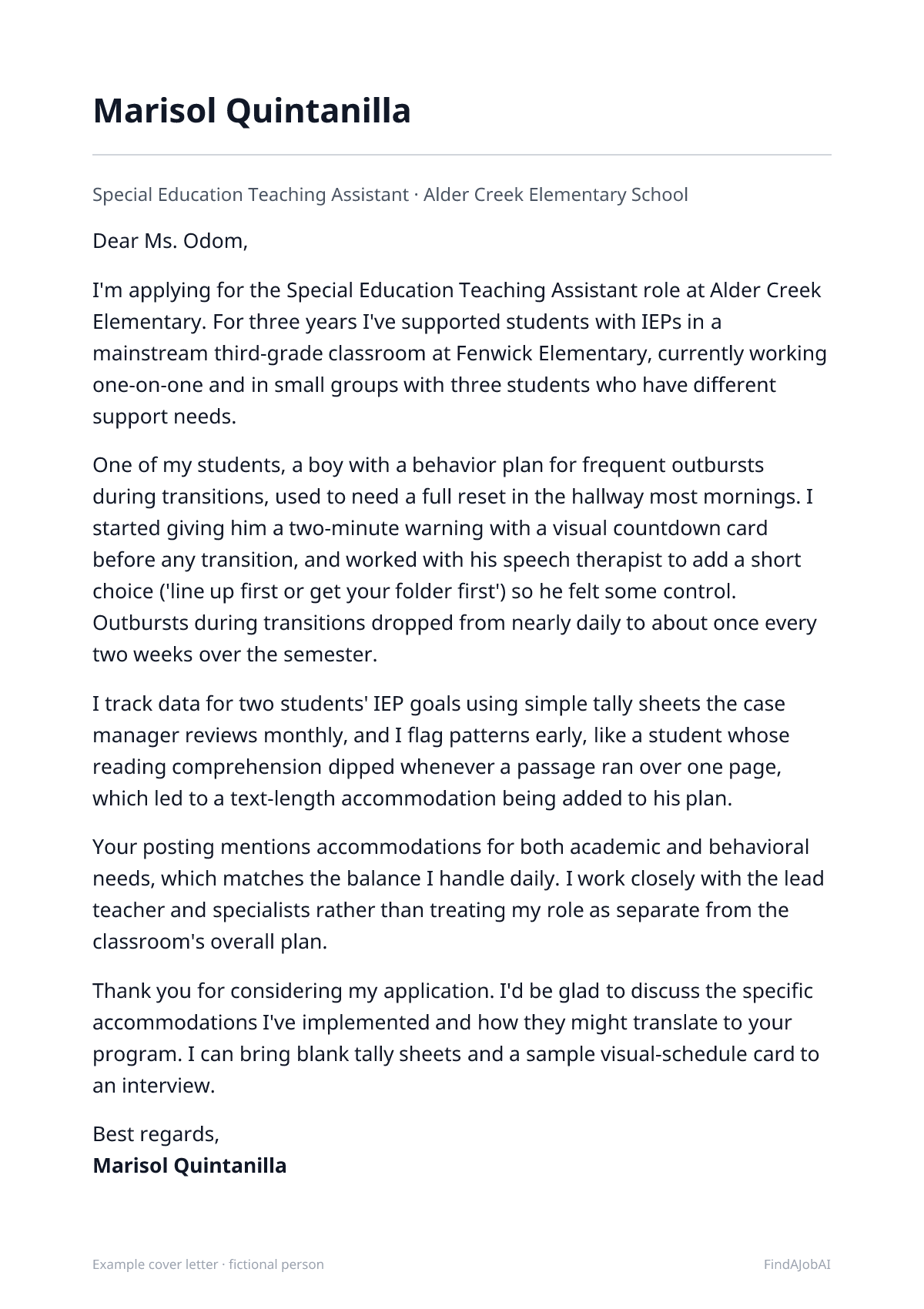
I'm applying for the Special Education Teaching Assistant role at Alder Creek Elementary. For three years I've supported students with IEPs in a mainstream third-grade classroom at Fenwick Elementary, currently working one-on-one and in small groups with three students who have different support needs.
One of my students, a boy with a behavior plan for frequent outbursts during transitions, used to need a full reset in the hallway most mornings. I started giving him a two-minute warning with a visual countdown card before any transition, and worked with his speech therapist to add a short choice ('line up first or get your folder first') so he felt some control. Outbursts during transitions dropped from nearly daily to about once every two weeks over the semester.
I track data for two students' IEP goals using simple tally sheets the case manager reviews monthly, and I flag patterns early, like a student whose reading comprehension dipped whenever a passage ran over one page, which led to a text-length accommodation being added to his plan.
Your posting mentions accommodations for both academic and behavioral needs, which matches the balance I handle daily. I work closely with the lead teacher and specialists rather than treating my role as separate from the classroom's overall plan.
Thank you for considering my application. I'd be glad to discuss the specific accommodations I've implemented and how they might translate to your program. I can bring blank tally sheets and a sample visual-schedule card to an interview.
Best regards,
Marisol Quintanilla
Example 2 · Career changer
Retail supervisor moving into a classroom support role
Tobias managed a bookstore's weekend kids' program and wants to move into schools. The ad values patience and small-group reading support.
Example letter · fictional
Dear Hiring Manager,
I'm applying for the Teaching Assistant role at Pemberwick Charter School. For four years I managed a bookstore's weekend children's program, running a weekly reading circle for ages six to nine, and I'm now looking to move that experience into a full-time classroom role.
Our reading circle included a boy who refused to read aloud in front of the group, which was starting to shrink his participation in everything else. I started letting him read to me quietly beforehand so he'd already know the passage when his turn came, and within a few months he was volunteering to read first some weeks. The store's owner later asked me to train two newer staff members using that same approach.
I completed a 40-hour paraprofessional training course last spring and volunteer twice a week in a first-grade classroom at my local elementary school, where I help run small reading groups and support a student who is still building basic phonics skills. I've also learned to keep a bag of small whiteboards and picture cards on hand, because a child who won't answer out loud will often point or draw.
Your posting emphasizes small-group reading support and patience with students who are reluctant to participate, which is exactly the kind of work I did in the reading circle and now do as a volunteer. I'd bring that same approach to a full school day.
Thank you for your time. I'm available for an interview whenever convenient and can share a reference from both the bookstore and my volunteer placement.
Sincerely,
Tobias Reinholt
Example 3 · Senior or lead
Lead TA applying to coordinate a school's support staff
Winifred oversees five teaching assistants at a middle school. The ad is for a lead TA who will handle scheduling and new TA training.
Example letter · fictional
Dear Mr. Okonjo,
I'm applying for the Lead Teaching Assistant role at Brackenfield Middle School. For the past three years I've informally coordinated our building's five teaching assistants, after six years as a classroom TA myself, and I'd like to take on that coordination formally.
Your posting mentions inconsistent coverage when a TA calls out. I built a simple shared schedule showing which TA supports which classroom and student each period, with a backup assigned for each slot, so a substitute or another TA can step in without the lead teacher scrambling. Coverage gaps dropped from a near-weekly problem to only a handful of times a semester.
I also noticed new TAs were learning accommodation routines by trial and error, which was hard on students who need consistency. I wrote a one-page guide for our three most common accommodation types, with specific scripts for transitions and redirections, and paired each new hire with a mentor TA for the first month. Two of our newer TAs told me it cut their anxiety about the first weeks considerably, and the guide is now used across two other classrooms.
I haven't managed a budget for classroom materials or handled formal TA evaluations, and at Brackenfield I'd want to learn your current process for both before suggesting changes. For the first few months I'd shadow the person who builds the schedule now and ask which swaps cause the most friction.
I'd welcome a conversation about where your TA team feels stretched thin right now, whether that's scheduling, training or communication with lead teachers.
Sincerely,
Winifred Castellanos
All three letters, and the short version below, are fictional: the people, employers and numbers are invented. Borrow the structure, never the facts.
- Prefer to write it yourself? Use the free cover letter template.
- Check your CV against the job first: the free CV score shows the missing keywords.
Why the first letter works, paragraph by paragraph
Paragraph 1: Opening
States the setting, years of experience and the specific number and variety of students supported. Schools want to know the writer has handled more than one kind of need, not just one easy case.
Paragraph 2: A behavior strategy that worked
Describes a specific problem, a strategy tried (a visual countdown and a choice), collaboration with a specialist, and a measurable change in frequency, which shows method rather than just patience.
Paragraph 3: Academic support and data
Tracking IEP goal data and catching a pattern that led to a formal accommodation shows the writer contributes to, not just executes, a student's plan.
Paragraph 4: Why this school
Responds to the ad's specific mention of both academic and behavioral accommodations and frames the writer's role as integrated with the classroom team.
Paragraph 5: Close
Offers to discuss specific accommodations, a concrete next step that invites a real conversation rather than a general thank-you.
What the career changer's letter does differently
The career changer's letter builds its case from a weekend reading program instead of classroom employment, naming one student's specific turnaround and the fact that a manager trusted the approach enough to have it taught to others. A paraprofessional course and current classroom volunteering show the move is already underway, not just intended.
What the senior letter does differently
The lead TA letter reports team-level fixes instead of one classroom story: a coverage schedule that closed a recurring gap, a training guide that reduced new-hire anxiety, and specific numbers on both. It names the gap in budget and evaluation experience plainly rather than implying full management readiness.
Short teaching assistant cover letter: an email-ready version
Many applications arrive as an email or a small text box, and a full page doesn't fit. This version runs 120 to 150 words and keeps only what a reader needs to decide whether to reply. A teaching assistant answers a preschool's short online application field, sent by email because the posting listed no portal link.
Short version · email · fictional131 words
Subject: Teaching Assistant application – early childhood support – Benedikt Haverfield
Hello Ms. Dunmore,
I'm applying for the Teaching Assistant role at Clover Patch Preschool. I have two years of experience supporting a mixed-age preschool classroom, including one student with a sensory processing plan I helped implement daily.
That student used to melt down during loud group activities; I started offering noise-reducing headphones and a quiet corner option before transitions, and his participation in group time improved steadily over a few months. I also learned to preview the day's schedule with him on picture cards, so loud activities were never a surprise.
I hold a current CPR certification and a 20-hour early childhood training course. My resume is included, and I'm glad to answer any follow-up questions. I can share a reference from the lead teacher who supervised me.
Best,
Benedikt Haverfield
The short version keeps one sensory accommodation story with a clear before-and-after and drops the scheduling or team detail that belongs in a longer letter, since a short field rewards one concrete classroom moment.
Opening lines that work for teaching assistant cover letters
The first sentence decides whether the second gets read. Here are six openings, one for each situation you might be in. Pick the one that matches yours and swap in your own facts: every name and number below is invented.
1. You have a standout result
A student in my classroom used to melt down during loud group activities until we added noise-reducing headphones as an option before transitions; his participation improved steadily after that. I'd like to bring that kind of practical problem-solving to your preschool.
2. The ad names a problem you've solved
Your ad mentions frequent coverage gaps when a TA is absent. At my current school I built a shared backup schedule that cut those gaps from a near-weekly problem to only a handful of times a semester.
3. Someone referred you
Your lead teacher, Cassandra Villanueva, supervised my student placement last year and mentioned your opening, which is why I'm writing.
4. You admire what they build
My own child attended your after-school program for two years, and the way your staff handled his transition into kindergarten is part of why I want to work in your building.
5. You're new to the field or switching into it
I spent four years running a weekend reading circle at a bookstore before deciding to move into classrooms full time, and the patience that job required is still how I approach a reluctant reader.
6. You have senior scope or a specialism
As the TA who wrote our building's current guide for new hires on accommodation routines, I'm looking for a role where I can take on that kind of coordination formally.
How to write a teaching assistant cover letter
Five steps, in the order you'd write them. The shape stays the same for every job (a short opening, proof, a reason for this employer, a close), and what goes into each part is what changes with the role.
Open with the students you actually support
State the grade level, classroom setting, and the number and range of students you work with. This tells the reader your real experience level before any story, and distinguishes one-on-one support from whole-classroom small-group work.
Describe one strategy, not a list of duties
Pick a single situation, academic or behavioral, where you tried something specific and it worked. Name the problem, what you changed, and how you knew it helped, so the reader sees your thinking rather than a restated job description.
Show the outcome in a way a teacher would recognize
A frequency change, a participation shift, or a goal met are concrete signals a classroom teacher trusts. Avoid vague claims like 'made real progress.' If there's no clean number, describe specifically what changed in the student's behavior or work.
Name relevant training without over-listing it
Mention a paraprofessional course, CPR certification, or specific training the ad asks for, but tie at least one to the example you just gave. A certification mentioned alongside a real strategy reads as more credible than a bare list.
Close by naming how you work with the lead teacher
TAs rarely work alone, so end with a sentence on how you communicate with the teacher or specialists you support, and what you'd want to understand about their classroom routines first. This signals you see yourself as part of a team, not an independent operator.
Teaching Assistant cover letter do's and don'ts
Do
- Describe one student situation in enough detail to show your actual strategy, not just that you were patient or caring.
- Mention any training, such as a paraprofessional course or behavior intervention training, the ad specifically names.
- Show how you work with the lead teacher or specialists, since TAs are rarely expected to work alone.
Don't
- Don't use real student names or identifying details; keep classroom examples general enough to protect privacy.
- Don't claim to have written or led an IEP; describe your actual role in supporting one.
- Don't rely on "I love working with kids" as your main point; show it through a specific strategy that worked.
Common teaching assistant cover letter mistakes
Each one is easy to make and quick to fix before you send the letter.
Restating the job posting's duties
Listing "supports small groups, assists with behavior management" just repeats the ad. Replace each duty with one specific example of you doing it, so the reader learns something new about your actual work.
Naming a specific student
Specific names, grades or diagnoses tied to a real student can raise privacy concerns. Describe the situation and your strategy clearly while keeping the student general enough not to be identifiable.
Leading with enthusiasm instead of evidence
"I've always loved working with children" is the first line of nearly every TA letter. Open with a specific classroom moment instead, and let your tone show the enthusiasm on its own.
Treating all certifications as equally important
A long list of trainings and certificates buries the one the ad actually asks for. Lead with that one and let your resume carry the rest.
Downplaying non-classroom experience
Camp counseling, tutoring or retail kids' programs are relevant if described specifically. Name the comparable skill, such as managing a group or handling a reluctant participant, rather than apologizing for the setting.
Email subject lines for teaching assistant applications
Applying by email? Put the job title, any reference number and your name in the subject line.
- Special Education TA application – IEP support, behavior plans – Marisol Quintanilla
- Teaching Assistant application – small-group reading support – Tobias Reinholt
- Application: Teaching Assistant, Grade 2 (Req. 0734) – Marisol Quintanilla
Everything for Teaching Assistants
- Teaching Assistant resume exampleA full resume, plus bullet and summary examples
- Teaching Assistant interview questions30 questions with sample answers
- Teaching Assistant job descriptionDuties, skills and requirements
- Career change cover letter: template + examples
Other cover letter examples
Teaching Assistant cover letter FAQ
What should I write in a teaching assistant cover letter?
Describe one student situation where your approach made a difference, whether academic or behavioral, and what changed as a result. Mention how you work with the lead teacher or specialists, since collaboration is central to the role.
How do I write a teaching assistant cover letter with no classroom experience?
Use relevant work with kids from another setting, such as coaching, tutoring, camp counseling or retail programs, and name one specific situation you handled well. Add any paraprofessional training or current volunteering to show you're moving into the field seriously.
Should I mention specific accommodations or behavior plans in my letter?
Yes, in general terms. Describing a strategy you used for a transition, a reading accommodation, or a behavior plan shows practical skill, as long as you avoid any student-identifying details.
How we built this page
The FindAJobAI team wrote the three example letters, the short email version, the opening lines and the advice for teaching assistant roles. The people, employers and numbers in the letters are invented; the structure, the kind of evidence and the order of the paragraphs are the parts to copy.
Once we track enough live teaching assistant job ads, this page also shows the skills they ask for most, counted the same way as our in-demand skills report.
Last reviewed on November 1, 2026.