Biomedical Engineer Resume Example (2026)
By FindAJobAI team Updated How we built this page
Biomedical engineering resumes cross two worlds: hands-on engineering and the regulatory discipline medical devices require. A strong resume shows both, naming the device, the standard or test it had to pass, and what happened when it reached that bar, not just a list of tools and coursework.
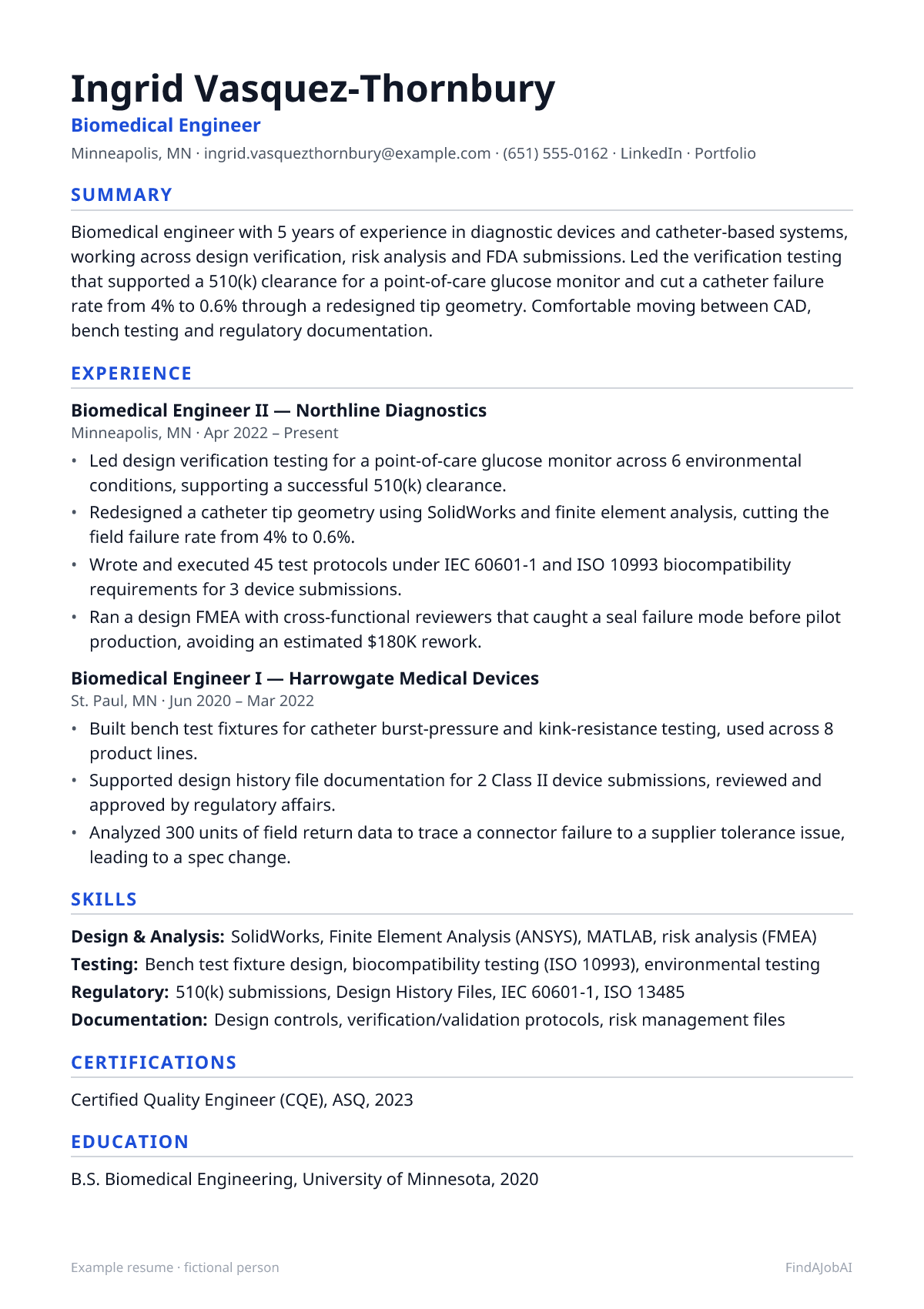
The example below is a biomedical engineer with five years split between a diagnostics startup and a catheter manufacturer. Notice how each bullet names the device, the test or standard involved, and the result, instead of only listing design software.
Biomedical Engineer resume template
This example as a one-page template: one column, standard headings and plain text, the format applicant tracking systems read most reliably.
After you sign up, Create my CV builds your own resume in this same one-column layout, from your real experience.
Mid-level biomedical engineer resume example
A complete one-page example for a fictional biomedical engineer: every bullet pairs an action with what changed because of it.
Example resume · fictional person
Ingrid Vasquez-Thornbury
Biomedical Engineer
Minneapolis, MN · [email protected] · (651) 555-0162 · LinkedIn · Portfolio
Summary
Biomedical engineer with 5 years of experience in diagnostic devices and catheter-based systems, working across design verification, risk analysis and FDA submissions. Led the verification testing that supported a 510(k) clearance for a point-of-care glucose monitor and cut a catheter failure rate from 4% to 0.6% through a redesigned tip geometry. Comfortable moving between CAD, bench testing and regulatory documentation.
Experience
Biomedical Engineer II, Northline Diagnostics
Minneapolis, MN · Apr 2022 – Present
- Led design verification testing for a point-of-care glucose monitor across 6 environmental conditions, supporting a successful 510(k) clearance.
- Redesigned a catheter tip geometry using SolidWorks and finite element analysis, cutting the field failure rate from 4% to 0.6%.
- Wrote and executed 45 test protocols under IEC 60601-1 and ISO 10993 biocompatibility requirements for 3 device submissions.
- Ran a design FMEA with cross-functional reviewers that caught a seal failure mode before pilot production, avoiding an estimated $180K rework.
Biomedical Engineer I, Harrowgate Medical Devices
St. Paul, MN · Jun 2020 – Mar 2022
- Built bench test fixtures for catheter burst-pressure and kink-resistance testing, used across 8 product lines.
- Supported design history file documentation for 2 Class II device submissions, reviewed and approved by regulatory affairs.
- Analyzed 300 units of field return data to trace a connector failure to a supplier tolerance issue, leading to a spec change.
Skills
- Design & Analysis: SolidWorks, Finite Element Analysis (ANSYS), MATLAB, risk analysis (FMEA)
- Testing: Bench test fixture design, biocompatibility testing (ISO 10993), environmental testing
- Regulatory: 510(k) submissions, Design History Files, IEC 60601-1, ISO 13485
- Documentation: Design controls, verification/validation protocols, risk management files
Certifications
- Certified Quality Engineer (CQE), ASQ, 2023
Education
- B.S. Biomedical Engineering, University of Minnesota, 2020
Fictional example by the FindAJobAI team: the person, employers and numbers are invented. Keep the structure; use your own work and numbers you can explain in an interview.
Entry-level biomedical engineer resume example
A new biomedical engineering graduate with one internship and a senior design project standing in for work experience. Education sits right under the summary, and the capstone project is written like a job, ending in a working result rather than a grade.
Entry-level example resume · fictional person
Osheen Marchetti-Kwan
Biomedical Engineer
Providence, RI · [email protected] · (401) 555-0138 · LinkedIn · Portfolio
Summary
Entry-level biomedical engineer with a B.S. in Biomedical Engineering and a senior design project building a low-cost pulse oximeter prototype that passed accuracy testing against a clinical reference device. Interned at a medical device startup supporting bench testing on a wearable monitor. Comfortable with SolidWorks, MATLAB and basic design control documentation.
Education
- B.S. Biomedical Engineering, Brown University, 2025
Experience
Biomedical Engineering Intern, Carrowmore Health Technologies
Providence, RI · May 2025 – Aug 2025
- Built and ran bench test fixtures for a wearable heart rate monitor across 3 motion conditions, logging results for 40 test cycles.
- Assisted in drafting 2 test protocols under the engineer's review, used in the device's early verification testing.
- Flagged a signal dropout pattern in 15% of test runs, traced with a senior engineer to a loose electrode connector.
Lab Assistant, Biomedical Instrumentation Lab, Brown University
Providence, RI · Sep 2023 – May 2025
- Maintained and calibrated 8 pieces of lab equipment for undergraduate biomedical instrumentation courses.
- Supported 30 students per semester in debugging circuit builds for a biosignal amplifier lab assignment.
Skills
- Design & Analysis: SolidWorks, MATLAB, basic finite element analysis, circuit design
- Testing: Bench test fixtures, signal measurement, basic statistical analysis
- Regulatory basics: Design control fundamentals, documentation practices, ISO 13485 (coursework)
Projects
- Low-cost pulse oximeter (senior capstone): designed and built a prototype in a team of 4, achieving readings within 2% of a clinical reference device across 20 test subjects.
- 3D-printed prosthetic hand attachment (coursework): designed a gripping mechanism in SolidWorks that held objects up to 2 pounds across 50 grip-and-release cycles.
Senior biomedical engineer resume example
A senior engineer ten years in, now leading device development and owning the design control process for a team. The bullets shift from running individual tests to setting process, mentoring engineers and carrying submissions through to clearance, and the summary names the team size and submission count.
Senior example resume · fictional person
Aurelio Branagh-Dumont
Senior Biomedical Engineer
San Diego, CA · [email protected] · (619) 555-0197 · LinkedIn
Summary
Senior biomedical engineer with 10 years of experience leading device development for implantable and diagnostic products. Owns the design control process for a 12-person engineering team and has supported 6 FDA submissions, including 2 PMAs, while mentoring 4 junior engineers through their first verification protocols.
Experience
Senior Biomedical Engineer, Westcastle Implant Systems
San Diego, CA · Feb 2020 – Present
- Own the design control process for a 12-person engineering team across 4 active implantable device programs.
- Led verification and validation for a cardiac lead product supporting a PMA submission, coordinating 60 test protocols across 3 labs.
- Rebuilt the team's risk management file template to align with ISO 14971:2019, adopted across all active programs.
- Mentor 4 junior engineers through their first design verification protocols, reviewing test plans before execution.
Biomedical Engineer III, Alderbrook Diagnostics
San Diego, CA · Jan 2016 – Jan 2020
- Led design verification for 3 point-of-care diagnostic platforms, supporting 2 successful 510(k) clearances.
- Investigated a 2.5% false-negative rate in a rapid test cartridge, identifying a reagent storage issue that cut the rate to 0.3%.
- Built a standardized FMEA template used across 5 engineering teams, cutting average risk review time by 30%.
Biomedical Engineer, Thornfield Medical Instruments
Irvine, CA · Jul 2013 – Dec 2015
- Designed and executed bench testing for a surgical stapler's firing mechanism across 10,000 actuation cycles.
- Supported design history file compilation for a Class II device submission, reviewed and cleared without major findings.
Skills
- Design & Analysis: SolidWorks, ANSYS, MATLAB, statistical process control, DFMEA/PFMEA
- Regulatory: PMA and 510(k) submissions, ISO 13485, ISO 14971, IEC 60601-1
- Leadership: Design control ownership, mentoring engineers, cross-functional program leadership
Education
- M.S. Biomedical Engineering, University of California, San Diego, 2013
- B.S. Bioengineering, University of California, Irvine, 2011
How to write a biomedical engineer resume
Five steps, in the order a recruiter reads the page. The format around them stays plain for every job: one column, standard headings, newest role first.
Header: name, target title and links
Use the title "Biomedical Engineer" even if your title was R&D Engineer or Device Engineer, and name the device category you've worked in (diagnostics, implantables, surgical instruments) early, since regulatory requirements and hiring needs vary sharply by category.
Summary: what you do and your best proof
Name the device types you've worked on, the stage of development (design, verification, submission) and one measurable result, such as a clearance supported or a failure rate reduced. Skip lines like "passionate about improving patient outcomes"; show it through a specific device result instead.
Experience: newest first, a result in every bullet
Open each bullet with the device or component, then the test, standard or design action, then the result: a clearance, a failure rate change or a cost avoided. Listing tools alone says less than naming what you built, tested or caught with them.
Skills: grouped, in the ad's words
Group skills into design/analysis tools, testing methods and regulatory standards, naming specific standards (ISO 13485, IEC 60601-1, ISO 10993) rather than "regulatory knowledge." Include software by name, since many device company ATS systems filter on it.
Education and certifications
List your degree and year, plus any relevant certification such as CQE or RAC if you hold one. Without device industry experience, add a Projects section describing your senior design or capstone project like a work bullet, with the device, the testing performed and the result.
Skills to put on a biomedical engineer resume
Hard skills are the tools and methods of the job; soft skills are how you work with people. Each comes with one way to prove it, because a skill named only in a list counts for little. Add the ones you really have.
Hard skills
- SolidWorks
- Name a component or device you designed or redesigned in it and the measurable result of the change.
- Finite element analysis
- Mention what you simulated (stress, fatigue, thermal) and the design decision it informed.
- Design verification/validation
- Give the device, the number of protocols run and whether they supported a clearance or submission.
- Risk analysis (FMEA)
- Point to a specific failure mode you caught and what it prevented, such as rework cost or a field issue.
- ISO 13485
- Mention a design control deliverable you owned under this standard, such as a design history file.
- IEC 60601-1
- Reference a specific test type (electrical safety, EMC) you ran or coordinated under this standard.
- ISO 10993 biocompatibility
- Name the materials or device you scoped testing for and the timeline it supported.
- 510(k) / PMA submissions
- Say which section you contributed to (verification, risk, labeling) and the submission's outcome.
- MATLAB
- Describe an analysis or signal processing task you automated or sped up with it.
- Bench test fixture design
- Name the test type (burst pressure, fatigue, kink resistance) and how many product lines used the fixture.
- Design history file documentation
- Mention how many submissions or devices your documentation supported and any review outcome.
- Statistical process control
- Give a process or metric you monitored and a defect or variance reduction you achieved.
Soft skills
- Cross-functional collaboration
- Name the teams (quality, regulatory, manufacturing, clinical) you coordinated with and the problem you solved together.
- Attention to detail
- Describe a defect or discrepancy you caught before it reached testing or submission.
- Technical writing
- Mention a protocol, report or submission section you wrote and who reviewed or approved it.
- Root cause analysis
- Give a failure rate you investigated, the cause you found and the rate after your fix.
- Mentoring
- Count the engineers you trained or reviewed work for, and on what kind of task.
- Project prioritization
- Describe managing multiple test protocols or device programs at once and how you sequenced them.
- Regulatory judgment
- Mention a decision about testing scope or documentation that kept a submission on schedule.
Biomedical Engineer resume bullet examples: weak vs strong
The same work, written two ways. The strong version names the tool, the scope and a result; the numbers are examples, yours must be real.
Weak: Designed medical devices.
Strong: Redesigned a blood pressure cuff bladder shape in SolidWorks, reducing measurement variance across 50 test subjects by 18%.
Names the device, the tool and a measured improvement.
Weak: Performed testing on devices.
Strong: Ran 30 cycles of accelerated aging tests on a surgical stapler under ASTM F1980, confirming a 2-year shelf-life claim.
Specifies the test type, standard and what the result supported.
Weak: Worked on FDA submissions.
Strong: Compiled the verification section of a 510(k) submission for an infusion pump, which received clearance with no additional testing requests.
Shows direct ownership of a submission section and its outcome.
Weak: Analyzed failure data.
Strong: Traced a 3% in-field sensor failure rate to a solder joint defect, leading to a process change that cut failures to 0.4%.
Gives before-and-after numbers and the root cause found.
Weak: Familiar with risk management.
Strong: Led a design FMEA for a dialysis machine component that identified a leak path later confirmed in supplier testing, preventing a field issue.
Converts a skill claim into a specific risk caught before it shipped.
Weak: Collaborated with cross-functional teams.
Strong: Coordinated with 4 teams (quality, regulatory, manufacturing and clinical) to resolve a labeling discrepancy before a product launch deadline.
Names the teams and the concrete problem resolved.
Weak: Knowledge of biocompatibility standards.
Strong: Scoped and tracked ISO 10993 biocompatibility testing for 5 new patient-contact materials, keeping all 5 on the submission timeline.
Shows applied knowledge with a count and a timeline result.
15 more biomedical engineer resume bullet examples
Grouped by area of the job, so you can find the ones closest to your work. Keep the shape (action, scope, result) and replace the invented numbers with your own.
Design and development
- Redesigned a surgical clamp's jaw geometry in SolidWorks, reducing tissue slippage in bench trials from 12% to 2%.
- Ran finite element analysis on a hip implant stem under simulated gait loads, identifying a stress concentration that led to a 15% thicker design region.
- Designed a disposable biopsy needle housing that cut assembly time from 90 to 40 seconds across a pilot run of 200 units.
- Prototyped 3 iterations of a wearable glucose sensor patch, improving adhesion time from 2 to 5 days in wear testing on 25 subjects.
Testing and verification
- Executed 50 cycles of accelerated aging on a wound dressing adhesive under ASTM F1980, confirming an 18-month shelf-life claim.
- Ran electrical safety testing under IEC 60601-1 on a patient monitor, identifying a grounding issue before the design freeze.
- Completed biocompatibility test scoping under ISO 10993 for 4 new patient-contact materials, keeping all 4 on the submission timeline.
- Built a custom test rig to measure catheter kink radius across 100 samples, standardizing a previously manual measurement process.
Regulatory and quality
- Compiled the risk management section of a 510(k) submission covering 35 identified failure modes, cleared without additional review questions.
- Investigated a 3.2% field failure rate on an infusion set connector, tracing it to a supplier tolerance drift and cutting the rate to 0.5%.
- Updated a design history file template to meet ISO 13485 audit findings, reducing missing-document flags from 18 to 2 in the next internal audit.
- Led a design FMEA review with 5 cross-functional stakeholders that identified a sterilization compatibility risk before tooling was finalized.
Collaboration and process
- Coordinated with regulatory, quality and manufacturing teams to resolve a labeling discrepancy, keeping a product launch on its original date.
- Trained 3 junior engineers on writing verification protocols, reviewing their first 10 protocols before submission to the design file.
- Presented quarterly test results to a 15-person program review board, flagging 2 risks that changed the project timeline.
Biomedical Engineer resume summary examples
Two or three lines on what you do and your strongest proof. Start from the one closest to your level and use your own facts.
Biomedical engineer with a B.S. in Biomedical Engineering and a senior design project building a low-cost pulse oximeter prototype. Interned at a medical device startup supporting bench testing on a wearable monitor. Comfortable with SolidWorks, MATLAB and basic design control documentation.
Biomedical engineer with 5 years of experience in diagnostic devices and catheter-based systems, working across verification, risk analysis and FDA submissions. Led verification testing supporting a 510(k) clearance for a glucose monitor and cut a catheter failure rate from 4% to 0.6%.
Senior biomedical engineer with 10 years of experience leading device development for implantable and diagnostic products. Owns the design control process for a 12-person engineering team and has supported 6 FDA submissions, including 2 PMAs.
Common biomedical engineer resume mistakes
Each one is easy to make and quick to fix before you apply.
Naming tools without the test or design result
SolidWorks and MATLAB in a Skills section say what you can open, not what you built. Pair each tool with a device detail and an outcome.
No device type or classification context
Implantables, diagnostics and surgical instruments carry different regulatory weight. Name the device class and type so a hiring manager can match it to their program.
Vague regulatory language
"Familiar with FDA regulations" is too broad to verify. Name the specific standard or submission type (510(k), PMA, ISO 13485) and your actual role in it.
Counting tests run instead of what they found
"Ran 50 verification tests" doesn't say whether anything mattered. State what a test caught or confirmed and what happened next.
Treating academic projects as lesser experience
A senior design or capstone project with real testing and a working result is legitimate evidence of skill. Write it with the same structure as a work bullet.
ATS tips for a biomedical engineer resume
Applicant tracking systems turn your file into text that recruiters search, mostly for the skills and titles in the ad. They rarely reject a resume on their own; one that parses badly or misses the ad's words just doesn't come up.
- Name the device class and type you've worked on (Class II catheter, point-of-care diagnostic, implantable); regulatory requirements differ sharply by class.
- Cite the specific standards you've worked under (ISO 13485, IEC 60601-1, ISO 10993) rather than just writing "regulatory compliance."
- Show testing experience with the test type, the standard and the result, not just the tool used to run it.
- If you contributed to an FDA submission, name which section (verification, risk, labeling) and the outcome.
- Quantify failure rates, test counts or cycle counts wherever you tracked them; these numbers carry weight in a medical device resume.
For the format itself, run the free ATS resume checklist.
Everything for Biomedical Engineers
- Biomedical Engineer cover letter examplesThree example letters and a short email version
- Biomedical Engineer interview questions30 questions with sample answers
- Biomedical Engineer job descriptionDuties, skills and requirements
- How to tailor your resume without lying
Other resume examples
Biomedical Engineer resume FAQ
What certifications help a biomedical engineer resume?
A Certified Quality Engineer (CQE) credential or Regulatory Affairs Certification (RAC) can help, especially for roles touching submissions or quality systems, but hands-on device and testing experience matters more.
How do I write a biomedical engineering resume with only academic projects?
Describe your senior design or capstone project like a work bullet: the device, the testing you performed and the result, such as a working prototype or a passed design review.
Should I list specific regulatory standards on my resume?
Yes, if you've worked under them directly, such as ISO 13485 or IEC 60601-1. Naming standards signals you understand the compliance environment, which many ATS systems and recruiters search for.
How we built this page
The FindAJobAI team wrote the three example resumes, the bullets, the skills and the advice for biomedical engineer roles. The people, employers and numbers in the examples are invented; the structure, the tools and the way each bullet is built are the parts to copy.
Once we track enough live biomedical engineer job ads, this page also shows the skills they ask for most, counted the same way as our in-demand skills report.
Last reviewed on November 1, 2026.