Electrical Engineer Resume Example (2026)
By FindAJobAI team Updated How we built this page
Electrical engineer postings tend to split into a few tracks: PCB and embedded hardware, power systems, or controls, but all of them ask for proof that your design actually worked under test, not just that you drew a schematic. An electrical engineer resume should name the board or system, the test or standard it had to pass, and what changed when it didn't.
The example below is an electrical engineer with four years split between a smart-home device startup and an industrial controls company. Notice how each bullet names the circuit or system, the tool or test behind it, and a measurable outcome, instead of listing responsibilities.
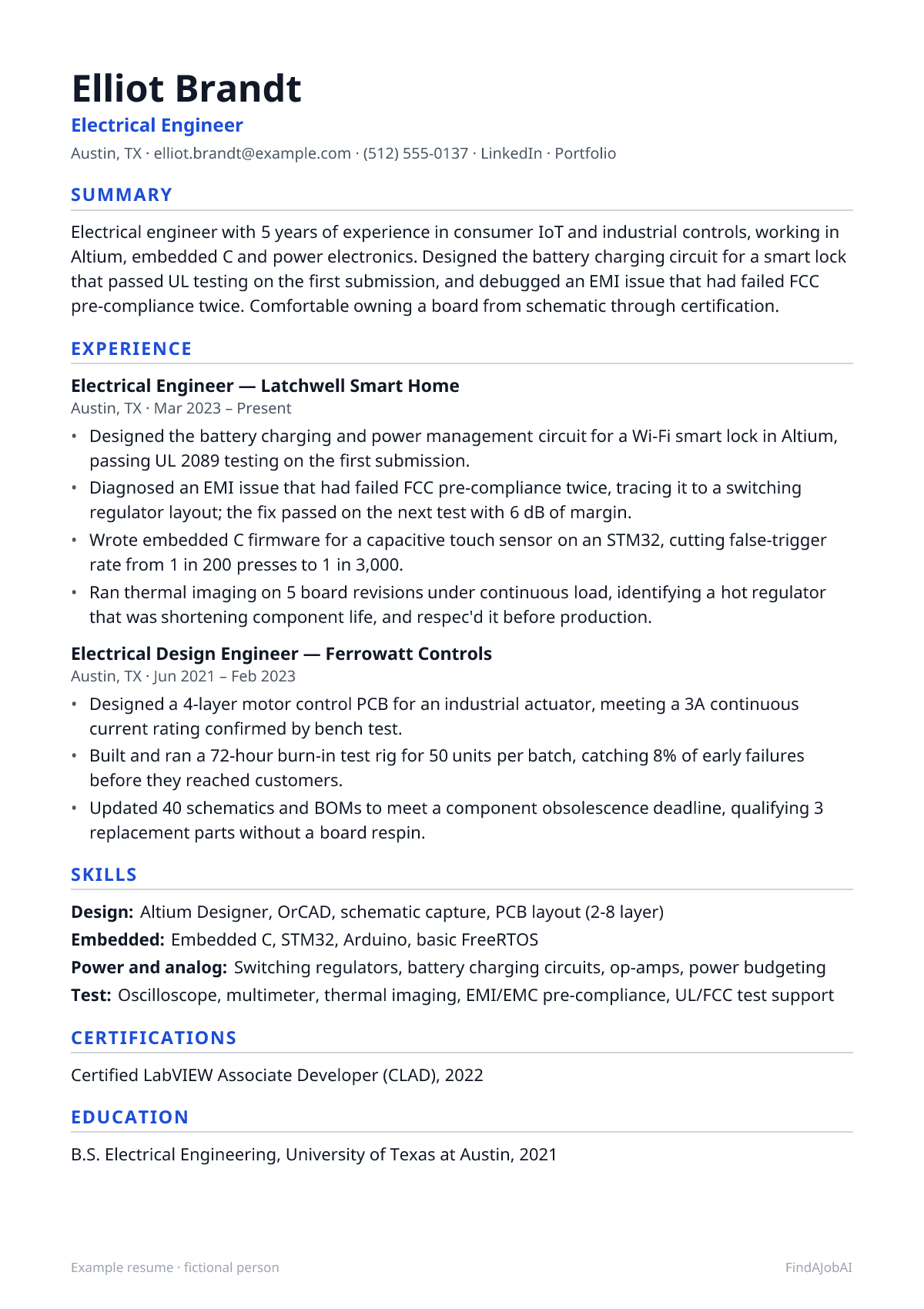
Electrical Engineer resume template
This example as a one-page template: one column, standard headings and plain text, the format applicant tracking systems read most reliably.
After you sign up, Create my CV builds your own resume in this same one-column layout, from your real experience.
Mid-level electrical engineer resume example
A complete one-page example for a fictional electrical engineer: every bullet pairs an action with what changed because of it.
Example resume · fictional person
Elliot Brandt
Electrical Engineer
Austin, TX · [email protected] · (512) 555-0137 · LinkedIn · Portfolio
Summary
Electrical engineer with 5 years of experience in consumer IoT and industrial controls, working in Altium, embedded C and power electronics. Designed the battery charging circuit for a smart lock that passed UL testing on the first submission, and debugged an EMI issue that had failed FCC pre-compliance twice. Comfortable owning a board from schematic through certification.
Experience
Electrical Engineer, Latchwell Smart Home
Austin, TX · Mar 2023 – Present
- Designed the battery charging and power management circuit for a Wi-Fi smart lock in Altium, passing UL 2089 testing on the first submission.
- Diagnosed an EMI issue that had failed FCC pre-compliance twice, tracing it to a switching regulator layout; the fix passed on the next test with 6 dB of margin.
- Wrote embedded C firmware for a capacitive touch sensor on an STM32, cutting false-trigger rate from 1 in 200 presses to 1 in 3,000.
- Ran thermal imaging on 5 board revisions under continuous load, identifying a hot regulator that was shortening component life, and respec'd it before production.
Electrical Design Engineer, Ferrowatt Controls
Austin, TX · Jun 2021 – Feb 2023
- Designed a 4-layer motor control PCB for an industrial actuator, meeting a 3A continuous current rating confirmed by bench test.
- Built and ran a 72-hour burn-in test rig for 50 units per batch, catching 8% of early failures before they reached customers.
- Updated 40 schematics and BOMs to meet a component obsolescence deadline, qualifying 3 replacement parts without a board respin.
Skills
- Design: Altium Designer, OrCAD, schematic capture, PCB layout (2-8 layer)
- Embedded: Embedded C, STM32, Arduino, basic FreeRTOS
- Power and analog: Switching regulators, battery charging circuits, op-amps, power budgeting
- Test: Oscilloscope, multimeter, thermal imaging, EMI/EMC pre-compliance, UL/FCC test support
Certifications
- Certified LabVIEW Associate Developer (CLAD), 2022
Education
- B.S. Electrical Engineering, University of Texas at Austin, 2021
Fictional example by the FindAJobAI team: the person, employers and numbers are invented. Keep the structure; use your own work and numbers you can explain in an interview.
Entry-level electrical engineer resume example
A new electrical engineering graduate with one internship and a robotics team project. Education sits right under the summary, and the capstone and team projects carry the weight an entry-level resume needs, each ending in a tested result rather than a list of parts used.
Entry-level example resume · fictional person
Hannah Kowalski
Electrical Engineer
Pittsburgh, PA · [email protected] · (412) 555-0128 · LinkedIn · Portfolio · GitHub
Summary
Entry-level electrical engineer with a B.S. in Electrical Engineering and a solar charge controller capstone project, plus a summer internship at a test equipment company. Works in Altium and embedded C, with hands-on experience from a university robotics team's power subsystem. Looking for a first full-time hardware or embedded engineering role.
Education
- B.S. Electrical Engineering, Carnegie Mellon University, 2026
Experience
Power Subsystem Lead, Robotics Team, Carnegie Mellon University
Pittsburgh, PA · Sep 2023 – May 2026
- Designed the battery management and power distribution board in Altium for a competition robot, supporting 40A peak draw without a brownout.
- Debugged a motor driver overheating issue by adding a current-sense feedback loop in firmware, cutting thermal shutdowns from 5 per match to zero.
Hardware Test Intern, Steel City Test Instruments
Pittsburgh, PA · May 2025 – Aug 2025
- Ran automated bench tests on 6 revisions of a power supply board, logging voltage ripple and efficiency data that engineering used to pick the final design.
- Wrote a Python script to parse oscilloscope captures from 200 test runs, cutting manual data entry from 3 hours to 20 minutes per batch.
- Built a test fixture jig for a connector board, catching 2 pin-mapping errors before they reached a customer demo.
Skills
- Design: Altium Designer, KiCad, schematic capture, basic PCB layout (2-4 layer)
- Embedded: Embedded C, STM32, ESP32, Arduino
- Power and analog: Battery management basics, linear and switching regulators, op-amps (coursework)
- Test: Oscilloscope, multimeter, bench power supplies, Python for data logging
Projects
- Senior capstone, solar charge controller (Altium, embedded C): designed a custom PCB and MPPT firmware on an STM32, achieving 94% tracking efficiency against a bench solar simulator.
- Home weather station (ESP32, KiCad): designed a low-power sensor board and firmware reporting over Wi-Fi, running 3 months on a single battery charge.
Senior electrical engineer resume example
A principal engineer twelve years in, now leading a hardware team. The bullets move from building boards to setting EMC and design review standards, owning certification strategy, and the summary names the team size and the product line's value.
Senior example resume · fictional person
Gregory Alston
Principal Electrical Engineer
San Jose, CA · [email protected] · (408) 555-0182 · LinkedIn
Summary
Principal electrical engineer with 12 years designing power electronics and embedded systems for industrial and consumer products, leading a team of 5 engineers on a $25M product line. Set the EMC pre-compliance process now used across 4 product families, and led a redesign that cut field return rate on a flagship power supply by 55%.
Experience
Principal Electrical Engineer, Vantage Power Electronics
San Jose, CA · May 2020 – Present
- Lead a team of 5 electrical engineers across 2 product lines, setting design review checkpoints that cut late-stage respins by 40%.
- Led root cause analysis on a power supply with a 5% field return rate, redesigning the output filter stage to cut returns to 2.2% within 2 quarters.
- Built an in-house EMI pre-compliance test setup, cutting external lab cycles from 4 to 1 per product and shortening time-to-certification by 6 weeks.
- Qualified 2 new PCB fabrication vendors through first-article testing and impedance verification, reducing single-source risk on a $10M product line.
Senior Electrical Engineer, Brightline Industrial Systems
San Jose, CA · Sep 2016 – Apr 2020
- Owned electrical design for a motor drive redesign, cutting BOM cost by $8 per unit through a switching topology change while holding efficiency above 94%.
- Ran DFM and signal integrity reviews with 3 contract manufacturers, cutting first-pass test failures on a new control board by 11%.
- Mentored 3 junior engineers on PCB layout and EMC fundamentals, 2 of whom were later promoted to senior roles.
Electrical Engineer, Comstock Automation
Fremont, CA · Jul 2014 – Aug 2016
- Designed sensor interface and signal conditioning circuits for an industrial controller line, validated against a 3-year temperature cycling test.
- Created and maintained 150+ schematics and BOMs, reviewed directly with manufacturing to cut first-pass scrap by 9%.
Skills
- Design: Altium Designer, Cadence Allegro, OrCAD, 2-12 layer PCB layout
- Power and embedded: Switching power supplies, motor drives, embedded C/C++, signal integrity
- Leadership: EMC and certification strategy, design review standards, mentoring engineers, supplier qualification
Education
- B.S. Electrical Engineering, San Jose State University, 2014
How to write an electrical engineer resume
Five steps, in the order a recruiter reads the page. The format around them stays plain for every job: one column, standard headings, newest role first.
Header: name, target title and links
“Hardware Engineer” or “RF Engineer” may be your real title, but put “Electrical Engineer” in the headline as well, next to your main design tool, because screeners search for the two together.
Summary: what you do and your best proof
Say which corner of the field you work in (embedded, power electronics or analog), the kind of product, and the board design tool you use. Close with one result you can defend, such as a certification passed first time or a fault rate you brought down. Replace “strong problem-solving skills” with the problem itself.
Experience: newest first, a result in every bullet
Start each bullet with the board or circuit, then the test that proved it worked, then what changed: reliability, efficiency, cost or an approval you won. “Designed PCBs” tells a screener nothing; a board that cleared UL testing on its first submission tells them how well you did it.
Skills: grouped, in the ad's words
Sort them into design tools, firmware languages, power and analog, and lab equipment or standards. Name the exact CAD package and microcontroller family, and list only the compliance standards you have personally tested a product against.
Education and certifications
Put your degree and year first, then any EIT, PE or CLAD credentials you hold. With little paid experience, add a Projects section of capstone or team builds, each naming the circuit problem and the measurement that showed it worked.
Skills to put on an electrical engineer resume
Hard skills are the tools and methods of the job; soft skills are how you work with people. Each comes with one way to prove it, because a skill named only in a list counts for little. Add the ones you really have.
Hard skills
- Altium Designer or OrCAD
- Name a board you laid out in it and a layout challenge you solved, such as routing high-current or high-speed traces.
- Embedded C/C++
- State the microcontroller family and what the firmware did, with a measurable result like reduced false-trigger rate or power draw.
- Power electronics
- Name the converter topology (buck, boost, flyback) and the efficiency, current or battery-life number it achieved.
- EMI/EMC testing
- Describe an emission or susceptibility issue you found and fixed, and the margin or standard it then passed.
- Signal integrity
- Mention a high-speed or noisy signal you routed or filtered and the issue it resolved, such as ringing or crosstalk.
- Oscilloscope and lab debugging
- Describe a hardware fault you traced with a scope, including the symptom and the root cause found.
- UL/FCC/CE compliance
- Name the standard your product was tested against and whether it passed on the first submission or what you fixed to pass.
- PCB layout (multilayer)
- Give the layer count and a constraint you met, such as current rating, impedance control or thermal rise.
- Battery management
- Mention the chemistry and the protection or charging feature you designed, with a safety or life result.
- Test and measurement automation
- Describe a script or fixture you built and the manual time it replaced.
Soft skills
- Root cause debugging
- Describe a hard-to-reproduce failure, the method you used to isolate it, and the fix.
- Cross-functional collaboration
- Name the other function (firmware, mechanical, manufacturing) and what the collaboration changed in the design.
- Design for cost
- Give a cost reduction you drove on a board or BOM and the unit volume it applied to.
- Communication with non-engineers
- Describe a technical tradeoff you explained to a program manager or customer.
- Project ownership
- Name a board or subsystem you owned end to end, from schematic through certification.
- Attention to detail
- Mention a schematic or layout error you caught before it reached fabrication.
- Mentoring
- Say how many junior engineers or technicians you coached, and what you taught them to do alone.
Electrical Engineer resume bullet examples: weak vs strong
The same work, written two ways. The strong version names the tool, the scope and a result; the numbers are examples, yours must be real.
Weak: Designed PCBs in Altium.
Strong: Designed a 6-layer PCB in Altium for a battery management system, routing high-current traces that held a 5A continuous load without exceeding a 10°C rise.
Names the board, the layout challenge and the measured result.
Weak: Wrote embedded firmware.
Strong: Wrote embedded C for a sensor fusion routine on an ARM Cortex-M4, cutting the false-positive rate on a motion detector from 4% to 0.3%.
Shows firmware work tied to a measurable accuracy improvement.
Weak: Debugged hardware issues.
Strong: Traced an intermittent brownout to a decoupling capacitor placement, fixing a failure that had caused 12% of units to fail final test.
Gives the root cause, the fix and the scale of the problem it solved.
Weak: Worked on compliance testing.
Strong: Led EMI pre-compliance testing for a new product, identifying and fixing 2 emission peaks that would have failed FCC Part 15.
Turns a vague compliance duty into a specific test outcome avoided.
Weak: Responsible for power design.
Strong: Designed a buck-boost power supply stage that extended battery life from 8 to 14 hours on a handheld device, confirmed by bench discharge testing.
Shows the circuit type and a user-facing result backed by test data.
Weak: Collaborated with manufacturing.
Strong: Worked with a contract manufacturer to resolve a solder bridging issue on a fine-pitch connector, cutting first-pass test failures from 6% to 1%.
Shows the collaboration producing a measured manufacturing improvement.
15 more electrical engineer resume bullet examples
Grouped by area of the job, so you can find the ones closest to your work. Keep the shape (action, scope, result) and replace the invented numbers with your own.
PCB design and layout
- Laid out an 8-layer controller board in Altium with controlled impedance traces, passing signal integrity simulation on the first pass.
- Redesigned a connector footprint to fix a solder bridging defect, cutting first-pass test failures from 7% to under 1%.
- Converted a 2-layer prototype board to a 4-layer production design, resolving a ground loop that had caused intermittent sensor noise.
- Created a reusable power module schematic used across 3 product lines, cutting new-board design time by roughly a week each.
Embedded and firmware
- Wrote embedded C for a PID motor control loop on an STM32, cutting speed overshoot from 15% to 3% during startup.
- Implemented a watchdog and brownout recovery routine, eliminating a field issue where units required manual power-cycling to recover.
- Optimized a sensor polling routine to cut average current draw by 30%, extending battery life on a handheld device from 6 to 9 hours.
- Integrated a BLE module into an existing firmware stack, adding wireless configuration that cut setup support calls by half.
Power and analog
- Designed a buck converter stage delivering 3.3V at 2A with under 2% ripple, verified on bench against a worst-case load transient.
- Diagnosed a thermal shutdown issue on a power module, respec'ing a MOSFET to cut junction temperature by 18°C under full load.
- Built a battery charging circuit with overcurrent and thermal protection, passing UL 2054 safety testing on the first submission.
- Re-laid out a 12 V to 3.3 V buck converter and cut output ripple from 85 mV to 30 mV, passing the customer's noise spec on the first sample.
Test, compliance and quality
- Led FCC Part 15 pre-compliance testing, identifying and filtering 2 emission peaks that would have failed formal certification.
- Built an automated test fixture for 50-unit production batches, catching 6% of early failures before units reached shipping.
- Set up an ESD and surge test protocol for a new product, finding and fixing a vulnerability at the USB input before launch.
Electrical Engineer resume summary examples
Two or three lines on what you do and your strongest proof. Start from the one closest to your level and use your own facts.
Electrical engineer with a B.S. in Electrical Engineering and a senior capstone project building a solar charge controller with custom PCB and firmware. Comfortable in Altium and embedded C, with hands-on experience from a university robotics team's power and motor control subsystem.
Electrical engineer with 4 years designing embedded hardware for industrial sensors, working in Altium, embedded C and power electronics. Led the redesign of a sensor interface board that cut field returns by 25% and passed CE certification on the first try.
Senior electrical engineer with 10 years in power electronics and embedded systems, now leading a team of 4 engineers on a $8M product line. Owns design reviews, EMC strategy and certification planning, and cut time-to-certification by 6 weeks through an in-house pre-compliance test setup.
Common electrical engineer resume mistakes
Each one is easy to make and quick to fix before you apply.
Listing design tools with no board shown
Altium or OrCAD on their own say you can open the software. Pair each tool with a board you designed and the constraint it met.
No numbers on power, failure rate or certification outcome
“Improved reliability” is vague. Give the before-and-after number, even an estimate, for failure rate, efficiency or test margin.
Burying compliance experience in the skills list only
A bullet showing what standard you tested against and whether you passed is worth more than listing “UL” or “FCC” alone. Use at least one bullet to show the outcome.
Project descriptions written like a lab report
A capstone project description that reads like a lab report loses a hiring manager. Write it like a job: the circuit problem, your design decisions, and the tested outcome.
ATS tips for an electrical engineer resume
Applicant tracking systems turn your file into text that recruiters search, mostly for the skills and titles in the ad. They rarely reject a resume on their own; one that parses badly or misses the ad's words just doesn't come up.
- Name your design tool specifically (Altium, OrCAD, Cadence); most hardware ads screen for one by name.
- Show embedded firmware work in bullets tied to a measurable result, not just listed as a language.
- Mention which standards your boards were tested against (UL, FCC, CE); it signals you've shipped real products.
- If you debugged a hard hardware problem, describe the root cause and fix; it shows depth beyond schematic capture.
For the format itself, run the free ATS resume checklist.
Everything for Electrical Engineers
- Electrical Engineer jobs1,196 open roles, updated hourly
- Electrical Engineer salary in the United StatesAdvertised pay in real job ads
- Electrical Engineer cover letter examplesThree example letters and a short email version
- Electrical Engineer interview questions30 questions with sample answers
- Electrical Engineer job descriptionDuties, skills and requirements
- How to tailor your resume without lying
Other resume examples
Electrical Engineer resume FAQ
What skills should an electrical engineer put on a resume?
A named PCB design tool, embedded programming experience if relevant to the role, power electronics or analog design basics, and exposure to compliance testing like UL, FCC or CE. Tie each one to a board or project rather than listing it alone.
How do I write an electrical engineer resume with no work experience?
Lead with your degree and put real project work front and center: capstone projects, robotics or SAE team subsystems, and any lab or internship work, even informal. Describe each project like a job: the circuit, your design decisions and the test result.
How do I show hardware debugging skill on a resume?
Describe one hard problem by its symptom, your root cause process, the tools you used (scope, thermal camera) and the fix. That sequence shows troubleshooting ability better than listing “debugging” as a skill.
How we built this page
The FindAJobAI team wrote the three example resumes, the bullets, the skills and the advice for electrical engineer roles. The people, employers and numbers in the examples are invented; the structure, the tools and the way each bullet is built are the parts to copy.
Once we track enough live electrical engineer job ads, this page also shows the skills they ask for most, counted the same way as our in-demand skills report.
Last reviewed on November 1, 2026.