Game Developer Resume Example (2026)
By FindAJobAI team Updated How we built this page
Game developer postings mix engine names, a language or two, and a plea for someone who has actually shipped something. The resumes that stand out name the engine, the platform and a number a producer would recognize: frame rate, load time, crash rate, or a feature players kept using. A resume that only lists "Unity" and "C#" looks like every other applicant's.
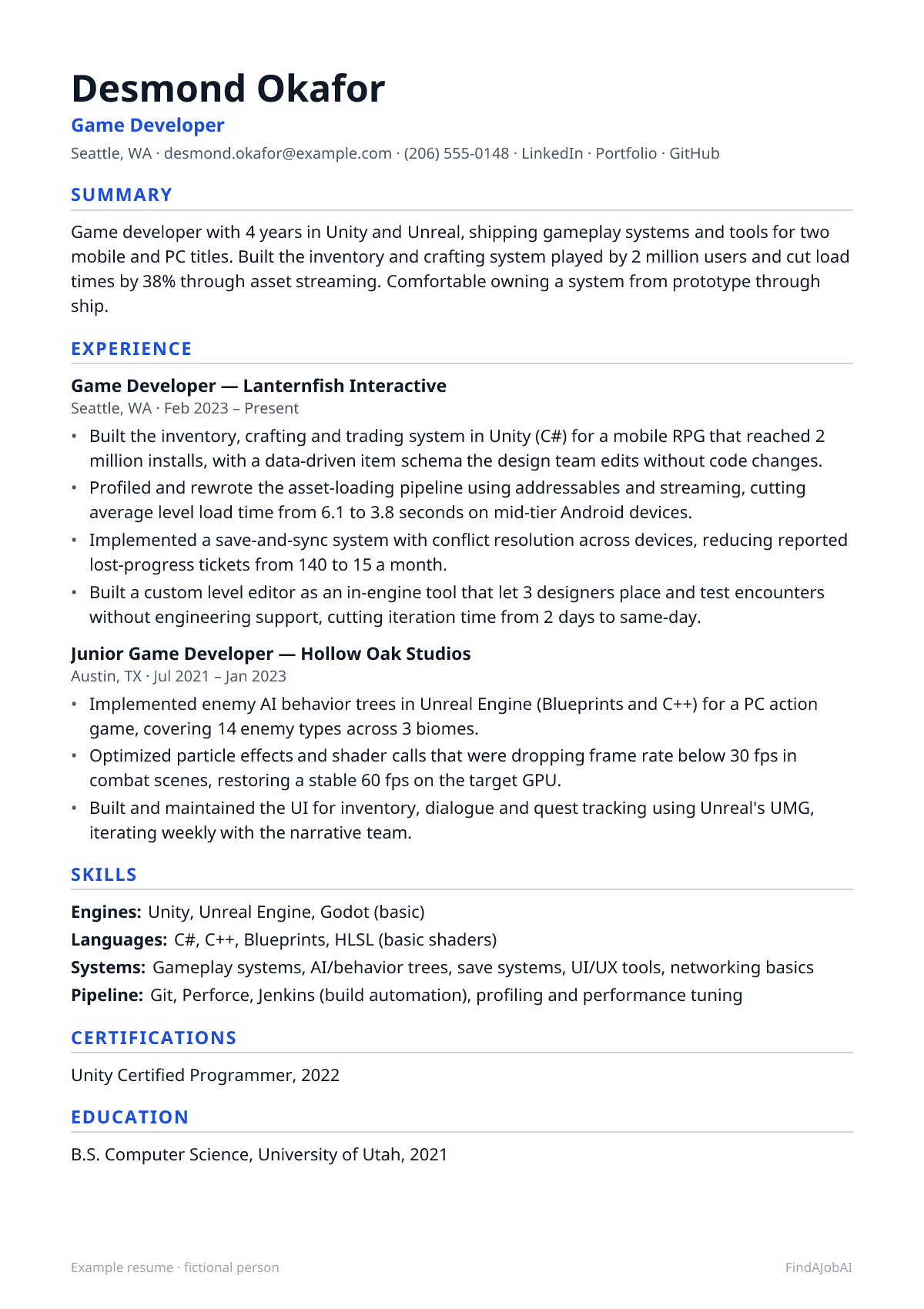
The example below is a developer with four years split between a small Unity studio and a mobile publisher. Each bullet names the system he built, the engine and the measurable effect, rather than listing engine familiarity on its own.
Game Developer resume template
This example as a one-page template: one column, standard headings and plain text, the format applicant tracking systems read most reliably.
After you sign up, Create my CV builds your own resume in this same one-column layout, from your real experience.
Mid-level game developer resume example
A complete one-page example for a fictional game developer: every bullet pairs an action with what changed because of it.
Example resume · fictional person
Desmond Okafor
Game Developer
Seattle, WA · [email protected] · (206) 555-0148 · LinkedIn · Portfolio · GitHub
Summary
Game developer with 4 years in Unity and Unreal, shipping gameplay systems and tools for two mobile and PC titles. Built the inventory and crafting system played by 2 million users and cut load times by 38% through asset streaming. Comfortable owning a system from prototype through ship.
Experience
Game Developer, Lanternfish Interactive
Seattle, WA · Feb 2023 – Present
- Built the inventory, crafting and trading system in Unity (C#) for a mobile RPG that reached 2 million installs, with a data-driven item schema the design team edits without code changes.
- Profiled and rewrote the asset-loading pipeline using addressables and streaming, cutting average level load time from 6.1 to 3.8 seconds on mid-tier Android devices.
- Implemented a save-and-sync system with conflict resolution across devices, reducing reported lost-progress tickets from 140 to 15 a month.
- Built a custom level editor as an in-engine tool that let 3 designers place and test encounters without engineering support, cutting iteration time from 2 days to same-day.
Junior Game Developer, Hollow Oak Studios
Austin, TX · Jul 2021 – Jan 2023
- Implemented enemy AI behavior trees in Unreal Engine (Blueprints and C++) for a PC action game, covering 14 enemy types across 3 biomes.
- Optimized particle effects and shader calls that were dropping frame rate below 30 fps in combat scenes, restoring a stable 60 fps on the target GPU.
- Built and maintained the UI for inventory, dialogue and quest tracking using Unreal's UMG, iterating weekly with the narrative team.
Skills
- Engines: Unity, Unreal Engine, Godot (basic)
- Languages: C#, C++, Blueprints, HLSL (basic shaders)
- Systems: Gameplay systems, AI/behavior trees, save systems, UI/UX tools, networking basics
- Pipeline: Git, Perforce, Jenkins (build automation), profiling and performance tuning
Certifications
- Unity Certified Programmer, 2022
Education
- B.S. Computer Science, University of Utah, 2021
Fictional example by the FindAJobAI team: the person, employers and numbers are invented. Keep the structure; use your own work and numbers you can explain in an interview.
Entry-level game developer resume example
A computer science graduate with one internship and two self-published game jam projects standing in for shipped work. Education sits right under the summary, and each project bullet ends with a number (downloads, rating, playtesters) instead of just naming the engine.
Entry-level example resume · fictional person
Priyanka Venkataraman
Game Developer
Pittsburgh, PA · [email protected] · (412) 555-0119 · LinkedIn · Portfolio · GitHub
Summary
Entry-level game developer with a B.S. in Computer Science and a Unity-focused internship building tools for a mobile puzzle studio. Shipped two solo projects in Unity, including a platformer with 9,000 itch.io downloads, and is comfortable in C# and Unity's animation, physics and UI systems.
Education
- B.S. Computer Science, Carnegie Mellon University, 2026
Experience
Game Development Intern, Thistledown Games
Pittsburgh, PA · Jan 2026 – May 2026
- Built an in-editor level-validation tool in Unity (C#) that caught 230 broken level configurations before they reached QA.
- Implemented 3 new match-3 power-up mechanics for a live mobile title, each shipped behind a feature flag and A/B tested with players.
- Fixed 18 reported bugs in the daily-reward and notification systems across one release cycle.
Teaching Assistant, Intro to Game Programming, Carnegie Mellon University
Pittsburgh, PA · Sep 2024 – Dec 2025
- Graded and gave feedback on Unity assignments for 60 students across 2 semesters, holding weekly office hours on C# and physics bugs.
- Wrote a supplementary tutorial on Unity's animation state machine after noticing it caused the most repeated student questions.
Skills
- Engines: Unity, Unreal Engine (Blueprints)
- Languages: C#, C++ (coursework), Blueprints
- Systems: 2D physics, animation state machines, basic shader graph, UI toolkit
- Tools: Git, GitHub Actions, Aseprite, FMOD (basic)
Projects
- Emberfall (Unity, C#): solo 2D platformer with custom physics-based movement, 9,000 downloads on itch.io and a 4.3-star average over 140 ratings.
- Signal Loss (Unreal Engine, Blueprints): 48-hour game jam entry built with 2 teammates, placed in the top 20 of 310 entries at a regional jam.
Senior game developer resume example
A lead developer nine years in, now owning engine architecture across a studio's titles. The bullets move from building individual systems to setting technical direction, mentoring engineers and making decisions that affected ship dates and player-facing performance across a whole team.
Senior example resume · fictional person
Fionnuala Mackenzie
Senior Game Developer
Vancouver, BC · [email protected] · (604) 555-0184 · LinkedIn · Portfolio
Summary
Senior game developer with 9 years shipping PC and console titles in Unreal Engine and Unity, now leading gameplay and engine architecture for a 40-person studio. Owns the combat and AI systems on a shipped 1.2-million-unit title and mentors 4 engineers across two active projects.
Experience
Lead Game Developer, Driftwood Interactive
Vancouver, BC · Apr 2021 – Present
- Lead a team of 4 gameplay engineers across combat, AI and progression systems for an action-RPG that shipped to 1.2 million units.
- Designed the enemy AI architecture in Unreal Engine (C++) supporting 30+ enemy types with shared behavior trees, cutting new-enemy implementation time from 2 weeks to 3 days.
- Set the studio's performance budget per frame system (AI, rendering, physics) and ran weekly profiling reviews, keeping the console build above 55 fps through full production.
- Mentored 4 engineers on Unreal and C++ engine internals, with 2 promoted to mid-level during their time on the team.
Senior Game Developer, Copperline Studios
Montreal, QC · Aug 2017 – Mar 2021
- Owned the combat system for a console beat-'em-up, including hit detection, combo chains and input buffering tuned across 500+ playtest sessions.
- Rebuilt the asset-streaming pipeline in Unreal, cutting level load times from 14 to 5 seconds and removing 2 full-time QA hours a day spent waiting on loads.
- Integrated a third-party netcode library for the game's 4-player co-op mode, stabilizing sync issues that had caused 1 in 5 online matches to desync.
Game Developer, Hollow Oak Studios
Austin, TX · Jun 2014 – Jul 2017
- Built gameplay systems in Unity for 2 shipped mobile titles, including the progression and daily-quest systems for a title with 800,000 installs.
- Wrote the save-and-sync system used across both titles, reducing lost-progress support tickets by 70% after launch.
Skills
- Engines: Unreal Engine, Unity, proprietary engine experience
- Languages: C++, C#, HLSL, Blueprints
- Architecture: AI/behavior trees, netcode, performance profiling, build pipelines
- Leadership: Hiring and mentoring engineers, technical direction, cross-team planning
Education
- B.S. Computer Engineering, University of Waterloo, 2014
How to write a game developer resume
Five steps, in the order a recruiter reads the page. The format around them stays plain for every job: one column, standard headings, newest role first.
Header: name, target title and links
Lead with your strongest engine (Unity or Unreal) in the headline area if the ad names one specifically, and link to a portfolio with playable builds or gameplay footage, since most studios watch before they read code.
Summary: what you do and your best proof
Name your engines, the platform(s) you've shipped on, and one system you're known for, then one number: install count, a performance fix or a playtest result. Skip "passionate gamer" lines; studios want shipped work, not fandom.
Experience: newest first, a result in every bullet
Open each bullet with the system you built, then the engine and language, then the measurable result: install count, frame rate, load time or a playtest or support-ticket number. "Worked on gameplay" says nothing a reviewer can picture; "built the crafting system players use most" does.
Skills: grouped, in the ad's words
Group by engine, language, systems and pipeline tools. List the engine version if the ad specifies one, and separate C++ depth from Blueprint-only experience if you have both, since studios often need one specifically.
Education and certifications
List your degree with the year. Without shipped professional work, add a Projects section with two games, each naming the engine, your role, and a concrete number: downloads, rating, jam placement or playtester count.
Skills to put on a game developer resume
Hard skills are the tools and methods of the job; soft skills are how you work with people. Each comes with one way to prove it, because a skill named only in a list counts for little. Add the ones you really have.
Hard skills
- Unity (C#)
- Name a shipped or published title and the specific system you built in it, such as inventory or save systems.
- Unreal Engine (C++/Blueprints)
- Say whether you worked in C++, Blueprints or both, and name the gameplay system or tool you owned.
- Gameplay systems design
- Name the system (combat, crafting, progression) and a number: install count, playtest sessions or a tuning result.
- AI / behavior trees
- Give the number of enemy or NPC types your AI covered and the engine you built it in.
- Performance profiling
- State the before-and-after frame rate, load time or memory number and the platform you measured it on.
- Shader programming (HLSL/Shader Graph)
- Name a visual effect or optimization you shipped and its measured performance cost.
- Networking / netcode
- Name the multiplayer mode, the technique (prediction, lag compensation) and a stability or desync number.
- UI/UX implementation
- Name the screen or system (inventory, settings, HUD) and a usability or accessibility detail players asked for.
- Version control (Git/Perforce)
- Mention team size and any branching or merge process you set up, especially for binary assets.
- Save systems
- Give the platform count or sync scenario your save system handled and a reduction in related support tickets.
- Build automation (Jenkins/CI)
- Describe the build step you automated and the time it saved per release.
- Platform SDKs (console/mobile)
- Name the platform and a certification or submission requirement you handled.
Soft skills
- Cross-discipline collaboration
- Name the other discipline (design, art, QA) and a specific decision you shaped together.
- Playtest-driven iteration
- Give the number of playtest sessions behind a tuning decision and what changed.
- Scoping under deadline
- Describe a feature you cut or simplified to hit a milestone and why it still worked.
- Debugging under pressure
- Name a crash or blocker found close to a ship date and how fast it was resolved.
- Mentoring
- Count the engineers you mentored and name a skill, such as engine internals, they grew in.
- Communicating technical tradeoffs
- Describe a performance-versus-feature tradeoff you explained to a non-engineer and the decision that followed.
- Ownership
- Name a system you owned end to end, from prototype through its shipped, measured state.
Game Developer resume bullet examples: weak vs strong
The same work, written two ways. The strong version names the tool, the scope and a result; the numbers are examples, yours must be real.
Weak: Worked on gameplay features in Unity.
Strong: Built the dodge-and-parry combat system in Unity (C#) for a PC title, tuned across 400 playtester sessions to fix the timing window players complained about most.
Names the system, the engine and the evidence behind the tuning.
Weak: Fixed bugs and improved performance.
Strong: Found and fixed a memory leak in the enemy-spawning system that was causing crashes after 20 minutes of play, extending average session length by 35%.
A specific bug, its cause and the measurable effect of the fix.
Weak: Familiar with Unreal Engine.
Strong: Built a custom Unreal Engine plugin that let designers script cutscene timing in Blueprints, cutting cutscene iteration from 3 engineering requests a week to zero.
Turns a skill claim into a tool that removed engineering as a bottleneck.
Weak: Worked with the design team on levels.
Strong: Partnered with 2 level designers to rebuild the pacing of the game's first hour, raising tutorial completion from 61% to 84% in playtests.
Shows collaboration tied to a retention-relevant metric.
Weak: Improved game performance.
Strong: Reduced draw calls in the main hub scene from 1,800 to 400 by batching static meshes, raising frame rate from 24 to 58 fps on base-model consoles.
Specific technique with before-and-after numbers.
Weak: Built UI for the game.
Strong: Built the settings and accessibility menu, including remappable controls and colorblind palettes, shipped in response to 300+ player requests.
Ties UI work to real player demand and scope.
Weak: Worked on multiplayer features.
Strong: Implemented client-side prediction and lag compensation for a 4-player co-op mode, cutting perceived input lag complaints by half in the closed beta.
Names the networking technique and its measured player impact.
15 more game developer resume bullet examples
Grouped by area of the job, so you can find the ones closest to your work. Keep the shape (action, scope, result) and replace the invented numbers with your own.
Gameplay systems
- Built a dynamic difficulty system that adjusted enemy spawn rates based on player death count, reducing quit-after-death rate by 18% in playtests.
- Implemented a quest and dialogue branching system supporting 400 unique nodes, used across 3 story chapters.
- Built the progression and skill-tree system for a mobile RPG, balanced across 40 playtest sessions before launch.
- Added a photo-mode feature requested by 1,200 players in community feedback, shipped within one sprint using existing camera tooling.
Performance and engine work
- Reduced garbage collection spikes in Unity by pooling 12 frequently-instantiated enemy and projectile prefabs, smoothing frame times during combat.
- Cut shader compilation stutter on first level load by precompiling 200 shader variants during the loading screen.
- Migrated a project from Unity 2020 to 2022 LTS, resolving 35 breaking API changes without a content freeze.
- Reduced build times from 45 to 12 minutes by restructuring asset bundles and enabling incremental builds.
Tools and pipeline
- Built a custom Unity editor tool for placing and previewing enemy spawn points, cutting level setup time from 4 hours to 45 minutes.
- Wrote a localization pipeline pulling text from a shared spreadsheet into 8 supported languages automatically at build time.
- Set up automated nightly builds with Jenkins across 3 platforms, catching integration breaks before the morning standup.
- Created a data-validation script that flagged 60 missing audio cues before a content-complete milestone.
Multiplayer and live operations
- Implemented server-authoritative movement for a PvP mode, eliminating a speed-hack exploit reported by players.
- Built and shipped 3 live-service events with time-limited content, driving a measurable spike in daily active users each time.
- Diagnosed and fixed a matchmaking bug causing uneven lobbies, dropping average wait time from 90 to 25 seconds.
Game Developer resume summary examples
Two or three lines on what you do and your strongest proof. Start from the one closest to your level and use your own facts.
Game developer with a computer science degree and two shipped student projects in Unity, including a 2D puzzle-platformer with 12,000 downloads on itch.io. Comfortable in C# and Unity's animation and physics systems, with growing experience in Unreal.
Game developer with 4 years shipping gameplay systems in Unity and Unreal for mobile and PC titles. Built the crafting system in a 2-million-install mobile RPG and cut average load times by 38% through asset streaming.
Senior game developer with 9 years leading gameplay and engine work on three shipped PC and console titles. Owns the combat and AI architecture for a 40-person studio's current project and mentors 4 engineers in Unreal and C++.
Common game developer resume mistakes
Each one is easy to make and quick to fix before you apply.
Listing engines with no shipped system attached
Unity and Unreal in Skills say what you can open; the bullets must say what you built and shipped in them. Name one owned system per engine.
No platform or scale context
"Shipped a mobile game" leaves out whether it reached 500 people or 2 million. Give the install count, concurrent players or review count you're able to share.
Describing optimization without numbers
"Improved performance" could mean anything. State the frame rate, load time or memory number before and after your fix.
Hiding NDA titles entirely
Dropping an unreleased project loses real experience. Describe the system, engine and your role without the title name instead of omitting the job.
Portfolio links to source code only
A GitHub link with no video or playable build forces a reviewer to read code before judging the game. Lead with gameplay footage or a browser build.
ATS tips for a game developer resume
Applicant tracking systems turn your file into text that recruiters search, mostly for the skills and titles in the ad. They rarely reject a resume on their own; one that parses badly or misses the ad's words just doesn't come up.
- Name the engine (Unity, Unreal, Godot) in the bullet, not only in Skills; ads usually ask for one by name.
- Give a shipped title's platform and rough scale (installs, concurrent players, reviews) if you can share it.
- Describe performance work in frame rate, load time or memory, not as "optimized the game".
- List the specific systems you owned (inventory, AI, networking, UI) rather than "gameplay programming" alone.
- If NDA limits what you can name, describe the system and the engine without naming the unreleased title.
For the format itself, run the free ATS resume checklist.
Everything for Game Developers
- Game Developer cover letter examplesThree example letters and a short email version
- Game Developer interview questions30 questions with sample answers
- Game Developer job descriptionDuties, skills and requirements
- How to tailor your resume without lying
Other resume examples
Game Developer resume FAQ
What should a game developer resume include?
The engines and languages you've shipped with, named systems you built or owned (AI, combat, UI, networking), and any measurable effect: frame rate, load time, crash rate or player numbers you're allowed to share.
How do I list unreleased or NDA-covered games on a resume?
Describe the system, engine and your role without naming the unannounced title, for example "combat system for an unannounced PC title (Unreal Engine, C++)". Most studios accept this phrasing.
Do game jams count as experience on a resume?
Yes, especially early in a career. List the jam, the engine, your role and what you built in the time limit; a finished small game says more than an unfinished large one.
Should I include a portfolio link on a game developer resume?
Yes. Link to playable builds or gameplay clips rather than only source code, since most hiring managers will watch footage before reading a repository.
How we built this page
The FindAJobAI team wrote the three example resumes, the bullets, the skills and the advice for game developer roles. The people, employers and numbers in the examples are invented; the structure, the tools and the way each bullet is built are the parts to copy.
Once we track enough live game developer job ads, this page also shows the skills they ask for most, counted the same way as our in-demand skills report.
Last reviewed on November 1, 2026.