Medical Laboratory Scientist Resume Example (2026)
By FindAJobAI team Updated How we built this page
Medical laboratory scientist postings ask for your license or certification up front, then look for proof you can run specific instruments, catch errors before they reach a chart, and keep turnaround times where the hospital needs them. A resume that just lists "hematology, microbiology, chemistry" reads like every other MLS applicant's. What stands out is a result: a critical value caught, a turnaround time hit, an instrument validated.
The example below is an MLS with five years split between a community hospital lab and a reference lab's chemistry section. Each bullet names the instrument or method, the volume and what the work caught or improved.
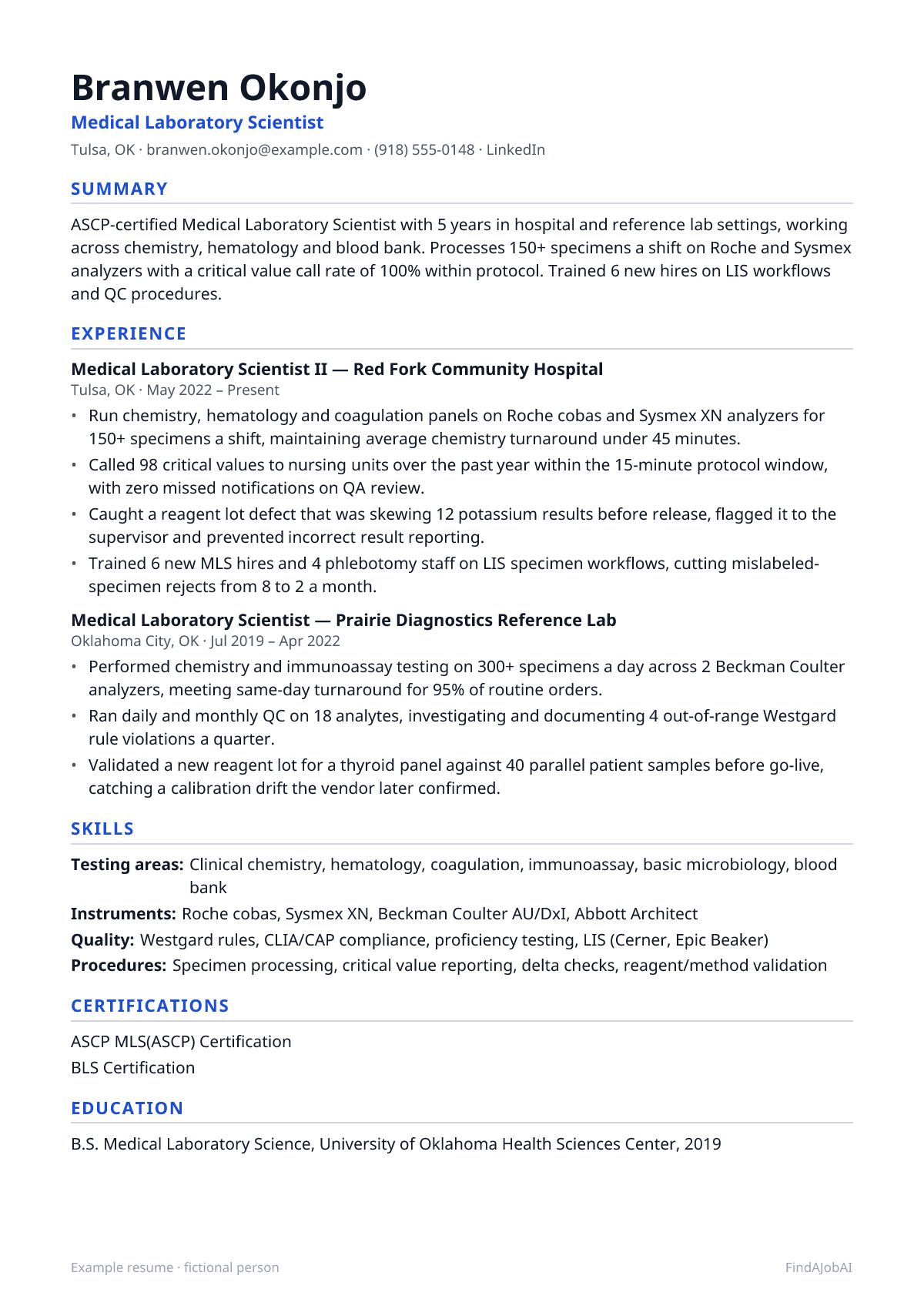
Medical Laboratory Scientist resume template
This example as a one-page template: one column, standard headings and plain text, the format applicant tracking systems read most reliably.
After you sign up, Create my CV builds your own resume in this same one-column layout, from your real experience.
Mid-level medical laboratory scientist resume example
A complete one-page example for a fictional medical laboratory scientist: every bullet pairs an action with what changed because of it.
Example resume · fictional person
Summary
ASCP-certified Medical Laboratory Scientist with 5 years in hospital and reference lab settings, working across chemistry, hematology and blood bank. Processes 150+ specimens a shift on Roche and Sysmex analyzers with a critical value call rate of 100% within protocol. Trained 6 new hires on LIS workflows and QC procedures.
Experience
Medical Laboratory Scientist II, Red Fork Community Hospital
Tulsa, OK · May 2022 – Present
- Run chemistry, hematology and coagulation panels on Roche cobas and Sysmex XN analyzers for 150+ specimens a shift, maintaining average chemistry turnaround under 45 minutes.
- Called 98 critical values to nursing units over the past year within the 15-minute protocol window, with zero missed notifications on QA review.
- Caught a reagent lot defect that was skewing 12 potassium results before release, flagged it to the supervisor and prevented incorrect result reporting.
- Trained 6 new MLS hires and 4 phlebotomy staff on LIS specimen workflows, cutting mislabeled-specimen rejects from 8 to 2 a month.
Medical Laboratory Scientist, Prairie Diagnostics Reference Lab
Oklahoma City, OK · Jul 2019 – Apr 2022
- Performed chemistry and immunoassay testing on 300+ specimens a day across 2 Beckman Coulter analyzers, meeting same-day turnaround for 95% of routine orders.
- Ran daily and monthly QC on 18 analytes, investigating and documenting 4 out-of-range Westgard rule violations a quarter.
- Validated a new reagent lot for a thyroid panel against 40 parallel patient samples before go-live, catching a calibration drift the vendor later confirmed.
Skills
- Testing areas: Clinical chemistry, hematology, coagulation, immunoassay, basic microbiology, blood bank
- Instruments: Roche cobas, Sysmex XN, Beckman Coulter AU/DxI, Abbott Architect
- Quality: Westgard rules, CLIA/CAP compliance, proficiency testing, LIS (Cerner, Epic Beaker)
- Procedures: Specimen processing, critical value reporting, delta checks, reagent/method validation
Certifications
- ASCP MLS(ASCP) Certification
- BLS Certification
Education
- B.S. Medical Laboratory Science, University of Oklahoma Health Sciences Center, 2019
Fictional example by the FindAJobAI team: the person, employers and numbers are invented. Keep the structure; use your own work and numbers you can explain in an interview.
Entry-level medical laboratory scientist resume example
A new graduate with a 400-hour clinical rotation standing in for work history. Education sits right under the summary since the degree and certification are the strongest credentials, and each rotation bullet names the section, the volume and one specific task performed under supervision.
Entry-level example resume · fictional person
Ingrid Vossberg
Medical Laboratory Scientist
Boise, ID · [email protected] · (208) 555-0163 · LinkedIn
Summary
Entry-level Medical Laboratory Scientist, ASCP-certified, with a 400-hour clinical rotation across chemistry, hematology, microbiology and blood bank at a regional hospital lab. Ran Beckman Coulter and Sysmex analyzers, performed manual differentials and assisted with daily QC. Looking for a first full-time bench position.
Education
- B.S. Medical Laboratory Science, Boise State University, 2026
Experience
Clinical Rotation Student, Medical Laboratory Science, St. Aldric Regional Medical Center
Boise, ID · Jan 2026 – May 2026
- Rotated through chemistry, hematology, microbiology and blood bank over 400 hours, processing an average of 40 specimens a day under supervision.
- Performed 60 manual white blood cell differentials, cross-checked against supervisor readings with a 97% concordance rate.
- Ran daily QC on a Beckman Coulter AU analyzer and documented results for 10 chemistry analytes without a missed log entry.
- Assisted with ABO/Rh typing and antibody screens on 25 patient samples in the blood bank rotation, under tech supervision.
Laboratory Assistant (Part-time, during coursework), Snake River Family Clinic
Boise, ID · Sep 2024 – Dec 2025
- Processed and labeled 30+ specimens a day for outside lab pickup, maintaining a zero-mislabel record over 15 months.
- Logged point-of-care glucose and urinalysis results into the clinic's EHR for 2 providers.
Skills
- Testing areas: Chemistry, hematology (manual differentials), basic microbiology, blood bank
- Instruments: Beckman Coulter AU, Sysmex XN (student use), microscopy
- Quality: Daily QC logging, specimen labeling and chain of custody, CLIA basics
Certifications
- MLS(ASCP) Certification, 2026
- BLS Certification
Senior medical laboratory scientist resume example
A lead scientist ten years in, now supervising a section instead of only running the bench. The bullets shift toward CAP inspection readiness, validating new equipment and staff development, and the summary leads with the section size and the inspection and proficiency testing record.
Senior example resume · fictional person
Desmond Kwarteng
Lead Medical Laboratory Scientist
Columbus, OH · [email protected] · (614) 555-0192 · LinkedIn
Summary
Lead Medical Laboratory Scientist with 10 years across hospital and reference labs, supervising a 12-person chemistry and hematology section. Leads CAP inspection readiness, validates new analyzers before go-live, and has kept the section's proficiency testing pass rate at 100% for 4 straight years running.
Experience
Lead Medical Laboratory Scientist, Scioto Valley Medical Center
Columbus, OH · Aug 2020 – Present
- Supervise a 12-person chemistry and hematology section processing 800+ specimens a day across 2 shifts, scheduling and reviewing competency for the full team.
- Led CAP inspection readiness for 3 cycles, closing all deficiencies before the inspection with zero findings on the most recent survey.
- Validated 2 new analyzers (a Roche cobas 8000 and a Sysmex XN-series) before go-live, running 80 parallel patient samples each against the legacy systems.
- Maintained a 100% proficiency testing pass rate across 18 analytes for 4 consecutive years, auditing every result packet before submission.
Senior Medical Laboratory Scientist, Heartland Reference Diagnostics
Columbus, OH · Mar 2016 – Jul 2020
- Ran chemistry and immunoassay testing on 400+ specimens a day, mentoring 4 junior scientists on troubleshooting flagged results.
- Rewrote the section's Westgard rule response procedure after an audit, cutting undocumented QC overrides from 6 to 0 a quarter.
- Investigated a recurring calibration drift on an immunoassay analyzer, working with the vendor to replace a failing component.
Medical Laboratory Scientist, Buckeye Memorial Hospital
Dayton, OH · Jun 2013 – Feb 2016
- Performed chemistry, hematology and coagulation testing on 200+ specimens a shift in a 24-hour hospital lab.
- Called an average of 15 critical values a week to care teams within protocol, with no missed-notification incidents over 3 years.
Skills
- Testing areas: Clinical chemistry, hematology, coagulation, immunoassay, blood bank oversight
- Instruments: Roche cobas 8000, Sysmex XN-series, Beckman Coulter AU/DxI
- Leadership: CAP/CLIA inspection readiness, staff competency assessment, analyzer validation, scheduling
Education
- B.S. Medical Laboratory Science, The Ohio State University, 2013
How to write a medical laboratory scientist resume
Five steps, in the order a recruiter reads the page. The format around them stays plain for every job: one column, standard headings, newest role first.
Header: name, target title and links
Lead with your ASCP (or AMT) certification and license status right under your name or in the summary, since most labs screen for it before reading further. Use the title "Medical Laboratory Scientist" (or "Clinical Laboratory Scientist" if that's your state's term) to match how postings search.
Summary: what you do and your best proof
State your certification, years of experience, the testing areas you cover and one concrete number: specimen volume, critical value call rate or turnaround time. Skip generic lines like "detail-oriented team player"; name the analyzers instead.
Experience: newest first, a result in every bullet
Open each bullet with the testing area or instrument, then the volume and the result: what you ran, how much, and what it caught or kept on target. A QC catch, a validation, or a turnaround time held under pressure says more than "performed various lab tests."
Skills: grouped, in the ad's words
Group by testing area, instrument brand, and quality/compliance. Name the specific analyzer models you've run rather than "lab equipment," since labs hire for familiarity with their own brands.
Education and certifications
List your MLS/CLS degree with the year, plus your ASCP or AMT certification and state license if required. New graduates should list clinical rotations like jobs, with hours, the lab sections covered and specific tasks performed.
Skills to put on a medical laboratory scientist resume
Hard skills are the tools and methods of the job; soft skills are how you work with people. Each comes with one way to prove it, because a skill named only in a list counts for little. Add the ones you really have.
Hard skills
- Clinical chemistry
- Name the analytes or panels you ran most and your typical turnaround time.
- Hematology
- Mention manual differentials or CBC volume and any concordance rate with a senior tech or pathologist.
- Coagulation testing
- Point to the panel (PT/INR, PTT) and the volume you processed in a shift.
- Microbiology
- Name the specimen types you worked up and any organism identification method you used.
- Blood bank / immunohematology
- Give the testing you performed (ABO/Rh, antibody screens, crossmatch) and the volume.
- Immunoassay testing
- Name the analyzer and the panel, plus any delta check or discrepancy you caught.
- Instrument operation (name the brand)
- List the specific analyzer brand and model; labs hire for familiarity with their existing equipment.
- Quality control (Westgard rules)
- Give the number of violations you investigated in a period and how you documented corrective action.
- Critical value reporting
- State your call volume and your record against the required notification window.
- Specimen processing
- Give your daily or shift volume and your rejection or mislabel rate.
- LIS systems (Cerner, Epic Beaker)
- Name the system and a workflow you used it for, such as specimen tracking or result verification.
- Method or reagent validation
- Describe a validation you ran, the sample size and what it caught or confirmed.
Soft skills
- Attention to detail
- Describe an error or discrepancy you caught before results were released, with its scale.
- Working under pressure
- Name a high-volume or short-staffed shift and the turnaround time you still held.
- Teaching and mentoring
- Count the techs or students you trained and a quality metric that improved afterward.
- Communication with care teams
- Give your critical value call volume and your record within the required time window.
- Problem-solving
- Describe an instrument or QC issue you diagnosed and how you resolved it.
- Reliability
- Mention a streak of shifts, audits or inspections with zero errors or findings.
- Adaptability
- Point to a new analyzer, LIS system or testing method you learned and how fast you were running it independently.
Medical Laboratory Scientist resume bullet examples: weak vs strong
The same work, written two ways. The strong version names the tool, the scope and a result; the numbers are examples, yours must be real.
Weak: Performed lab tests.
Strong: Ran chemistry and hematology panels on 150+ specimens a shift, keeping average turnaround under 45 minutes during a staffing shortage.
Names the panels, the volume and the result under pressure.
Weak: Responsible for quality control.
Strong: Investigated 4 Westgard rule violations a quarter on chemistry analyzers, documenting root cause and corrective action for every one.
Shows QC as an active, documented process, not a checkbox.
Weak: Reported critical values.
Strong: Called 98 critical values to nursing units within the 15-minute protocol window over one year, with zero missed notifications on QA audit.
A compliance task proven with a volume and an audit result.
Weak: Trained new staff.
Strong: Trained 6 new MLS hires on LIS specimen workflows, cutting mislabeled-specimen rejects from 8 to 2 a month.
It links the training to a measurable outcome.
Weak: Experience with lab instruments.
Strong: Validated a new thyroid panel reagent lot against 40 parallel patient samples, catching a calibration drift the vendor later confirmed.
Turns an instrument claim into a specific catch.
Weak: Good attention to detail.
Strong: Caught a reagent defect skewing 12 potassium results before release, preventing incorrect values from reaching patient charts.
Attention to detail shown through a concrete error caught.
15 more medical laboratory scientist resume bullet examples
Grouped by area of the job, so you can find the ones closest to your work. Keep the shape (action, scope, result) and replace the invented numbers with your own.
Bench testing and turnaround
- Ran a full chemistry panel on 180 specimens during a single overnight shift, holding average turnaround at 38 minutes with one tech out sick.
- Processed 50 STAT hematology orders a week with a median turnaround of 22 minutes, within the hospital's 30-minute target.
- Performed 400 manual differentials over a year with a 98% concordance rate against pathologist review.
- Ran coagulation panels on 60 specimens a shift during a cardiac surgery ramp-up, with zero reported delays to the OR.
Quality control and compliance
- Resolved 15 Westgard rule flags over a quarter, documenting root cause for each and closing every one within the shift.
- Passed 20 consecutive proficiency testing events across 3 testing areas with zero unacceptable results.
- Audited 200 QC log entries ahead of a CAP inspection, correcting 6 documentation gaps before the surveyor arrived.
- Reduced specimen rejection rate from 4% to 1% over 6 months by retraining 8 phlebotomy staff on collection technique.
Instruments and validation
- Validated a new Sysmex hematology analyzer against 50 parallel patient samples before go-live, confirming results within 2% of the legacy system.
- Diagnosed a reagent contamination issue causing 9 erroneous troponin results, isolated it to a single lot and had the fix in place within a shift.
- Trained 4 colleagues on a newly installed immunoassay analyzer, cutting average run setup time from 20 to 8 minutes.
- Carried out monthly preventive maintenance on 3 chemistry analyzers, cutting unplanned downtime from about 9 hours a quarter to 3.
Critical values and patient safety
- Called 120 critical potassium and glucose values to nursing units over a year, with 100% compliance to the 15-minute notification window.
- Flagged a delta check discrepancy on a repeat chemistry panel that led to catching a specimen mix-up before results were charted.
- Reviewed 30 days of critical-call logs, found 6 calls outside the 15-minute window and added a charge-tech backup rule that brought late calls to 0 the next month.
Medical Laboratory Scientist resume summary examples
Two or three lines on what you do and your strongest proof. Start from the one closest to your level and use your own facts.
Recent MLS graduate, ASCP-certified, with a 400-hour clinical rotation across chemistry, hematology and microbiology at a regional hospital lab. Comfortable running Beckman Coulter and Sysmex analyzers and performing manual differentials. Looking for a first full-time bench position in a hospital or reference lab.
ASCP-certified Medical Laboratory Scientist with 5 years in hospital and reference lab settings, working across chemistry, hematology and blood bank. Processes 150+ specimens a shift with a critical value call rate of 100% within protocol.
Lead Medical Laboratory Scientist with 10 years across hospital and reference labs, now supervising a 12-person chemistry and hematology section. Leads CAP inspection readiness, validates new analyzers, and has kept the section's proficiency testing pass rate at 100% for 4 straight years.
Common medical laboratory scientist resume mistakes
Each one is easy to make and quick to fix before you apply.
Credential listed last, almost as an afterthought
ASCP or AMT certification is often the first screening filter. Move it into the summary or right under your name so it's not missed.
Listing testing areas with no volume or result
"Chemistry, hematology, microbiology" says what you've touched, not how well. Add specimen volume, turnaround time or a catch to at least a few bullets.
Omitting instrument brands and models
"Experience with analyzers" hides whether you know the equipment a lab actually uses. Name the brands (Roche, Sysmex, Beckman Coulter, Abbott) you've run.
No mention of QC or compliance work
CAP and CLIA compliance are core to the job, not an extra. Include a bullet about Westgard rules, proficiency testing or inspection readiness.
Treating critical value reporting as assumed
Don't leave out your call volume and compliance record; it's a patient-safety metric labs specifically look for on a resume.
ATS tips for a medical laboratory scientist resume
Applicant tracking systems turn your file into text that recruiters search, mostly for the skills and titles in the ad. They rarely reject a resume on their own; one that parses badly or misses the ad's words just doesn't come up.
- List your ASCP (or AMT) certification and license status clearly near the top; many ATS filters screen on this first.
- Name the specific analyzers you've run (Roche cobas, Sysmex, Beckman Coulter, Abbott); labs standardize on particular brands.
- Give specimen volume per shift or day; it signals whether you can handle a high-throughput hospital or reference lab.
- Mention QC and Westgard rule experience directly, since CAP and CLIA compliance show up in almost every posting.
- Include critical value reporting and turnaround time numbers if you have them; both are patient-safety measures labs track closely.
For the format itself, run the free ATS resume checklist.
Everything for Medical Laboratory Scientists
- Medical Laboratory Scientist cover letter examplesThree example letters and a short email version
- Medical Laboratory Scientist job descriptionDuties, skills and requirements
- How to tailor your resume without lying
Other resume examples
Medical Laboratory Scientist resume FAQ
What certification do I need to list on a medical laboratory scientist resume?
List your ASCP MLS or MT certification (or AMT equivalent) and your state license if your state requires one. Put it near your name or summary since many postings screen for it first.
How do I write a resume with only clinical rotation experience?
List your rotations like jobs, with the lab section, hospital name, dates and the volume or type of testing you performed, plus your ASCP certification status.
Should I list every instrument I've ever touched?
List instruments you can run independently and competently, grouped by brand or type. If a posting names a specific analyzer you haven't used, it's fine to omit it rather than pad the list.
How important are turnaround time and critical value numbers?
Very. Labs are measured on both, and a resume that shows you understand and hit those targets reads as someone who can start contributing on day one.
How we built this page
The FindAJobAI team wrote the three example resumes, the bullets, the skills and the advice for medical laboratory scientist roles. The people, employers and numbers in the examples are invented; the structure, the tools and the way each bullet is built are the parts to copy.
Once we track enough live medical laboratory scientist job ads, this page also shows the skills they ask for most, counted the same way as our in-demand skills report.
Last reviewed on November 1, 2026.