Operations Analyst Resume Example (2026)
By FindAJobAI team Updated How we built this page
Operations analyst job ads usually ask for a mix of Excel, SQL, and a logistics or manufacturing background, plus the ability to turn a process problem into a fix. What sets a resume apart is proof that a recommendation was actually implemented. An operations analyst resume should name the process, the metric and what changed after your change.
The example below is an operations analyst with four years split between a regional distribution company and a mid-size manufacturer. Each bullet names the process studied, the method and the result in hours, cost or error rate, rather than describing duties.
Operations Analyst resume template
This example as a one-page template: one column, standard headings and plain text, the format applicant tracking systems read most reliably.
After you sign up, Create my CV builds your own resume in this same one-column layout, from your real experience.
Mid-level operations analyst resume example
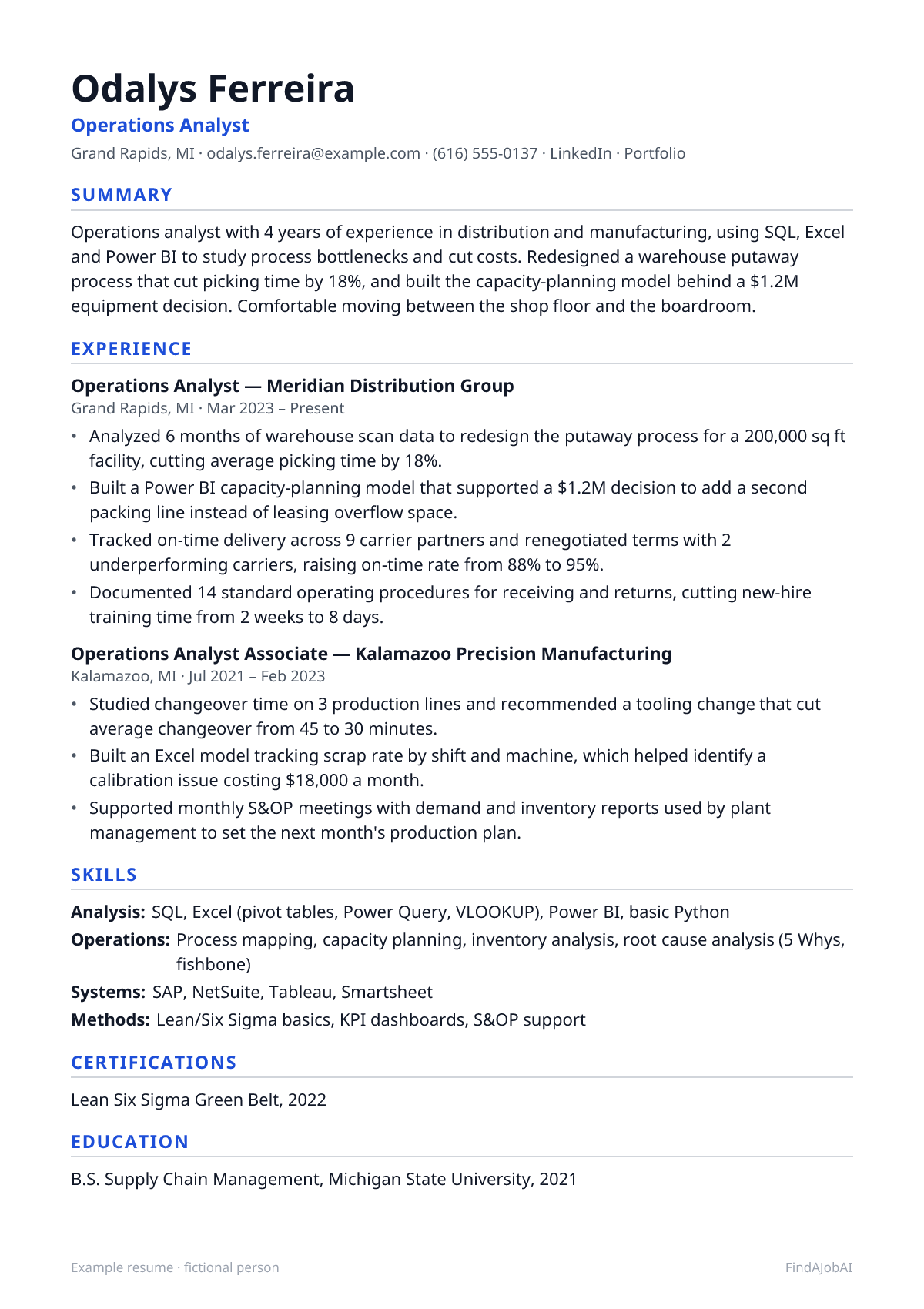
A complete one-page example for a fictional operations analyst: every bullet pairs an action with what changed because of it.
Example resume · fictional person
Odalys Ferreira
Operations Analyst
Grand Rapids, MI · [email protected] · (616) 555-0137 · LinkedIn · Portfolio
Summary
Operations analyst with 4 years of experience in distribution and manufacturing, using SQL, Excel and Power BI to study process bottlenecks and cut costs. Redesigned a warehouse putaway process that cut picking time by 18%, and built the capacity-planning model behind a $1.2M equipment decision. Comfortable moving between the shop floor and the boardroom.
Experience
Operations Analyst, Meridian Distribution Group
Grand Rapids, MI · Mar 2023 – Present
- Analyzed 6 months of warehouse scan data to redesign the putaway process for a 200,000 sq ft facility, cutting average picking time by 18%.
- Built a Power BI capacity-planning model that supported a $1.2M decision to add a second packing line instead of leasing overflow space.
- Tracked on-time delivery across 9 carrier partners and renegotiated terms with 2 underperforming carriers, raising on-time rate from 88% to 95%.
- Documented 14 standard operating procedures for receiving and returns, cutting new-hire training time from 2 weeks to 8 days.
Operations Analyst Associate, Kalamazoo Precision Manufacturing
Kalamazoo, MI · Jul 2021 – Feb 2023
- Studied changeover time on 3 production lines and recommended a tooling change that cut average changeover from 45 to 30 minutes.
- Built an Excel model tracking scrap rate by shift and machine, which helped identify a calibration issue costing $18,000 a month.
- Supported monthly S&OP meetings with demand and inventory reports used by plant management to set the next month's production plan.
Skills
- Analysis: SQL, Excel (pivot tables, Power Query, VLOOKUP), Power BI, basic Python
- Operations: Process mapping, capacity planning, inventory analysis, root cause analysis (5 Whys, fishbone)
- Systems: SAP, NetSuite, Tableau, Smartsheet
- Methods: Lean/Six Sigma basics, KPI dashboards, S&OP support
Certifications
- Lean Six Sigma Green Belt, 2022
Education
- B.S. Supply Chain Management, Michigan State University, 2021
Fictional example by the FindAJobAI team: the person, employers and numbers are invented. Keep the structure; use your own work and numbers you can explain in an interview.
Entry-level operations analyst resume example
A recent supply chain graduate with one internship scheduling production. Education sits under the summary, and a capstone project stands in for the warehouse experience she doesn't have yet, ending in a specific layout recommendation rather than a task list.
Entry-level example resume · fictional person
Calliope Nakashima
Operations Analyst
South Bend, IN · [email protected] · (574) 555-0128 · LinkedIn · Portfolio
Summary
Entry-level operations analyst with a B.S. in Supply Chain Management and a summer internship scheduling production at a food manufacturer. Built a capstone project modeling warehouse layout and labor needs in Excel, and knows basic SQL and process mapping. Looking for a first full-time analyst role in manufacturing or distribution.
Education
- B.S. Supply Chain Management, University of Notre Dame, 2026
Experience
Production Scheduling Intern, Heartland Harvest Foods
South Bend, IN · May 2026 – Aug 2026
- Built the weekly production schedule for 3 lines using Excel and the plant's order backlog, balancing changeovers to meet 95% of promised ship dates.
- Tracked downtime causes across 3 shifts for 10 weeks and found that un-scheduled maintenance caused 40% of lost hours, flagged to the maintenance lead.
- Shadowed the plant's S&OP meeting and built a one-page summary of demand versus capacity that the operations manager adopted for future meetings.
Supply Chain Capstone Project, University of Notre Dame
South Bend, IN · Sep 2025 – Dec 2025
- Modeled a warehouse layout redesign for a fictional 3PL client in Excel, projecting a 15% cut in picking travel distance.
- Presented findings to a panel of 4 supply chain faculty and 2 industry guests, scoring in the top 3 of 18 team projects.
Skills
- Analysis: Excel (pivot tables, VLOOKUP), SQL basics, process mapping
- Operations: Production scheduling, inventory basics, root cause analysis
- Systems: SAP (coursework), Power BI (coursework)
Certifications
- APICS CPIM Part 1, 2026
Projects
- Labor forecasting model (Excel): built a staffing model for a seasonal warehouse using 2 years of historical order data, projecting peak-week headcount within 5%.
- Inventory classification exercise (SQL, Excel): ran an ABC analysis on a public retail dataset of 5,000 SKUs to identify the 12% driving most revenue.
Senior operations analyst resume example
A team lead nine years in, now managing analysts across a distribution network. The bullets shift from single-site fixes to network-level decisions, standard methods adopted company-wide and the budget her team's analysis steers.
Senior example resume · fictional person
Thorsten Abimbola
Senior Operations Analyst
Memphis, TN · [email protected] · (901) 555-0150 · LinkedIn
Summary
Senior operations analyst and team lead with 9 years in logistics and manufacturing, managing 3 analysts and the capacity-planning model behind $8M in annual network decisions for a national distribution company. Built the standard process-review method used at 12 facilities and has cut company-wide overtime costs by $1.4M since 2022.
Experience
Senior Operations Analyst, Cascadia Freight Network
Memphis, TN · Feb 2021 – Present
- Lead a team of 3 analysts supporting network planning across 12 distribution centers, setting quarterly priorities with regional operations directors.
- Own the capacity-planning model that informed $8M in facility and equipment decisions over 3 years, including the choice to expand 2 sites instead of opening a new one.
- Standardized a process-review method now used at all 12 facilities, shortening the average improvement project from 10 weeks to 6.
- Led a labor-scheduling redesign across the network that cut overtime costs by $1.4M a year while holding on-time shipment rates steady.
Operations Analyst, Volkner Industrial Supply
Louisville, KY · Jun 2017 – Jan 2021
- Analyzed inventory turns across 40 SKU categories, recommending reorder point changes that freed $600,000 in tied-up stock.
- Built the Power BI dashboard tracking order-to-ship time for 2 warehouses, cutting average cycle time from 3.2 to 2.1 days.
- Trained 8 warehouse supervisors to read their own KPI dashboards, cutting ad hoc reporting requests to the analytics team by half.
Junior Operations Analyst, Bluegrass Parts Distribution
Louisville, KY · Aug 2014 – May 2017
- Tracked fill rate and backorders across 1,500 SKUs in Excel, flagging 60 chronic shortages that led to new supplier agreements.
- Supported monthly inventory counts at 2 warehouses, cutting count discrepancies from 4% to under 1% over 18 months.
Skills
- Analysis: SQL, Excel, Power BI, Python (basic), capacity modeling
- Operations: Network planning, inventory strategy, labor scheduling, Lean process reviews
- Leadership: Hiring and coaching analysts, cross-site standardization, executive reporting
Certifications
- Lean Six Sigma Black Belt, 2019
Education
- B.S. Industrial Engineering, University of Kentucky, 2014
How to write an operations analyst resume
Five steps, in the order a recruiter reads the page. The format around them stays plain for every job: one column, standard headings, newest role first.
Header: name, target title and links
Use the title “Operations Analyst” even if your title was Business Operations Specialist or Process Analyst, and name the type of operation (warehouse, manufacturing, retail, service) right under it.
Summary: what you do and your best proof
State your years of experience, your core tools (Excel, SQL, a BI tool) and one process or cost result, then the scale of the operation you supported. Skip lines like “detail-oriented team player”; a real number does that job better.
Experience: newest first, a result in every bullet
Open each bullet with the process or metric you studied, then the method and the measured change: a time cut, a cost saved or an error rate reduced. Listing duties like “analyzed data” says little; naming what changed after your analysis says a lot.
Skills: grouped, in the ad's words
Group tools into analysis (Excel, SQL, BI), operations methods (process mapping, root cause analysis) and systems (SAP, NetSuite, a specific WMS). Name your Lean or Six Sigma belt if you hold one.
Education and certifications
A supply chain, business or industrial engineering degree fits well here. Without analyst experience, add a Projects section with one or two exercises, such as an ABC analysis or a layout model, each with a stated recommendation.
Skills to put on an operations analyst resume
Hard skills are the tools and methods of the job; soft skills are how you work with people. Each comes with one way to prove it, because a skill named only in a list counts for little. Add the ones you really have.
Hard skills
- Excel
- Name the features you rely on (pivot tables, VLOOKUP, Power Query) next to a process or report they improved.
- SQL
- Point to the data you pulled for an analysis and the operational question it answered.
- Power BI / Tableau
- Say who checks your dashboard, how often, and one decision or issue it surfaced.
- Process mapping
- Name the process you mapped and the step count or time you cut after the redesign.
- Root cause analysis
- Reference a specific method (5 Whys, fishbone) and the cause it uncovered.
- Capacity planning
- Give the decision your model supported and its dollar size or timeframe.
- Inventory analysis
- Mention the SKU count or dollar value involved and what changed after your recommendation.
- ERP systems (SAP, NetSuite, Oracle)
- Name the specific modules you used, such as inventory or production planning.
- Lean / Six Sigma
- State your belt level and one project where you applied the method, with its result.
- S&OP support
- Describe the report or forecast you contributed and who used it to plan.
- Labor scheduling
- Give the headcount or shift count involved and the overtime or cost change that followed.
- KPI dashboard design
- Name the metric and the audience, and say what changed once it was visible.
Soft skills
- Cross-functional collaboration
- Name the teams involved in a specific project and what the collaboration changed.
- Communicating to non-analysts
- Describe translating a finding for shop-floor or warehouse staff, not just managers.
- Attention to detail
- Mention an error or discrepancy you caught before it affected a shipment or report.
- Prioritization
- Give your request volume and how you decided which process to study first.
- Project management
- Name a project's timeline and your role in keeping it on schedule.
- Adaptability
- Describe adjusting an analysis when data or priorities changed mid-project.
- Curiosity
- Describe a question you asked that wasn't assigned, and what it turned up.
Operations Analyst resume bullet examples: weak vs strong
The same work, written two ways. The strong version names the tool, the scope and a result; the numbers are examples, yours must be real.
Weak: Analyzed operations data.
Strong: Studied 4 months of forklift GPS data to find that 30% of travel time came from a single aisle layout, leading to a redesign that cut travel time by 12%.
Names the data source, the finding and the result.
Weak: Improved process efficiency.
Strong: Redesigned the returns intake process from a 7-step to a 4-step flow, cutting average processing time from 22 to 9 minutes per item.
Shows the before-and-after of the process itself.
Weak: Created reports for management.
Strong: Built a weekly Power BI report on line downtime that plant managers now check each Monday, which surfaced a recurring conveyor fault within its first month.
Reporting measured by who uses it and what it surfaced.
Weak: Reduced costs.
Strong: Traced a $40,000 monthly overage in packaging spend to an uncapped reorder rule and fixed the trigger, saving about $30,000 a month going forward.
A specific cause, fix and dollar result instead of a vague claim.
Weak: Worked cross-functionally with other teams.
Strong: Ran a joint review with procurement and the warehouse team that cut safety stock on 25 slow-moving SKUs, freeing $90,000 in tied-up inventory.
Shows collaboration through a concrete inventory result.
Weak: Used Excel for data analysis.
Strong: Built an Excel model with VLOOKUP and pivot tables to forecast weekly labor needs, cutting overtime hours by 15% over 2 quarters.
Turns a tool claim into a forecasting result with a number.
15 more operations analyst resume bullet examples
Grouped by area of the job, so you can find the ones closest to your work. Keep the shape (action, scope, result) and replace the invented numbers with your own.
Process improvement
- Mapped the order-to-cash process across 5 departments and cut average cycle time from 9 days to 6 by removing 2 redundant approval steps.
- Redesigned the receiving dock workflow at a 150,000 sq ft warehouse, cutting truck turnaround time from 55 to 35 minutes.
- Ran a 5 Whys analysis on recurring late shipments and traced 70% of delays to a single carrier's pickup schedule, leading to a new pickup window.
- Standardized the return-to-vendor process across 3 regional warehouses, cutting processing errors from 15% to 4%.
Inventory and cost
- Ran an ABC analysis on 4,000 SKUs and recommended tighter reorder points on the bottom 60%, freeing $250,000 in working capital.
- Traced a $22,000 monthly shipping cost increase to a routing error in the carrier system and worked with IT to fix it within a week.
- Analyzed scrap data across 2 production lines and identified a calibration drift costing $14,000 a month, flagged for maintenance.
- Cut safety stock on 80 slow-moving SKUs after a 12-month demand review, releasing $410,000 in tied-up inventory without increasing stockouts.
Reporting and planning
- Built the weekly operations scorecard used by 10 department leads, tracking 8 KPIs including fill rate, on-time delivery and labor cost per unit.
- Automated a monthly capacity report in Power BI, cutting preparation time from 2 days to 3 hours and catching 2 planning errors before they reached leadership.
- Forecasted seasonal labor needs for a distribution center of 300 employees, projecting peak staffing within 5% of actual need.
- Supported quarterly S&OP meetings with demand and inventory data for $40M in annual revenue, flagging 3 supply risks before they caused stockouts.
Cross-functional projects
- Partnered with procurement and warehouse teams on a vendor consolidation project that cut the supplier base from 45 to 28 without raising lead times.
- Led a joint review with IT to replace a manual spreadsheet tracker with a shared dashboard, cutting data entry errors by 90% across 2 teams.
- Trained 15 warehouse associates on a new scanning process during a system rollout, reaching full adoption within 2 weeks.
Operations Analyst resume summary examples
Two or three lines on what you do and your strongest proof. Start from the one closest to your level and use your own facts.
Operations analyst with a supply chain management degree and a summer internship scheduling production for a food manufacturer. Built a capstone project modeling warehouse layout in Excel, and is comfortable with SQL basics and process mapping.
Operations analyst with 4 years in retail and manufacturing operations, using SQL and Power BI to study bottlenecks. Redesigned a fulfillment process that cut average order time by 20% and supports monthly planning for a $40M distribution business.
Senior operations analyst with 9 years leading process improvement for a national logistics company, managing a team of 3 analysts and the capacity model behind $8M in annual network decisions.
Common operations analyst resume mistakes
Each one is easy to make and quick to fix before you apply.
Listing duties instead of process changes
"Analyzed operations data" says nothing about what changed. Name the process, the method and the before-and-after number.
No scale for the operation supported
A $2M warehouse and a $200M distribution network need different staffing. State facility size, order volume or budget so your numbers mean something.
Burying cost savings in a summary line only
A total savings figure in the summary is a good hook, but at least one bullet should show the specific process and fix behind it.
Treating every tool as equally important
List the tools you actually used for analysis (Excel, SQL, a BI tool) ahead of ones you only touched occasionally, and match the ad's priorities.
Vague cross-functional claims
"Worked with other departments" says little. Name the teams involved and the specific decision or process the collaboration changed.
ATS tips for an operations analyst resume
Applicant tracking systems turn your file into text that recruiters search, mostly for the skills and titles in the ad. They rarely reject a resume on their own; one that parses badly or misses the ad's words just doesn't come up.
- Name the systems you've worked in (SAP, NetSuite, a specific WMS); many operations roles are tied to one platform.
- Describe process changes with a before-and-after number: time, cost, error rate or throughput.
- If you hold a Lean or Six Sigma certification, name the belt level; it signals how deep your process training goes.
- Show cross-functional work by naming the teams involved and what the collaboration changed, not just that you "worked with stakeholders".
- Mention the size of the operation you supported (facility size, order volume, budget) to give your numbers context.
For the format itself, run the free ATS resume checklist.
Everything for Operations Analysts
- Operations Analyst cover letter examplesThree example letters and a short email version
- Operations Analyst interview questions30 questions with sample answers
- Operations Analyst job descriptionDuties, skills and requirements
- How to tailor your resume without lying
Other resume examples
Operations Analyst resume FAQ
What is the difference between an operations analyst and a business analyst resume?
An operations analyst resume leans on process, inventory and logistics metrics tied to a physical or service operation, while a business analyst resume often leans more on requirements gathering and software projects. Use whichever metrics match your actual work.
What tools should an operations analyst list on a resume?
Excel at a minimum, plus SQL or a BI tool if you use one, and any ERP or warehouse management system specific to your industry, such as SAP or NetSuite.
How do I show impact on an operations analyst resume without a business degree?
Count what changed after your analysis: hours saved, errors reduced, cost avoided. Hiring managers read those numbers regardless of your degree.
Should an operations analyst resume include Six Sigma certification?
Yes, if you hold one. Name the belt level (Yellow, Green, Black) since it signals how much process improvement training you've had.
How we built this page
The FindAJobAI team wrote the three example resumes, the bullets, the skills and the advice for operations analyst roles. The people, employers and numbers in the examples are invented; the structure, the tools and the way each bullet is built are the parts to copy.
Once we track enough live operations analyst job ads, this page also shows the skills they ask for most, counted the same way as our in-demand skills report.
Last reviewed on November 1, 2026.