Aerospace Engineer Cover Letter Example (2026)
By FindAJobAI Team Updated How we built this page
Aerospace hiring managers read cover letters to confirm discipline fit and judgment. The best letters name the hardware you've worked on, tell one technical problem where your analysis or design changed an outcome, and show you understand the test and certification discipline that makes aerospace different from other engineering.
Aerospace Engineer cover letter template
This letter as a one-page template: an opening that names the job and your strongest fact, proof that answers the ad, a reason for this employer and a short close.
After you sign up, FindAJobAI drafts your own letter for a real job from your CV in this format, and you edit it before you send it.
Example 1 · Experienced
Aircraft stress engineer applying to a launch vehicle company
Annika does certification stress work on business jet structures. The ad is for a structures engineer on launch vehicle tanks and interstages.
Example letter · fictional
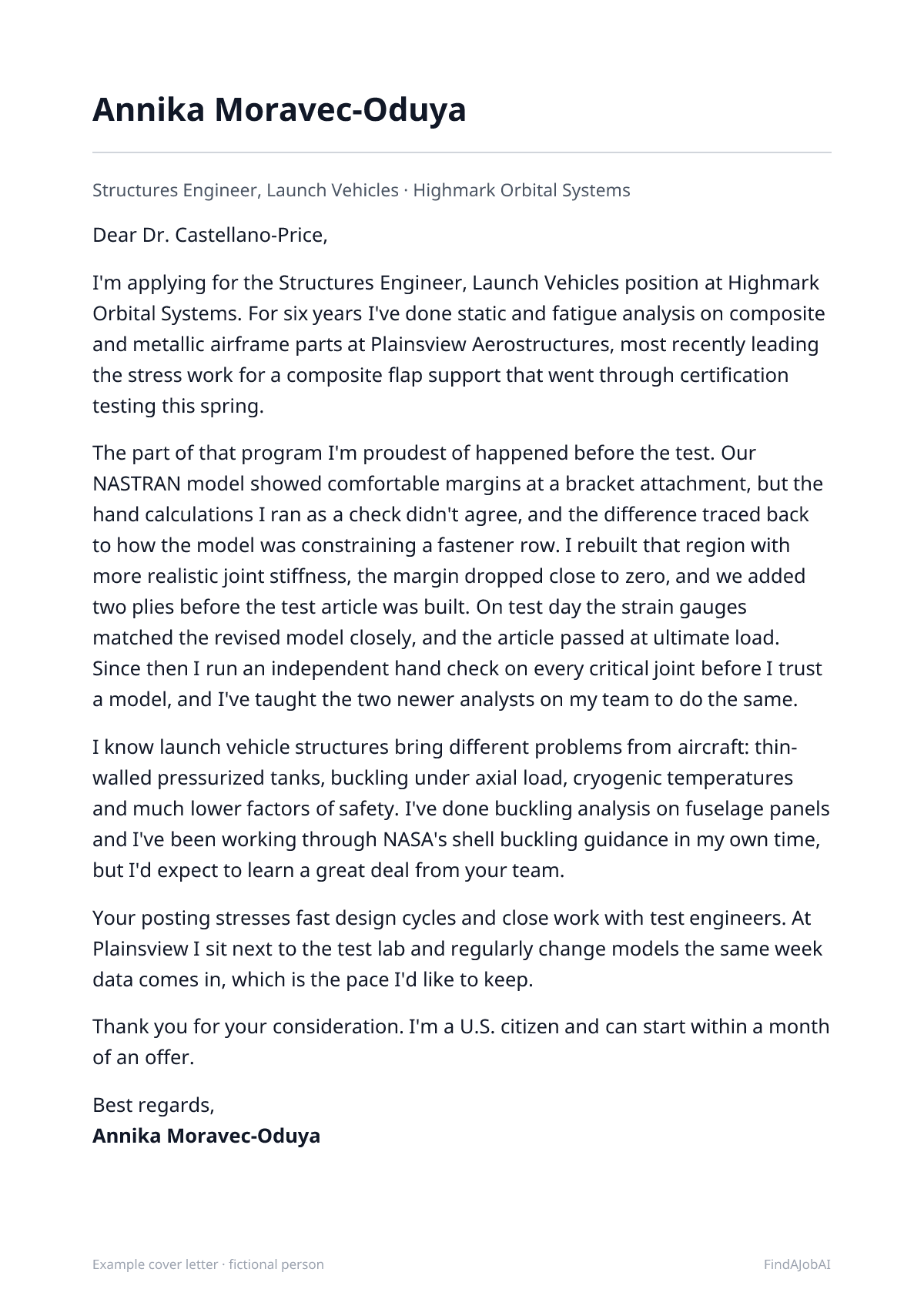
Dear Dr. Castellano-Price,
I'm applying for the Structures Engineer, Launch Vehicles position at Highmark Orbital Systems. For six years I've done static and fatigue analysis on composite and metallic airframe parts at Plainsview Aerostructures, most recently leading the stress work for a composite flap support that went through certification testing this spring.
The part of that program I'm proudest of happened before the test. Our NASTRAN model showed comfortable margins at a bracket attachment, but the hand calculations I ran as a check didn't agree, and the difference traced back to how the model was constraining a fastener row. I rebuilt that region with more realistic joint stiffness, the margin dropped close to zero, and we added two plies before the test article was built. On test day the strain gauges matched the revised model closely, and the article passed at ultimate load. Since then I run an independent hand check on every critical joint before I trust a model, and I've taught the two newer analysts on my team to do the same.
I know launch vehicle structures bring different problems from aircraft: thin-walled pressurized tanks, buckling under axial load, cryogenic temperatures and much lower factors of safety. I've done buckling analysis on fuselage panels and I've been working through NASA's shell buckling guidance in my own time, but I'd expect to learn a great deal from your team.
Your posting stresses fast design cycles and close work with test engineers. At Plainsview I sit next to the test lab and regularly change models the same week data comes in, which is the pace I'd like to keep.
Thank you for your consideration. I'm a U.S. citizen and can start within a month of an offer.
Best regards,
Annika Moravec-Oduya
Example 2 · Entry level
New aerospace graduate applying for a propulsion engineering role
Mateus led propulsion on a student rocketry team and interned at an engine test site. The ad is for an entry-level propulsion engineer.
Example letter · fictional
Dear Ms. Antonelli-Groves,
I'm applying for the Propulsion Engineer I role at Redline Propulsion Labs. I'll graduate in May with a B.S. in aerospace engineering from Purdue, where I spent three years on our student liquid rocketry team, the last one as propulsion lead.
Our team built a kerosene and liquid oxygen engine with a target thrust of about 1,000 pounds. During our second hot fire, chamber pressure oscillated badly and we shut down early. I went through the high-speed pressure data with our advisor, matched the oscillation frequency to the feed system rather than the chamber, and redesigned the injector manifold to stiffen the oxidizer side. The next three hot fires ran to full duration with stable pressure. I wrote up the investigation as a short report for the next year's team, including the two ideas that didn't work, so they wouldn't repeat them.
Last summer I interned at an engine test stand in Mississippi, where I wrote test procedures, helped install pressure transducers and thermocouples and reduced data in Python after each run. By the end of the summer the test engineers had me preparing the first-look plots they reviewed each evening before planning the next day's firing. That's where I learned how much careful procedures matter when you're working around high-pressure propellants.
Your ad mentions injector and combustion stability work, which is exactly the problem I enjoyed most on our team. I still have a lot to learn about production engine design and analysis tools, and I'd welcome a role where I can learn from experienced engineers on the test stand and at the desk.
Thank you for your time. I'm a U.S. citizen, available to start in June, and happy to relocate.
Sincerely,
Mateus Fairbanks-Iwu
Example 3 · Senior or lead
Lead structures engineer applying for a chief engineer role
Bartosz leads a ten-person analysis team at an airframer. The ad is for a chief engineer, structures, on a new eVTOL aircraft program.
Example letter · fictional
Dear Mr. Okafor-Lindholm,
I'm writing about the Chief Engineer, Structures role at Skyward Air Mobility. I've worked sixteen years in aircraft structures, the last five leading a ten-engineer analysis group at Great Lakes Airframes, where we own structural substantiation for a business jet fuselage program.
The hardest part of my current role has been getting analysis, design and test to move together. Two years ago our certification schedule was slipping because reports were written after designs were frozen, and every late finding forced a redesign. I set up a joint weekly review where stress engineers saw designs while they were still in CAD, and we agreed with the FAA designee on which areas needed test rather than analysis early on. We closed the next major milestone on time, and the review is now standard across the program.
Your posting describes a composite airframe with distributed electric propulsion and a certification path the FAA is still shaping. I haven't certified an eVTOL, and I know the special conditions and the battery and rotor loads are new territory. What I can bring is a structured substantiation plan, a team that writes reports reviewers trust, and a habit of agreeing the method with regulators before spending months on analysis.
I've never led a group larger than twelve or set a structures budget from scratch, and I'd want to understand your test facilities and supplier base before committing to a plan. I'd also want to meet your FAA project team early, since the agreed certification basis will shape every structural decision after it.
Thank you for reading. I'd welcome a conversation about where your structures program stands today.
Kind regards,
Bartosz Achebe-Whitfield
All three letters, and the short version below, are fictional: the people, employers and numbers are invented. Borrow the structure, never the facts.
- Prefer to write it yourself? Use the free cover letter template.
- Check your CV against the job first: the free CV score shows the missing keywords.
Why the first letter works, paragraph by paragraph
Paragraph 1: Opening
Names discipline, years, hardware type and a recent certification program in two sentences, so the reader sees a structures specialist at once.
Paragraph 2: The margin she caught
A hand calculation that disagreed with the FEA, a modeling fix and a passed test show exactly the judgment structures leads look for, with a clear outcome.
Paragraph 3: The domain switch
She names how launch vehicles differ from aircraft and what she's done to prepare, which shows she understands the move instead of assuming skills transfer.
Paragraph 4: Matching the pace of the team
Links her close work with test engineers to the company's fast design cycle, a detail taken straight from the ad.
Paragraph 5: Close
States citizenship, which ITAR roles require, and a start date, removing two common questions.
What the entry-level letter does differently
The new graduate's letter uses a student rocketry problem as real engineering evidence: a combustion instability, data analysis, a design change and stable hot fires afterward. The internship adds test stand discipline, and he's honest that production engine work is still ahead of him.
What the senior letter does differently
A chief engineer letter should show how the writer organizes teams and regulators, not personal analysis skill. Bartosz's joint design review and early agreement with the designee address schedule risk, and he names the eVTOL-specific gaps and his limited budget experience plainly.
Short aerospace engineer cover letter: an email-ready version
Many applications arrive as an email or a small text box, and a full page doesn't fit. This version runs 120 to 150 words and keeps only what a reader needs to decide whether to reply. An aerospace engineer applies through a recruiter's portal with a short message field, so the note is written as a brief email.
Short version · email · fictional126 words
Subject: Systems Engineer – 5 years requirements and verification, DO-160 testing – Delphine Kowalczyk-Hart
Hello Ms. Tanaka-Brooks,
I'm applying for the Systems Engineer position at Northwind Avionics. I have five years of requirements management and verification on cockpit display units, including planning and running DO-160 environmental qualification tests.
On my current program I reorganized our requirements traceability in DOORS so each test procedure linked directly to the requirements it verified, which cut the time spent preparing for certification audits and helped us close our verification matrix two weeks early. I also wrote the environmental test procedures for vibration, temperature and humidity and witnessed each run at the lab.
I'm a U.S. citizen and looking for a role closer to the design side. My resume is attached, and I'm free for a call on most weekday afternoons.
Thank you,
Delphine Kowalczyk-Hart
The short version names discipline, product and the qualification standard first, then one concrete result about traceability and audit readiness. It adds citizenship because avionics roles often fall under export rules.
Opening lines that work for aerospace engineer cover letters
The first sentence decides whether the second gets read. Here are six openings, one for each situation you might be in. Pick the one that matches yours and swap in your own facts: every name and number below is invented.
1. You have a standout result
My hand calculations disagreed with our FEA at a bracket attachment, and the fix we made before testing helped the article pass at ultimate load. That kind of check is what I'd bring to your structures team.
2. The ad names a problem you've solved
Your posting asks for structures engineers who can move quickly between analysis and test, which is how I've worked for six years next to the test lab at an aerostructures supplier.
3. Someone referred you
Your propulsion lead, Ignacio Varga, was my mentor during a test stand internship last summer, and he suggested I apply for your entry-level propulsion engineer role.
4. You admire what they build
I watched your vehicle's first orbital launch live from the beach with my rocketry team, and that day is a big part of why I want to work on your structures.
5. You're new to the field or switching into it
After three years building and firing liquid rocket engines on a student team, I'm ready to work on flight propulsion hardware full time as a propulsion engineer.
6. You have senior scope or a specialism
Sixteen years in aircraft structures and five leading a substantiation team have prepared me to set up your structures organization and certification plan from the ground up.
How to write an aerospace engineer cover letter
Five steps, in the order you'd write them. The shape stays the same for every job (a short opening, proof, a reason for this employer, a close), and what goes into each part is what changes with the role.
Name your discipline and hardware first
Structures, aerodynamics, propulsion, systems and flight test are separate careers. Open with yours and the aircraft, engine or spacecraft you've worked on, so the hiring manager can match you to the team and program in the first two sentences.
Tell one technical story with a test or design outcome
Choose a problem where your analysis, design or testing changed a decision: a margin caught, a weight saving, an instability solved. Explain how you checked your result and what happened in test or certification, which shows the rigor aerospace teams expect.
Show you understand certification or flight risk
Aerospace differs from other engineering because failure has serious consequences. Mention certification reports, test plans, design reviews or safety factors you've worked with, so the reader sees you respect the process instead of seeing it as paperwork.
Address domain changes honestly
Moving from aircraft to space, defense to commercial, or student work to industry is common. Name what's different, what you've done to prepare, and what you expect to learn, so the reader knows you've thought about the switch carefully.
Handle citizenship and clearance briefly
Many aerospace roles are controlled by ITAR or require a security clearance. If the posting asks, state your citizenship or clearance status in one sentence near the end so the recruiter can move your application forward without an extra email.
Aerospace Engineer cover letter do's and don'ts
Do
- Name your discipline and the hardware or vehicles you've worked on in the first paragraph.
- Tell one technical problem where your analysis, design or test work changed the outcome.
- State citizenship or clearance status if the role involves ITAR or defense work.
Don't
- Don't say you've loved airplanes since childhood without connecting it to real work.
- Don't list every software package; mention the tools tied to your story.
- Don't claim expertise in a discipline you've only touched in coursework.
Common aerospace engineer cover letter mistakes
Each one is easy to make and quick to fix before you send the letter.
Leading with childhood passion for flight
Many applicants open this way. Lead with your discipline and a technical result instead, and save personal motivation for one short line if you include it at all.
Describing analysis without validation
Results that were never checked carry little weight. Mention hand checks, test correlation or reviewer acceptance so the reader trusts your numbers.
Ignoring weight, schedule or test outcomes
Aerospace managers remember weight saved, tests passed and milestones met. Connect your story to at least one of these so its value is clear.
Skipping citizenship when the role requires it
Recruiters for ITAR or cleared roles may set aside applications that don't address it. A single sentence stating your status prevents that.
Email subject lines for aerospace engineer applications
Applying by email? Put the job title, any reference number and your name in the subject line.
- Structures Engineer, Launch Vehicles – 6 years composite stress analysis – Annika Moravec-Oduya
- Propulsion Engineer I – liquid rocketry team lead, test stand intern – Mateus Fairbanks-Iwu
- Application: Structures Engineer (Req. 3197), U.S. citizen – Annika Moravec-Oduya
Everything for Aerospace Engineers
- Aerospace Engineer resume exampleA full resume, plus bullet and summary examples
- Aerospace Engineer interview questions30 questions with sample answers
- Aerospace Engineer job descriptionDuties, skills and requirements
- Cover letter with no experience: templates
Other cover letter examples
Aerospace Engineer cover letter FAQ
What should an aerospace engineer cover letter include?
Your discipline, the hardware you've worked on and one technical problem you solved, with how analysis or test confirmed it. Mention certification or test experience and citizenship or clearance if the role requires it.
How do I write an aerospace cover letter as a new graduate?
Use student team or senior design work as evidence: the subsystem you owned, a problem you solved and the test result. Add internships with specific tasks, and be clear about what you still want to learn.
Should I mention ITAR or citizenship in my cover letter?
If the posting says the role requires U.S. person status or a clearance, state your status briefly in the closing. It saves the recruiter a step and prevents your application being set aside.
How we built this page
The FindAJobAI team wrote the three example letters, the short email version, the opening lines and the advice for aerospace engineer roles. The people, employers and numbers in the letters are invented; the structure, the kind of evidence and the order of the paragraphs are the parts to copy.
Once we track enough live aerospace engineer job ads, this page also shows the skills they ask for most, counted the same way as our in-demand skills report.
Last reviewed on November 1, 2026.