Anesthesia Technician Cover Letter Example (2026)
By FindAJobAI Team Updated How we built this page
Anesthesia technician ads list the same certification, the same equipment and the same "fast-paced OR" line, so most applications blur together. A cover letter lets you show what an anesthesiologist actually cares about: that the right equipment is in the room before anyone asks, that machine checks are never skipped, and that you stay steady when an airway or a bleed turns a routine case into an emergency.
Anesthesia Technician cover letter template
This letter as a one-page template: an opening that names the job and your strongest fact, proof that answers the ad, a reason for this employer and a short close.
After you sign up, FindAJobAI drafts your own letter for a real job from your CV in this format, and you edit it before you send it.
Example 1 · Experienced
Anesthesia technician applying to a Level I trauma center
Marguerite works at a community hospital and wants trauma and cardiac work. The ad stresses emergency response and invasive monitoring.
Example letter · fictional
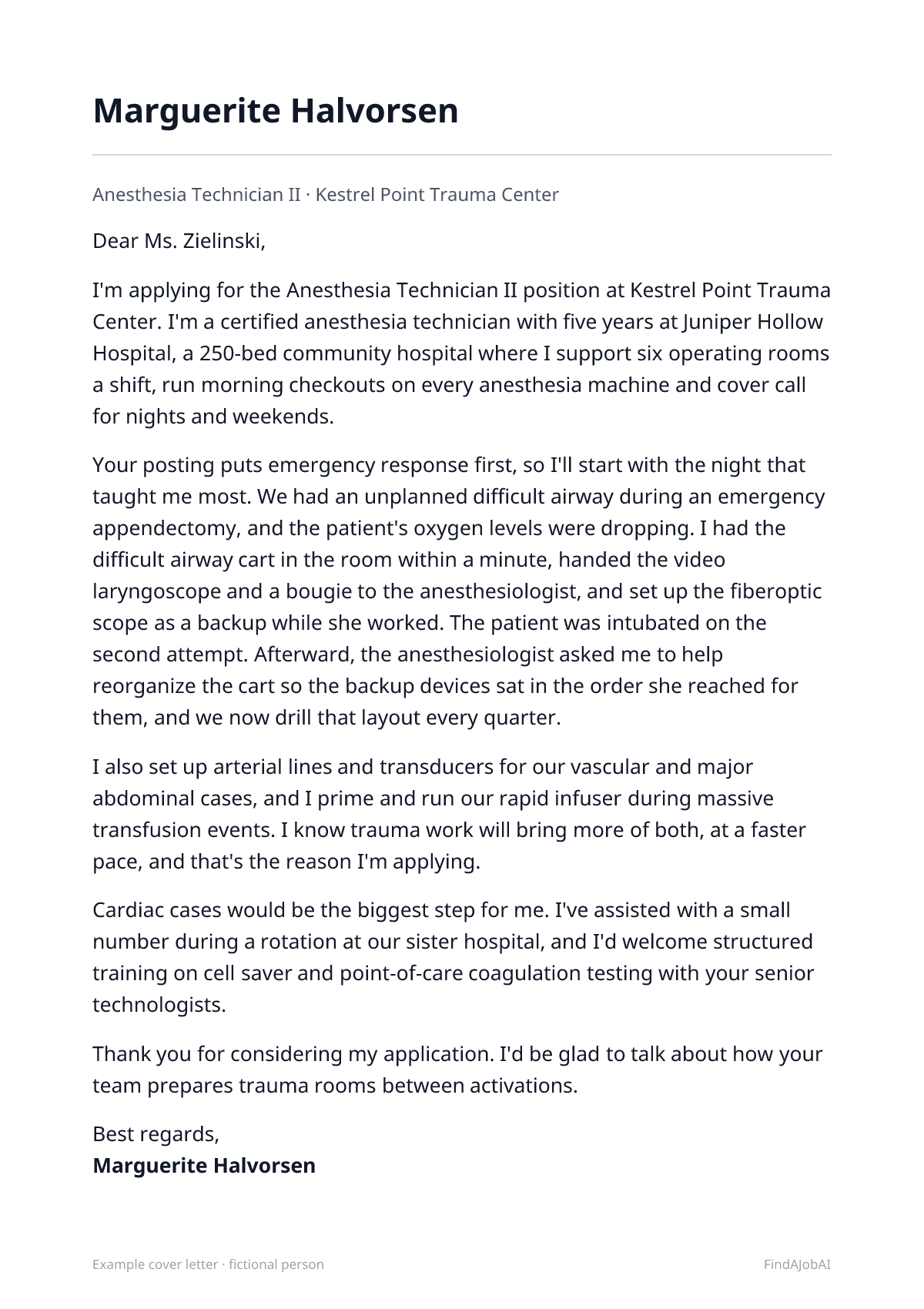
Dear Ms. Zielinski,
I'm applying for the Anesthesia Technician II position at Kestrel Point Trauma Center. I'm a certified anesthesia technician with five years at Juniper Hollow Hospital, a 250-bed community hospital where I support six operating rooms a shift, run morning checkouts on every anesthesia machine and cover call for nights and weekends.
Your posting puts emergency response first, so I'll start with the night that taught me most. We had an unplanned difficult airway during an emergency appendectomy, and the patient's oxygen levels were dropping. I had the difficult airway cart in the room within a minute, handed the video laryngoscope and a bougie to the anesthesiologist, and set up the fiberoptic scope as a backup while she worked. The patient was intubated on the second attempt. Afterward, the anesthesiologist asked me to help reorganize the cart so the backup devices sat in the order she reached for them, and we now drill that layout every quarter.
I also set up arterial lines and transducers for our vascular and major abdominal cases, and I prime and run our rapid infuser during massive transfusion events. I know trauma work will bring more of both, at a faster pace, and that's the reason I'm applying.
Cardiac cases would be the biggest step for me. I've assisted with a small number during a rotation at our sister hospital, and I'd welcome structured training on cell saver and point-of-care coagulation testing with your senior technologists.
Thank you for considering my application. I'd be glad to talk about how your team prepares trauma rooms between activations.
Best regards,
Marguerite Halvorsen
Example 2 · Career changer
Sterile processing technician moving into anesthesia technology
Florian spent four years in sterile processing and just finished an anesthesia technology program. The ad is for an entry-level anesthesia tech.
Example letter · fictional
Dear Mr. Acheson,
I'm applying for the Anesthesia Technician role at Larkfield Surgical Hospital. I've worked in sterile processing at Weston Hills Medical Center for four years, and in May I completed an anesthesia technology certificate with 600 clinical hours. I'm sitting the Cer.A.T. exam in July.
Sterile processing gave me habits that matter in anesthesia. I've decontaminated and assembled thousands of instrument trays, so high-level disinfection of laryngoscope blades and airway equipment already feels routine. More importantly, I learned that a missing item in a tray can delay an entire surgical team, which is why I check every setup twice before I call it ready.
My clinical hours gave me the anesthesia-specific skills. I supported about 250 cases at a teaching hospital, completed more than a hundred supervised machine checkouts and set up arterial line transducers for cardiac cases under a senior technologist. During one rotation, I noticed the CO2 absorbent canister on a machine had changed colour during morning checks and replaced it before the first case. My preceptor wrote that catch into my final evaluation.
Your posting mentions a busy orthopedic and spine schedule with early starts. I'm used to six o'clock shifts from sterile processing, and I know how much a surgical day depends on rooms being ready before the team arrives. I'd bring that discipline, plus fresh clinical training and a real eagerness to learn from your senior technologists, to your anesthesia department.
Thank you for your time. I'd be glad to come in for a working interview or a shadow shift whenever it suits your team.
Kind regards,
Florian Abernethy
Example 3 · Senior or lead
Lead anesthesia technologist applying to manage a hospital system's anesthesia tech program
Genevieve leads anesthesia techs at one hospital and wants to manage them across three. The ad stresses equipment programs and training.
Example letter · fictional
Dear Dr. Caldicott,
I'm applying for the Anesthesia Technology Manager position at Brightwell Health Partners. I'm a Cer.A.T.T. with thirteen years in anesthesia technology, and for the past five years I've led a team of ten technicians covering twenty-four operating rooms and several off-site locations at Ravensworth Medical Center.
Your posting highlights equipment reliability and standard training across sites. When I became lead, our preventive maintenance records lived in three spreadsheets and nobody could say which devices were overdue. I worked with biomedical engineering to move every anesthesia device into one tracking schedule, assigned weekly checks to named technicians and started a monthly report for our anesthesia chair. Overdue maintenance items dropped from dozens to a handful, and we haven't cancelled a case for equipment in over two years.
Training was the other gap. New technicians learned from whoever was on shift, so skills varied widely. I wrote a ten-week orientation with signed competencies for machine checkout, invasive monitoring, rapid infusers and emergency carts, and paired each new hire with one preceptor. Our last six hires all completed it, and anesthesiologists now ask for newer techs by name in trauma rooms.
I still take trauma and cardiac rooms on busy days, because I want my team to see me doing the work I ask of them. I haven't managed teams across separate hospitals, and I'd plan to spend my first weeks at each site learning their equipment, staffing and habits before proposing any changes.
I'd welcome the chance to talk about your equipment goals and how training works across your hospitals today.
Sincerely,
Genevieve Haverford
All three letters, and the short version below, are fictional: the people, employers and numbers are invented. Borrow the structure, never the facts.
- Prefer to write it yourself? Use the free cover letter template.
- Check your CV against the job first: the free CV score shows the missing keywords.
Why the first letter works, paragraph by paragraph
Paragraph 1: Opening
Gives certification, hospital size, rooms per shift and call coverage in two sentences, which answers the main screening questions right away.
Paragraph 2: Emergency story
A specific difficult airway shows speed, the exact equipment handed over and a follow-up improvement, which proves calm judgment rather than claiming it.
Paragraph 3: Monitoring and infusers
Briefly covers arterial lines, transducers and rapid infuser work, matching the posting's invasive monitoring requirement without a long list.
Paragraph 4: Honest gap
Names cardiac cases as the biggest step and asks for structured training, which builds trust with a manager who will check anyway.
Paragraph 5: Close
Offers a specific topic, trauma room preparation, that shows the writer is already thinking about the new department's workflow.
What the career changer's letter does differently
The career changer's letter turns sterile processing into an advantage: disinfection skills, tray accuracy and early-shift discipline. It then shows anesthesia training through case counts, machine checkouts and one real catch during morning checks, and names the exam date so the employer knows certification is close.
What the senior letter does differently
A lead technologist's letter reports systems: one maintenance schedule, a monthly report, a ten-week orientation with signed competencies. It still shows the writer covers trauma and cardiac rooms personally, and names multi-hospital management as an honest gap with a plan to learn each site first.
Short anesthesia technician cover letter: an email-ready version
Many applications arrive as an email or a small text box, and a full page doesn't fit. This version runs 120 to 150 words and keeps only what a reader needs to decide whether to reply. An anesthesia technician replies to a hospital recruiter's LinkedIn message about a night-shift opening, attaching a resume.
Short version · email · fictional125 words
Subject: Anesthesia Technician, nights – Cer.A.T., trauma call experience – Lucian Przybylski
Hello Ms. Esterhazy,
Thank you for your message about the night-shift Anesthesia Technician opening at Silverlake Medical Center. I'm Cer.A.T. certified with three years at a busy community hospital, where I cover nights and weekend call for six operating rooms and labor and delivery.
On nights I'm often the only anesthesia tech in the building, so I'm used to setting up emergency cases quickly, running the rapid infuser for trauma and bringing the difficult airway cart without waiting to be asked. I also keep the machine checkout log complete for the day team, so first cases start on time.
My resume is attached. I'm available to talk any weekday afternoon, and I can start with two weeks' notice to my current employer.
Best,
Lucian Przybylski
The short version answers what a recruiter needs for a night role: certification, independent night experience, emergency skills and start date. It skips stories and equipment detail that the hiring manager can explore later in an interview.
Opening lines that work for anesthesia technician cover letters
The first sentence decides whether the second gets read. Here are six openings, one for each situation you might be in. Pick the one that matches yours and swap in your own facts: every name and number below is invented.
1. You have a standout result
During an unplanned difficult airway last spring, I had the airway cart and fiberoptic scope ready within a minute. I'd like to bring that kind of readiness to your trauma operating rooms.
2. The ad names a problem you've solved
Your posting asks for an anesthesia technician who can support a busy multi-room schedule. I cover six rooms a shift and run morning checkouts on every machine before first cases.
3. Someone referred you
Your lead anesthesia technologist, Henrike Castellano, precepted me during my clinical rotation. She encouraged me to apply when your evening position opened, knowing I wanted more trauma experience.
4. You admire what they build
My father had heart surgery at your hospital, and the calm way the whole anesthesia team worked stayed with me. That experience is why I trained as an anesthesia technician.
5. You're new to the field or switching into it
After four years in sterile processing, I completed an anesthesia technology program with 600 clinical hours. I'd like to bring my disinfection and setup discipline into a direct anesthesia role.
6. You have senior scope or a specialism
As lead anesthesia technologist, I built our equipment maintenance schedule and a ten-week orientation program. I'm now looking for a role where I can build those systems across several hospitals.
How to write an anesthesia technician cover letter
Five steps, in the order you'd write them. The shape stays the same for every job (a short opening, proof, a reason for this employer, a close), and what goes into each part is what changes with the role.
Open with an emergency or a catch
Start with one real moment: a difficult airway, a massive transfusion or a fault found during morning checks. Anesthesia teams trust techs who are ready before they're asked, and a specific story in the first lines shows that more clearly than any description of yourself.
Give your setting, rooms and certification early
State your Cer.A.T. status, the type of facility and how many rooms you cover per shift in the first paragraph. These details answer the manager's first questions and let the rest of the letter focus on the stories that set you apart.
Match the equipment the posting names
If the ad mentions invasive monitoring, rapid infusers, cell saver or point-of-care testing, say which you already use and how often. Pick the two or three that matter most rather than listing every device, and keep each mention tied to real work.
Be honest about case types you haven't supported
Cardiac, transplant or pediatric anesthesia each need specific skills. If you haven't supported them, say so briefly and name related experience you do have. Asking for structured training shows maturity, and it matches what managers will learn at a shadow shift.
Close with shift availability and an offer to shadow
Mention shift preferences, call availability or start date if the posting stresses them, and offer a shadow shift or working interview. Anesthesia departments often need nights and weekends covered, so clear availability can move your application forward quickly.
Anesthesia Technician cover letter do's and don'ts
Do
- Describe one emergency or near miss and the exact equipment or steps you handled.
- State your Cer.A.T. status, or the exam date if you're eligible.
- Mention how many rooms and cases you support so the reader can judge your pace.
- Name the equipment from the ad that you already use, such as rapid infusers or invasive monitoring.
Don't
- Don't list every device you've touched; pick the ones the posting cares about and show them in use.
- Don't claim cardiac or transplant experience you haven't had; describe what you've done and offer to learn.
- Don't forget cleaning and stock work; anesthesia managers rely on techs for both.
Common anesthesia technician cover letter mistakes
Each one is easy to make and quick to fix before you send the letter.
Writing a list of equipment instead of a story
A paragraph of device names reads like a resume. Choose one or two devices from the ad and show them in a real case, such as priming a rapid infuser during a trauma activation.
Skipping emergency experience
Managers want to know how you act when a case goes wrong. Describe one emergency or drill and your role, keeping patient details out and focusing on the steps you took.
Overclaiming advanced cases
Claiming cardiac or transplant experience you don't have is easy to expose on a shadow shift. Describe what you've supported and ask for training in the rest.
Leaving out certification status
Cer.A.T. is a common requirement or near-term expectation. State that you're certified, or give your exam date, so the manager doesn't have to search your resume.
Ignoring shift and call needs
Many anesthesia openings exist because nights, weekends or call are hard to cover. If you can work them, say so clearly near the close of your letter.
Email subject lines for anesthesia technician applications
Applying by email? Put the job title, any reference number and your name in the subject line.
- Anesthesia Technician II – Cer.A.T., difficult airway and rapid infuser work – Marguerite Halvorsen
- Anesthesia Technician – sterile processing background, 600 clinical hours – Florian Abernethy
- Application: Anesthesia Technician II, Kestrel Point (Req. 7724) – Marguerite Halvorsen
Everything for Anesthesia Technicians
- Anesthesia Technician resume exampleA full resume, plus bullet and summary examples
- Anesthesia Technician interview questions30 questions with sample answers
- Anesthesia Technician job descriptionDuties, skills and requirements
- Career change cover letter: template + examples
Other cover letter examples
Anesthesia Technician cover letter FAQ
What should an anesthesia technician cover letter include?
Your certification and setting in one line, then one story about an emergency or a catch during equipment checks. Add a sentence on the equipment the posting stresses, and close with something specific about the department, such as its trauma or cardiac service.
How do I write an anesthesia technician cover letter with no experience?
Lead with your anesthesia technology program, clinical hours and case count. Connect related work, such as sterile processing, EMT or OR assistant roles, to the habits anesthesia teams need, like careful setups and calm work under pressure, and offer a shadow shift.
Should I mention emergencies in an anesthesia technician cover letter?
Yes, if you have a real example. A short story about a difficult airway, malignant hyperthermia drill or massive transfusion shows how you act under pressure. Focus on what you did and keep patient details out of it.
How we built this page
The FindAJobAI team wrote the three example letters, the short email version, the opening lines and the advice for anesthesia technician roles. The people, employers and numbers in the letters are invented; the structure, the kind of evidence and the order of the paragraphs are the parts to copy.
Once we track enough live anesthesia technician job ads, this page also shows the skills they ask for most, counted the same way as our in-demand skills report.
Last reviewed on November 1, 2026.