EMT Cover Letter Example (2026)
By FindAJobAI Team Updated How we built this page
EMT hiring managers read a stack of letters that all say "I want to help people." Yours should show what kind of service you've worked on, how many calls you run, one moment where your judgment or calm made a difference, and the practical facts a supervisor needs: certifications, driving record and the shifts you can work.
EMT cover letter template
This letter as a one-page template: an opening that names the job and your strongest fact, proof that answers the ad, a reason for this employer and a short close.
After you sign up, FindAJobAI drafts your own letter for a real job from your CV in this format, and you edit it before you send it.
Example 1 · Experienced
911 EMT applying to a county EMS agency
Owen has run calls on a private 911 and transfer service for four years. The county ad wants busy-system experience and strong charting.
Example letter · fictional
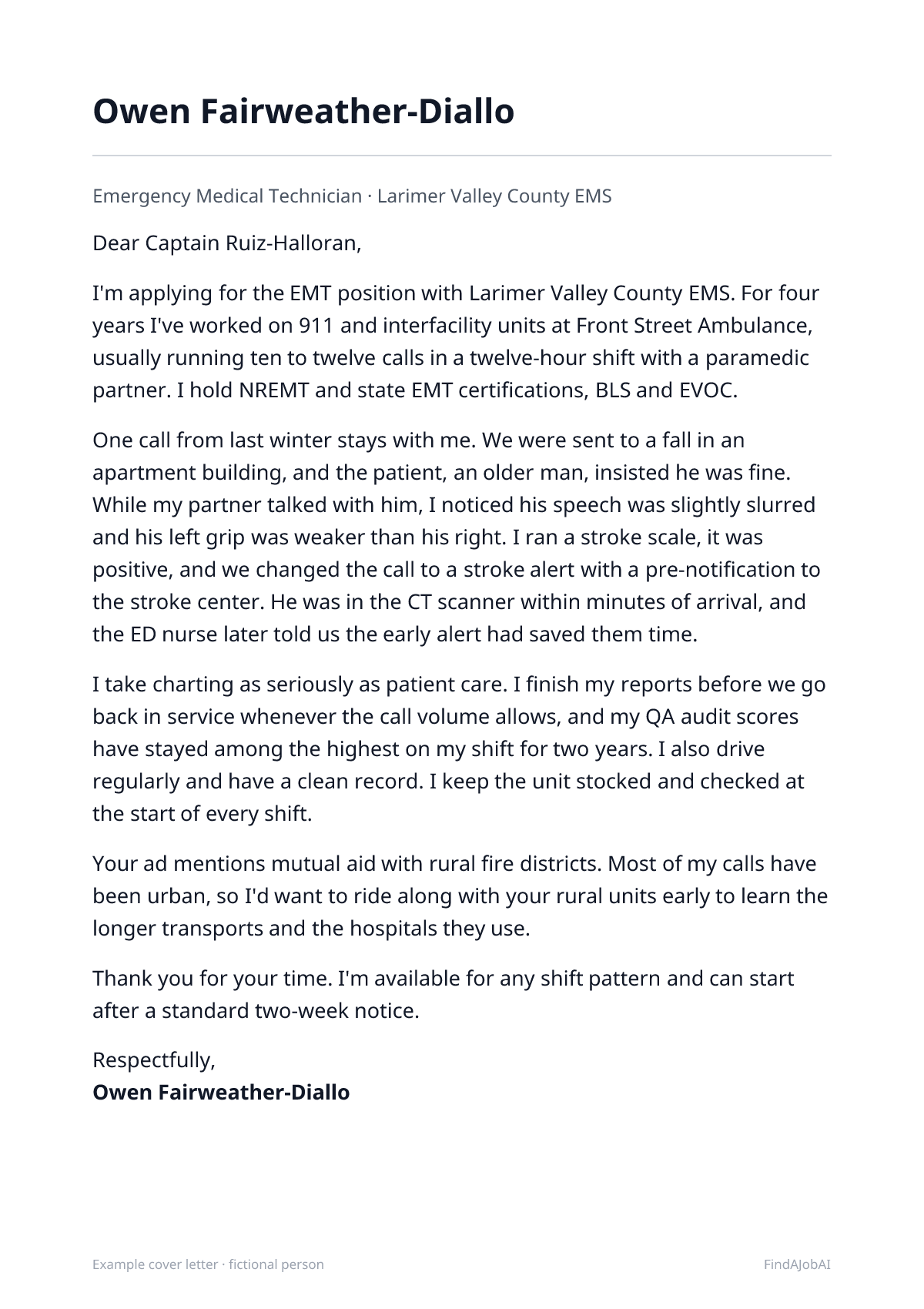
Dear Captain Ruiz-Halloran,
I'm applying for the EMT position with Larimer Valley County EMS. For four years I've worked on 911 and interfacility units at Front Street Ambulance, usually running ten to twelve calls in a twelve-hour shift with a paramedic partner. I hold NREMT and state EMT certifications, BLS and EVOC.
One call from last winter stays with me. We were sent to a fall in an apartment building, and the patient, an older man, insisted he was fine. While my partner talked with him, I noticed his speech was slightly slurred and his left grip was weaker than his right. I ran a stroke scale, it was positive, and we changed the call to a stroke alert with a pre-notification to the stroke center. He was in the CT scanner within minutes of arrival, and the ED nurse later told us the early alert had saved them time.
I take charting as seriously as patient care. I finish my reports before we go back in service whenever the call volume allows, and my QA audit scores have stayed among the highest on my shift for two years. I also drive regularly and have a clean record. I keep the unit stocked and checked at the start of every shift.
Your ad mentions mutual aid with rural fire districts. Most of my calls have been urban, so I'd want to ride along with your rural units early to learn the longer transports and the hospitals they use.
Thank you for your time. I'm available for any shift pattern and can start after a standard two-week notice.
Respectfully,
Owen Fairweather-Diallo
Example 2 · Career changer
Retail store manager starting as a new EMT
Priyanka managed a busy pharmacy retail store for six years and just earned her EMT certification. She is applying for an entry-level interfacility EMT job.
Example letter · fictional
Dear Tri-County Recruiting Team,
I'm applying for the EMT position at Tri-County Medical Transport. I passed the NREMT exam last month and received my state EMT license this week, and I'm looking for a service with a structured field training program to begin my EMS career.
For six years I managed a pharmacy retail store with a staff of fourteen. The job taught me to stay calm when things go wrong at once, to keep careful records, and to talk with people who are worried or upset. More than once I handled medical emergencies in the store, including a customer who collapsed near the pharmacy counter. I called 911, started CPR with our pharmacist until the crew arrived, and that day is the reason I enrolled in an EMT course.
During my course I completed forty-eight hours of ambulance ride time and twenty-four hours in an emergency department, practising assessments, vitals and patient movement under preceptors. My instructors gave me strong marks on scene management and radio reports in our practical scenarios. On one ride-along, I took the history from an anxious patient with chest pain while my preceptor set up the monitor, and he asked me to give the handoff report at the hospital.
Your ad says new EMTs start on interfacility transfers before moving to emergency calls. That suits me well, because I'd like to build my assessment skills and confidence with stretchers and stair chairs before working 911 calls.
Thank you for considering me. I can work nights and weekends and am ready to start orientation right away.
Sincerely,
Priyanka Sorensen-Mehta
Example 3 · Senior or lead
EMT field training officer applying to lead orientation at a larger service
Hollis has trained new EMTs for three years at a small service. The ad is for a field training officer at a regional ambulance provider.
Example letter · fictional
Dear Ms. Engebretsen,
I'm applying for the Field Training Officer role at Northern Plains Ambulance Service. I've been an EMT for nine years and have spent the last three as the field training officer at Prairie Rose EMS, where I run orientation for every new EMT and keep our skills checkoff records.
When I took over orientation, new hires were cleared to work alone on different timelines depending on who trained them, and some arrived on their first solo shift unsure about stair chair use or radio reports. I wrote a three-week checklist with set skills for each week, paired trainees with the same preceptor throughout, and added a short ride with me at the end of week three. Since then, every new EMT has finished orientation on schedule, and supervisors stopped reporting the same first-month gaps.
I also review a sample of charts each week and give feedback in person, which has made our reports more consistent before they reach the QA nurse. When I see the same mistake on several charts, such as missing reassessment vitals, I cover it at our next skills session instead of correcting each person separately, and I check the following month whether the error has gone away.
Your service is much larger, with several stations and a dispatch center. I haven't trained at that scale, so I'd want to spend early weeks learning how your stations differ before changing anything.
I'd welcome the chance to talk about how your orientation runs today and where it could be stronger.
Sincerely,
Hollis Varga-Thornbury
All three letters, and the short version below, are fictional: the people, employers and numbers are invented. Borrow the structure, never the facts.
- Prefer to write it yourself? Use the free cover letter template.
- Check your CV against the job first: the free CV score shows the missing keywords.
Why the first letter works, paragraph by paragraph
Paragraph 1: Opening
Gives the service type, years, call volume, partner level and certifications, which is everything a supervisor screens on in one paragraph.
Paragraph 2: The stroke call
A specific moment where his assessment changed the call, told without claiming the hospital's outcome as his own.
Paragraph 3: Charting and driving
Shows he cares about the less visible parts of the job that supervisors spend time chasing.
Paragraph 4: Rural transport gap
Admits he has worked mostly urban calls and proposes a practical way to close the gap.
Paragraph 5: Shifts and start date
Shift flexibility and a start date are what a scheduler needs to act on the application.
What the career changer's letter does differently
The career changer can't point to field experience, so she leans on what transfers from managing a store: calm in a crisis, record keeping and talking with worried people. Her real CPR moment explains why she chose EMS, and her ride-along hours show she has been on an ambulance. Saying she welcomes interfacility work first shows she understands how new EMTs are usually placed.
What the senior letter does differently
The training officer letter is about other people's readiness: a structured checklist, steady preceptor pairs and a final ride, with a clear result that every trainee finished on schedule. It is honest that his current service is small, which a larger employer will notice anyway.
Short EMT cover letter: an email-ready version
Many applications arrive as an email or a small text box, and a full page doesn't fit. This version runs 120 to 150 words and keeps only what a reader needs to decide whether to reply. An EMT replies by email to an event medical company's post that asked for availability and certifications in a few lines.
Short version · email · fictional134 words
Subject: Event EMT application – NREMT and BLS, available summer weekends – Rosalind Kipchumba
Hi Mr. Castellano,
I'm writing about your Event EMT opening for the summer festival season. I hold NREMT, state EMT and BLS certifications and have worked two years on an interfacility ambulance service.
Last summer I staffed first aid tents at six music festivals, where most patients were heat illness, minor injuries and intoxication. I'm comfortable working long days outdoors, keeping clear logs of every patient contact, and handing patients to transport units quickly with a short verbal report. I also helped restock and check our tent supplies before each gate opening.
I'm available every weekend from June through September, including overnight camping events, and I have my own transport to sites outside the city. I can send copies of my cards today and join a site briefing at short notice.
Thanks,
Rosalind Kipchumba
The short version answers exactly what the post asked: certifications, relevant event experience and availability. It drops the call story because event companies hire mostly on dates and reliability.
Opening lines that work for EMT cover letters
The first sentence decides whether the second gets read. Here are six openings, one for each situation you might be in. Pick the one that matches yours and swap in your own facts: every name and number below is invented.
1. You have a standout result
On a fall call last winter, I noticed a slight slur and weak grip that turned a routine lift assist into a stroke alert, and that habit of careful assessment is what I'd bring to your service.
2. The ad names a problem you've solved
I run ten to twelve 911 and transfer calls in a twelve-hour shift and hold NREMT, BLS and EVOC certifications, which matches what your posting asks for.
3. Someone referred you
Your field supervisor, Marguerite Osei, precepted me during my ride-along hours and encouraged me to apply once I had my state license.
4. You admire what they build
After six years managing a busy retail pharmacy store and performing CPR on a customer before the ambulance arrived, I trained as an EMT and am ready to start my first field position.
5. You're new to the field or switching into it
For three years I've run orientation for every new EMT at my service, and I'd like to bring that structure to a larger team.
6. You have senior scope or a specialism
Your service's community CPR classes trained my whole neighbourhood association last spring, and I'd like to join the team that runs them.
How to write an EMT cover letter
Five steps, in the order you'd write them. The shape stays the same for every job (a short opening, proof, a reason for this employer, a close), and what goes into each part is what changes with the role.
Open with certifications and service type
State your NREMT and state certification, BLS and any driving course, then the kind of service you've worked on, 911, interfacility or events, and roughly how many calls you run. Supervisors screen on those facts before reading any further.
Tell one call that shows your judgment
Pick a call where you noticed something important, handled a difficult scene or communicated well with a frightened family. Keep names and other identifying details out, and describe your actions rather than claiming the hospital's outcome as your own.
Show you handle the less visible work
Mention charting quality, equipment checks or safe driving. These parts of the job take a lot of supervisors' time, so evidence that you handle them well makes you stand out from applicants who only talk about emergencies.
Be honest about settings you haven't worked
If the service runs rural transports, critical care transfers or fire-based EMS and you haven't, say so in a sentence and explain how you'd learn. Supervisors trust a clear gap more than a claim they will soon see through on shift.
Close with availability and a start date
Ambulance services schedule around coverage gaps. Say which shifts you can work, whether you can drive, and when you can begin orientation, so a scheduler can see exactly where you would fit on the rota during your first month.
EMT cover letter do's and don'ts
Do
- Name your certifications and the type of service you've worked on in the first paragraph.
- Tell one call where your assessment or communication changed what happened next.
- State your shift availability and driving status, since they decide scheduling.
Don't
- Don't open with a general line about wanting to help people; show it with a call.
- Don't share identifying patient details; keep stories general enough to protect privacy.
- Don't take credit for outcomes produced by the whole crew and hospital team.
Common EMT cover letter mistakes
Each one is easy to make and quick to fix before you send the letter.
Opening with 'I've always wanted to help people'
Every applicant says it. Replace it with your certification, experience and one call or moment that shows how you work.
Telling a call story with identifying details
Keep call stories general, with no names, addresses or exact dates, so you respect patient privacy in your letter.
Claiming team outcomes as personal saves
Describe what you noticed and did, and credit the crew and hospital for the result.
Saying nothing about shifts you can cover
Shift coverage drives EMS hiring. Name the shifts and days you can work and your earliest start date.
Email subject lines for EMT applications
Applying by email? Put the job title, any reference number and your name in the subject line.
- EMT application – NREMT, 4 years 911 and interfacility – Owen Fairweather-Diallo
- New EMT, NREMT certified, available for field orientation – Priyanka Sorensen-Mehta
- Application: EMT Field Training Officer (Posting 2219) – Owen Fairweather-Diallo
Everything for EMTs
- EMT resume exampleA full resume, plus bullet and summary examples
- EMT interview questions30 questions with sample answers
- EMT job descriptionDuties, skills and requirements
- Career change cover letter: template + examples
Other cover letter examples
EMT cover letter FAQ
What should an EMT cover letter include?
Your certifications, the type of service and call volume you've worked, one call that shows your judgment, and practical facts such as driving record and shift availability.
How do I write an EMT cover letter with no experience?
Lead with your new certification and course hours, then use skills from past jobs such as staying calm, record keeping and customer care. A real first aid moment can explain why you chose EMS.
Can I describe real patient calls in a cover letter?
Yes, but keep them general. Leave out names, addresses, dates and anything else that could identify the patient, and focus on what you noticed and did.
How we built this page
The FindAJobAI team wrote the three example letters, the short email version, the opening lines and the advice for EMT roles. The people, employers and numbers in the letters are invented; the structure, the kind of evidence and the order of the paragraphs are the parts to copy.
Once we track enough live EMT job ads, this page also shows the skills they ask for most, counted the same way as our in-demand skills report.
Last reviewed on November 1, 2026.