Meteorologist Cover Letter Example (2026)
By FindAJobAI Team Updated How we built this page
Meteorologist hiring managers assume you can read a sounding and a model run. A cover letter stands out when it shows one forecast that mattered, how you judged confidence, and who acted on your call. Keep the science inside the story and write the way you would brief a dispatcher or trader at five in the morning.
Meteorologist cover letter template
This letter as a one-page template: an opening that names the job and your strongest fact, proof that answers the ad, a reason for this employer and a short close.
After you sign up, FindAJobAI drafts your own letter for a real job from your CV in this format, and you edit it before you send it.
Example 1 · Experienced
Energy forecaster applying to an aviation weather desk
Saoirse forecasts temperature for a power trading firm and wants aviation work. The ad stresses convection timing and dispatcher briefings.
Example letter · fictional
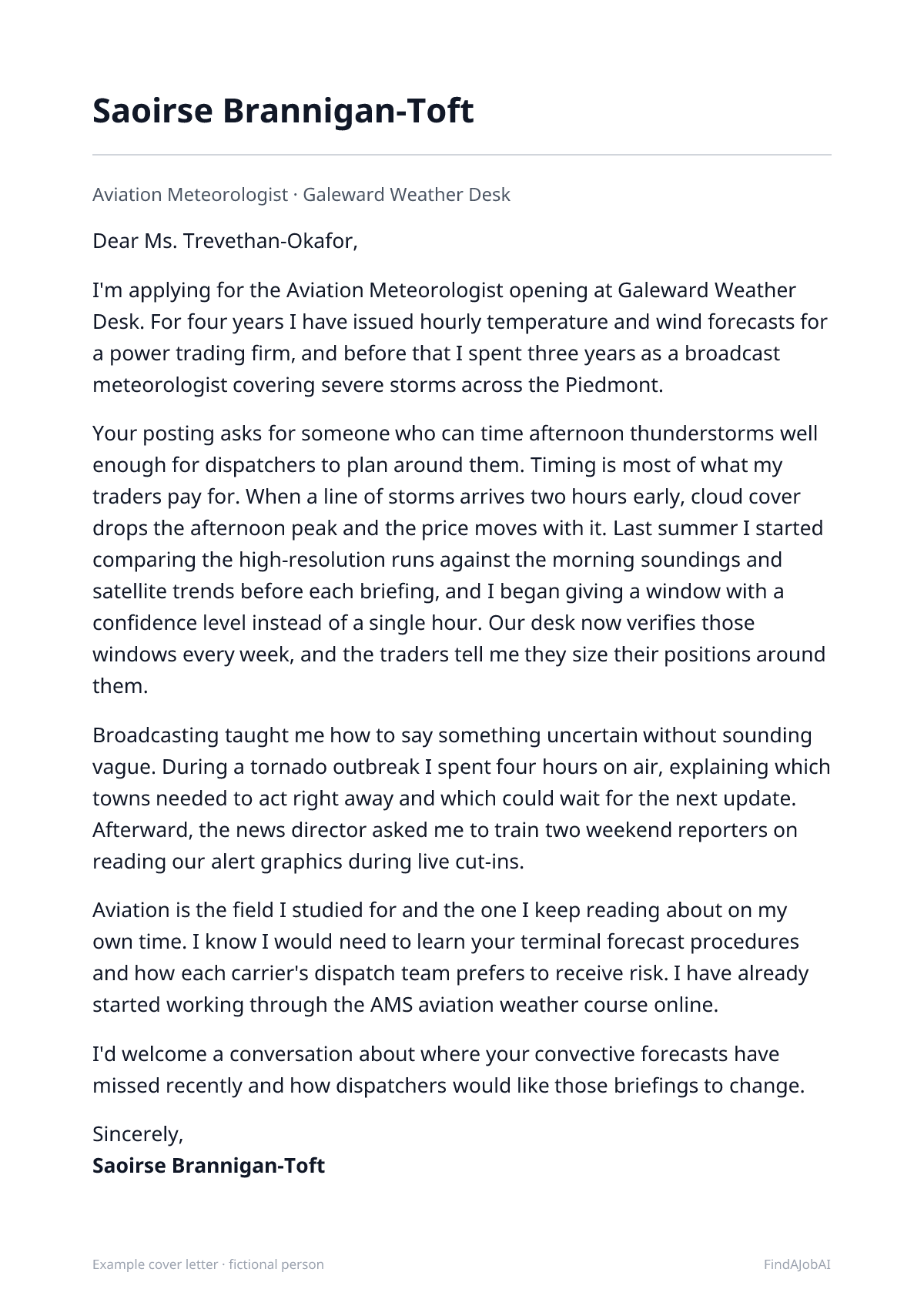
Dear Ms. Trevethan-Okafor,
I'm applying for the Aviation Meteorologist opening at Galeward Weather Desk. For four years I have issued hourly temperature and wind forecasts for a power trading firm, and before that I spent three years as a broadcast meteorologist covering severe storms across the Piedmont.
Your posting asks for someone who can time afternoon thunderstorms well enough for dispatchers to plan around them. Timing is most of what my traders pay for. When a line of storms arrives two hours early, cloud cover drops the afternoon peak and the price moves with it. Last summer I started comparing the high-resolution runs against the morning soundings and satellite trends before each briefing, and I began giving a window with a confidence level instead of a single hour. Our desk now verifies those windows every week, and the traders tell me they size their positions around them.
Broadcasting taught me how to say something uncertain without sounding vague. During a tornado outbreak I spent four hours on air, explaining which towns needed to act right away and which could wait for the next update. Afterward, the news director asked me to train two weekend reporters on reading our alert graphics during live cut-ins.
Aviation is the field I studied for and the one I keep reading about on my own time. I know I would need to learn your terminal forecast procedures and how each carrier's dispatch team prefers to receive risk. I have already started working through the AMS aviation weather course online.
I'd welcome a conversation about where your convective forecasts have missed recently and how dispatchers would like those briefings to change.
Sincerely,
Saoirse Brannigan-Toft
Example 2 · Entry level
New meteorology graduate applying to an agricultural weather firm
Emrys finished a meteorology degree and a summer internship. The firm wants an entry-level forecaster for frost and rainfall outlooks.
Example letter · fictional
Dear Dr. Draskovic-Penn,
I'm writing to apply for the entry-level Forecast Meteorologist position at Bluestem Renewable Forecasting. I graduated with a meteorology degree in May and spent last summer interning at an agricultural weather service, drafting frost and rainfall outlooks for farm clients.
Your posting mentions building forecasts for wind and solar sites in rural counties. During my internship I checked two months of our rainfall outlooks against county gauge data, mostly to learn how the forecasts were built. I noticed two counties where we were dry almost every week. The cause turned out to be a gauge network gap, so I suggested blending in radar estimates there, and my supervisor added that step to the daily routine. The error in those two counties dropped over the following month, and I kept a simple spreadsheet so anyone could follow the comparison.
I also wrote a small Python tool that plots model soundings for twelve regional airports every hour. It started as a class project, but the senior forecasters used it during a week of fog because it saved them from opening each sounding separately.
I want to work in renewable forecasting because small errors there change real decisions about power and money, and I like work where I can check my numbers against what happened. I'm still learning boundary layer behavior and would value a team that verifies its forecasts carefully. The verification summaries your team publishes each quarter are a big part of why I applied.
I'm available for a call any weekday and can share my verification notes and the plotting code.
Kind regards,
Emrys Hollowbeck
Example 3 · Senior or lead
Lead aviation meteorologist applying to run a utility weather team
Philippa leads a commercial aviation forecast desk and is applying to head the weather team at a large electric utility.
Example letter · fictional
Dear Mr. Oyelaran-Westergaard,
I'm applying for the Lead Meteorologist role at Cardinal Ridge Power Cooperative. I run a forecast desk of eleven meteorologists serving about forty airline and freight clients around the clock, and I spent nine years before that issuing terminal forecasts and icing briefings for regional carriers.
Your posting says the cooperative wants storm forecasts that crews and planners can act on, not just read. That was the problem I inherited at my current firm. Our advisories were accurate on average but arrived in a format dispatchers skimmed. I rebuilt them around a few decisions: hold, delay or reroute, each with a time window and a confidence level, and we published monthly scorecards to every client. Weather-related diversions for our clients fell by about a fifth over three years.
I've also had to deliver forecasts people did not want. Before a major ice storm I told a freight client to cancel a full night of operations a day early. Some of their managers pushed back hard, but the ice arrived on schedule and they later asked us to write that call into their standard playbook.
I have not forecast for a utility before, and I would want to spend time with your line crews and outage planners before changing anything about the current products. I would also ask your control room staff how forecasts reach them during an outage, since that handoff often decides whether a good forecast gets used.
I'd welcome a conversation about which recent storms your planners felt least prepared for and what they wished the forecast had told them.
Sincerely,
Philippa Szelagowska
All three letters, and the short version below, are fictional: the people, employers and numbers are invented. Borrow the structure, never the facts.
- Prefer to write it yourself? Use the free cover letter template.
- Check your CV against the job first: the free CV score shows the missing keywords.
Why the first letter works, paragraph by paragraph
Paragraph 1: Opening
Names the current energy forecasting role and the earlier broadcast years, so the reader sees forecasting depth and communication experience at once.
Paragraph 2: Storm timing for the posting
Takes the posting's point about storm timing and shows a concrete change: checking soundings and satellite, giving windows with confidence and verifying them weekly.
Paragraph 3: Proof under pressure
Uses live tornado coverage to show the writer can explain uncertain risk clearly when people need to act.
Paragraph 4: Why aviation
Gives an honest reason for the move and admits what still needs learning, which reads as realistic rather than weak.
Paragraph 5: Close
Asks about recent convective misses and dispatcher needs, which invites a working conversation instead of a generic reply.
What the entry-level letter does differently
The graduate letter uses one verification check the writer ran during an internship and a small tool people actually used. It names a gap in knowledge plainly, which suits an entry-level hire.
What the senior letter does differently
The senior letter focuses on making forecasts usable: decision-based advisories, public scorecards, fewer diversions and one unpopular call that proved right. It names the utility gap plainly.
Short meteorologist cover letter: an email-ready version
Many applications arrive as an email or a small text box, and a full page doesn't fit. This version runs 120 to 150 words and keeps only what a reader needs to decide whether to reply. A meteorologist replies by email to a crop insurer's posting for a climate risk meteorologist, keeping it short for a busy hiring manager.
Short version · email · fictional129 words
Subject: Climate Risk Meteorologist – drought and frost outlooks – Lowell Fennimore-Cask
Hi Ms. Pemberton-Rao,
I'm interested in the Climate Risk Meteorologist role at Sandhills Agri-Climate Advisors. I have five years at a regional agricultural weather service building frost, drought and seasonal rainfall outlooks for farm clients, mostly in Python with reanalysis and station data.
My most used product is a two-week frost risk outlook for orchards across nine counties. Growers use it to schedule wind machines and labor, and I verify it every season against station lows, which led me to fix a cold bias in valley sites. Last spring it gave growers four days of notice before a hard freeze, and most of them ran their machines that night.
My resume and a sample outlook are attached. I'm free for a call most mornings this week.
Best,
Lowell Fennimore-Cask
The short email gives one product, who uses it, how it is checked and one fix, which is enough for a manager to decide on a call.
Opening lines that work for meteorologist cover letters
The first sentence decides whether the second gets read. Here are six openings, one for each situation you might be in. Pick the one that matches yours and swap in your own facts: every name and number below is invented.
1. You have a standout result
Timing afternoon storms is most of what my traders pay for, and it is the skill your dispatch teams need most.
2. The ad names a problem you've solved
Your posting asks for forecasts crews can act on, and my desk now writes every advisory around a hold, delay or reroute decision.
3. Someone referred you
Your senior forecaster, Dr. Ottoline Faraday-Kwan, suggested I apply after we spoke on the same winter weather panel last spring.
4. You admire what they build
I spent last summer checking rainfall outlooks against gauge data, and your renewable sites are where I would most like to keep doing that work.
5. You're new to the field or switching into it
A one-day-early ice storm call I made became part of a client's standard playbook, and that kind of trust is what I want to build with your team.
6. You have senior scope or a specialism
After sixteen years forecasting for airlines and freight, I'd like to lead a weather team whose calls keep the power on.
How to write a meteorologist cover letter
Five steps, in the order you'd write them. The shape stays the same for every job (a short opening, proof, a reason for this employer, a close), and what goes into each part is what changes with the role.
Lead with who uses your forecasts
Open with your forecasting area and the people who rely on you, such as traders, dispatchers, farmers or viewers. The reader should know within two sentences what kind of meteorologist you are and why that fits the posting they wrote.
Show one forecast and how you judged it
Pick a forecast, warning or product and explain how you weighed models, observations and confidence. Then give the result in a form the reader can compare, such as lead time, a verification change or a decision someone made on time.
Prove you communicate under pressure
Mention a severe weather shift, live broadcast or urgent briefing where people needed a clear answer quickly. Hiring managers want to know you stay calm and plain-spoken when the weather is moving fast and the stakes are high for the people listening.
Admit the sector skills you lack
If you are changing sectors, say what you still need to learn, such as terminal forecast procedures or utility outage planning. A short, honest line about this builds more trust than claiming you already know everything about a new type of forecasting.
End on their weather problems
Close by asking about recent forecasts the team found hard or the decisions their users struggle with. It gives the reader an easy reason to reply and shows you are already thinking about their region, their clients and their verification results.
Meteorologist cover letter do's and don'ts
Do
- Pick one forecast or warning and the decision someone made because of it.
- Show how you judged confidence, such as ensemble spread or observation trends.
- Write in plain language, as you would brief a non-meteorologist.
Don't
- Don't list every model and product you have used; the resume carries that.
- Don't claim accuracy without saying how you measured it.
- Don't fill the letter with jargon like "CAPE" or "shortwave" without saying why it mattered.
Common meteorologist cover letter mistakes
Each one is easy to make and quick to fix before you send the letter.
A list of models instead of a story
Replace the list with one forecast, how you judged it and what the users did with it.
Claiming accuracy with no measure
Say how you verified the forecast, such as error over a season or warning lead time.
Heavy jargon
Translate terms so a dispatcher or manager understands the point on first read.
No user named
Say who relied on your forecasts, such as traders, pilots, growers or emergency managers.
Skipping the forecast users of the new sector
Connect your experience to their field, whether aviation, energy, agriculture or broadcast, with one example.
Email subject lines for meteorologist applications
Applying by email? Put the job title, any reference number and your name in the subject line.
- Aviation Meteorologist application – convection timing and briefings – Saoirse Brannigan-Toft
- Forecast Meteorologist (entry level) – B.S. Meteorology – Emrys Hollowbeck
- Application: Lead Meteorologist – Philippa Szelagowska
Everything for Meteorologists
- Meteorologist resume exampleA full resume, plus bullet and summary examples
- Meteorologist interview questions30 questions with sample answers
- Meteorologist job descriptionDuties, skills and requirements
- Cover letter with no experience: templates
Other cover letter examples
Meteorologist cover letter FAQ
What should a meteorologist cover letter include?
Your forecasting area and users, one forecast or warning with how you judged it and what people did, and why this employer's weather problems interest you.
How technical should a meteorologist cover letter be?
Mention tools and methods briefly, but spend most words on the situation, your judgment and the outcome. Technical detail can come up in the interview.
Should broadcast meteorologists include a reel link?
Yes. Add a link to a short reel in the letter or signature, and mention one severe weather segment it includes.
How we built this page
The FindAJobAI team wrote the three example letters, the short email version, the opening lines and the advice for meteorologist roles. The people, employers and numbers in the letters are invented; the structure, the kind of evidence and the order of the paragraphs are the parts to copy.
Once we track enough live meteorologist job ads, this page also shows the skills they ask for most, counted the same way as our in-demand skills report.
Last reviewed on November 1, 2026.