Optometrist Cover Letter Example (2026)
By FindAJobAI Team Updated How we built this page
Optometry practices receive applications from doctors with the same degree, the same boards and often the same equipment list. A cover letter earns its place when it shows how you practice: which patients you like seeing, a case where your exam changed someone's outcome, and how you'd help this particular practice grow its contact lens or medical eye care schedule.
Optometrist cover letter template
This letter as a one-page template: an opening that names the job and your strongest fact, proof that answers the ad, a reason for this employer and a short close.
After you sign up, FindAJobAI drafts your own letter for a real job from your CV in this format, and you edit it before you send it.
Example 1 · Experienced
Associate optometrist applying to a medically focused private practice
Dr. Fairweather has six years in a mixed retail and private setting. The ad asks for glaucoma management and help growing a dry eye service.
Example letter · fictional
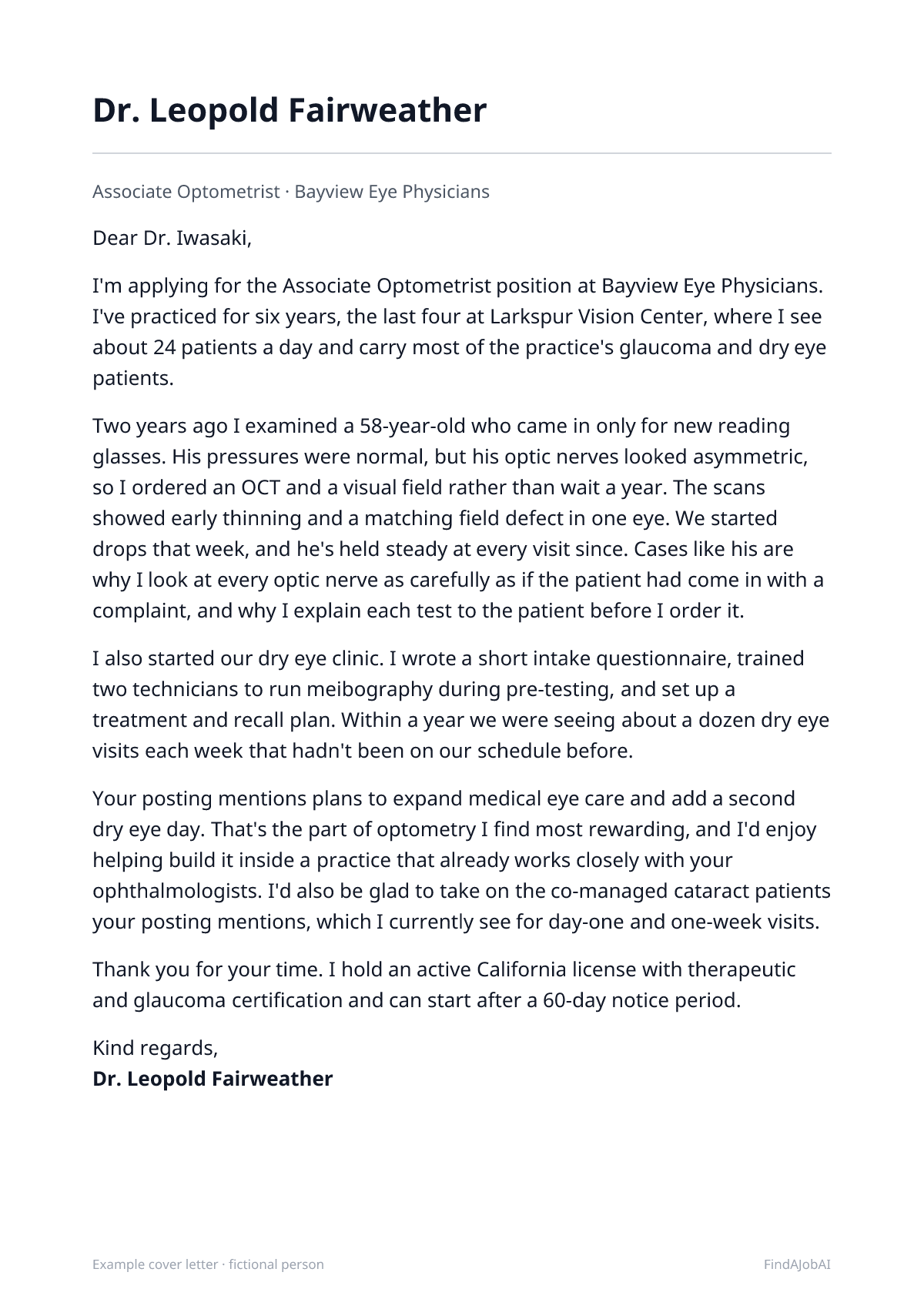
Dear Dr. Iwasaki,
I'm applying for the Associate Optometrist position at Bayview Eye Physicians. I've practiced for six years, the last four at Larkspur Vision Center, where I see about 24 patients a day and carry most of the practice's glaucoma and dry eye patients.
Two years ago I examined a 58-year-old who came in only for new reading glasses. His pressures were normal, but his optic nerves looked asymmetric, so I ordered an OCT and a visual field rather than wait a year. The scans showed early thinning and a matching field defect in one eye. We started drops that week, and he's held steady at every visit since. Cases like his are why I look at every optic nerve as carefully as if the patient had come in with a complaint, and why I explain each test to the patient before I order it.
I also started our dry eye clinic. I wrote a short intake questionnaire, trained two technicians to run meibography during pre-testing, and set up a treatment and recall plan. Within a year we were seeing about a dozen dry eye visits each week that hadn't been on our schedule before.
Your posting mentions plans to expand medical eye care and add a second dry eye day. That's the part of optometry I find most rewarding, and I'd enjoy helping build it inside a practice that already works closely with your ophthalmologists. I'd also be glad to take on the co-managed cataract patients your posting mentions, which I currently see for day-one and one-week visits.
Thank you for your time. I hold an active California license with therapeutic and glaucoma certification and can start after a 60-day notice period.
Kind regards,
Dr. Leopold Fairweather
Example 2 · Entry level
New optometry graduate applying to a pediatric and family practice
Dr. Osei-Brandt graduates in May with boards passed. The ad is for a family practice that wants to grow myopia management for children.
Example letter · fictional
Dear Dr. Morales,
I'm applying for the Optometrist position at Little Harbor Family Eye Care. I graduate from optometry school in May, I've passed all three parts of the national boards, and my Washington license with therapeutic certification is in process.
My strongest rotation was a semester at a children's vision clinic, where I examined more than 400 kids from infants to teenagers. One nine-year-old had failed a school screening twice, and his parents assumed he just needed glasses. During binocular testing I found a convergence problem that made reading tiring after a few minutes. I worked with my attending on a home therapy plan and a referral for in-office therapy, and his mother told us at follow-up that homework no longer ended in tears.
During the same rotation I helped fit 15 children in ortho-k lenses and measured axial length at each follow-up. I learned how much of myopia control depends on the conversation with parents: explaining why we treat, what to expect and why the recall visits matter.
Your practice is building a myopia management program, and I'd like to help it grow while learning from doctors who've practiced pediatrics for years. I'm comfortable with a full schedule after a VA externship that averaged 20 patients a day, where I also completed more than 80 dilated diabetic exams and wrote the letters to each patient's primary care doctor.
Thank you for considering my application. I'd welcome the chance to shadow a day in your office before any decision, so we can both see whether the fit is right for your patients and your team.
Sincerely,
Dr. Annika Osei-Brandt
Example 3 · Senior or lead
Experienced optometrist applying to lead clinical care across several offices
Dr. Achebe-Vance has 15 years in practice and leads a 3-doctor office. The ad is for a clinical director over 6 locations.
Example letter · fictional
Dear Ms. Carrington,
I'm applying for the Clinical Director role at Northridge Vision Partners. I've practiced optometry for 15 years and for the past six I've been lead doctor at Fernhill Eye Care, where I set clinical protocols for three doctors and nine technicians and still see patients four days a week.
When I took the lead role, each doctor handled glaucoma suspects differently: some ordered fields every six months, others once a year, and a few patients slipped through follow-up entirely. I wrote a shared protocol for testing intervals and referral thresholds, built a recall report in our EHR and reviewed it monthly with the front desk. After a chart audit the following year, missed glaucoma follow-ups had dropped to a handful, and our referring ophthalmologists started sending us their stable patients for co-management.
I've also hired and mentored two new graduates. Both had full schedules within their first year and both now run their own contact lens days, partly because I paired each with a technician for the first three months and reviewed their medical charts weekly.
Your posting describes uneven care across six offices, which is the same problem at a larger scale. I haven't directed care across multiple sites before, and I'd want to spend my first weeks working a full clinic day in each office, learning how its doctors and technicians handle recalls, before proposing any change.
I'd welcome the chance to discuss how your doctors work today, which outcomes you already measure and where you see the biggest gaps between offices.
Sincerely,
Dr. Rosalind Achebe-Vance
All three letters, and the short version below, are fictional: the people, employers and numbers are invented. Borrow the structure, never the facts.
- Prefer to write it yourself? Use the free cover letter template.
- Check your CV against the job first: the free CV score shows the missing keywords.
Why the first letter works, paragraph by paragraph
Paragraph 1: Opening
Gives years in practice, daily patient volume and the patient groups she carries, so the reader sees immediately that the medical focus in the ad is already part of her day.
Paragraph 2: The glaucoma case
A routine reading-glasses visit that turned into an early glaucoma diagnosis shows clinical judgment, the tests she ordered and the reason behind them.
Paragraph 3: Building the dry eye clinic
Concrete steps (intake form, technician training, recall plan) and a schedule result show she can grow a service, which the ad specifically asks for.
Paragraph 4: Why this practice
Ties her interest to the practice's stated plans and its relationship with ophthalmology, without generic praise.
Paragraph 5: Close
States license scope and the notice period, the two facts a practice needs to plan credentialing and a start date.
What the entry-level letter does differently
The new graduate letter turns a rotation into real evidence: patient numbers, a binocular vision case with a clear outcome and ortho-k experience that matches the practice's plans. It's open about being new and offers to shadow a day, which lowers the risk for a small practice hiring its first associate.
What the senior letter does differently
The senior letter centers on standardizing care, a shared glaucoma protocol, a recall report and an audit that confirmed the result, rather than on personal exam skill. It names a clear gap, no multi-site experience, and proposes a measured start, which reads as realistic leadership.
Short optometrist cover letter: an email-ready version
Many applications arrive as an email or a small text box, and a full page doesn't fit. This version runs 120 to 150 words and keeps only what a reader needs to decide whether to reply. An optometrist answers a recruiter's message about a part-time role covering two days a week at a group practice, with a short email.
Short version · email · fictional125 words
Subject: Part-time Optometrist – Tuesdays and Fridays – Dr. Matthias Okonjo-Reyes
Hi Ms. Delgado,
Thank you for your message about the part-time Optometrist role at Clearwater Eye Group. I'm licensed in Florida with therapeutic certification and have eight years of experience, mostly in a practice that sees many contact lens and diabetic patients.
Last month a diabetic patient told me she'd skipped two years of eye exams. Her dilated exam showed new swelling in the macula, and I arranged a retina appointment for the same week and sent her primary care doctor a summary. She started treatment before her vision changed.
Tuesdays and Fridays work well for me, and I can occasionally cover a Saturday clinic. My CV and license details are attached, and I'm free to talk any afternoon this week.
Best,
Dr. Matthias Okonjo-Reyes
The short reply covers the license, years and the patient mix in two sentences, then one diabetic case with fast coordination. It answers the recruiter's real question, which days are available, and leaves the longer story of the doctor's work for the interview.
Opening lines that work for optometrist cover letters
The first sentence decides whether the second gets read. Here are six openings, one for each situation you might be in. Pick the one that matches yours and swap in your own facts: every name and number below is invented.
1. You have a standout result
A patient who came in for reading glasses left with an early glaucoma diagnosis because his optic nerves didn't match. I'd like to bring that same careful exam to your patients.
2. The ad names a problem you've solved
Your posting mentions a growing wait for dry eye appointments. At my current practice I built a dry eye clinic that added about a dozen weekly visits within a year.
3. Someone referred you
Dr. Hollis Brenner, who supervised my VA externship, suggested I contact you because your practice is expanding its pediatric and myopia control services.
4. You admire what they build
My own children have been patients at your Harbor Road office for years, and watching how your doctors explain myopia control to parents made me want to practice there.
5. You're new to the field or switching into it
Before optometry school I spent two years as an optometric technician, and running pre-tests on hundreds of patients is what convinced me to become a doctor.
6. You have senior scope or a specialism
As lead optometrist for six years, I've written clinical protocols, mentored new graduates and cut missed glaucoma follow-ups across our office, and I'm ready to do this across several sites.
How to write an optometrist cover letter
Five steps, in the order you'd write them. The shape stays the same for every job (a short opening, proof, a reason for this employer, a close), and what goes into each part is what changes with the role.
Open with license, scope and the kind of practice you fit
Say where you're licensed, what your scope covers and how long you've practiced, then name the setting you know best: private, medical, retail, VA or ophthalmology group. A practice owner can decide from the first two lines whether to keep reading.
Share one anonymized case that shows how you examine
Pick a patient where your judgment mattered: an early disease catch, a difficult lens fit, a child whose reading problem turned out to be binocular. Describe what you noticed, what you ordered and what happened, without details that could identify the patient.
Show a service you helped build or grow
Practices want doctors who add value beyond a full schedule. If you started a dry eye clinic, a myopia control program or a scleral lens service, explain the steps you took and the change in the schedule that followed.
Match the practice's plans in your own words
Read the posting and the practice website for what they're trying to grow, then connect your experience to that goal. Avoid copying their phrases; a sentence about how you'd contribute to their specific plan is more convincing.
Close with practical details for credentialing
State your license status, any pending certifications, your notice period and the days or locations you're available to cover. Credentialing with insurance plans can take weeks, so these facts help a practice plan your start date.
Optometrist cover letter do's and don'ts
Do
- Name your license state and scope, including therapeutic and glaucoma certification, in the first or last paragraph.
- Describe one patient case, with identifying details removed, that shows how you think during an exam.
- Connect your experience to a service the practice wants to grow, such as dry eye, myopia control or specialty lenses.
Don't
- Don't list every instrument you've used; mention one only when it explains a clinical decision.
- Don't share details that could identify a patient; age range and condition are enough.
- Don't send the same letter to a retail chain and a medical practice; their schedules and goals differ.
Common optometrist cover letter mistakes
Each one is easy to make and quick to fix before you send the letter.
Repeating your CV paragraph by paragraph
The practice already has your education and rotations. Use the letter for one case, one service you built and your reason for wanting this practice.
Describing a patient too precisely
Even in a cover letter, protect privacy. Use an age range and condition, never names, dates of visits or anything a reader could trace to a person.
Leaving license scope unclear
Practices need to know if you can treat glaucoma and prescribe therapeutic drugs. State your scope and any pending license or certification with an expected date.
Praising the practice instead of showing fit
Compliments about a great reputation don't help the owner decide. Name the service they're growing and the experience you bring to it instead.
Writing only about routine exams
If the practice is growing medical eye care, show you're comfortable with it. Mention conditions you manage, tests you order and how you work with ophthalmologists.
Email subject lines for optometrist applications
Applying by email? Put the job title, any reference number and your name in the subject line.
- Associate Optometrist – glaucoma and dry eye experience – Dr. Leopold Fairweather
- Optometrist (2026 graduate) – pediatrics and ortho-k rotations – Dr. Annika Osei-Brandt
- Clinical Director application, Optometry (Ref. OD-114) – Dr. Rosalind Achebe-Vance
Everything for Optometrists
- Optometrist resume exampleA full resume, plus bullet and summary examples
- Optometrist interview questions30 questions with sample answers
- Optometrist job descriptionDuties, skills and requirements
- Cover letter with no experience: templates
Other cover letter examples
Optometrist cover letter FAQ
What should an optometrist include in a cover letter?
Your license and scope, years in practice or graduation date, the patient groups and services you focus on, one case that shows your judgment, and why this practice's direction fits you. Keep equipment lists and board details on the CV.
How does a new optometry graduate write a cover letter?
Use your rotations as experience: name the settings, approximate patient numbers and one case you handled under supervision. Mention boards and license status clearly, and show interest in the services the practice is building.
Is a cover letter needed for retail optometry jobs?
Many retail roles don't require one, but a short note still helps. Focus on comfort with a quick schedule, contact lens fitting and working alongside opticians, and say which days or locations you can cover.
Should I mention salary or production pay in an optometrist cover letter?
Usually not. Base pay, production bonuses and benefits are better discussed after a first conversation, once you know the practice's patient volume, schedule and how it splits routine and medical visits.
How we built this page
The FindAJobAI team wrote the three example letters, the short email version, the opening lines and the advice for optometrist roles. The people, employers and numbers in the letters are invented; the structure, the kind of evidence and the order of the paragraphs are the parts to copy.
Once we track enough live optometrist job ads, this page also shows the skills they ask for most, counted the same way as our in-demand skills report.
Last reviewed on November 1, 2026.