Surgical Assistant Cover Letter Example (2026)
By FindAJobAI Team Updated How we built this page
Surgical assistant letters land on the desk of a surgical services director, and often a surgeon reads them too. They want to know which specialties you assist in, how many cases you handle, what you do independently and whether the team trusts you in a difficult moment. A good letter answers those questions with a few honest numbers and one case story told calmly.
Surgical Assistant cover letter template
This letter as a one-page template: an opening that names the job and your strongest fact, proof that answers the ad, a reason for this employer and a short close.
After you sign up, FindAJobAI drafts your own letter for a real job from your CV in this format, and you edit it before you send it.
Example 1 · Experienced
First assistant applying to an orthopedic and robotic surgery center
Kawika first-assists about 450 general, orthopedic and robotic cases a year. The ad is for a surgical assistant at a new orthopedic hospital.
Example letter · fictional
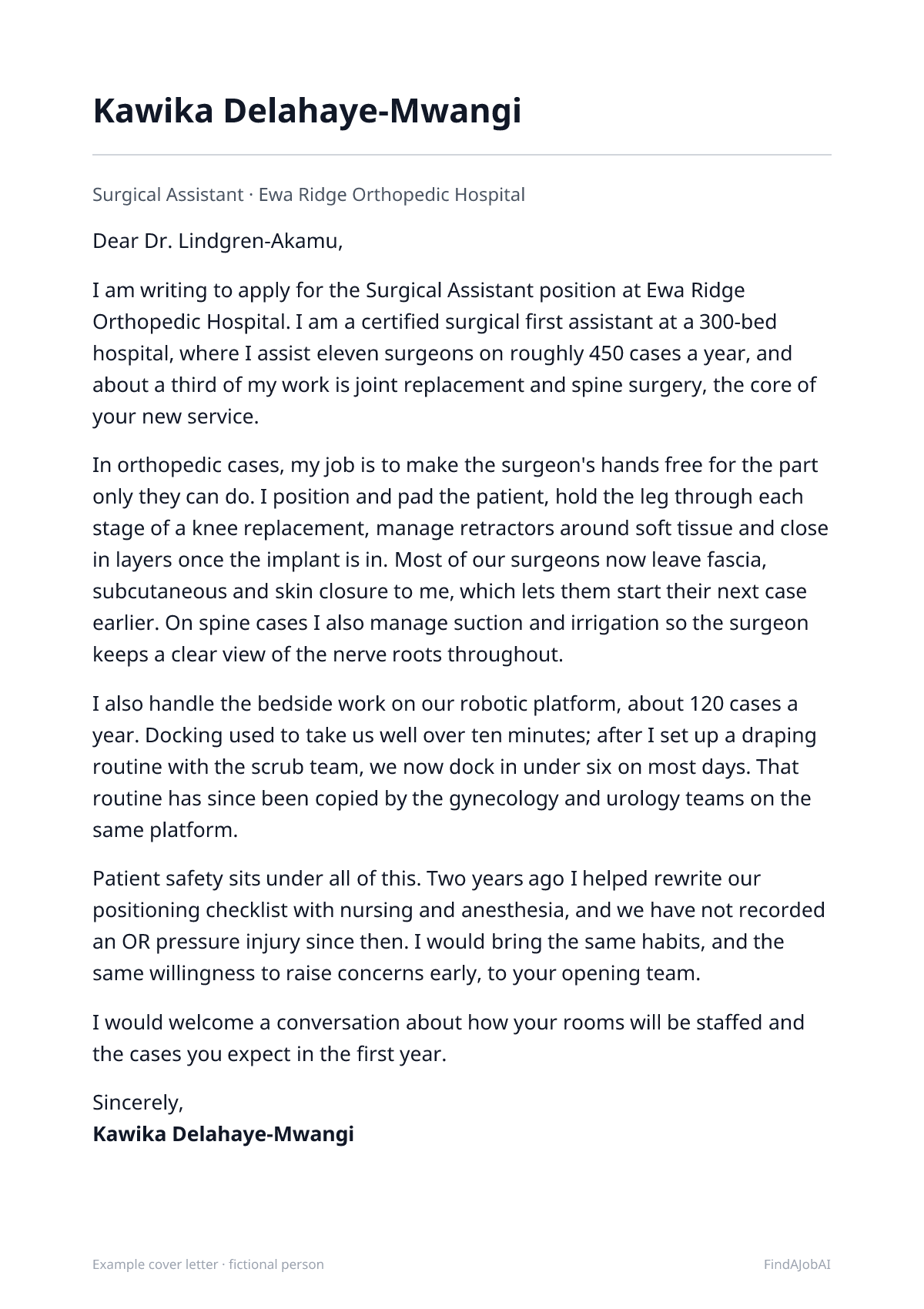
Dear Dr. Lindgren-Akamu,
I am writing to apply for the Surgical Assistant position at Ewa Ridge Orthopedic Hospital. I am a certified surgical first assistant at a 300-bed hospital, where I assist eleven surgeons on roughly 450 cases a year, and about a third of my work is joint replacement and spine surgery, the core of your new service.
In orthopedic cases, my job is to make the surgeon's hands free for the part only they can do. I position and pad the patient, hold the leg through each stage of a knee replacement, manage retractors around soft tissue and close in layers once the implant is in. Most of our surgeons now leave fascia, subcutaneous and skin closure to me, which lets them start their next case earlier. On spine cases I also manage suction and irrigation so the surgeon keeps a clear view of the nerve roots throughout.
I also handle the bedside work on our robotic platform, about 120 cases a year. Docking used to take us well over ten minutes; after I set up a draping routine with the scrub team, we now dock in under six on most days. That routine has since been copied by the gynecology and urology teams on the same platform.
Patient safety sits under all of this. Two years ago I helped rewrite our positioning checklist with nursing and anesthesia, and we have not recorded an OR pressure injury since then. I would bring the same habits, and the same willingness to raise concerns early, to your opening team.
I would welcome a conversation about how your rooms will be staffed and the cases you expect in the first year.
Sincerely,
Kawika Delahaye-Mwangi
Example 2 · Entry level
Surgical technologist with a new first-assisting certificate
Noelani, a scrub technologist for three years, just finished a first-assisting program. The ad is for an entry-level assistant at a community hospital.
Example letter · fictional
Dear Ms. Castellanos-Kekumu,
Please consider my application for the Surgical Assistant role at Waimea Uplands Community Hospital. I have worked as a certified surgical technologist for three years, and in October I completed a surgical first assisting program with 140 supervised cases. My national exam is booked for January.
My clinical rotation was in general and gynecologic surgery. I first-assisted on sixty laparoscopic gallbladder removals and thirty-five hysterectomies, drove the camera on about eighty cases and closed skin on ninety after the attending checked the deeper layers. The surgeons I worked with were demanding in the best way: they explained why they wanted the field exposed a certain way, and I learned to anticipate the next move rather than wait for the request.
Three years at the back table taught me habits that carry straight over. I know how to protect a sterile field, I take counts seriously and I have twice stopped a case closing until a count discrepancy was resolved. Both times the missing item was found on the field before the patient left the room. I would rather lose two minutes than send anyone home with a doubt.
I know I am early in this role, and I would expect close supervision on anything new, especially orthopedic cases, which I have not yet assisted. Your posting mentions a mentoring program, and that is exactly the support I am looking for, and I would happily join any skills sessions you run on weekends.
Thank you for your time. I would be glad to meet, and I can provide my clinical case log and preceptor evaluations.
Kind regards,
Noelani Pemberton-Adeyemi
Example 3 · Senior or lead
Cardiac lead surgical assistant applying to build a new heart program team
Rosalind leads seven assistants in cardiac surgery and runs vein harvest training. The ad is for a lead assistant at a hospital launching open-heart surgery.
Example letter · fictional
Dear Dr. Abernathy-Kaleikini,
I am applying for the Lead Surgical Assistant role in your new cardiac surgery program at Kona Lava Fields Medical Center. For the past six years I have led a team of seven assistants across three cardiac rooms, and I have spent ten of my fourteen years in the operating room in heart and vascular surgery.
Each year I assist on around three hundred open-heart cases, including bypass, valve repair and replacement and aortic work. I perform endoscopic vein harvest independently on about 220 of those cases, and we track every harvest site. Our infection rate has stayed under one percent, and I review any wound problem with the surgeon who closed the leg.
Building people is the part of the role I would bring to a new program. When I took over the team, only two assistants could harvest without supervision. I wrote a six-month training plan that moves from simulation to supervised cases with clear sign-off points, and five more assistants have since qualified. Each one now precepts the next trainee, so the program keeps running without me. I also set up an on-call rota that the team helped design, which has kept emergency coverage steady without burning anyone out.
Starting a heart program means writing procedures before the first patient arrives. I would like to help with preference cards, competency checklists and dry runs with perfusion, anesthesia and nursing, so the first cases feel routine rather than new. I have already done this once, when our hospital opened a third cardiac room.
I would be glad to discuss your launch timeline and the team you are planning.
With best regards,
Rosalind Kahaleua-Bergstrom
All three letters, and the short version below, are fictional: the people, employers and numbers are invented. Borrow the structure, never the facts.
- Prefer to write it yourself? Use the free cover letter template.
- Check your CV against the job first: the free CV score shows the missing keywords.
Why the first letter works, paragraph by paragraph
Paragraph 1: Opening
Gives certification, case volume and the overlap with the new hospital's specialty in the first two sentences.
Paragraph 2: Scope at the table
Describes what the assistant actually does in orthopedic cases, including independent closure the surgeons rely on.
Paragraph 3: Robotic work
Adds the platform volume and a concrete improvement in docking time.
Paragraph 4: Safety
Shows teamwork with nursing and anesthesia and a lasting patient-safety result.
Paragraph 5: Close
Asks about staffing and the case mix, which suits a hospital that is still opening rooms.
What the entry-level letter does differently
The new graduate leads with the supervised case log and exam date, then uses scrub experience to prove safety habits. She names her gap, orthopedics, and links it to the mentoring the posting offers, which reads as realistic rather than unsure.
What the senior letter does differently
The senior letter centers on leadership and launch work: training, sign-off points and an on-call rota built with the team. Outcomes are tracked and stated carefully, and the close offers practical help with the program's first months.
Short surgical assistant cover letter: an email-ready version
Many applications arrive as an email or a small text box, and a full page doesn't fit. This version runs 120 to 150 words and keeps only what a reader needs to decide whether to reply. A surgical assistant emails a perioperative director after a former colleague mentions an opening on the hospital's robotic team.
Short version · email · fictional138 words
Subject: Surgical Assistant, Robotic – SA-C, 150 robotic cases a year – Tobias Keawe-Halvorsen
Hi Ms. Ferreira-Nakamoto,
A former colleague on your surgical team mentioned that you are adding a robotic surgical assistant, so I wanted to write directly. I am an SA-C first assistant at an ambulatory surgery center, where I handle bedside work on about 150 robotic cases a year in urology and gynecology. Before that I spent five years scrubbing general and orthopedic cases.
Last spring our turnover between robotic cases was dragging, so I started pre-draping the arms during the previous case's closure. That saved around seven minutes per turnover and let us fit an extra case into most long days. Our surgeons noticed within the first week and asked the other teams to try it.
My resume and case log are attached. I can talk any weekday afternoon and give a month's notice.
Thank you,
Tobias Keawe-Halvorsen
The short email names how the writer heard about the role, states credential and robotic volume in one line and offers one turnover improvement with a clear result. The last line covers when the writer can talk and how soon they could start.
Opening lines that work for surgical assistant cover letters
The first sentence decides whether the second gets read. Here are six openings, one for each situation you might be in. Pick the one that matches yours and swap in your own facts: every name and number below is invented.
1. You have a standout result
Most of the surgeons I assist now leave closure to me, and I would like to bring that level of trust to your new orthopedic rooms.
2. The ad names a problem you've solved
I first-assisted on 140 supervised cases this year, and I am ready to move from the back table to the patient's side full time.
3. Someone referred you
Five assistants on my team learned to harvest veins independently through a training plan I wrote, and I would build the same for your program.
4. You admire what they build
Our robotic docking time dropped below six minutes after a draping routine I set up with the scrub team.
5. You're new to the field or switching into it
Two years without an OR pressure injury came from a positioning checklist I helped rewrite with nursing and anesthesia.
6. You have senior scope or a specialism
Your posting asks for an assistant who speaks up for safety, and I have twice held a closing count until the missing item was found.
How to write a surgical assistant cover letter
Five steps, in the order you'd write them. The shape stays the same for every job (a short opening, proof, a reason for this employer, a close), and what goes into each part is what changes with the role.
Put the credential and volume first
Open with your certification, years in the operating room and cases per year. Surgical directors screen for credentialing and experience before anything else, so these facts should appear in the first two sentences rather than in the middle of the letter.
Describe your work at the patient's side
Explain what you do during a typical case in the posting's specialty: positioning, exposure, hemostasis, camera work or closure. Say which steps you perform independently, because that scope tells surgeons how much time and effort you will save them.
Add one safety story
Choose a single example such as a count discrepancy you stopped, a positioning change or an infection result you track. Tell it in a few calm sentences. Safety habits matter as much as technical skill to the people who will hire you.
Match the hospital's service lines
Read the posting for specialties, platforms and growth plans, then connect your experience to them. If they mention a robotic or cardiac program, give your volume there. If you have a gap, name it and say how you would close it.
Write the way you talk in the OR
Clear, short and specific. Avoid long lists of adjectives and keep each paragraph focused on one idea. A letter that reads like a precise case report suggests you will communicate the same way with a surgeon mid-procedure.
Surgical Assistant cover letter do's and don'ts
Do
- Give your credential, yearly case volume and the specialties you assist in.
- Say which tasks you perform independently, such as closure or vein harvest.
- Include one patient-safety example, such as counts, positioning or sterile technique.
Don't
- Don't describe scrub duties as if they were first-assist work.
- Don't claim a certification you have not passed yet; give the exam date instead.
- Don't exaggerate experience in specialties you have only observed.
Common surgical assistant cover letter mistakes
Each one is easy to make and quick to fix before you send the letter.
Blurring first assisting with scrubbing
Separate the two clearly and lead with tasks you perform directly on the patient.
Leaving out the specialties you cover
Name the specialties and give a rough share of your yearly cases in each one.
Overstating independence
Say exactly which steps you do alone and which you do under direct supervision.
Forgetting the exam or credential date
Give the year of your certification, or the scheduled date if you are still sitting the exam.
Writing about surgery in general
Describe the posting's case types specifically, such as joint replacement or bypass surgery.
Email subject lines for surgical assistant applications
Applying by email? Put the job title, any reference number and your name in the subject line.
- Surgical Assistant – CSFA, 450 cases/year, ortho and robotic – Kawika Delahaye-Mwangi
- Surgical Assistant application – new first-assist graduate, 140 cases – Noelani Pemberton-Adeyemi
- Lead Surgical Assistant, Cardiac – CSA, 14 years in the OR – Rosalind Kahaleua-Bergstrom
Everything for Surgical Assistants
- Surgical Assistant resume exampleA full resume, plus bullet and summary examples
- Surgical Assistant interview questions30 questions with sample answers
- Surgical Assistant job descriptionDuties, skills and requirements
- Cover letter with no experience: templates
Other cover letter examples
Surgical Assistant cover letter FAQ
What should a surgical assistant cover letter include?
Your credential, the specialties and yearly case volume you assist on, which tasks you do independently, one safety example and a link to the hospital's service lines. Keep it to one page.
How do I write a surgical assistant cover letter as a new graduate?
Lead with your first-assisting program, your supervised case log and your exam date. Use your scrub experience to show sterile technique and count habits, and be honest about specialties you have not assisted in yet.
Should I mention robotic surgery experience?
Yes, if you have it. Name the platform, your yearly bedside volume and any improvement in docking or turnover. Many hospitals are expanding robotic programs and hire assistants for them specifically.
How we built this page
The FindAJobAI team wrote the three example letters, the short email version, the opening lines and the advice for surgical assistant roles. The people, employers and numbers in the letters are invented; the structure, the kind of evidence and the order of the paragraphs are the parts to copy.
Once we track enough live surgical assistant job ads, this page also shows the skills they ask for most, counted the same way as our in-demand skills report.
Last reviewed on November 1, 2026.