Statistician Resume Example (2026)
By FindAJobAI Team Updated How we built this page
Statistician postings ask for rigor: sound study design, the right model for the data, honest uncertainty and results that non-statisticians can act on. Most resumes list methods and software and stop there. The ones that get interviews show what was being decided, which design or model the candidate chose and why, and what changed because of the analysis.
The example below belongs to a statistician with five years in clinical research and public health surveys. Each bullet names the study or dataset, the method, and the outcome, such as a sample size that held up under review, a regulatory submission delivered on time or a survey estimate that guided funding.
Statistician resume template
This example as a one-page template: one column, standard headings and plain text, the format applicant tracking systems read most reliably.
After you sign up, Create my CV builds your own resume in this same one-column layout, from your real experience.
Mid-level statistician resume example
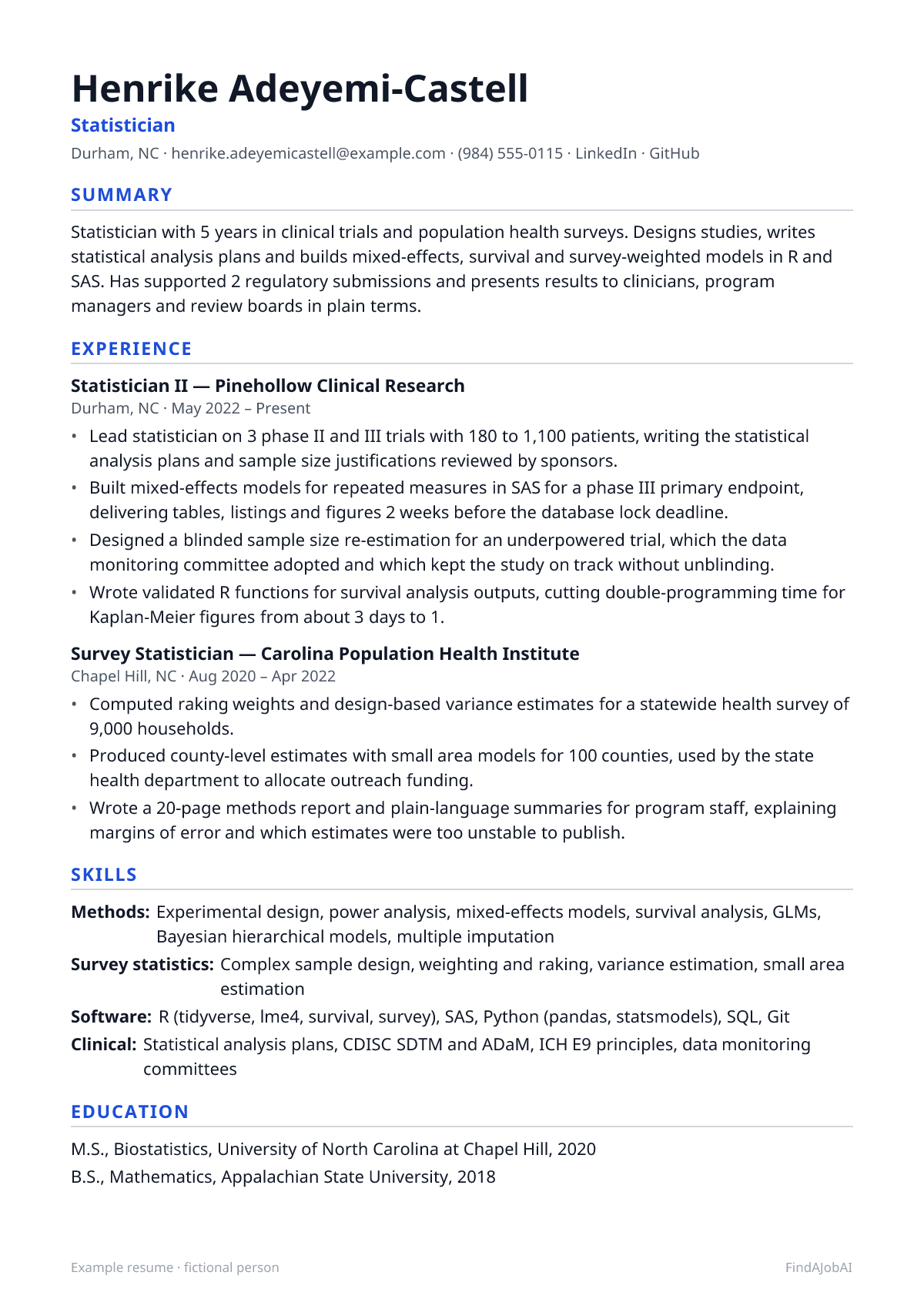
A complete one-page example for a fictional statistician: every bullet pairs an action with what changed because of it.
Example resume · fictional person
Henrike Adeyemi-Castell
Statistician
Durham, NC · [email protected] · (984) 555-0115 · LinkedIn · GitHub
Summary
Statistician with 5 years in clinical trials and population health surveys. Designs studies, writes statistical analysis plans and builds mixed-effects, survival and survey-weighted models in R and SAS. Has supported 2 regulatory submissions and presents results to clinicians, program managers and review boards in plain terms.
Experience
Statistician II, Pinehollow Clinical Research
Durham, NC · May 2022 – Present
- Lead statistician on 3 phase II and III trials with 180 to 1,100 patients, writing the statistical analysis plans and sample size justifications reviewed by sponsors.
- Built mixed-effects models for repeated measures in SAS for a phase III primary endpoint, delivering tables, listings and figures 2 weeks before the database lock deadline.
- Designed a blinded sample size re-estimation for an underpowered trial, which the data monitoring committee adopted and which kept the study on track without unblinding.
- Wrote validated R functions for survival analysis outputs, cutting double-programming time for Kaplan-Meier figures from about 3 days to 1.
Survey Statistician, Carolina Population Health Institute
Chapel Hill, NC · Aug 2020 – Apr 2022
- Computed raking weights and design-based variance estimates for a statewide health survey of 9,000 households.
- Produced county-level estimates with small area models for 100 counties, used by the state health department to allocate outreach funding.
- Wrote a 20-page methods report and plain-language summaries for program staff, explaining margins of error and which estimates were too unstable to publish.
Skills
- Methods: Experimental design, power analysis, mixed-effects models, survival analysis, GLMs, Bayesian hierarchical models, multiple imputation
- Survey statistics: Complex sample design, weighting and raking, variance estimation, small area estimation
- Software: R (tidyverse, lme4, survival, survey), SAS, Python (pandas, statsmodels), SQL, Git
- Clinical: Statistical analysis plans, CDISC SDTM and ADaM, ICH E9 principles, data monitoring committees
Education
- M.S., Biostatistics, University of North Carolina at Chapel Hill, 2020
- B.S., Mathematics, Appalachian State University, 2018
Fictional example by the FindAJobAI team: the person, employers and numbers are invented. Keep the structure; use your own work and numbers you can explain in an interview.
Entry-level statistician resume example
A recent master's graduate with a methods thesis and one summer internship. The resume leans on applied projects with real data and states the method, the dataset size and what the result showed.
Entry-level example resume · fictional person
Summary
Recent M.S. statistics graduate with a thesis on multiple imputation for longitudinal data and a summer internship validating survey weights. Fluent in R, comfortable in SAS and SQL, and careful about reproducible code and documented assumptions. Looking for an entry-level statistician role in health, government or industry research.
Experience
Statistical Analyst Intern, Upper Midwest Survey Center
Madison, WI · Jun 2025 – Aug 2025
- Checked nonresponse weights for a 6,500-respondent agricultural survey against population totals, flagging 2 strata where weights exceeded trimming limits.
- Wrote R code to compute replicate-weight standard errors, matching the center's SAS outputs to 4 decimal places.
- Drafted the methods appendix section on weighting for the published report.
Graduate Teaching Assistant, University of Wisconsin–Madison, Department of Statistics
Madison, WI · Sep 2023 – May 2025
- Led weekly lab sessions on regression and R for 3 sections of about 35 students each.
- Thesis: compared multiple imputation methods for dropout in a 4-wave cohort study using simulation and a real dataset of 2,300 participants.
Skills
- Methods: Linear and generalized linear models, mixed models, multiple imputation, simulation
- Software: R, SAS, SQL, Git, LaTeX
- Survey: Nonresponse weighting, replicate weights, design effects
Education
- M.S., Statistics, University of Wisconsin–Madison, 2025
- B.S., Mathematics, University of Minnesota Duluth, 2023
Senior statistician resume example
A principal statistician thirteen years in, setting statistical strategy for a drug development portfolio. The bullets move from individual analyses to program design, regulatory interactions and team leadership, each still tied to a concrete outcome.
Senior example resume · fictional person
Margarethe Oduya-Pellegrino
Principal Statistician
Boston, MA · [email protected] · (617) 555-0169 · LinkedIn
Summary
Principal statistician with 13 years in pharmaceutical development, leading statistical strategy for 9 programs in immunology and rare disease. Specializes in adaptive and Bayesian designs, represents statistics at regulatory meetings and manages 6 statisticians and programmers.
Experience
Principal Statistician, Thornquist Therapeutics
Boston, MA · Feb 2019 – Present
- Lead statistical strategy for 9 clinical programs, from first-in-human dose finding to phase III confirmatory trials.
- Designed a seamless phase II/III adaptive trial with a prespecified interim analysis, accepted by regulators after one written round of questions.
- Used Bayesian borrowing from a natural history study in a rare disease program, reducing the planned control arm from 60 to 35 patients.
- Manage 6 statisticians and statistical programmers, introducing code review and shared R packages that halved repeated output errors.
Senior Statistician, Larkmoor Pharmaceuticals
Cambridge, MA · Jul 2015 – Jan 2019
- Lead statistician on 2 phase III trials with 1,400 and 2,100 patients, delivering primary analyses and integrated summaries.
- Wrote statistical sections of 2 marketing applications and answered regulator queries on missing data handling.
Statistician, Bayview Contract Research
Boston, MA · Aug 2012 – Jun 2015
- Analyzed phase I and II studies for 12 sponsors, writing analysis plans and validating outputs.
Skills
- Design: Adaptive designs, group sequential methods, Bayesian borrowing, dose finding, estimands
- Regulatory: ICH E9(R1), FDA and EMA interactions, integrated summaries, CDISC ADaM
- Software: SAS, R, East, Stan, Git
- Leadership: Managing statisticians, code review standards, cross-functional study teams
Education
- PhD, Biostatistics, Boston University, 2012
- B.A., Mathematics, Wesleyan University, 2007
How to write a statistician resume
Five steps, in the order a recruiter reads the page. The format around them stays plain for every job: one column, standard headings, newest role first.
Header: name, target title and links
Use "Statistician" or your precise title, such as Biostatistician or Survey Statistician, and make your field clear, since clinical, survey and industrial roles screen for different experience.
Summary: what you do and your best proof
State your field, years of experience, main methods and software, and one type of decision your work supports. Mention regulatory or survey standards if the role is in those areas.
Experience: newest first, a result in every bullet
Begin each bullet with the study or data, then the method and the outcome. "Ran regressions" says little; the data, model choice and decision it informed say a lot.
Skills: grouped, in the ad's words
Group methods, field-specific knowledge (clinical, survey, quality), software and workflow tools. List methods you can explain and defend in an interview.
Education and certifications
List degrees with years, the most recent first. Add your thesis topic if it matches the role, and any publications in a short separate line.
Skills to put on a statistician resume
Hard skills are the tools and methods of the job; soft skills are how you work with people. Each comes with one way to prove it, because a skill named only in a list counts for little. Add the ones you really have.
Hard skills
- Experimental design
- Describe a study you designed, including randomization, blocking or stratification, and why.
- Power and sample size
- Give a study where your calculation changed the plan or held up under review.
- Regression and GLMs
- Name the outcome type, the model family and what the coefficients told decision makers.
- Mixed-effects models
- Describe the clustered or repeated data and the random effects structure you chose.
- Survival analysis
- Mention Kaplan-Meier, Cox models or competing risks work with the study context.
- Survey sampling and weighting
- State the sample design, weighting method and how you estimated variance.
- Bayesian methods
- Explain where priors or hierarchical models helped, such as small samples or borrowing.
- Missing data methods
- Describe multiple imputation or sensitivity analyses you ran and why they mattered.
- R
- Name packages you rely on and any functions or packages you wrote for others.
- SAS
- Mention procedures you use and validated outputs for regulated work.
- SQL and data preparation
- Show how you extracted and checked data before modeling.
- Reproducible workflows
- Mention Git, R Markdown or Quarto and how they made analyses easier to audit.
Soft skills
- Explaining uncertainty
- Show how you presented intervals or limitations to non-statisticians.
- Consulting
- Describe advising researchers or managers early in a study and the change it made.
- Skepticism
- Give an example of questioning a result or dataset and what you found.
- Writing
- Mention analysis plans, methods reports or publications you wrote.
- Collaboration
- Name the clinicians, engineers or program staff you worked with and how.
- Attention to detail
- Mention validation or double programming that caught errors.
- Independence
- Show a study or analysis you led from design to report.
Statistician resume bullet examples: weak vs strong
The same work, written two ways. The strong version names the tool, the scope and a result; the numbers are examples, yours must be real.
Weak: Did statistical analysis on data.
Strong: Fitted mixed-effects models to 3 years of patient visit data in R, showing the treatment effect held after adjusting for site and baseline severity.
Names the data, the method, the software and what the analysis established.
Weak: Calculated sample sizes.
Strong: Ran power analyses for 6 proposed studies, recommending smaller designs for 2 that saved an estimated 8 months of recruitment without losing power.
Shows the decision the analysis supported and its practical effect.
Weak: Worked on surveys.
Strong: Designed the stratified sample and nonresponse weights for a 4,000-respondent employee survey, keeping design effects under 1.5 for key estimates.
Gives design details and a quality measure a statistician would recognize.
Weak: Made reports and charts.
Strong: Built a parameterized R Markdown report for 12 regional managers, replacing a manual spreadsheet process that took 4 days each quarter.
Turns output into a time saving for named users.
Weak: Helped researchers with statistics.
Strong: Consulted on about 30 research projects a year, reviewing designs before data collection and catching 4 studies that could not answer their main question as planned.
Shows influence early in the research process, where it matters most.
Weak: Used Bayesian methods.
Strong: Applied a Bayesian hierarchical model to rare-event data from 40 sites, giving stable site-level estimates where raw rates swung widely.
Explains why the method was chosen and what it fixed.
15 more statistician resume bullet examples
Grouped by area of the job, so you can find the ones closest to your work. Keep the shape (action, scope, result) and replace the invented numbers with your own.
Study design and planning
- Wrote statistical analysis plans for 5 studies, prespecifying endpoints, models and sensitivity analyses before data were unblinded.
- Ran simulation-based power analyses for a cluster-randomized trial with 24 clinics, accounting for unequal cluster sizes.
- Reviewed 15 research protocols a year, recommending design changes that strengthened 6 of them before approval.
- Designed a stratified sample for a 5,000-person customer survey that cut field costs while keeping precision in each of 4 regions.
Modeling and analysis
- Fitted Cox proportional hazards models with time-varying covariates to registry data on 12,000 patients.
- Used multiple imputation with 40 imputed datasets and tipping-point analyses to show a trial result was robust to missing data.
- Built a generalized additive model of yield across 3 production lines, identifying a temperature range linked to defects.
- Applied small area estimation to produce district-level estimates where direct survey samples were too small.
Programming and validation
- Double-programmed primary efficacy tables in R against SAS outputs, resolving 14 discrepancies before submission.
- Wrote an internal R package for survey weighting used by 8 analysts.
- Moved a legacy analysis pipeline into Git with automated checks, so every report could be rerun from source data.
Communication and reporting
- Presented interim results to a 5-member data monitoring committee, explaining stopping boundaries in plain terms.
- Wrote plain-language summaries of survey findings for 3 public reports, each with clear notes on margins of error.
- Trained 20 researchers in a workshop series on interpreting confidence intervals and p-values correctly.
- Co-authored 4 peer-reviewed papers as the study statistician.
Statistician resume summary examples
Two or three lines on what you do and your strongest proof. Start from the one closest to your level and use your own facts.
Recent M.S. statistics graduate with a thesis on missing data methods and a summer internship validating survey weights. Fluent in R and comfortable in SAS and SQL, with a habit of writing reproducible code and clear method notes.
Statistician with 5 years in clinical trials and population health surveys, writing analysis plans and building mixed-effects, survival and survey-weighted models in R and SAS for sponsors and public agencies.
Principal statistician with 13 years in pharmaceutical development, leading statistical strategy across a portfolio of 9 programs, advising on adaptive designs and representing statistics at regulatory meetings.
Common statistician resume mistakes
Each one is easy to make and quick to fix before you apply.
A list of methods with no context
Every method should appear with the data and the decision it served, so the reader sees judgment, not just vocabulary.
Ignoring study design
Design work prevents bad analyses. Show studies you planned, power analyses you ran and protocols you improved.
No mention of communication
Statisticians must explain uncertainty to non-experts. Include reports, presentations or consulting work.
Listing every software package
Keep to tools you use regularly and can be tested on, such as R, SAS and SQL.
Overstating certainty
Describe results with appropriate caution. Claiming a model proved something can worry a statistically literate reader.
ATS tips for a statistician resume
Applicant tracking systems turn your file into text that recruiters search, mostly for the skills and titles in the ad. They rarely reject a resume on their own; one that parses badly or misses the ad's words just doesn't come up.
- Name the decision each analysis supported: a trial endpoint, a funding allocation, a product change or a policy.
- Pair methods with data context: the sample size, structure (repeated, clustered, survey) and the software used.
- Show design work, not just analysis, since planning studies well is where statisticians add the most value.
- Mention how you communicated uncertainty to non-statisticians, such as methods reports or plain-language summaries.
- Keep "Statistician" as the headline and add your area, such as clinical, survey or industrial, in the summary.
For the format itself, run the free ATS resume checklist.
Everything for Statisticians
- Statistician cover letter examplesThree example letters and a short email version
- Statistician interview questions30 questions with sample answers
- Statistician job descriptionDuties, skills and requirements
- How to tailor your resume without lying
Other resume examples
Statistician resume FAQ
What should a statistician resume include?
The kinds of studies or data you work with, the designs and models you use, your software, examples of analyses that informed decisions and how you report results. Add degrees and any regulatory or survey standards you know.
How is a statistician resume different from a data scientist resume?
Statistician resumes emphasize study design, inference, uncertainty and methodological rigor, often in regulated or research settings. Data scientist resumes lean more toward prediction, engineering and product work at scale.
Do I need a graduate degree for statistician jobs?
Many statistician roles ask for a master's degree, and some senior research roles prefer a PhD. Entry roles may accept a bachelor's degree with strong coursework, internships and examples of applied analysis.
How we built this page
The FindAJobAI team wrote the three example resumes, the bullets, the skills and the advice for statistician roles. The people, employers and numbers in the examples are invented; the structure, the tools and the way each bullet is built are the parts to copy.
Once we track enough live statistician job ads, this page also shows the skills they ask for most, counted the same way as our in-demand skills report.
Last reviewed on November 1, 2026.