UX Researcher Resume Example (2026)
By FindAJobAI Team Updated How we built this page
Hiring managers for research roles read resumes looking for one thing: did your studies change what the team built? Listing methods (interviews, usability tests, surveys, diary studies) shows you know the toolkit, but every applicant lists the same toolkit. The bullets that stand out name the question, the method chosen for it and the decision that followed.
The sample below is a UX researcher with five years across a B2B software company and a consumer health app. Look at how each bullet moves from study to decision to outcome, and how participant counts and timelines make the scope of the work concrete without inflating it.
UX Researcher resume template
This example as a one-page template: one column, standard headings and plain text, the format applicant tracking systems read most reliably.
After you sign up, Create my CV builds your own resume in this same one-column layout, from your real experience.
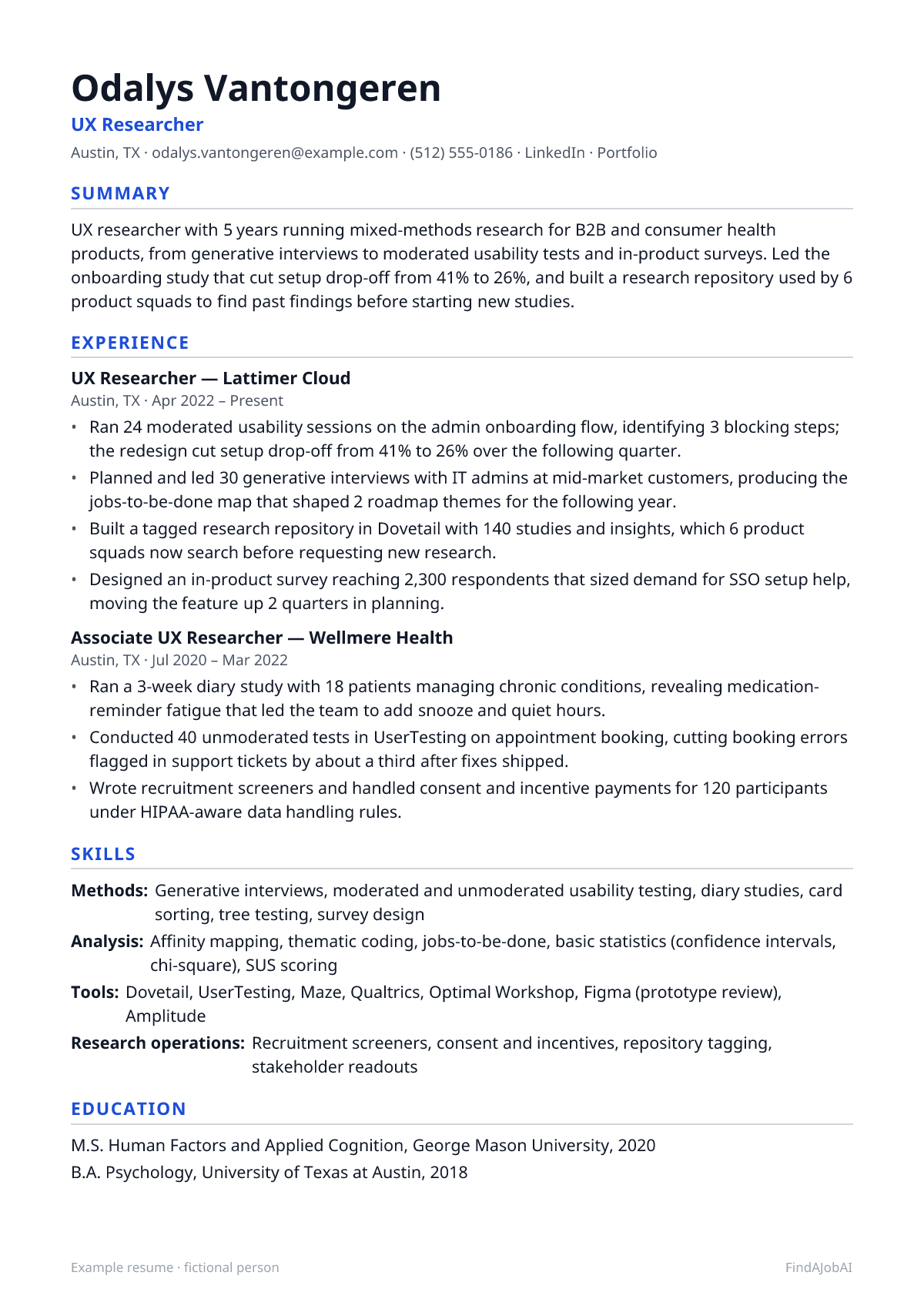
Mid-level UX researcher resume example
A complete one-page example for a fictional UX researcher: every bullet pairs an action with what changed because of it.
Example resume · fictional person
Odalys Vantongeren
UX Researcher
Austin, TX · [email protected] · (512) 555-0186 · LinkedIn · Portfolio
Summary
UX researcher with 5 years running mixed-methods research for B2B and consumer health products, from generative interviews to moderated usability tests and in-product surveys. Led the onboarding study that cut setup drop-off from 41% to 26%, and built a research repository used by 6 product squads to find past findings before starting new studies.
Experience
UX Researcher, Lattimer Cloud
Austin, TX · Apr 2022 – Present
- Ran 24 moderated usability sessions on the admin onboarding flow, identifying 3 blocking steps; the redesign cut setup drop-off from 41% to 26% over the following quarter.
- Planned and led 30 generative interviews with IT admins at mid-market customers, producing the jobs-to-be-done map that shaped 2 roadmap themes for the following year.
- Built a tagged research repository in Dovetail with 140 studies and insights, which 6 product squads now search before requesting new research.
- Designed an in-product survey reaching 2,300 respondents that sized demand for SSO setup help, moving the feature up 2 quarters in planning.
Associate UX Researcher, Wellmere Health
Austin, TX · Jul 2020 – Mar 2022
- Ran a 3-week diary study with 18 patients managing chronic conditions, revealing medication-reminder fatigue that led the team to add snooze and quiet hours.
- Conducted 40 unmoderated tests in UserTesting on appointment booking, cutting booking errors flagged in support tickets by about a third after fixes shipped.
- Wrote recruitment screeners and handled consent and incentive payments for 120 participants under HIPAA-aware data handling rules.
Skills
- Methods: Generative interviews, moderated and unmoderated usability testing, diary studies, card sorting, tree testing, survey design
- Analysis: Affinity mapping, thematic coding, jobs-to-be-done, basic statistics (confidence intervals, chi-square), SUS scoring
- Tools: Dovetail, UserTesting, Maze, Qualtrics, Optimal Workshop, Figma (prototype review), Amplitude
- Research operations: Recruitment screeners, consent and incentives, repository tagging, stakeholder readouts
Education
- M.S. Human Factors and Applied Cognition, George Mason University, 2020
- B.A. Psychology, University of Texas at Austin, 2018
Fictional example by the FindAJobAI team: the person, employers and numbers are invented. Keep the structure; use your own work and numbers you can explain in an interview.
Entry-level UX researcher resume example
An early-career researcher with a master's in HCI and one industry internship. Education leads, the internship shows real studies under supervision, and a graduate-school project fills the gap with a measurable usability study rather than a class list.
Entry-level example resume · fictional person
Kenji Albrecht-Moss
UX Researcher
Seattle, WA · [email protected] · (206) 555-0109 · LinkedIn · Portfolio
Summary
Entry-level UX researcher with an M.S. in Human Centered Design and a 6-month internship at a fintech, where he ran 12 usability tests and co-led 8 interviews on account opening. Writes discussion guides, screeners and short findings summaries, and is looking for a first full-time research role on a product team.
Education
- M.S. Human Centered Design and Engineering, University of Washington, 2025
- B.S. Cognitive Science, University of California San Diego, 2023
Experience
UX Research Intern, Copperleaf Bank Digital
Seattle, WA · Jan 2026 – Jun 2026
- Ran 12 moderated usability tests on the mobile account-opening flow, finding 2 confusing identity-verification steps the design team reworded before launch.
- Co-led 8 interviews with small-business owners about cash-flow tracking and synthesised them into 4 themes presented to the product lead.
- Wrote 3 recruitment screeners in User Interviews and scheduled 30 participants with no double-booked sessions.
Graduate Research Assistant, University of Washington Accessibility Lab
Seattle, WA · Sep 2024 – Dec 2025
- Ran 15 sessions with screen-reader users testing a transit app prototype, logging 22 accessibility issues ranked by severity for the lab's partner agency.
- Coded 40 interview transcripts in a shared codebook with 2 other assistants, reaching agreement on themes before publication.
Skills
- Methods: Moderated usability testing, semi-structured interviews, accessibility testing with assistive tech, card sorting
- Analysis: Thematic coding, affinity mapping, severity ratings, SUS
- Tools: Dovetail, User Interviews, Figma, Miro, Google Forms
Senior UX researcher resume example
A senior researcher who now sets research direction for a product area and manages other researchers. The bullets shift from running individual studies to choosing which questions get studied, building research operations and influencing leadership plans.
Senior example resume · fictional person
Ingrid Okonkwo-Hale
Senior UX Researcher
Boston, MA · [email protected] · (617) 555-0111 · LinkedIn · Portfolio
Summary
Senior UX researcher with 10 years in enterprise software, leading research for a 7-squad analytics product area and mentoring 3 researchers. Sets the quarterly research agenda with product leadership, runs foundational studies that shape annual roadmaps, and built the research ops program that cut recruitment lead time from 4 weeks to 10 days.
Experience
Senior UX Researcher, Northgate Analytics
Boston, MA · Feb 2021 – Present
- Lead research for a 7-squad analytics area, setting a quarterly agenda of 8 to 10 studies agreed with 3 product directors.
- Ran a foundational study of 45 interviews and 6 site visits with data teams, reframing the product around shared dashboards; 2 of the resulting bets became the year's top-funded initiatives.
- Built a research ops program with a 900-person customer panel and standard consent templates, cutting recruitment lead time from 4 weeks to 10 days.
- Mentor 3 researchers through weekly study reviews, with 2 promoted to mid-level within 18 months.
UX Researcher, Bramblewood Software
Cambridge, MA · May 2017 – Jan 2021
- Ran benchmark usability studies twice a year on 6 core tasks, tracking task success and time across 4 releases.
- Trained 12 designers to run lightweight guerrilla tests, adding about 30 small studies a year without extra researcher headcount.
Research Associate, Fernhill Market Insights
Boston, MA · Jun 2015 – Apr 2017
- Fielded 20 consumer surveys a year for retail clients, cleaning and weighting samples of 1,000 to 3,000 respondents.
- Moderated 35 focus groups and wrote the topline reports clients used to choose between packaging concepts.
Skills
- Research strategy: Research roadmaps, foundational studies, benchmark usability programs, stakeholder alignment
- Methods: Contextual inquiry, longitudinal studies, conjoint and MaxDiff surveys, quantitative usability metrics
- Leadership and ops: Mentoring researchers, participant panels, consent and data retention policy, democratised research training
Education
- M.A. Applied Anthropology, Boston University, 2015
- B.A. Sociology, Tufts University, 2013
How to write a UX researcher resume
Five steps, in the order a recruiter reads the page. The format around them stays plain for every job: one column, standard headings, newest role first.
Header: name, target title and links
Use "UX Researcher" or "User Researcher" to match the posting, and add Senior or Lead only if you held it. Put LinkedIn and a portfolio link under your name, since research teams usually review case studies before an interview.
Summary: what you do and your best proof
State your years, product domain and core methods, then name one study and the decision or metric it changed. A summary that ends with a concrete product outcome reads very differently from one that ends with "passionate about users".
Experience: newest first, a result in every bullet
Structure each bullet as research question, method with participant count, and the decision or result. Lead with the outcome when it's strong, and keep confidential product names generic while the numbers stay specific.
Skills: grouped, in the ad's words
Group skills into methods, analysis, tools and research operations. List the platforms you use weekly, like Dovetail, Maze or Qualtrics, and drop anything you would struggle to discuss in a portfolio review.
Education and certifications
List degrees in HCI, psychology, anthropology or related fields with the year. Early in your career, add one academic or volunteer study with participant numbers so the education section shows applied research.
Skills to put on a UX researcher resume
Hard skills are the tools and methods of the job; soft skills are how you work with people. Each comes with one way to prove it, because a skill named only in a list counts for little. Add the ones you really have.
Hard skills
- Generative interviewing
- Give the number of interviews, who the participants were and the product direction the themes shaped.
- Usability testing
- Say moderated or unmoderated, how many sessions, and the issues fixed before or after launch.
- Survey design
- Mention response count, the tool and the decision that the results supported or ruled out.
- Diary and longitudinal studies
- State the study length, the number of participants and the behaviour pattern only time could reveal.
- Card sorting and tree testing
- Name the navigation or information architecture change your results justified.
- Qualitative synthesis
- Describe how you coded data, such as a codebook or affinity map, and what came out of it.
- Quantitative UX metrics
- Mention SUS, task success or time-on-task and how you tracked them across releases.
- Research repositories
- Name the tool and how many teams or studies use it, to show research outlives one readout.
- Participant recruitment
- Give panel size, lead time and the screener approach that kept participants on target.
- Accessibility research
- Note sessions with assistive technology users and the barriers your findings removed.
- Mixed-methods triangulation
- Show a case where analytics and interviews together answered a question neither could alone.
Soft skills
- Stakeholder influence
- Describe a decision a product or design lead changed because of your study.
- Clear storytelling
- Mention the readout format you use, such as a 1-page summary or short clip reel.
- Scoping and prioritising
- Show how you chose which questions to study in a quarter and which to decline.
- Neutral moderation
- Give an example of avoiding leading questions or handling a participant who wanted to please you.
- Collaboration with design
- Note how you brought designers or engineers into sessions so findings landed faster.
- Ethical judgement
- Mention consent, data minimisation or sensitive-topic handling you set up for a study.
- Mentoring
- Count the researchers or designers you coached and what they can now run without you.
UX Researcher resume bullet examples: weak vs strong
The same work, written two ways. The strong version names the tool, the scope and a result; the numbers are examples, yours must be real.
Weak: Conducted user interviews.
Strong: Conducted 22 interviews with warehouse supervisors on shift planning, uncovering a manual spreadsheet workaround that became the brief for a new scheduling feature.
Shows who, how many and the product decision it fed.
Weak: Ran usability tests.
Strong: Ran 16 moderated usability tests on a checkout redesign before launch, finding a promo-code bug in the flow that engineering fixed before release.
Proves testing prevented a real problem.
Weak: Created personas.
Strong: Replaced 5 outdated marketing personas with 3 behaviour-based archetypes drawn from 35 interviews and usage data, now used in every squad's quarterly planning.
Explains the evidence and the adoption.
Weak: Designed surveys.
Strong: Designed a 12-question Qualtrics survey with 1,800 responses that ranked 9 candidate features, giving product leadership a ranked list for the annual plan.
Ties survey scale to a planning decision.
Weak: Shared research findings.
Strong: Shared findings through 20-minute readouts and 1-page summaries for 4 squads, with each study ending in a list of owned next steps.
Shows how research gets acted on, not just presented.
Weak: Did competitive analysis.
Strong: Benchmarked 5 competitor onboarding flows with 10 participants each, showing ours took twice as long to reach first value and justifying a simplification project.
Turns desk research into a measured comparison.
15 more UX researcher resume bullet examples
Grouped by area of the job, so you can find the ones closest to your work. Keep the shape (action, scope, result) and replace the invented numbers with your own.
Generative and discovery research
- Ran 28 contextual interviews in 4 regional clinics, mapping a referral handoff that the team redesigned into a single shared queue.
- Led a 6-week diary study with 20 first-time home buyers, identifying 3 anxiety points that shaped the mortgage app's progress tracker.
- Interviewed 18 churned customers within a month of cancellation, finding that missing exports drove most departures in the sample.
- Mapped the end-to-end service journey for field technicians from 12 ride-alongs, giving 3 squads a shared view of handoff failures.
Evaluative and usability research
- Ran a tree test with 150 participants on a new navigation, raising first-click success on 8 key tasks before engineering began.
- Moderated 20 sessions on a pricing page prototype, leading to clearer plan labels before the redesign shipped.
- Set up a quarterly benchmark of 5 core tasks with 40 participants each, giving leadership a trend line for usability.
- Tested 3 onboarding variants with 45 unmoderated participants in Maze, picking the variant with the fewest misclicks for launch.
Surveys and quantitative work
- Fielded a MaxDiff survey with 1,200 respondents to rank 14 feature ideas, replacing a vote-based backlog ranking.
- Paired 2 years of Amplitude event data with 15 interviews to explain why a reporting feature saw repeat use from only one segment.
- Ran a SUS survey after each of 4 releases, tracking scores in a shared dashboard for the product director.
Research operations and influence
- Created a research request form and weekly triage meeting that cleared a backlog of 25 open asks in 6 weeks.
- Trained 10 product managers to run 30-minute customer calls with a shared guide, logging 60 calls into the repository in a quarter.
- Wrote consent and data retention templates reviewed by legal, used for all 50 studies run the following year.
- Produced 2-minute highlight reels for 12 studies, which leadership watched in planning reviews instead of long decks.
UX Researcher resume summary examples
Two or three lines on what you do and your strongest proof. Start from the one closest to your level and use your own facts.
UX researcher with an HCI master's and a 6-month research internship at a fintech, where she ran 12 usability tests and co-led 8 interviews on account opening. Comfortable writing discussion guides, screeners and clear findings summaries in Dovetail.
UX researcher with 4 years in e-commerce, running interviews, usability tests and A/B test follow-ups for search and checkout. Research on filters led to a redesign that raised search-to-cart conversion, and she trains designers to run their own lightweight tests.
Senior UX researcher with 10 years in enterprise software, setting research strategy for a 7-squad product area and mentoring 3 researchers. Runs foundational studies that shape annual roadmaps and built the research ops program that cut recruitment lead time from 4 weeks to 10 days.
Common UX researcher resume mistakes
Each one is easy to make and quick to fix before you apply.
Methods with no decisions
"Ran interviews and usability tests" shows activity, not value. Add the design or roadmap decision each study informed, even when the outcome metric belongs to the product team.
Skipping participant numbers
Without counts, a reader can't tell a 3-person hallway test from a 40-session benchmark. Add numbers and the study length to every major bullet.
No portfolio or a design-only one
Research case studies should show the question, method choice and reasoning. A gallery of screens borrowed from designers doesn't show what you did.
Overclaiming product results
Research informs decisions that teams then ship. Say "led to" or "informed" and credit the team, rather than claiming a revenue lift alone.
Jargon-heavy summaries
Phrases like "empathy-driven human-centred insights" fill space. Replace them with the domain, the methods and one specific result.
ATS tips for a UX researcher resume
Applicant tracking systems turn your file into text that recruiters search, mostly for the skills and titles in the ad. They rarely reject a resume on their own; one that parses badly or misses the ad's words just doesn't come up.
- Pair every method with the question it answered and the decision it changed; a list of methods alone describes a course, not a career.
- Give participant counts and study length so the reader can judge rigour and scope at a glance.
- Name tools like Dovetail, UserTesting, Maze and Qualtrics; research job ads often list them.
- Keep confidential products vague but the decision specific, such as "moved a feature up 2 quarters".
- Link a portfolio with 2 or 3 case studies that show your reasoning from research question to recommendation.
For the format itself, run the free ATS resume checklist.
Everything for UX Researchers
- UX Researcher cover letter examplesThree example letters and a short email version
- UX Researcher interview questions30 questions with sample answers
- UX Researcher job descriptionDuties, skills and requirements
- How to tailor your resume without lying
Other resume examples
UX Researcher resume FAQ
Should a UX researcher resume include a portfolio link?
Yes. Most research hiring teams expect 2 or 3 case studies showing how you framed the question, chose a method, ran it and influenced a decision. Redact client details and keep each case to a few screens.
How do I show impact when research doesn't ship features directly?
Describe the decision the study changed: a feature reprioritised, a design reworked, a launch delayed for fixes. Then, where you can, add the outcome the product team measured after the change.
Is a psychology or HCI degree required for UX research?
It's common but not required. Many researchers come from anthropology, sociology, market research or design. What matters on the resume is evidence of sound study design and analysis in real product work.
How we built this page
The FindAJobAI team wrote the three example resumes, the bullets, the skills and the advice for UX researcher roles. The people, employers and numbers in the examples are invented; the structure, the tools and the way each bullet is built are the parts to copy.
Once we track enough live UX researcher job ads, this page also shows the skills they ask for most, counted the same way as our in-demand skills report.
Last reviewed on November 1, 2026.