AI Trainer Cover Letter Example (2026)
By FindAJobAI Team Updated How we built this page
AI trainer openings at model labs and data vendors attract thousands of applicants, and most are screened by a skills test. A short letter still helps for full-time, reviewer and specialist roles. Show your domain, the kinds of tasks you have done, and quality figures such as audit scores or reviewer acceptance that prove you are careful.
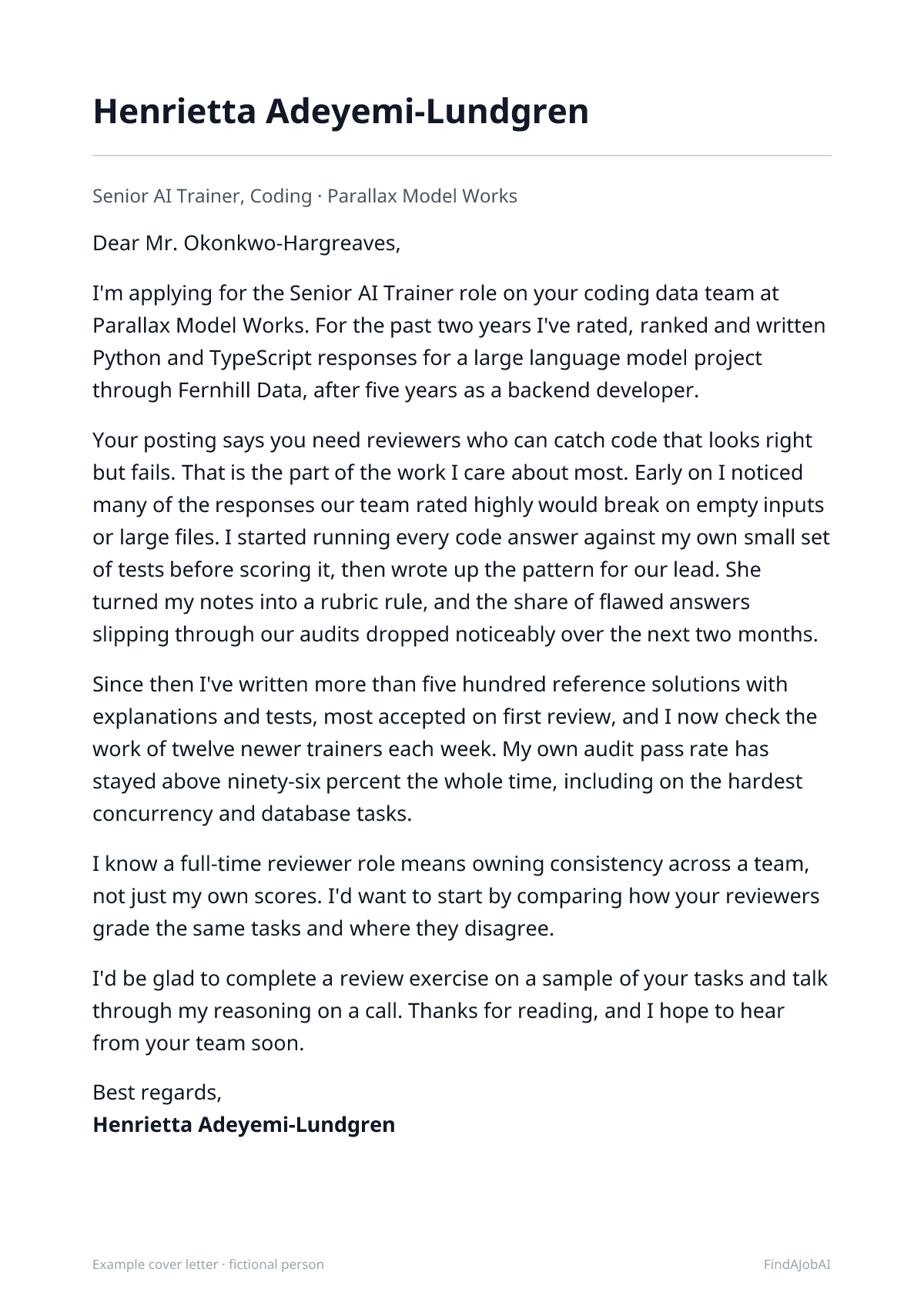
AI Trainer cover letter template
This letter as a one-page template: an opening that names the job and your strongest fact, proof that answers the ad, a reason for this employer and a short close.
After you sign up, FindAJobAI drafts your own letter for a real job from your CV in this format, and you edit it before you send it.
Example 1 · Experienced
Coding AI trainer applying for a senior reviewer role
Henrietta has two years rating and writing coding responses on contract. The ad is for a full-time senior reviewer on a coding data team.
Example letter · fictional
Dear Mr. Okonkwo-Hargreaves,
I'm applying for the Senior AI Trainer role on your coding data team at Parallax Model Works. For the past two years I've rated, ranked and written Python and TypeScript responses for a large language model project through Fernhill Data, after five years as a backend developer.
Your posting says you need reviewers who can catch code that looks right but fails. That is the part of the work I care about most. Early on I noticed many of the responses our team rated highly would break on empty inputs or large files. I started running every code answer against my own small set of tests before scoring it, then wrote up the pattern for our lead. She turned my notes into a rubric rule, and the share of flawed answers slipping through our audits dropped noticeably over the next two months.
Since then I've written more than five hundred reference solutions with explanations and tests, most accepted on first review, and I now check the work of twelve newer trainers each week. My own audit pass rate has stayed above ninety-six percent the whole time, including on the hardest concurrency and database tasks.
I know a full-time reviewer role means owning consistency across a team, not just my own scores. I'd want to start by comparing how your reviewers grade the same tasks and where they disagree.
I'd be glad to complete a review exercise on a sample of your tasks and talk through my reasoning on a call. Thanks for reading, and I hope to hear from your team soon.
Best regards,
Henrietta Adeyemi-Lundgren
Example 2 · Career changer
Registered nurse moving into medical AI training
Florian is a registered nurse with eight years on medical wards. The ad asks for clinicians to write and grade health answers for a model.
Example letter · fictional
Dear Dr. Szabo-Mensah,
I'm writing to apply for the medical AI trainer position at Clearwater Clinical AI. I'm a registered nurse with eight years on medical and cardiac wards, and for the past year I've done part-time health rating work alongside my hospital shifts.
What drew me to this work was seeing how often patients arrive having read confident but wrong advice online. In my rating work I review model answers about medications, symptoms and when to seek care. I've learned that the risky answers are rarely obviously wrong; they skip a warning, miss a drug interaction or sound too certain. I started noting those gaps in my justifications, and the project lead asked me to write fifteen example cases for other raters showing what a safe answer must include.
Nursing has trained me to follow detailed protocols, document clearly and escalate when something is outside my scope. I bring the same habits to rating, flagging tasks that need a physician's judgment rather than guessing, and writing justifications another clinician could check quickly.
I'm still learning the technical side, such as how preference data is used in training, and I've completed a short online course on how language models are built. I know the pace of full-time rating will be different from a ward shift, and I've set aside quiet weekday hours so I can keep my attention sharp on long, detailed tasks.
I'd welcome the chance to take your clinical assessment and to discuss how your team handles answers that need a specialist's review. Thank you for your time and consideration.
Kind regards,
Florian Abernethy-Osei
Example 3 · Senior or lead
Annotation quality lead applying to run a model lab's training data program
Marguerite leads quality for domain trainers at a data vendor. The ad is for a lead to own rubrics and audits for a lab's human data team.
Example letter · fictional
Dear Ms. Varga-Thompson,
I'm applying for the Human Data Quality Lead role at Lumen Ridge Research. For the past three years I've led quality at Saltbrook Data Services, where I manage about forty domain trainers and six reviewers producing coding, medical and legal training data for several model developers.
Your posting says reviewers often disagree and rework is eating into the budget. We faced the same problem. Our rubrics were long, examples were scattered, and reviewers graded the same task differently depending on who trained them. I rewrote the rubrics around fewer, clearer criteria with worked examples, started fortnightly calibration sessions on shared tasks and tracked agreement by reviewer and task type. Agreement rose from the low eighties to above ninety percent within five months, and client rejections fell by about forty percent.
I also built a two-stage audit that sends risky task types, such as medication questions, to a second expert reviewer. It costs a little more per task but saves far more in rework, and our clients noticed the difference in their evaluation results within the first quarter.
I haven't worked inside a lab, where data needs change quickly with each training run. I'd want to understand how your researchers decide what data they need, how fast guidelines must change between runs, and how quickly reviewers are expected to adapt when they do.
I'd welcome a conversation about where your reviewers disagree most, how your current audit sampling works, and which task types cost you the most rework today. I appreciate your time and attention.
Sincerely,
Marguerite Okafor-Lindholm
All three letters, and the short version below, are fictional: the people, employers and numbers are invented. Borrow the structure, never the facts.
- Prefer to write it yourself? Use the free cover letter template.
- Check your CV against the job first: the free CV score shows the missing keywords.
Why the first letter works, paragraph by paragraph
Paragraph 1: Opening
Names the languages, the type of work and a developer background, so a coding data team sees a fit in two lines.
Paragraph 2: The untested code story
Answers the ad's concern about code that looks right with a habit, a rubric change and a drop in flawed answers.
Paragraph 3: Volume and quality
Gives reference solution counts, reviewing load and a steady audit rate, the figures these teams track.
Paragraph 4: Reviewer mindset
Shows the writer understands team consistency, not just personal scores, which a senior role needs.
Paragraph 5: Close
Offers a review exercise, the normal next step and a fair test of real skill.
What the career changer's letter does differently
The nurse's letter turns clinical judgment into training evidence: catching missing warnings, writing example cases for raters and flagging out-of-scope tasks. Learning steps are concrete, and the change of pace from ward shifts is admitted honestly.
What the senior letter does differently
This lead letter connects the ad's disagreement and rework problems to rubric redesign, calibration and a two-stage audit, with agreement and rejection figures. The move from vendor to lab is acknowledged with a sensible first question.
Short AI trainer cover letter: an email-ready version
Many applications arrive as an email or a small text box, and a full page doesn't fit. This version runs 120 to 150 words and keeps only what a reader needs to decide whether to reply. An AI trainer emails a hiring manager who posted a math reasoning role on a professional networking site and invited direct messages.
Short version · email · fictional123 words
Subject: AI Trainer, Math – 1,500 reasoning tasks at 95% expert agreement – Soren Achterberg-Nakamura
Hi Ms. Delgado-Farrow,
I saw your post about a math reasoning AI trainer role at Quillstone Reasoning Labs. For a year I've solved and checked multi-step math and logic problems for a model training project, about 1,500 tasks in total.
My flags on flawed reasoning chains matched expert graders about ninety-five percent of the time, and I wrote 300 prompts that exposed unit-conversion mistakes, most of which went into the client's evaluation set.
You mentioned needing people who catch right answers reached the wrong way. That is the error I look for first in every task, because a correct final number can hide a broken method. I'm happy to take your assessment this week and can start part-time right away.
Thanks,
Soren Achterberg-Nakamura
A hiring manager on a networking site wants proof of careful reasoning. This email gives task volume, an expert agreement figure and red-team impact, then answers the exact skill named in the post.
Opening lines that work for AI trainer cover letters
The first sentence decides whether the second gets read. Here are six openings, one for each situation you might be in. Pick the one that matches yours and swap in your own facts: every name and number below is invented.
1. You have a standout result
Across about 4,000 coding comparisons, I've kept a weekly audit pass rate above 96%, and I'd like to bring that care to your team.
2. The ad names a problem you've solved
Your ad says you need reviewers who catch code that looks right but fails. I test every answer before I score it.
3. Someone referred you
Imogen Castellanos, a reviewer on your coding team, and I worked on the same rating project, and she suggested I apply.
4. You admire what they build
I wrote forty rubric examples that are now part of onboarding for new coding raters on my current project.
5. You're new to the field or switching into it
After eight years as a registered nurse, I want to help models give safer health answers to the patients I used to treat.
6. You have senior scope or a specialism
I lead quality for forty domain trainers and want to bring my calibration and audit methods to a model lab.
How to write an AI trainer cover letter
Five steps, in the order you'd write them. The shape stays the same for every job (a short opening, proof, a reason for this employer, a close), and what goes into each part is what changes with the role.
Lead with your domain and task types
AI training projects hire by domain, such as coding, math, medicine or law, and by task type, such as ranking, writing or red teaming. Put both in your first lines so the reader can match you to an opening quickly and see your strongest area.
Prove quality with your own figures
Give audit pass rates, reviewer acceptance or agreement with expert graders. These numbers matter far more than hours or task counts, because a careless rater lowers data quality. If you review others, add how their scores changed under your feedback.
Describe one error you caught
Pick a moment when you spotted something other raters missed, such as code failing on edge cases or a health answer skipping a warning. Explain how you found it and what changed afterward, for example a rubric update or new examples for the team.
Show how you handle uncertainty
Projects value raters who flag tasks outside their expertise instead of guessing. Mention how you follow guidelines, escalate unclear cases and check sources, since this honesty is what keeps training data trustworthy and what reviewers watch for.
Offer to take the assessment
Most AI trainer roles use a skills test or trial project. Close by offering to complete it soon, and mention your availability and time zone if the role is part-time or remote, so the recruiter can move you forward without extra questions.
AI Trainer cover letter do's and don'ts
Do
- Name your domain and the task types you have done.
- Give audit scores, acceptance rates or agreement figures.
- Show how you handle tasks outside your expertise.
Don't
- Don't describe the work as simple clicking or data entry.
- Don't name confidential clients or models if your contract forbids it.
- Don't claim domains you could not pass a test in.
Common AI trainer cover letter mistakes
Each one is easy to make and quick to fix before you send the letter.
Treating the role as easy side work
Reviewers look for care and expertise. Show the reasoning and checking your tasks involve.
Leaving out quality figures
Audit scores and acceptance rates are what these teams track. Include at least one.
Breaking confidentiality
Do not name models or end clients if your contract forbids it. Describe the work generically.
Claiming every domain
Projects test you in each one. Focus on the field where your skills are strongest.
Ignoring the assessment
Mention you are ready to take the skills test, since that usually decides the outcome.
Email subject lines for AI trainer applications
Applying by email? Put the job title, any reference number and your name in the subject line.
- Senior AI Trainer, Coding – 2 years rating code, 96% audit rate – Henrietta Adeyemi-Lundgren
- AI Trainer, Medical – registered nurse with health rating experience – Florian Abernethy-Osei
- Application: AI Trainer, Coding Reviewer (Req. 7731) – Henrietta Adeyemi-Lundgren
Everything for AI Trainers
- AI Trainer resume exampleA full resume, plus bullet and summary examples
- AI Trainer interview questions30 questions with sample answers
- AI Trainer job descriptionDuties, skills and requirements
- Career change cover letter: template + examples
Other cover letter examples
AI Trainer cover letter FAQ
What should I write in an AI trainer cover letter?
State your domain, the kinds of tasks you have done, such as ranking, writing reference answers or red teaming, and give quality figures like audit pass rates. Add one example of catching an error others missed.
Can I become an AI trainer without tech experience?
Yes. Many projects want nurses, lawyers, teachers, writers and language specialists. Show your professional expertise, careful writing and how you follow detailed guidelines, then pass the project's skills test.
Should I mention which AI models I have worked on?
Usually not by name, since many contracts are confidential. Describe the work instead, for example ranking coding answers for a large language model, and focus on your own quality results.
How we built this page
The FindAJobAI team wrote the three example letters, the short email version, the opening lines and the advice for AI trainer roles. The people, employers and numbers in the letters are invented; the structure, the kind of evidence and the order of the paragraphs are the parts to copy.
Once we track enough live AI trainer job ads, this page also shows the skills they ask for most, counted the same way as our in-demand skills report.
Last reviewed on November 1, 2026.