Business Systems Analyst Cover Letter Example (2026)
By FindAJobAI Team Updated How we built this page
Hiring managers read business systems analyst cover letters for one thing above all: can you stand between a business team and a system and get the details right? Show a change you delivered from request to go-live, the system you worked in and how users were better off. One concrete project beats a list of methods.
Business Systems Analyst cover letter template
This letter as a one-page template: an opening that names the job and your strongest fact, proof that answers the ad, a reason for this employer and a short close.
After you sign up, FindAJobAI drafts your own letter for a real job from your CV in this format, and you edit it before you send it.
Example 1 · Experienced
ERP analyst applying to a manufacturer's systems team
Henrik has three years supporting NetSuite for a distribution company. The ad is for a business systems analyst on a manufacturer's finance systems team.
Example letter · fictional
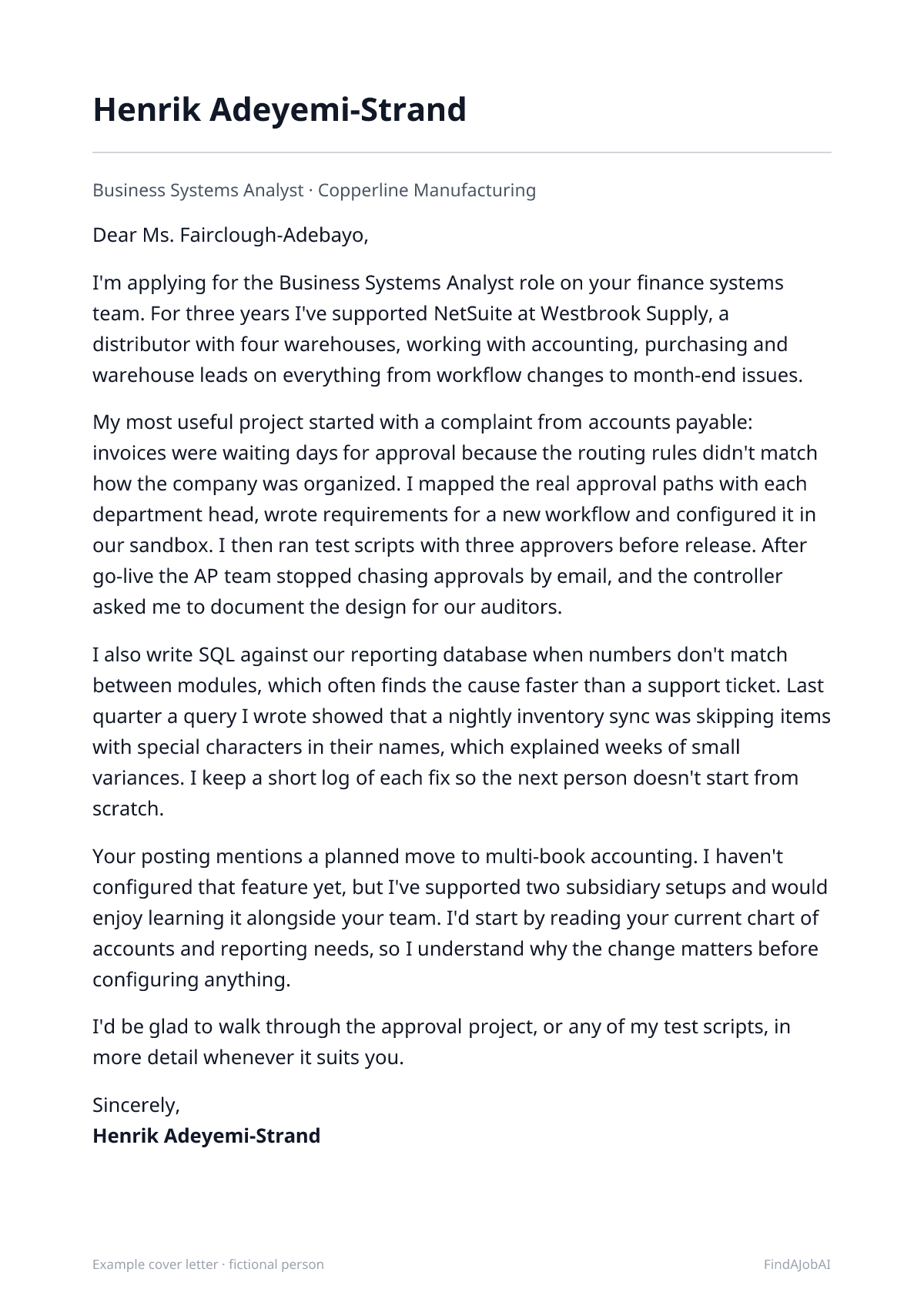
Dear Ms. Fairclough-Adebayo,
I'm applying for the Business Systems Analyst role on your finance systems team. For three years I've supported NetSuite at Westbrook Supply, a distributor with four warehouses, working with accounting, purchasing and warehouse leads on everything from workflow changes to month-end issues.
My most useful project started with a complaint from accounts payable: invoices were waiting days for approval because the routing rules didn't match how the company was organized. I mapped the real approval paths with each department head, wrote requirements for a new workflow and configured it in our sandbox. I then ran test scripts with three approvers before release. After go-live the AP team stopped chasing approvals by email, and the controller asked me to document the design for our auditors.
I also write SQL against our reporting database when numbers don't match between modules, which often finds the cause faster than a support ticket. Last quarter a query I wrote showed that a nightly inventory sync was skipping items with special characters in their names, which explained weeks of small variances. I keep a short log of each fix so the next person doesn't start from scratch.
Your posting mentions a planned move to multi-book accounting. I haven't configured that feature yet, but I've supported two subsidiary setups and would enjoy learning it alongside your team. I'd start by reading your current chart of accounts and reporting needs, so I understand why the change matters before configuring anything.
I'd be glad to walk through the approval project, or any of my test scripts, in more detail whenever it suits you.
Sincerely,
Henrik Adeyemi-Strand
Example 2 · Career changer
Staff accountant moving into business systems
Priya has four years as a staff accountant and has become the go-to person for her team's ERP questions. The ad is for a junior business systems analyst.
Example letter · fictional
Dear Seabright Systems Team,
I'm applying for the Junior Business Systems Analyst position at Seabright Health Partners. I've worked as a staff accountant for four years, and over the last two I've become the person my team asks when something in our ERP doesn't behave as expected.
That started during our upgrade to Microsoft Dynamics. I volunteered for user acceptance testing, wrote test cases for the accounts receivable processes I knew best and found that credit memos weren't applying to the correct invoices. The issue was fixed before go-live, and our IT team asked me to keep testing finance changes after that.
Since then I've learned SQL through an evening course and use it to reconcile data between our ERP and the billing system. I also wrote short how-to guides for month-end tasks that new accountants now use in their first week.
I want to move into systems work because I enjoy fixing the cause of a problem more than working around it. My accounting background means I understand why finance users ask for what they ask, which should help me write clearer requirements. I know how stressful month-end can be when a system misbehaves, and I'd like to be the analyst who prevents those problems rather than one who only hears about them afterwards. I'm also comfortable presenting to small groups, which I expect will help during training and testing sessions.
Thank you for your time. I'd welcome the chance to discuss the role and to show you the test cases and guides I've written.
Best regards,
Priya Lindholm-Asante
Example 3 · Senior or lead
Senior analyst applying to lead a CRM replacement
Maximilian has nine years in business systems and led a Salesforce rollout for a sales team of two hundred. The ad is for a lead analyst on a CRM replacement.
Example letter · fictional
Dear Mr. Kovalenko-Byrne,
I'm applying for the Lead Business Systems Analyst role on your CRM replacement program. I've worked in business systems for nine years, and for the last three I've led analysis for the Salesforce platform at Ridgeway Financial, which supports a sales and service team of about two hundred people.
Our biggest project was moving the service team off an old case system. Early workshops produced a long wish list, so I changed approach: we shadowed agents for a week and mapped the handful of journeys that made up most of their work. Requirements focused on those first, and we left rarer requests for later releases. The first release went live on schedule, and agents stopped keeping their own spreadsheets alongside the system.
I lead two analysts, review their requirements and test plans, and work closely with our architect on data migration and integrations. I've learned that most rollout problems start with unclear data ownership, so I agree owners for key fields before any migration begins, and I make sure every owner sees a sample of their migrated data before cutover.
Your program covers agents and underwriters across three countries. I haven't run a multi-country rollout before, so I'd plan early time with local teams to find where processes differ by country and where they only appear to differ. I'd also want to agree early how each country will test and sign off releases, so no team feels the system was designed elsewhere and handed to them.
Thank you for reading. I'd welcome a conversation about the program and how your team works.
Sincerely,
Maximilian Oduya-Fairbanks
All three letters, and the short version below, are fictional: the people, employers and numbers are invented. Borrow the structure, never the facts.
- Prefer to write it yourself? Use the free cover letter template.
- Check your CV against the job first: the free CV score shows the missing keywords.
Why the first letter works, paragraph by paragraph
Paragraph 1: Opening
Names the system, the company type and the teams supported, which tells a hiring manager the exact kind of systems work done.
Paragraph 2: The workflow project
Walks through the full cycle: a business complaint, real process mapping, written requirements, sandbox configuration, testing with users and an outcome the controller valued.
Paragraph 3: SQL and documentation
Shows technical depth and the habit of leaving notes, both of which systems teams depend on.
Paragraph 4: The multi-book admission
Admits not knowing one feature in the posting while showing related experience, which reads as credible rather than weak.
Paragraph 5: Close
Offers to discuss the projects in detail, inviting the conversation the hiring manager wants to have.
What the career changer's letter does differently
The career changer's letter uses accounting work as systems experience: UAT on an ERP upgrade, a defect found before go-live, SQL reconciliation and user guides. It explains the motivation for the move in one plain sentence.
What the senior letter does differently
A senior business systems letter is about scope and judgment: choosing what to build first, leading other analysts and preventing migration trouble. It names an honest gap, a multi-country rollout, and pairs it with a sensible plan.
Short business systems analyst cover letter: an email-ready version
Many applications arrive as an email or a small text box, and a full page doesn't fit. This version runs 120 to 150 words and keeps only what a reader needs to decide whether to reply. A business systems analyst replies by email to a hiring manager who shared a Workday analyst opening in a professional group.
Short version · email · fictional128 words
Subject: Business Systems Analyst, HR Systems – 4 years Workday configuration – Saoirse Bjornstad-Kamara
Dear Ms. Pennington-Sauer,
I'm writing about the Business Systems Analyst opening on your HR systems team. I've configured and supported Workday for four years at a retailer with about 6,000 employees, mostly in core HR, absence and business processes.
Last year I rebuilt our new hire business process after store managers kept missing steps and new starters arrived without system access. I mapped the real sequence with HR partners, removed two approvals that added delay without adding control, and tested the new flow with two regions before launch. Onboarding tickets dropped soon after, and store managers stopped emailing HR to chase paperwork.
Could we speak briefly this week, by phone or video? My resume and a sample process map from that project are attached.
Kind regards,
Saoirse Bjornstad-Kamara
The short version leads with platform, modules and company size, then gives one compact project with a clear result, which suits a manager reading a referral email between meetings.
Opening lines that work for business systems analyst cover letters
The first sentence decides whether the second gets read. Here are six openings, one for each situation you might be in. Pick the one that matches yours and swap in your own facts: every name and number below is invented.
1. You have a standout result
I've supported NetSuite for three years at a four-warehouse distributor, and I'd like to bring that mix of configuration and finance knowledge to your systems team.
2. The ad names a problem you've solved
Your posting asks for an analyst who can turn messy requests into clear requirements. My last workflow project started with a complaint and ended with a design our auditors now use.
3. Someone referred you
After four years as a staff accountant and two as my team's unofficial ERP expert, I'm ready to move into business systems work full time.
4. You admire what they build
Your systems manager, Ingrid Afolabi-Sorensen, suggested I apply after we worked together on an integration test between our two companies last spring.
5. You're new to the field or switching into it
I've configured Workday business processes for a retailer of 6,000 employees, and I'm looking for an HR systems team where I can go deeper.
6. You have senior scope or a specialism
As lead analyst for a Salesforce platform used by two hundred people, I've learned that rollouts succeed or fail on requirements and data ownership.
How to write a business systems analyst cover letter
Five steps, in the order you'd write them. The shape stays the same for every job (a short opening, proof, a reason for this employer, a close), and what goes into each part is what changes with the role.
Lead with your systems and users
In your first lines, name the platforms you have worked in and the teams you supported, such as finance on NetSuite or sales on Salesforce. Hiring managers often recruit for a specific system, so this tells them quickly whether your experience matches.
Describe one change end to end
Pick a project and walk through it briefly: the business problem, how you gathered requirements, what you configured or specified, how you tested and what changed for users. Showing the whole cycle proves you can carry work from a vague request to a working release.
Show technical depth honestly
Mention SQL, integrations or data migration with a real example of use. Don't list tools you only touched once. Systems teams prefer an analyst who knows the limits of their skills over one who claims everything.
Connect to their systems roadmap
Read the posting for clues about upcoming work, such as an upgrade, a new module or a replacement project. Link it to something similar you have done, or admit a gap and say how you'd learn, which reads as honest and prepared.
Keep the close practical
Offer to walk through a project, a requirements sample or a process map in an interview. Hiring managers for systems roles often want to see how you document, so inviting that discussion is a natural and confident way to finish the letter.
Business Systems Analyst cover letter do's and don'ts
Do
- Name the systems you have configured or supported, such as NetSuite, Salesforce or Workday.
- Describe one change from business request to go-live, including testing.
- Mention SQL or data skills with a real use, not just a list.
Don't
- Don't list methodologies without a project that shows them in use.
- Don't claim configuration work you only watched someone else do.
- Don't forget the business side; say who benefited from the change.
Common business systems analyst cover letter mistakes
Each one is easy to make and quick to fix before you send the letter.
Writing like a general business analyst
Name the systems and the hands-on work, such as configuration, testing and data checks, so the reader sees the systems side of your experience.
Listing methods without results
Replace lists of frameworks with one project that shows requirements, testing and a measurable change for users.
Overstating technical skills
Say what you can do confidently in SQL or integrations, and be honest about what you are still learning.
Ignoring the business users
Systems work exists to help people. Mention who used the change and how their day improved.
Email subject lines for business systems analyst applications
Applying by email? Put the job title, any reference number and your name in the subject line.
- Business Systems Analyst – 3 years NetSuite, finance workflows – Henrik Adeyemi-Strand
- Junior Business Systems Analyst – accountant with ERP testing experience – Priya Lindholm-Asante
- Senior Business Systems Analyst – CRM rollout lead, 9 years – Maximilian Oduya-Fairbanks
Everything for Business Systems Analysts
- Business Systems Analyst resume exampleA full resume, plus bullet and summary examples
- Business Systems Analyst interview questions30 questions with sample answers
- Business Systems Analyst job descriptionDuties, skills and requirements
- Career change cover letter: template + examples
Other cover letter examples
Business Systems Analyst cover letter FAQ
What should a business systems analyst cover letter include?
The systems you've worked in, one project from requirement to go-live, your testing and data skills, and why the company's systems or industry interest you. Keep it under one page.
How do I move into business systems analysis from another role?
Show systems work you already do: UAT on upgrades, reports you built, data you reconciled or guides you wrote. Add SQL or platform training and explain how your business background helps you understand users.
Should I mention specific software in the letter?
Yes. Business systems roles are often tied to a platform, so naming NetSuite, Salesforce, SAP or Workday, and what you did in it, helps the hiring manager judge fit quickly.
How we built this page
The FindAJobAI team wrote the three example letters, the short email version, the opening lines and the advice for business systems analyst roles. The people, employers and numbers in the letters are invented; the structure, the kind of evidence and the order of the paragraphs are the parts to copy.
Once we track enough live business systems analyst job ads, this page also shows the skills they ask for most, counted the same way as our in-demand skills report.
Last reviewed on November 1, 2026.