Elevator Mechanic Cover Letter Example (2026)
By FindAJobAI Team Updated How we built this page
Elevator contractors and building owners read cover letters for proof that you can keep units safe and in service, pass inspections and handle emergencies calmly. A strong elevator mechanic cover letter names your license and the equipment you know, tells one story about a fault you fixed or a route you improved, and gives a result in callbacks, downtime or inspections.
Elevator Mechanic cover letter template
This letter as a one-page template: an opening that names the job and your strongest fact, proof that answers the ad, a reason for this employer and a short close.
After you sign up, FindAJobAI drafts your own letter for a real job from your CV in this format, and you edit it before you send it.
Example 1 · Experienced
Licensed service mechanic applying to a hospital and office contractor
Severin runs a 46-unit service route in Manhattan. The ad asks for traction and hydraulic service, MRL experience and hospital work.
Example letter · fictional
Dear Mr. Fairweather-Okafor,
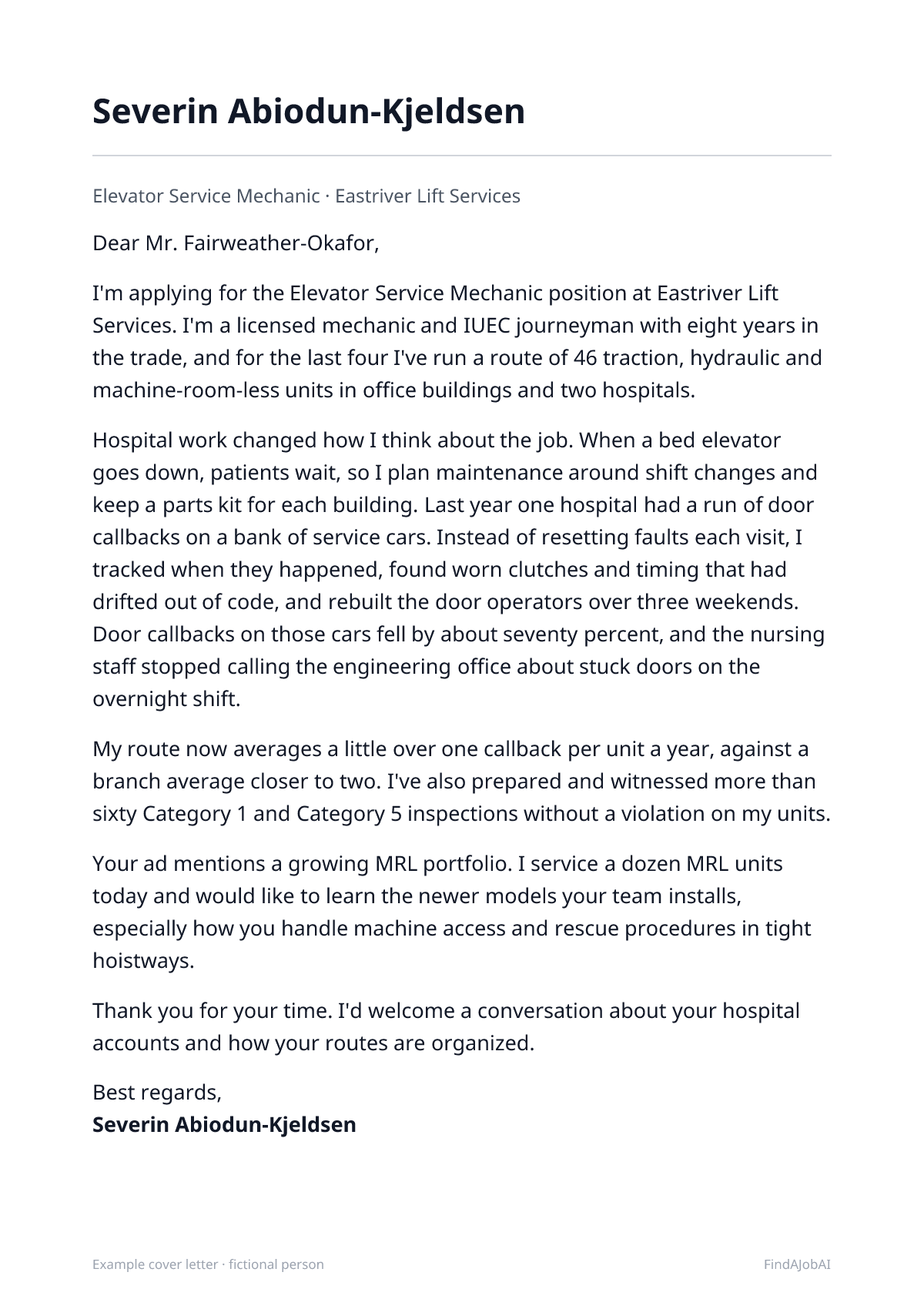
I'm applying for the Elevator Service Mechanic position at Eastriver Lift Services. I'm a licensed mechanic and IUEC journeyman with eight years in the trade, and for the last four I've run a route of 46 traction, hydraulic and machine-room-less units in office buildings and two hospitals.
Hospital work changed how I think about the job. When a bed elevator goes down, patients wait, so I plan maintenance around shift changes and keep a parts kit for each building. Last year one hospital had a run of door callbacks on a bank of service cars. Instead of resetting faults each visit, I tracked when they happened, found worn clutches and timing that had drifted out of code, and rebuilt the door operators over three weekends. Door callbacks on those cars fell by about seventy percent, and the nursing staff stopped calling the engineering office about stuck doors on the overnight shift.
My route now averages a little over one callback per unit a year, against a branch average closer to two. I've also prepared and witnessed more than sixty Category 1 and Category 5 inspections without a violation on my units.
Your ad mentions a growing MRL portfolio. I service a dozen MRL units today and would like to learn the newer models your team installs, especially how you handle machine access and rescue procedures in tight hoistways.
Thank you for your time. I'd welcome a conversation about your hospital accounts and how your routes are organized.
Best regards,
Severin Abiodun-Kjeldsen
Example 2 · Career changer
Commercial electrician moving into the elevator trade
Rosamund is a licensed commercial electrician who has wired elevator machine rooms. The ad is for an elevator helper or apprentice role.
Example letter · fictional
Dear Northgate Hiring Committee,
I'm writing about the Elevator Apprentice opening at Northgate Vertical Systems. I'm a licensed commercial electrician with six years of experience, and some of my favorite jobs have been machine room and hoistway power for new elevator installations.
On a recent office tower project, our crew ran feeders and disconnects for six traction cars while the elevator crew set their controllers. I got to know the elevator mechanics well, and they started asking me to help trace wiring faults during their testing. On one car, I found a miswired disconnect auxiliary contact that had them chasing a controller fault for two days. That job made me realize I was more interested in the elevator side of the room than the feeder side. I wanted to understand how the whole car worked, not just the power that fed it.
Since then I've completed OSHA 30, read through the ASME A17.1 sections that apply to electrical work and spent several days shadowing a service mechanic on his route. I understand that an apprenticeship means starting over in many ways, including pay and seniority, and I'm ready for that because I want a long career in this trade.
Your ad says you value apprentices with electrical backgrounds. I can already read diagrams, test circuits safely and work lockout procedures without being reminded, which should let me focus on learning the mechanical and code side quickly.
I'd be glad to talk about my electrical work and why I want to make this move.
Kind regards,
Rosamund Tshabalala-Engström
Example 3 · Senior or lead
Adjuster and supervisor applying to lead a regional service team
Octavia supervises twelve mechanics on 600 units. The ad is for a service manager to cut callbacks in a large regional portfolio.
Example letter · fictional
Dear Ms. Albrecht-Nyambura,
I'm applying for the Elevator Service Manager role at Keystone Arc Elevator. I've spent nineteen years in the trade, starting as an apprentice and working through construction and adjusting, and for the last seven I've supervised twelve service mechanics covering about six hundred units.
Your ad says callbacks in the region have climbed and customers are noticing. When I took over my current team, we had the same problem. Routes had grown over the years without a plan, so some mechanics covered buildings across town while their older, high-risk units got the same attention as new ones. I rebuilt the routes around building risk, equipment age and travel time, and I started a weekly review of every unit with three or more callbacks that month. Within two years our callback rate fell from about two per unit a year to under one and a half, and overtime dropped too.
I also still adjust new gearless installations, and most of the cars I've tuned have passed final acceptance on the first inspection. Staying on the tools keeps me honest about what I ask the team to do, and it means mechanics can call me about a hard fault and get real help rather than a reminder about paperwork.
Your portfolio includes more escalators and moving walks than mine, and I'd want to learn how your team handles transit accounts and their tighter outage windows.
I'd like to hear which buildings are driving the callbacks and what the mechanics think is behind them.
Sincerely,
Octavia Ferreira-Lindgren
All three letters, and the short version below, are fictional: the people, employers and numbers are invented. Borrow the structure, never the facts.
- Prefer to write it yourself? Use the free cover letter template.
- Check your CV against the job first: the free CV score shows the missing keywords.
Why the first letter works, paragraph by paragraph
Paragraph 1: Opening
Puts the license, union status, years and route size up front, the credentials an elevator contractor checks before reading further.
Paragraph 2: The hospital story
Shows judgment about critical buildings and one fault traced to a cause with a clear callback result, the core evidence of a good service mechanic.
Paragraph 3: Route results
Callback rate against the branch average and clean inspections give the manager two figures they track every month.
Paragraph 4: MRL growth area
Connects directly to the ad and shows willingness to learn new equipment without overstating experience.
Paragraph 5: Close
Asks about hospital accounts and routes, which makes the interview start on the work rather than generic questions.
What the career changer's letter does differently
The career changer's letter uses one real job site to connect electrical work with elevators: helping elevator mechanics, finding a miswired contact and realizing where her interest lies. OSHA 30, code reading and shadowing show preparation, and she frames her electrical skills as a head start rather than a replacement for training.
What the senior letter does differently
A senior letter shows method: routes rebuilt around risk, a weekly review of problem units and a measured drop in callbacks. Staying on the tools builds trust with mechanics, and the honest note about escalator portfolios shows awareness of where she will need to learn.
Short elevator mechanic cover letter: an email-ready version
Many applications arrive as an email or a small text box, and a full page doesn't fit. This version runs 120 to 150 words and keeps only what a reader needs to decide whether to reply. A hydraulic specialist replies to a small independent elevator company owner who posted the job on a trade board with an email address.
Short version · email · fictional122 words
Subject: Elevator Mechanic – hydraulic and residential service – Lazarus Ndiaye-Pettersen
Hi Mr. Kowalewski,
I saw your post for an elevator mechanic at Stoneridge Lift Repair. I'm a licensed mechanic with seven years in the trade, most of it servicing hydraulic units in residential buildings and small offices.
On my current route of thirty-eight units, I cut callbacks on one troubled hydraulic bank from twenty-two a year to six by replacing a failing valve and resealing two jacks. I've also kept my monthly maintenance compliance at one hundred percent for three years.
Your post mentions a small team where each mechanic handles their own customers. That's how I like to work, and my customers have my direct number. My resume is attached, and I can meet any morning next week.
Thanks,
Lazarus Ndiaye-Pettersen
The short email gives a license, a route size and one callback result, then matches the owner's description of independent work, which is all a small-company owner needs before calling.
Opening lines that work for elevator mechanic cover letters
The first sentence decides whether the second gets read. Here are six openings, one for each situation you might be in. Pick the one that matches yours and swap in your own facts: every name and number below is invented.
1. You have a standout result
Last year I cut door callbacks on a hospital service bank by about seventy percent. I'd like to bring that same attention to your hospital and office accounts.
2. The ad names a problem you've solved
Your ad says your hydraulic portfolio has aging valves and frequent leveling complaints. I've rebuilt valves and resealed jacks on dozens of similar units and know where those faults start.
3. Someone referred you
Your service supervisor, Anselm Varga-Moreno, and I worked the same modernization crew for two years. He told me you need a mechanic who can run a route alone, which is why I'm writing.
4. You admire what they build
I've passed more than sixty city inspections without a violation on my units, and I'd like to keep that record on your route.
5. You're new to the field or switching into it
After six years wiring elevator machine rooms as a commercial electrician, I want to move into the elevator trade itself as an apprentice.
6. You have senior scope or a specialism
I've supervised twelve mechanics covering six hundred units and cut our callback rate by a third, and I'm looking to lead a regional team through the same work.
How to write an elevator mechanic cover letter
Five steps, in the order you'd write them. The shape stays the same for every job (a short opening, proof, a reason for this employer, a close), and what goes into each part is what changes with the role.
Lead with your credentials
Elevator contractors check licenses, apprenticeship status and union membership first. Put them in your opening sentence along with years in the trade and the equipment you know, so the reader can confirm the basics before reading your story.
Tell one service or installation story
Choose a fault you traced, a problem building you turned around or a modernization you finished on time. Describe what was wrong, what you checked and what you changed, in plain trade language a service manager will recognize at once.
Use the numbers managers track
Give callbacks per unit, downtime, inspections passed without violations or projects finished ahead of schedule. Compare against a baseline such as the branch average, so the figure means something to a reader who does not know your route.
Describe how you work safely
Add a sentence on lockout, hoistway access procedures, safety training or incident-free years. Elevator work carries real risk, and employers want to know you protect yourself, your helper and building occupants on every single job, including the rushed ones.
Match their buildings and equipment
Close by naming something from the ad, such as hospital accounts, MRL units or escalators, and what you would want to learn about it. This shows you read the posting and gives the interviewer an obvious first topic.
Elevator Mechanic cover letter do's and don'ts
Do
- State your license, apprenticeship and union status in the opening paragraph.
- Tell one fault or route story with a callback, downtime or inspection result.
- Name the equipment types you service so the reader can match you to their portfolio.
Don't
- Don't claim experience on equipment you have only seen; say what you have actually serviced.
- Don't leave out safety; one line on lockout habits or incident-free years matters here.
- Don't send the same letter to union and non-union employers without adjusting it.
Common elevator mechanic cover letter mistakes
Each one is easy to make and quick to fix before you send the letter.
Hiding the license until the last line
Credentials decide whether the letter gets read. State your license and apprenticeship status in the first sentence or two.
Listing route duties with no outcomes
Every mechanic does maintenance and callbacks. Show what changed on your route, such as fewer callbacks or clean inspections.
Overstating equipment experience
Contractors will test what you claim. Name the equipment you have actually serviced and say plainly where you would need training.
No mention of emergency calls
Entrapments and after-hours calls are part of the job. A line on how you handle them shows you are ready for real route work.
A generic letter for every employer
Union contractors, independents and building owners want different things. Adjust the opening and close for each one.
Email subject lines for elevator mechanic applications
Applying by email? Put the job title, any reference number and your name in the subject line.
- Elevator Service Mechanic – licensed, IUEC journeyman, 46-unit route – Severin Abiodun-Kjeldsen
- Elevator Apprentice – licensed commercial electrician – Rosamund Tshabalala-Engström
- Application: Elevator Service Supervisor (Job 7741) – QEI certified
Everything for Elevator Mechanics
- Elevator Mechanic resume exampleA full resume, plus bullet and summary examples
- Elevator Mechanic interview questions30 questions with sample answers
- Elevator Mechanic job descriptionDuties, skills and requirements
- Career change cover letter: template + examples
Other cover letter examples
Elevator Mechanic cover letter FAQ
What should I write in an elevator mechanic cover letter?
Open with your license, apprenticeship and the equipment you know. Tell one story about a fault you fixed or a route you improved, with callbacks, downtime or inspection results, then link it to the buildings or equipment in the ad.
How do I write an elevator apprentice cover letter with no elevator experience?
Show related skills such as electrical, mechanical or construction work, safety training and any time spent around elevator crews. Say why you want this trade specifically and that you understand the apprenticeship path and its demands.
Should I mention my union local in an elevator mechanic cover letter?
Yes, when applying to union contractors, since IUEC status is often required. For building owners or non-union firms, focus on your license, training and route results instead.
How we built this page
The FindAJobAI team wrote the three example letters, the short email version, the opening lines and the advice for elevator mechanic roles. The people, employers and numbers in the letters are invented; the structure, the kind of evidence and the order of the paragraphs are the parts to copy.
Once we track enough live elevator mechanic job ads, this page also shows the skills they ask for most, counted the same way as our in-demand skills report.
Last reviewed on November 1, 2026.