Penetration Tester Cover Letter Example (2026)
By FindAJobAI team Updated How we built this page
Pentester ads read like checklists of certifications and testing methodologies, so most applicants sound interchangeable. A cover letter earns attention by naming one engagement: the target, what you found, how you proved it mattered, and what the client fixed because of your report.
Penetration Tester cover letter template
This letter as a one-page template: an opening that names the job and your strongest fact, proof that answers the ad, a reason for this employer and a short close.
After you sign up, FindAJobAI drafts your own letter for a real job from your CV in this format, and you edit it before you send it.
Example 1 · Experienced
Web application pentester applying to a financial software firm
Quinn tests web and mobile apps for a security consultancy. The ad asks for OWASP Top 10 depth and clear client reporting.
Example letter · fictional
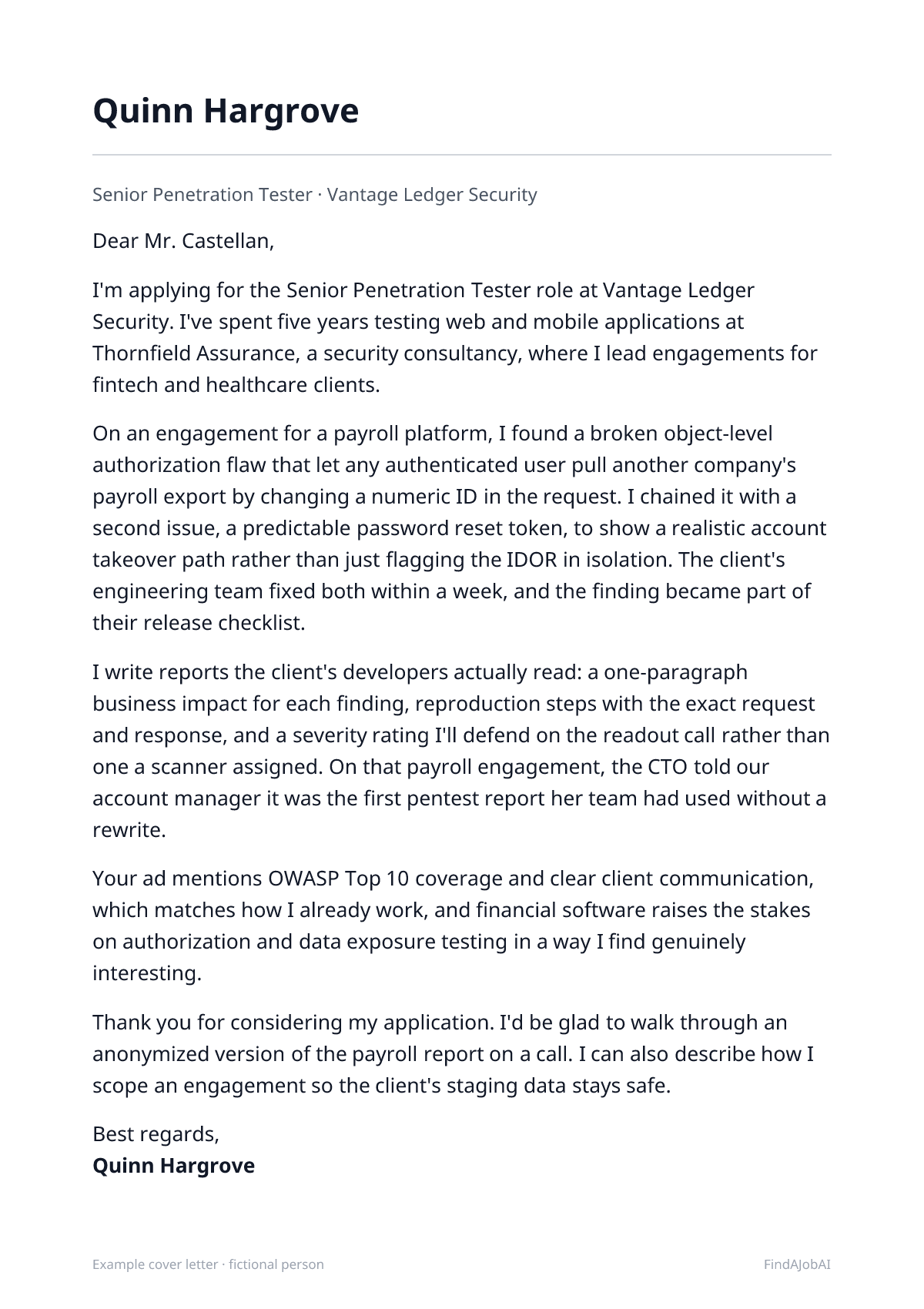
Dear Mr. Castellan,
I'm applying for the Senior Penetration Tester role at Vantage Ledger Security. I've spent five years testing web and mobile applications at Thornfield Assurance, a security consultancy, where I lead engagements for fintech and healthcare clients.
On an engagement for a payroll platform, I found a broken object-level authorization flaw that let any authenticated user pull another company's payroll export by changing a numeric ID in the request. I chained it with a second issue, a predictable password reset token, to show a realistic account takeover path rather than just flagging the IDOR in isolation. The client's engineering team fixed both within a week, and the finding became part of their release checklist.
I write reports the client's developers actually read: a one-paragraph business impact for each finding, reproduction steps with the exact request and response, and a severity rating I'll defend on the readout call rather than one a scanner assigned. On that payroll engagement, the CTO told our account manager it was the first pentest report her team had used without a rewrite.
Your ad mentions OWASP Top 10 coverage and clear client communication, which matches how I already work, and financial software raises the stakes on authorization and data exposure testing in a way I find genuinely interesting.
Thank you for considering my application. I'd be glad to walk through an anonymized version of the payroll report on a call. I can also describe how I scope an engagement so the client's staging data stays safe.
Best regards,
Quinn Hargrove
Example 2 · Career changer
Network engineer moving into penetration testing
Priyasha found and reported a misconfiguration using tools she taught herself. The ad lists a help-desk-to-security path as acceptable.
Example letter · fictional
Dear Hiring Manager,
I'm applying for the Junior Penetration Tester role at Blackthorn Cyber. I've spent four years as a network engineer at a regional hospital system, and the part of that job I've chased hardest is finding out how our own network could be broken into before someone else does.
Eighteen months ago I ran an internal Nmap sweep out of curiosity and found a legacy file server still answering on SMBv1 with null sessions enabled, three years after it was supposed to be decommissioned. I escalated it, wrote up the exposure in plain terms for our security committee, and it was isolated within a day. That find pushed me to study testing seriously rather than treat it as a side curiosity.
Since then I've earned the eJPT, I'm partway through the OSCP coursework, and I've completed over forty boxes on Hack The Box, documenting each one as if it were a client report. I'm comfortable with Burp Suite, Nmap, and Metasploit, and my networking background means I read a target's infrastructure quickly rather than guessing at it.
Your posting accepts a networking or sysadmin background in place of prior testing titles, which is exactly my situation, and I'd bring both the offensive skills I've been building and an unusually solid read on how enterprise networks are actually configured.
Thank you for your time. My Hack The Box profile and two sanitized writeups are linked on my resume, and I'd welcome the chance to talk further.
Kind regards,
Priyasha Deol
Example 3 · Senior or lead
Red team lead applying to build a first internal red team
Osei leads six operators at a consultancy. The ad is for a first in-house red team lead who will set scope, run campaigns and report to the CISO.
Example letter · fictional
Dear Ms. Ferraro,
I'm applying for the Red Team Lead role at Ironford Logistics. For the last three years I've led a six-person red team at Graywatch Consulting, running adversary simulation engagements for retail and logistics clients, and before that I spent six years as a penetration tester. I'd like to build an internal team from its first engagement.
Your ad says leadership wants to know whether a real intrusion would be caught before it caused damage, not just whether a scanner finds open ports. That's the exact gap I closed at Graywatch. I ran a campaign against a distribution client that started with a phished warehouse manager's credentials, moved laterally through a flat VLAN, and reached the shipping control system in under six hours without triggering a single alert. The writeup became the business case for their network segmentation project.
A red team earns trust by showing what detection missed, not just what access was gained. On a separate engagement, I staged a slow data exfiltration over DNS that the client's SOC caught on day four, and I used that catch in the report as proof their new monitoring investment was working, which mattered as much to them as the access I got.
I've mentored four operators through their first live campaigns and built the rules of engagement template Graywatch still uses. I haven't run a team as an internal hire reporting directly to a CISO, and at Ironford I'd expect to spend real time early on aligning scope and rules of engagement with your legal and operations leads.
A conversation about which systems concern your leadership most, and how incidents are currently detected and escalated, would be a good place to start.
Sincerely,
Osei Appiah-Kubi
All three letters, and the short version below, are fictional: the people, employers and numbers are invented. Borrow the structure, never the facts.
- Prefer to write it yourself? Use the free cover letter template.
- Check your CV against the job first: the free CV score shows the missing keywords.
Why the first letter works, paragraph by paragraph
Paragraph 1: Opening
States the employer type served (fintech and healthcare clients) and the scope of the role, lead on engagements, so the reader knows the writer's level before reading further.
Paragraph 2: The finding that mattered
A specific vulnerability class (IDOR), the chain that made it serious (combined with a predictable reset token), and the client outcome, fixed within a week and added to a checklist, rather than a vague claim of finding 'critical issues.'
Paragraph 3: How the writer reports
Names what makes a report usable to developers: business impact, exact reproduction steps, a defended severity rating. The CTO quote is a concrete signal of client trust, which matters more in consulting than tool lists.
Paragraph 4: Why this company
Mirrors the ad's two stated priorities and adds a specific reason financial software suits the writer's existing focus on authorization testing.
Paragraph 5: Close
Offers to walk through an anonymized report live, a low-risk next step that respects the current client's confidentiality.
What the career changer's letter does differently
The career changer's letter starts from a real discovery made out of curiosity before any testing title (the SMBv1 misconfiguration), shows it led to deliberate study rather than a one-off, and lists concrete proof of current skill: a certification, in-progress coursework, and a documented practice history. It explicitly ties a networking background to what the ad says it will accept.
What the senior letter does differently
A red team lead letter reports what detection caught and missed, not only what access was gained, since that's what in-house leadership actually cares about. The six-hour, undetected path to a shipping control system shows business risk in plain terms, and the gap, no prior internal reporting line to a CISO, is named rather than hidden.
Short penetration tester cover letter: an email-ready version
Many applications arrive as an email or a small text box, and a full page doesn't fit. This version runs 120 to 150 words and keeps only what a reader needs to decide whether to reply. A penetration tester answers a SaaS company's short-form application question after finding the role through a referral, sent by email per the ad's instructions.
Short version · email · fictional122 words
Subject: Penetration Tester (web, API) – authentication bypass finding – Tomasz Wierzbicki
Hello Mr. Albescu,
I'm applying for the Penetration Tester role at Haverbrook Systems. I have four years of web and API testing experience at a security consultancy, where I lead engagements against SaaS platforms similar in size to yours.
My strongest recent finding was an authentication bypass in a password reset flow: a predictable token let me take over any account without the original credentials. The client fixed it within two days and now includes the scenario in their own QA regression tests.
I enjoy testing multi-tenant SaaS products specifically, since one mistake in tenant isolation can expose many customers at once. My resume is attached, and I can share a sanitized version of the reset-flow report on request.
Best,
Tomasz Wierzbicki
A short-form question forces one finding, so the version keeps the authentication bypass and its concrete outcome rather than a list of skills. Offering a sanitized report preserves client confidentiality while still giving the reader something to act on.
Opening lines that work for penetration tester cover letters
The first sentence decides whether the second gets read. Here are six openings, one for each situation you might be in. Pick the one that matches yours and swap in your own facts: every name and number below is invented.
1. You have a standout result
On a recent engagement I chained an IDOR with a weak password reset token into a full account takeover, and the client fixed both within a week. I'd like to find issues like that for your platform.
2. The ad names a problem you've solved
Your ad says developers often rewrite pentest reports before anyone reads them. I write mine the way I'd want a report written to me: one paragraph of business impact per finding, with reproduction steps a developer can follow without asking a question.
3. Someone referred you
Your security engineer, Odalys Kwarteng, worked with me on an external engagement last year and suggested I apply, since your team values clear reporting over long finding counts.
4. You admire what they build
I've used your platform as a customer for two years, and a question about how tenant data is isolated behind the scenes is part of why I'm applying to test it directly.
5. You're new to the field or switching into it
I spent four years as a network engineer before teaching myself offensive security on my own time, starting with a misconfiguration I found and reported on our own hospital network. Testing is where I want to keep doing that work professionally.
6. You have senior scope or a specialism
As a red team lead for three years, I built the rules of engagement template my company still uses and have run six-hour, undetected campaigns against live production networks. I'm looking for a role where I can build that capability in-house.
How to write a penetration tester cover letter
Five steps, in the order you'd write them. The shape stays the same for every job (a short opening, proof, a reason for this employer, a close), and what goes into each part is what changes with the role.
Match the testing type the ad actually lists
Web, network, mobile, cloud, and red team engagements require different skills and tell different stories. Read which ones the ad names and pick a real engagement of yours in that category. A network engagement story doesn't help an ad asking for API testing depth.
Open with the finding and its proven impact
Name the vulnerability class and how you proved it mattered, such as chaining it with a second flaw to show real access, before describing your tools. A scanner finding a bug isn't the story; what you did with it, and what the client fixed, is.
Describe the outcome, not the finding count
Say what changed because of your report: a fix shipped, a process added, a detection gap closed. Avoid tallying how many vulnerabilities you found in an engagement. One well-proven, well-explained finding is more convincing than a long list of low-severity ones.
Separate held certifications from in-progress ones
State clearly which credentials, like OSCP, eJPT, or CPTS, you hold versus are studying for, and back them with documented practice such as a Hack The Box or TryHackMe history. Overstating certification status is an easy way to lose credibility with a technical reviewer.
Show you can write for a non-technical reader
Mention how you explain severity and business impact to people who aren't engineers, such as a one-paragraph summary per finding or a readout call you run. Close by naming a system or question you'd want to test first, so the reader sees where you'd start.
Penetration Tester cover letter do's and don'ts
Do
- Name the vulnerability class and the business impact you proved, not just a CVSS score or a tool's severity label.
- Mention the testing types the ad lists (web, network, mobile, cloud) only where you have a real engagement behind each one.
- Show how you report: what a client's engineers acted on, and how fast.
Don't
- Don't claim you "think like an attacker"; show one chained exploit instead.
- Don't list every certification you're studying for as if already earned; separate held from in-progress.
- Don't name a current or past client, or describe a finding specifically enough that it could be fingerprinted; anonymize the company and the exact system.
Common penetration tester cover letter mistakes
Each one is easy to make and quick to fix before you send the letter.
Claiming to "think like an attacker"
Every applicant writes this. Replace it with one real exploit chain and what it proved was possible, which shows the mindset instead of asserting it.
Counting vulnerabilities instead of describing impact
"Found 60 vulnerabilities" says nothing about severity or outcome. Pick the one finding that changed something and explain the chain, the proof, and the fix.
Listing certifications without status
Writing "OSCP, CISSP, CEH" when some are in progress misleads a technical reviewer who will ask about them. State held versus in-progress clearly, and back held ones with real engagement history.
Naming or describing a specific client or system
Details specific enough to identify a past client's finding can violate the engagement's confidentiality terms. Anonymize the company and keep the technical description general enough not to fingerprint the target.
Writing only about tools, not reporting
A letter that lists Burp Suite, Nmap, and Metasploit without mentioning how findings are communicated reads like a resume restated in prose. Add a sentence on how you make a report usable to the engineers who have to fix it.
Email subject lines for penetration tester applications
Applying by email? Put the job title, any reference number and your name in the subject line.
- Senior Penetration Tester application – web and mobile, fintech clients – Quinn Hargrove
- Junior Penetration Tester – network engineer, eJPT, OSCP in progress – Priyasha Deol
- Application: Penetration Tester, Red Team (Req. 2240) – Quinn Hargrove
Everything for Penetration Testers
- Penetration Tester resume exampleA full resume, plus bullet and summary examples
- Penetration Tester interview questions30 questions with sample answers
- Penetration Tester job descriptionDuties, skills and requirements
- Career change cover letter: template + examples
Other cover letter examples
Penetration Tester cover letter FAQ
What should I write in a penetration tester cover letter?
One engagement that mattered: the vulnerability class, how you chained or proved impact, and what the client fixed because of your report. Add a sentence on how you communicate findings to engineers. Your certifications and tools are already on your resume.
How do I write a penetration tester cover letter with no professional testing experience?
Use a real discovery from a related role such as networking or IT support, then add certifications like eJPT or OSCP and documented practice on platforms like Hack The Box or TryHackMe. Name what you found or built and how you verified it.
Should I name past clients or specific vulnerabilities I found?
No. Describe the vulnerability class and the outcome in general terms, and keep the company anonymized. Offer to share a sanitized report or writeup instead of naming names in the letter.
Do I need OSCP to apply for a penetration tester role?
Many ads prefer it but accept equivalents like eJPT, CPTS, or a strong practical portfolio. If you don't have OSCP yet, say what you do have and what you're working toward, backed by documented hands-on work.
How we built this page
The FindAJobAI team wrote the three example letters, the short email version, the opening lines and the advice for penetration tester roles. The people, employers and numbers in the letters are invented; the structure, the kind of evidence and the order of the paragraphs are the parts to copy.
Once we track enough live penetration tester job ads, this page also shows the skills they ask for most, counted the same way as our in-demand skills report.
Last reviewed on November 1, 2026.