Psychologist Cover Letter Example (2026)
By FindAJobAI Team Updated How we built this page
Psychologist hiring committees already know your degree and license from the CV. The letter shows how you think as a clinician: which treatments you use and why, how you measure progress, how you work with psychiatry or primary care, and what you would add to their program. Keep every clinical example de-identified.
Psychologist cover letter template
This letter as a one-page template: an opening that names the job and your strongest fact, proof that answers the ad, a reason for this employer and a short close.
After you sign up, FindAJobAI drafts your own letter for a real job from your CV in this format, and you edit it before you send it.
Example 1 · Experienced
Licensed psychologist applying to a hospital trauma program
Ingrid has four years of outpatient practice using CPT and prolonged exposure. The ad is for a trauma-focused psychologist in a hospital clinic.
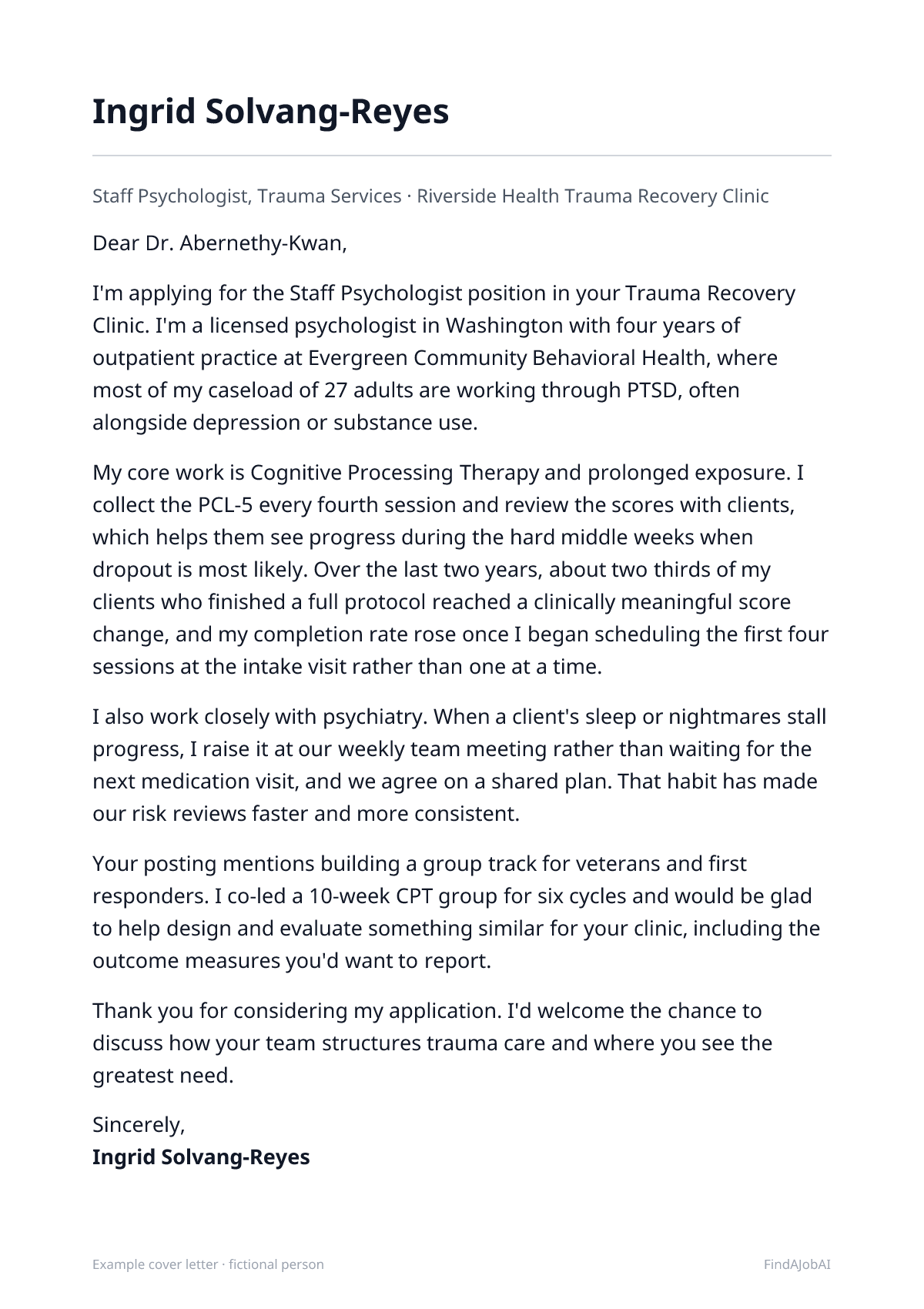
Example letter · fictional
Dear Dr. Abernethy-Kwan,
I'm applying for the Staff Psychologist position in your Trauma Recovery Clinic. I'm a licensed psychologist in Washington with four years of outpatient practice at Evergreen Community Behavioral Health, where most of my caseload of 27 adults are working through PTSD, often alongside depression or substance use.
My core work is Cognitive Processing Therapy and prolonged exposure. I collect the PCL-5 every fourth session and review the scores with clients, which helps them see progress during the hard middle weeks when dropout is most likely. Over the last two years, about two thirds of my clients who finished a full protocol reached a clinically meaningful score change, and my completion rate rose once I began scheduling the first four sessions at the intake visit rather than one at a time.
I also work closely with psychiatry. When a client's sleep or nightmares stall progress, I raise it at our weekly team meeting rather than waiting for the next medication visit, and we agree on a shared plan. That habit has made our risk reviews faster and more consistent.
Your posting mentions building a group track for veterans and first responders. I co-led a 10-week CPT group for six cycles and would be glad to help design and evaluate something similar for your clinic, including the outcome measures you'd want to report.
Thank you for considering my application. I'd welcome the chance to discuss how your team structures trauma care and where you see the greatest need.
Sincerely,
Ingrid Solvang-Reyes
Example 2 · Entry level
Doctoral graduate applying for a postdoctoral fellowship
Caspian is finishing an APA-accredited internship at a VA medical center. The ad is for a one-year postdoc in integrated primary care.
Example letter · fictional
Dear Dr. Vasquez-Lindahl,
I'm applying for the Postdoctoral Fellowship in Integrated Primary Care at Lakemont Family Health Network. I will complete my PhD in clinical psychology this summer, along with an APA-accredited internship at the Huron Valley VA, and I'm looking for a fellowship that gives me the supervised hours I need for licensure in a primary care setting.
Half of my internship was spent in a primary care clinic, where I saw patients for brief 30-minute visits between their medical appointments. I learned to focus a session on one target, such as sleep, pain or a stressful diagnosis, and to give the physician a two-line note they could use the same afternoon. I carried about 14 patients at a time and co-led a weekly chronic pain group for two cohorts.
I'm trained in CBT for insomnia, ACT and motivational interviewing, and I completed 18 assessment reports during internship. My supervisors would describe me as someone who asks for feedback early and adjusts quickly, which matters in a setting where the next patient is always waiting.
Your fellowship's focus on diabetes and chronic disease management interests me most. My dissertation looked at adherence to treatment plans, and I would like to apply what I learned to work with your care teams. I'm especially interested in how brief behavioral visits can support patients who are struggling to follow medication or diet plans after a new diagnosis.
Thank you for your time. I have attached my CV and can provide letters from my internship supervisors whenever they are needed.
Kind regards,
Caspian Thorvaldsen
Example 3 · Senior or lead
Clinical director applying to lead behavioral health for a health system
Marguerite directs eleven clinicians across two outpatient sites. The ad is for a director of psychology services at a regional health system.
Example letter · fictional
Dear Dr. Fenwick-Asante,
I'm applying for the Director of Psychology Services role at Prairie Valley Health System. I'm a licensed psychologist with fourteen years of practice, and for the past six I've served as clinical director at Northstar Behavioral Health Partners, leading eleven psychologists and therapists across two outpatient sites.
When I took the role, new clients waited about six weeks for a first appointment and outcome data existed only for a handful of clinicians. We moved to a triage intake with a same-week phone assessment, added brief four-session CBT tracks for milder presentations, and built PHQ-9 and GAD-7 collection into check-in. First-appointment waits fell to about three weeks, and measure completion reached over 90% of visits within eight months, which gave us real data for staffing decisions.
I also direct our internship track. We train three interns and two postdoctoral fellows a year, and every fellow since 2021 has passed the EPPP on the first attempt. I still carry a small adult trauma caseload, which keeps me close to the clinical decisions my team makes every day.
I haven't yet led psychology services inside a hospital system with inpatient consultation, which your role includes, and I would want to spend early time with your consult-liaison team before proposing changes. I'd also expect to learn a great deal from your hospital psychologists about how consultation requests are prioritized on busy inpatient units.
I'd welcome a conversation about your access goals, your training programs and how psychology fits into the system's growth plans.
Sincerely,
Marguerite Ashdown-Nakamura
All three letters, and the short version below, are fictional: the people, employers and numbers are invented. Borrow the structure, never the facts.
- Prefer to write it yourself? Use the free cover letter template.
- Check your CV against the job first: the free CV score shows the missing keywords.
Why the first letter works, paragraph by paragraph
Paragraph 1: Opening
States license, state, years and caseload makeup in two sentences so the committee knows immediately where the writer fits.
Paragraph 2: Treatment and measurement
Names the protocols, how outcomes are measured and an aggregate result, plus a small practice change that improved completion, which shows clinical reasoning rather than a list of trainings.
Paragraph 3: Team work
Shows collaboration with psychiatry with a concrete habit, which hospital programs value highly.
Paragraph 4: Fit with the posting
Links the writer's group experience to the group track the ad mentions and offers to help evaluate it.
Paragraph 5: Close
Invites a discussion about the clinic's needs instead of repeating qualifications.
What the entry-level letter does differently
The postdoc applicant's letter is honest that licensure is still ahead and uses internship numbers (caseload, groups, reports) for every claim. It shows fit with primary care through a specific skill, brief focused visits with quick notes for physicians, and ties the dissertation to the fellowship's focus.
What the senior letter does differently
A director's letter reports system results: waitlist time, measurement coverage, training outcomes. It keeps a short line about ongoing clinical work for credibility and names one honest gap, inpatient consultation, with a plan to learn it.
Short psychologist cover letter: an email-ready version
Many applications arrive as an email or a small text box, and a full page doesn't fit. This version runs 120 to 150 words and keeps only what a reader needs to decide whether to reply. A licensed psychologist emails a group private practice owner after a colleague mentioned an opening for an anxiety specialist.
Short version · email · fictional122 words
Subject: Licensed Psychologist – ERP and CBT for anxiety, referred by Dr. Patel – Evander Mulcahy-Roux
Hello Dr. Brennan-Osei,
Dr. Leah Patel mentioned that your practice is looking for a psychologist who specializes in anxiety and OCD. I'm licensed in Colorado and have spent three years treating adults and teens with exposure and response prevention and CBT at a university counseling center.
I track Y-BOCS and GAD-7 scores throughout treatment, and I started offering out-of-office exposure sessions when clients stalled, which helped more of them finish treatment rather than dropping out in the middle weeks. Most of my clients now complete a full course of exposure work.
My CV is attached. I'd be glad to talk by phone this week about your caseload, referral sources and how new clinicians usually build a practice with you.
Best,
Evander Mulcahy-Roux
The short version leads with the referral, states license and specialty, and gives one concrete practice change. It skips the full training list, which the attached CV covers, and ends with practical questions a group practice owner cares about.
Opening lines that work for psychologist cover letters
The first sentence decides whether the second gets read. Here are six openings, one for each situation you might be in. Pick the one that matches yours and swap in your own facts: every name and number below is invented.
1. You have a standout result
When I began scheduling the first four CPT sessions at intake, more of my trauma clients completed the full protocol. I'd like to bring that focus on practical access to your trauma program.
2. The ad names a problem you've solved
Your posting asks for a psychologist who can work inside primary care. During internship I saw patients in 30-minute visits between medical appointments and wrote notes physicians could use the same afternoon.
3. Someone referred you
Dr. Leah Patel suggested I contact you about your anxiety specialist opening, since most of my caseload is exposure-based work for OCD and panic.
4. You admire what they build
I trained at your hospital as a practicum student, and the way your team integrates psychology into medical rounds is why I'd like to return as a licensed psychologist.
5. You're new to the field or switching into it
I'm finishing my doctoral internship this summer and looking for a postdoctoral year that combines assessment and brief intervention, which is exactly what your fellowship describes.
6. You have senior scope or a specialism
As clinical director, I cut first-appointment waits from six weeks to three across two sites, and I'm looking for a system-level role where I can do that work at a larger scale.
How to write a psychologist cover letter
Five steps, in the order you'd write them. The shape stays the same for every job (a short opening, proof, a reason for this employer, a close), and what goes into each part is what changes with the role.
Open with license and fit
Committees screen for licensure and setting first, so state your license, state, years of practice and main population in the opening sentences. If you're license-eligible, give the expected date clearly so nobody has to guess whether you can bill independently.
Explain how you treat, not just what you trained in
Name your core protocols and describe one decision you make within them, such as how you handle a stall or plan the first sessions. That shows clinical reasoning, which a CV list of certificates and workshops cannot show to a hiring committee.
Use aggregate outcomes
Measurement-based care is now common, so give a de-identified figure such as the share of clients reaching a meaningful change on a standard measure, or a waitlist reduction. Never use a single client's story, even with details changed, because it raises confidentiality concerns.
Describe your place in the care team
Psychologists in hospitals and clinics coordinate with psychiatry, primary care, case management and schools. Describe a specific habit, such as raising concerns at a weekly team meeting, so the reader can picture you as a colleague and not only as a solo clinician.
Connect to their program
Read the posting for program plans such as a new group track, a training program or a specialty clinic. Offer one concrete way your experience fits, and be honest about any part of the role you haven't done yet, with a short plan to learn it.
Psychologist cover letter do's and don'ts
Do
- State license status, state and any PSYPACT authorization in the first paragraph.
- Name the treatments and measures you use and give a de-identified, aggregate outcome.
- Show how you work with psychiatry, primary care or schools on shared clients.
Don't
- Don't describe an individual client's story, even with the name removed.
- Don't call your approach eclectic without naming the protocols behind it.
- Don't repeat your CV's training list; explain how you use that training.
Common psychologist cover letter mistakes
Each one is easy to make and quick to fix before you send the letter.
Telling a client story
Even a de-identified anecdote can worry a committee. Use aggregate results and describe your approach in general terms instead.
Listing every training workshop
The CV already covers your trainings. Pick the two or three protocols you use most and explain how you apply them.
Leaving license status vague
Write the exact status: licensed in which state, license-eligible from which date, or PSYPACT authorization. Ambiguity slows the screening process.
Ignoring the setting
A letter written for private practice reads oddly for a hospital consult role. Address the setting's pace, team and documentation needs.
Overclaiming leadership readiness
If you haven't directed a program or managed budgets, say what you have led, such as a group track or supervision, and name the gap honestly.
Email subject lines for psychologist applications
Applying by email? Put the job title, any reference number and your name in the subject line.
- Staff Psychologist, Trauma Services – licensed WA, CPT and PE – Ingrid Solvang-Reyes
- Postdoctoral Fellowship, Integrated Primary Care – PhD 2026 – Caspian Thorvaldsen
- Application: Licensed Psychologist (Req. 5582) – Ingrid Solvang-Reyes
Everything for Psychologists
- Psychologist resume exampleA full resume, plus bullet and summary examples
- Psychologist interview questions30 questions with sample answers
- Psychologist job descriptionDuties, skills and requirements
- Cover letter with no experience: templates
Other cover letter examples
Psychologist cover letter FAQ
What should a psychologist cover letter include?
License status, setting and population, the treatments you use and how you measure outcomes, one aggregate result, and how you would fit the program's specific needs. Keep it to one page and keep every example de-identified.
How long should a psychologist cover letter be?
About one page, or 250 to 400 words for clinical jobs. Academic positions often expect a longer letter covering research and teaching, so follow the posting's instructions.
Should I mention my dissertation in a clinical job application?
Only if it connects to the role, such as a dissertation on treatment adherence for a primary care position. One sentence linking it to the job is enough.
How we built this page
The FindAJobAI team wrote the three example letters, the short email version, the opening lines and the advice for psychologist roles. The people, employers and numbers in the letters are invented; the structure, the kind of evidence and the order of the paragraphs are the parts to copy.
Once we track enough live psychologist job ads, this page also shows the skills they ask for most, counted the same way as our in-demand skills report.
Last reviewed on November 1, 2026.