Site Reliability Engineer Resume Example (2026)
By FindAJobAI team Updated How we built this page
SRE hiring managers read for outcomes: services you kept up, incidents you led, toil you removed and the code you wrote to get there. A site reliability engineer resume that reads like a tool inventory misses the part of the job they're hiring for.
The example below is a senior SRE with eight years, starting as a systems engineer at a bank and now owning SLOs for a streaming platform. Each bullet carries a reliability number: availability, recovery time, pages or hours saved.
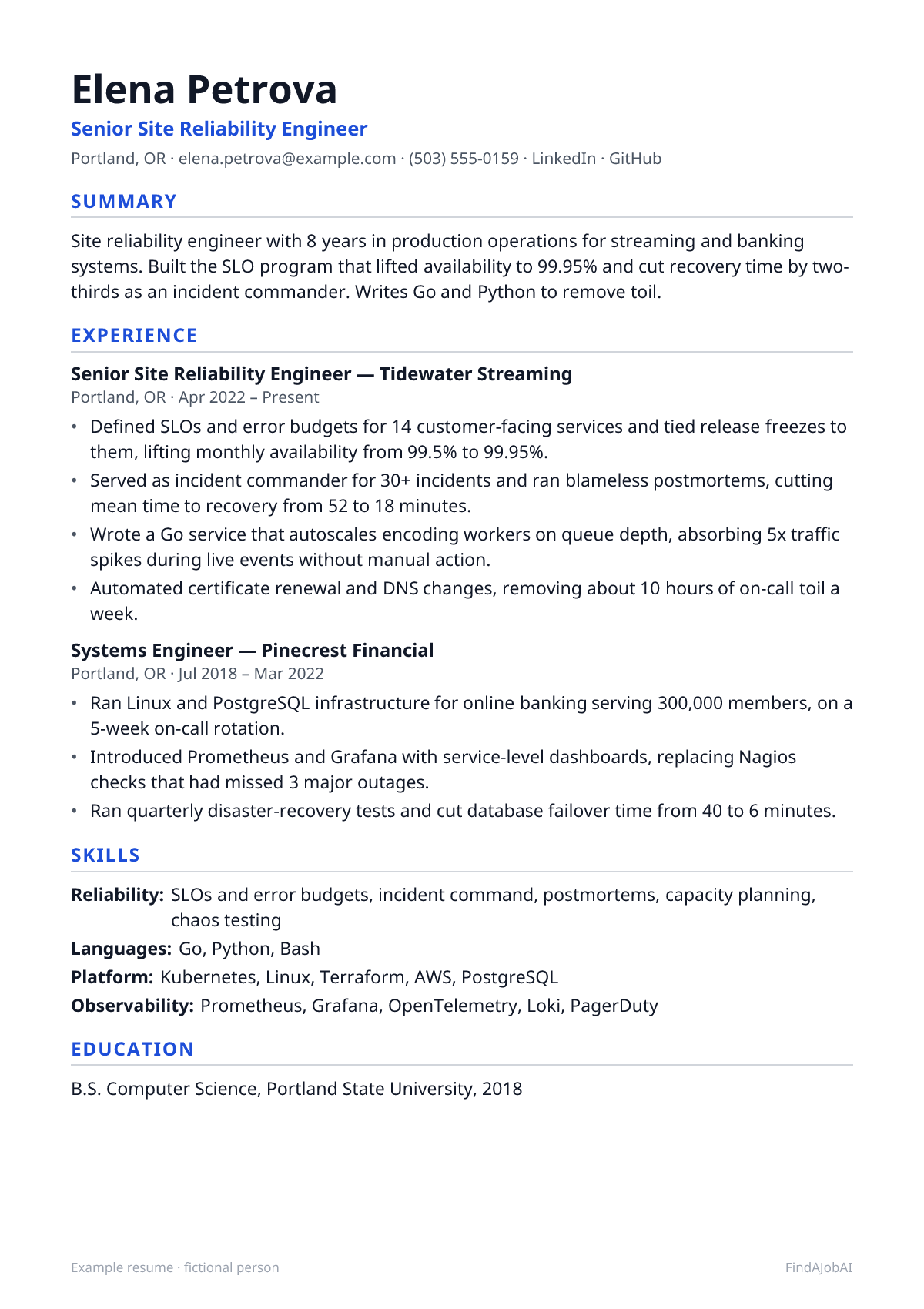
Site Reliability Engineer resume template
This example as a one-page template: one column, standard headings and plain text, the format applicant tracking systems read most reliably.
After you sign up, Create my CV builds your own resume in this same one-column layout, from your real experience.
Mid-level site reliability engineer resume example
A complete one-page example for a fictional site reliability engineer: every bullet pairs an action with what changed because of it.
Example resume · fictional person
Elena Petrova
Senior Site Reliability Engineer
Portland, OR · [email protected] · (503) 555-0159 · LinkedIn · GitHub
Summary
Site reliability engineer with 8 years in production operations for streaming and banking systems. Built the SLO program that lifted availability to 99.95% and cut recovery time by two-thirds as an incident commander. Writes Go and Python to remove toil.
Experience
Senior Site Reliability Engineer, Tidewater Streaming
Portland, OR · Apr 2022 – Present
- Defined SLOs and error budgets for 14 customer-facing services and tied release freezes to them, lifting monthly availability from 99.5% to 99.95%.
- Served as incident commander for 30+ incidents and ran blameless postmortems, cutting mean time to recovery from 52 to 18 minutes.
- Wrote a Go service that autoscales encoding workers on queue depth, absorbing 5x traffic spikes during live events without manual action.
- Automated certificate renewal and DNS changes, removing about 10 hours of on-call toil a week.
Systems Engineer, Pinecrest Financial
Portland, OR · Jul 2018 – Mar 2022
- Ran Linux and PostgreSQL infrastructure for online banking serving 300,000 members, on a 5-week on-call rotation.
- Introduced Prometheus and Grafana with service-level dashboards, replacing Nagios checks that had missed 3 major outages.
- Ran quarterly disaster-recovery tests and cut database failover time from 40 to 6 minutes.
Skills
- Reliability: SLOs and error budgets, incident command, postmortems, capacity planning, chaos testing
- Languages: Go, Python, Bash
- Platform: Kubernetes, Linux, Terraform, AWS, PostgreSQL
- Observability: Prometheus, Grafana, OpenTelemetry, Loki, PagerDuty
Education
- B.S. Computer Science, Portland State University, 2018
Fictional example by the FindAJobAI team: the person, employers and numbers are invented. Keep the structure; use your own work and numbers you can explain in an interview.
Entry-level site reliability engineer resume example
An SRE in the first eighteen months. On-call is the centerpiece, with pages handled and reviews led, and every automation bullet names the toil it removed.
Entry-level example resume · fictional person
Connor Doyle
Site Reliability Engineer
Spokane, WA · [email protected] · (509) 555-0165 · LinkedIn · GitHub
Summary
Site reliability engineer with 16 months on an SRE team after a computer science degree. Writes Go and Python automation, builds Prometheus alerts and Grafana dashboards, and is on the primary on-call rotation for 12 services. Most interested in capacity planning and chaos testing.
Experience
Site Reliability Engineer I, Palouse Software
Spokane, WA · Jun 2025 – Present
- Joined the primary on-call rotation for 12 services after 3 months, handling 25 pages and leading 2 incident reviews.
- Wrote a Go tool that checks certificate expiry on 300 endpoints daily, ending the expired-certificate outages that had happened twice a year.
- Built SLO dashboards in Grafana for 5 services from Prometheus metrics, used in the weekly reliability review.
- Automated the database failover runbook in Python, turning a 40-minute manual procedure into a 6-minute one.
Infrastructure Intern, Gonzaga University IT Services
Spokane, WA · Jun 2024 – Aug 2024
- Moved 30 lab servers to Ansible-managed configuration, cutting rebuild time from a day to an hour.
Skills
- Languages: Go, Python, Bash
- Observability: Prometheus, Grafana, Alertmanager, Loki
- Platform: Kubernetes, Linux, Terraform, AWS
Education
- B.S. Computer Science, Gonzaga University, 2025
Senior site reliability engineer resume example
A principal SRE whose work is the reliability system itself: standards, the incident program, multi-region design and chaos testing. Each bullet ends in incidents avoided or customers unaffected.
Senior example resume · fictional person
Yuki Sato
Principal Site Reliability Engineer
San Francisco, CA · [email protected] · (628) 555-0168 · LinkedIn · GitHub
Summary
Principal SRE with 14 years in production operations for consumer apps and payments, setting reliability strategy for 300 engineers. Built the SLO and incident programs behind a 60% drop in customer-facing incidents, and led the move to multi-region active-active for the core APIs.
Experience
Principal Site Reliability Engineer, Tandem Pay
San Francisco, CA · Apr 2021 – Present
- Set reliability strategy for 300 engineers: SLO standards, the incident process and production readiness reviews for every new service.
- Led the move of 8 core APIs to multi-region active-active on AWS; a full regional outage in 2025 caused no customer impact.
- Built the incident program (severity levels, commander rotation, tracked postmortems), cutting customer-facing incidents by 60% in 2 years.
- Started monthly chaos game days that found 22 failure modes before customers did.
Staff Site Reliability Engineer, Brightloop Social
San Francisco, CA · Jan 2016 – Mar 2021
- Ran capacity planning for a feed serving 30 million daily users, forecasting peaks within 10% for 3 years.
- Wrote a Go autoscaler for cache clusters that cut caching costs by $90,000 a month.
- Served as incident commander for more than 50 major incidents.
Systems Engineer, Golden Gate Hosting
Oakland, CA · Jun 2012 – Dec 2015
- Ran Linux fleet operations for 2,000 servers across 2 data centers.
Skills
- Reliability: SLO design, incident management, chaos engineering, capacity planning, production readiness
- Languages: Go, Python
- Platform: Kubernetes, AWS (multi-region), Envoy, Terraform, PostgreSQL
- Observability: OpenTelemetry, Prometheus, Grafana, Honeycomb
Education
- B.S. Electrical Engineering and Computer Sciences, University of California, Berkeley, 2012
How to write a site reliability engineer resume
Five steps, in the order a recruiter reads the page. The format around them stays plain for every job: one column, standard headings, newest role first.
Header: name, target title and links
Use Site Reliability Engineer or SRE, in the ad's form, and add GitHub if it shows your tooling. If your title was Systems or Production Engineer, keep it on the job and name the SRE work in the summary.
Summary: what you do and your best proof
Lead with reliability outcomes (availability, recovery time, incidents) and the scale of what you keep running, then the languages you automate in.
Experience: newest first, a result in every bullet
Use the ad's reliability vocabulary (SLOs, error budgets, incident command, postmortems) inside bullets with before and after numbers. Give at least one bullet per role to code you wrote.
Skills: grouped, in the ad's words
Group reliability practices, languages, platform and observability tools. Practices such as capacity planning are search terms too, so list them alongside the tools.
Education and certifications
A computing or engineering degree goes last with its year. Certifications matter less for SRE than for DevOps; a CKA is worth listing, a row of badges isn't.
Skills to put on a site reliability engineer resume
Hard skills are the tools and methods of the job; soft skills are how you work with people. Each comes with one way to prove it, because a skill named only in a list counts for little. Add the ones you really have.
Hard skills
- SLOs and error budgets
- Name how many services have SLOs you defined and what happened when a budget ran out.
- Incident management
- Give your role (commander or responder), the incident count and recovery times.
- Observability
- Mention the metrics, logs and traces you built and how much faster problems were detected.
- Go or Python
- Show a tool or service you wrote that removed toil or prevented an outage.
- Kubernetes operations
- Describe reliability work on clusters: upgrades, autoscaling, disruption budgets.
- Linux internals
- Mention a problem you debugged at the OS level (memory, networking, file descriptors) and the outcome.
- Capacity planning
- Give a forecast you made and how close it came to reality.
- Distributed systems
- Explain a failure mode you designed around, such as retry storms or timeouts.
- Networking and load balancing
- Mention DNS, load balancer or service mesh work and its effect.
- Chaos engineering
- Count the failure modes your game days or experiments uncovered.
- Databases in production
- Describe failover, replication or backup work with recovery times.
- Infrastructure as code
- Show reliability changes you delivered through Terraform or similar, reviewed like code.
Soft skills
- Blameless postmortems
- Mention reviews you led and the fixes that followed them.
- Calm leadership
- Describe coordinating responders through a major incident.
- Influence without authority
- Show a reliability standard teams adopted because you made the case for it.
- Clear writing
- Mention runbooks or postmortems that others use.
- Systems thinking
- Describe a recurring problem you traced to a root cause spanning several teams.
- Saying no well
- Show a launch you delayed or a freeze you called, and why it was right.
What employers ask for in site reliability engineer job ads
The skills named most often in the 441 newest site reliability engineer job ads we track (out of 1,042 live postings), as the share of ads that mention each:
- 1Incident management73%
- 2Kubernetes71%
- 3Observability71%
- 4Python64%
- 5CI/CD61%
- 6AWS60%
- 7Terraform59%
- 8Infrastructure as Code57%
Add only the ones you really have, in Skills and in a bullet that shows how you used them. The full list is on the Site Reliability Engineer resume keywords page.
From live job ads · computed November 2, 2026 · refreshed daily
Site Reliability Engineer resume bullet examples: weak vs strong
The same work, written two ways. The strong version names the tool, the scope and a result; the numbers are examples, yours must be real.
Weak: Ensured high availability of services.
Strong: Moved the login service to active-active across 2 AWS regions, taking it through a full regional outage with no failed sign-ins.
Availability shown by a real event, not an adjective.
Weak: Handled incidents.
Strong: Led response to a cascading database failure as incident commander, restoring service in 26 minutes and shipping 7 postmortem fixes within a month.
Your role, the recovery time and the follow-through.
Weak: Created monitoring dashboards.
Strong: Replaced 400 host-level alerts with 35 SLO burn-rate alerts, so pages fire only when users are affected.
Shows SRE thinking: alert on user impact, at scale.
Weak: Reduced toil.
Strong: Automated monthly database failover drills in Python, saving 6 hours of manual work per drill and catching 2 broken replicas.
Toil reduction with time saved and problems found.
Weak: Did capacity planning.
Strong: Built a capacity model from Prometheus data that forecast the 2025 holiday peak within 8%, avoiding a rushed hardware purchase.
A forecast with its accuracy and the decision it informed.
Weak: Participated in on-call.
Strong: Reworked the on-call rotation and runbooks for 9 services, cutting after-hours pages per engineer from 11 to 3 a month.
On-call as something you improved, with the human cost measured.
15 more site reliability engineer resume bullet examples
Grouped by area of the job, so you can find the ones closest to your work. Keep the shape (action, scope, result) and replace the invented numbers with your own.
Incident response
- Led the response to a DNS misconfiguration that took down login, restoring service in 19 minutes and adding config validation to the pipeline.
- Built an incident bot that opens a channel, pages the right team and starts a timeline, cutting the time to assemble responders from 15 minutes to 3.
- Tracked 140 postmortem action items on a shared board, closing 9 in 10 within 30 days.
- Wrote runbooks for the 20 noisiest alerts, so new on-call engineers resolve them without escalating.
SLOs and observability
- Agreed latency and availability SLOs for 25 APIs with product owners and tied deploy freezes to error budgets.
- Added OpenTelemetry tracing across the checkout path, finding a 400 ms delay caused by a sequential fraud check.
- Cut alert volume from 900 to 120 a week by deleting unactionable alerts and moving to burn-rate alerts.
Automation and toil
- Automated node replacement for hardware faults, removing about 12 hours of manual work a week.
- Wrote a Kubernetes operator in Go that rotates database credentials for 40 services without restarts.
- Measured toil per team every quarter and cut it from 40% to 18% of SRE time.
Resilience and capacity
- Added pod disruption budgets and topology spread to 60 services, so node drains stopped causing errors.
- Ran quarterly region-evacuation drills, cutting failover time from 45 to 8 minutes.
- Load-tested the platform at twice the forecast holiday peak and fixed 4 bottlenecks before the season began.
- Added retries with jitter and request budgets in the service mesh, ending the retry storms behind 3 outages.
- Built a capacity model from 2 years of traffic data that set quarterly cluster growth and avoided emergency hardware purchases.
Site Reliability Engineer resume summary examples
Two or three lines on what you do and your strongest proof. Start from the one closest to your level and use your own facts.
Site reliability engineer with 2 years in Linux systems administration and solid scripting in Python and Bash. Built the team's first Grafana dashboards and automated patching for 150 hosts. Learning Kubernetes and SLO-based alerting.
SRE with 5 years of experience keeping a payments API at 99.99% availability on Kubernetes and GCP. Leads incident response, writes Go tooling to remove toil, and owns the SLO program for 8 services.
Staff site reliability engineer with 12 years in production operations, setting reliability strategy for a 200-engineer company. Built the SLO framework, incident process and chaos testing practice behind a steep drop in customer-facing incidents.
Common site reliability engineer resume mistakes
Each one is easy to make and quick to fix before you apply.
Describing operations, not engineering
Restarting services and watching dashboards is operations. Show the code and systems you built so nobody has to do that by hand.
Incidents without outcomes
“Handled incidents” is vague. Give your role, the recovery time and the fix that followed.
Blame in the bullets
Writing that another team caused an outage reads badly. Describe the failure and your response in neutral terms.
No reliability numbers
Availability, recovery time, pages and toil hours are the job's scoreboard. Put before and after figures in your bullets.
Every monitoring tool you've touched
One observability stack you know deeply beats six you tried. Keep the ones behind your bullets.
ATS tips for a site reliability engineer resume
Applicant tracking systems turn your file into text that recruiters search, mostly for the skills and titles in the ad. They rarely reject a resume on their own; one that parses badly or misses the ad's words just doesn't come up.
- Use the reliability vocabulary the ad uses (SLOs, error budgets, incident management, postmortems); SRE recruiters search for these terms, not only tools.
- Name your incident role precisely: incident commander, on-call engineer or postmortem owner.
- Show coding. SRE ads often ask for Go or Python, so give a bullet for a tool or automation you wrote.
- Quantify with availability, MTTR, pages per week and toil hours removed, each with a before and after.
- If your title was systems or operations engineer but the work was SRE, keep the real title and say "site reliability engineer" in the summary.
For the format itself, run the free ATS resume checklist.
Everything for Site Reliability Engineers
- Site Reliability Engineer jobs1,042 open roles, updated hourly
- Site Reliability Engineer salary in the United StatesAdvertised pay in real job ads
- Site Reliability Engineer cover letter examplesThree example letters and a short email version
- Site Reliability Engineer interview questions30 questions with sample answers
- Site Reliability Engineer resume keywordsThe skills job ads ask for most
- Site Reliability Engineer job descriptionDuties, skills and requirements
- How to tailor your resume without lying
Other resume examples
Site Reliability Engineer resume FAQ
What's the difference between an SRE and a DevOps resume?
An SRE resume centers on reliability outcomes: SLOs, incidents, error budgets, toil removed and the code you wrote to get there. A DevOps resume leans more on delivery: pipelines, infrastructure as code and deployment speed.
How do I describe incidents on a resume without blaming anyone?
Describe the system, your role and the fix, for example "Led response to a cache stampede that took checkout down, restored service in 20 minutes and added request coalescing." Blameless wording reads as senior.
Do SRE resumes need coding experience?
Usually, yes. SRE ads often ask for software engineering skills in Go, Python or Java, so show at least one tool, service or automation you built and what it changed.
How we built this page
The FindAJobAI team wrote the three example resumes, the bullets, the skills and the advice for site reliability engineer roles. The people, employers and numbers in the examples are invented; the structure, the tools and the way each bullet is built are the parts to copy.
The live skills section is based on 441 site reliability engineer job ads analysed, the newest we track, with the same deterministic skill matcher as our in-demand skills report: no AI model reads the postings. It was last computed on November 2, 2026 and refreshes daily.
Last reviewed on November 1, 2026.