Astronomer Cover Letter Example (2026)
By FindAJobAI Team Updated How we built this page
Astronomer cover letters are read by search committees at universities, observatories and space agencies, and by data teams that hire astronomers for their coding and statistics. A strong letter names your research area, the telescopes and data you work with and the code you write, then tells one clear story about a result. It also explains why this group, survey or instrument is the right next step for you.
Astronomer cover letter template
This letter as a one-page template: an opening that names the job and your strongest fact, proof that answers the ad, a reason for this employer and a short close.
After you sign up, FindAJobAI drafts your own letter for a real job from your CV in this format, and you edit it before you send it.
Example 1 · Experienced
Postdoc applying for a staff astronomer role at an observatory
Wilhelmina is in her second postdoc on supernova surveys. The ad is for a staff astronomer supporting a wide-field survey and its users.
Example letter · fictional
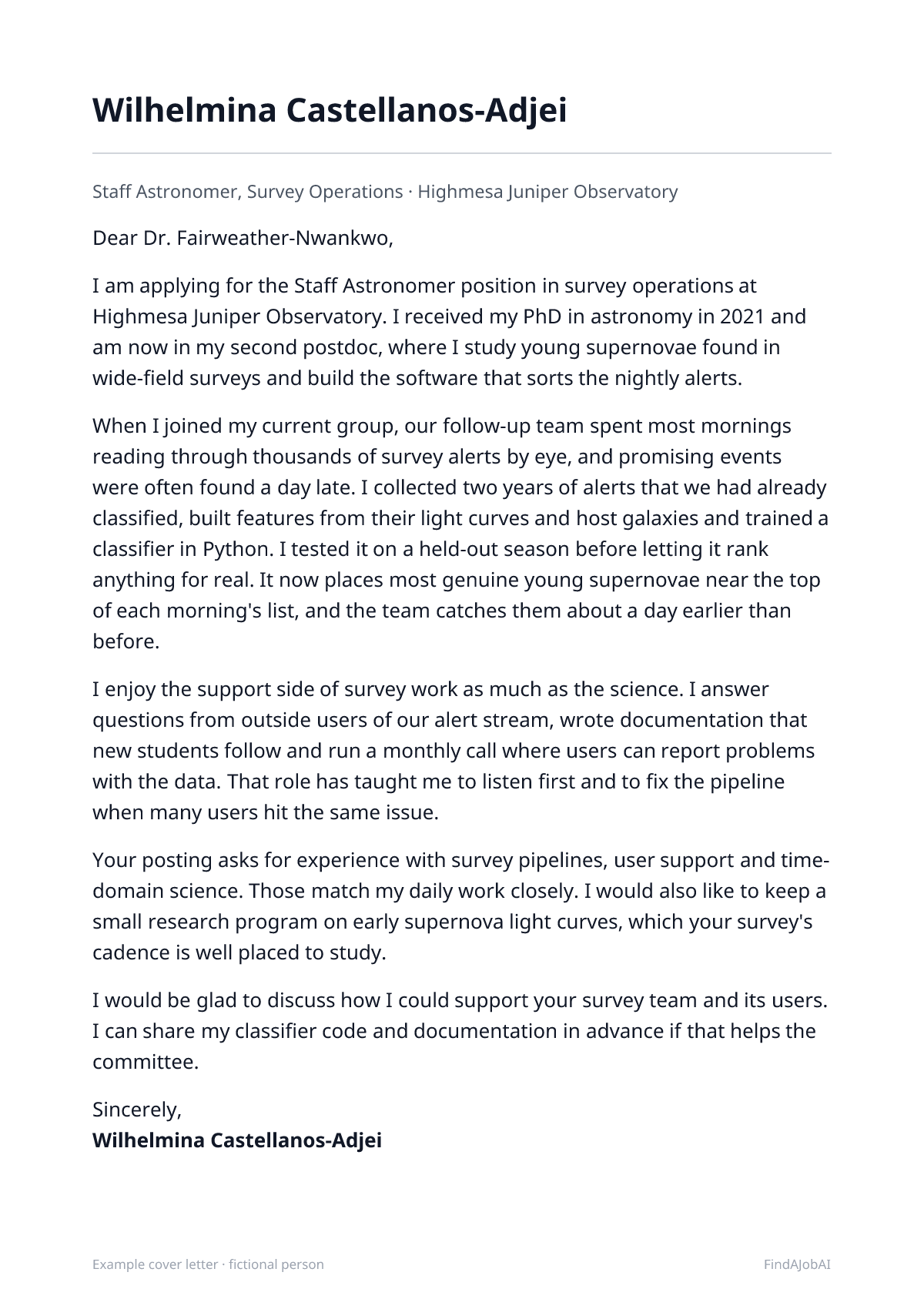
Dear Dr. Fairweather-Nwankwo,
I am applying for the Staff Astronomer position in survey operations at Highmesa Juniper Observatory. I received my PhD in astronomy in 2021 and am now in my second postdoc, where I study young supernovae found in wide-field surveys and build the software that sorts the nightly alerts.
When I joined my current group, our follow-up team spent most mornings reading through thousands of survey alerts by eye, and promising events were often found a day late. I collected two years of alerts that we had already classified, built features from their light curves and host galaxies and trained a classifier in Python. I tested it on a held-out season before letting it rank anything for real. It now places most genuine young supernovae near the top of each morning's list, and the team catches them about a day earlier than before.
I enjoy the support side of survey work as much as the science. I answer questions from outside users of our alert stream, wrote documentation that new students follow and run a monthly call where users can report problems with the data. That role has taught me to listen first and to fix the pipeline when many users hit the same issue.
Your posting asks for experience with survey pipelines, user support and time-domain science. Those match my daily work closely. I would also like to keep a small research program on early supernova light curves, which your survey's cadence is well placed to study.
I would be glad to discuss how I could support your survey team and its users. I can share my classifier code and documentation in advance if that helps the committee.
Sincerely,
Wilhelmina Castellanos-Adjei
Example 2 · Entry level
Astronomy graduate applying for a research assistant role
Florian has a BS in astronomy and two years of research on binary stars. The ad is for a research assistant at a university observatory.
Example letter · fictional
Dear Professor Ellingsworth-Abara,
I am writing to apply for the Research Assistant position at Pinecrest Valley University Observatory. I will graduate this May with a bachelor's degree in astronomy and physics, and I have spent the past two years doing research on eclipsing binary stars with our campus telescope.
Most of that research happened at night and in the morning after. I observed twelve binary systems over about thirty nights, and at first it took me most of a day to reduce one night of images by hand. I wrote a Python script with Astropy that handled calibration and photometry the same way every time and logged each step. It brought a night's reduction down to under an hour, and two younger students now use it for their own projects.
I also learned what careful work means in observational astronomy. I keep detailed observing logs, check my results against published periods and repeat measurements when the weather or the focus looked doubtful. My measured periods matched the literature closely, and I presented the work as a poster at a national meeting.
Your observatory runs public nights as well as research programs, and that mix appeals to me. I have helped at fifteen public viewing evenings, explaining what visitors see through the eyepiece in simple words. I would be happy to support both sides of the work while I prepare for graduate school.
I would welcome the chance to talk about the position and the projects a new assistant would join. I can also bring my observing logs and reduction code to an interview if that would be useful.
Best regards,
Florian Mukherjee-Halstead
Example 3 · Senior or lead
Survey data lead applying to head survey science at a new telescope
Evangeline leads a survey data team at a research consortium. The ad is for a head of survey science at an observatory building a new wide-field telescope.
Example letter · fictional
Dear Professor Kowalczyk-Amadi,
I am applying for the Head of Survey Science role at the Redstone Plateau Telescope Project. I have sixteen years in observational astronomy, and for the last seven I have led the data team of a wide-field imaging survey at Silverfern Astronomical Consortium, a group of ten scientists and engineers.
Our survey struggled with late data releases when I took over the team. Each release was assembled by hand in the last few months, and errors found by users forced two corrections. I broke the work into quarterly internal releases with automatic validation tests, asked science working groups to sign off on each one and published a clear schedule. The next three public releases went out on time, and outside teams have since used them in a large number of papers.
I still do research and keep close to the data. I review calibration results each month, publish on galaxy clusters and serve on time allocation committees. I believe a survey lead who understands the science cases makes better choices about cadence, depth and processing priorities.
Your telescope is moving from construction to its first science operations, and the survey plan will shape its first decade. I would start by meeting the instrument, software and science teams, then agree a written plan for commissioning data, early releases and user support.
I would welcome a conversation about your timeline and the team you hope to build around the survey. I would also be glad to share the validation checklist and release schedule my team uses today, so you can judge how we work in practice.
Kind regards,
Evangeline Ashworth-Okonjo
All three letters, and the short version below, are fictional: the people, employers and numbers are invented. Borrow the structure, never the facts.
- Prefer to write it yourself? Use the free cover letter template.
- Check your CV against the job first: the free CV score shows the missing keywords.
Why the first letter works, paragraph by paragraph
Paragraph 1: Opening
Gives the role, the PhD year, the current postdoc and the research area in two sentences, so the committee sees the fit before reading further.
Paragraph 2: The alert classifier story
Describes a real workflow problem, the data gathered, a model tested on held-out data before use and a practical gain for the team.
Paragraph 3: Supporting survey users
Shows service work such as documentation, user calls and pipeline fixes, which a survey operations role depends on.
Paragraph 4: Survey requirements and research plan
Maps three stated requirements to daily work and adds a modest research plan tied to the survey's strengths.
Paragraph 5: Close
Asks for a conversation and offers code and documentation in advance, which gives the committee concrete evidence.
What the entry-level letter does differently
The graduate's letter shows maturity through a script that made reductions consistent and through careful checks against published values. Both matter more to an observatory than a long list of courses.
What the senior letter does differently
A senior letter centers on delivery and people: release schedules, validation, working groups and survey planning. It keeps research credibility in one paragraph and ends with a plan tied to the telescope's next stage.
Short astronomer cover letter: an email-ready version
Many applications arrive as an email or a small text box, and a full page doesn't fit. This version runs 120 to 150 words and keeps only what a reader needs to decide whether to reply. An astronomer moving to industry replies by email to a hiring manager who posted a data scientist role at a satellite imaging company.
Short version · email · fictional120 words
Subject: Data Scientist, Imaging Analytics – PhD astronomy, image pipelines – Benedetta Ravensworth-Ibe
Hi Ms. Thorvaldsen-Kariuki,
I am writing about the Data Scientist opening on your imaging analytics team. I hold a PhD in astronomy and spent five years building Python pipelines that calibrate and analyze large sets of telescope images.
In my current postdoc I trained a model to flag faulty images before they entered our science database. It now removes most bad frames automatically and saves the team hours of manual checking each week. I work daily with Python, SQL and cloud computing, and I document everything I build.
My resume and a short code sample are attached. I would be glad to talk any day this week, and I am happy to complete a take-home exercise.
Thank you,
Benedetta Ravensworth-Ibe
The short email turns astronomy into image and data work in its first sentence, gives one practical model result and closes with an easy next step for a busy manager.
Opening lines that work for astronomer cover letters
The first sentence decides whether the second gets read. Here are six openings, one for each situation you might be in. Pick the one that matches yours and swap in your own facts: every name and number below is invented.
1. You have a standout result
Every morning our survey sends thousands of alerts, and the classifier I built now finds the young supernovae among them a day earlier than we used to.
2. The ad names a problem you've solved
I have spent thirty nights at a campus telescope and many more mornings turning those images into reliable light curves.
3. Someone referred you
Two late data releases taught me more about running a survey than any paper I have written.
4. You admire what they build
Your staff astronomer, Leontyne Abernethy-Osei, suggested I apply after we compared pipeline notes at a winter meeting.
5. You're new to the field or switching into it
I study exploding stars, but most of my working day is spent writing and testing Python code.
6. You have senior scope or a specialism
After five years calibrating telescope images, I want to apply the same methods to images of the Earth.
How to write an astronomer cover letter
Five steps, in the order you'd write them. The shape stays the same for every job (a short opening, proof, a reason for this employer, a close), and what goes into each part is what changes with the role.
Lead with research area and data
Open with your degree, your research area and the telescopes or surveys whose data you use. Committees often read dozens of letters for one post, so naming objects, methods and instruments early lets them place you within seconds and keep reading with interest.
Tell one result in plain words
Choose a single project, such as a pipeline, a classifier or a measurement, and explain the problem, what you built or measured and what changed. Write for a reader outside your subfield, because staff and industry panels often include engineers and managers.
Show service and support work
Observatories and surveys need astronomers who document tools, help users and keep systems running. Mention user support, documentation, instrument work or time allocation duties, and say what you learned from them about producing reliable data.
Connect to the group's next stage
Read the observatory or company pages and name a concrete link, such as a new instrument, a survey cadence or a data product. Offer a modest idea for your first months so the reader sees you have thought carefully about their real situation and needs.
Close with evidence on offer
End by asking for a conversation and offering code, documentation or a short talk. Astronomy hiring often depends on seeing real work, so a link to a repository or catalog gives the panel something concrete to check before the interview.
Astronomer cover letter do's and don'ts
Do
- Name your research area, telescopes, instruments and the data you work with.
- Tell one story where your code or analysis produced a measurable result.
- Explain why this group, survey or instrument fits your next step.
Don't
- Don't paste your research statement into the letter.
- Don't list every telescope you have visited without saying what you achieved there.
- Don't hide service, teaching or outreach work; many roles value it highly.
Common astronomer cover letter mistakes
Each one is easy to make and quick to fix before you send the letter.
Turning the letter into a research statement
Keep science background to a sentence or two and focus on what you built, measured and delivered.
Leaving out software and statistics
Name your languages, libraries and methods, since most astronomy roles now involve heavy coding.
Ignoring the service part of a staff role
Describe user support, documentation or instrument duties you have done and enjoyed.
Using astronomy jargon with industry readers
Translate light curves and alerts into time series, images and classification problems they know.
Email subject lines for astronomer applications
Applying by email? Put the job title, any reference number and your name in the subject line.
- Staff Astronomer, Survey Operations – PhD, time-domain pipelines – Wilhelmina Castellanos-Adjei
- Research Assistant, Observatory Programs – BS Astronomy 2026 – Florian Mukherjee-Halstead
- Head of Survey Science – 16 years, data release lead – Evangeline Ashworth-Okonjo
Everything for Astronomers
- Astronomer resume exampleA full resume, plus bullet and summary examples
- Astronomer interview questions30 questions with sample answers
- Astronomer job descriptionDuties, skills and requirements
- Cover letter with no experience: templates
Other cover letter examples
Astronomer cover letter FAQ
What should an astronomer cover letter include?
Your degree and research area, the telescopes, surveys and code you work with, one result told clearly, any service or teaching work that fits the role and why the group or observatory interests you.
How long should an astronomer cover letter be?
For staff, industry and assistant roles, one page is best. Faculty searches may ask for separate research and teaching statements, so keep the cover letter itself short and point to them.
How do astronomers apply for data science jobs?
Describe research as data work: data volumes, models, statistical methods, pipelines and measured results. Name Python, SQL and machine learning tools, and explain why you want to work on business problems.
How we built this page
The FindAJobAI team wrote the three example letters, the short email version, the opening lines and the advice for astronomer roles. The people, employers and numbers in the letters are invented; the structure, the kind of evidence and the order of the paragraphs are the parts to copy.
Once we track enough live astronomer job ads, this page also shows the skills they ask for most, counted the same way as our in-demand skills report.
Last reviewed on November 1, 2026.