EMT Resume Example (2026)
By FindAJobAI Team Updated How we built this page
EMT postings from ambulance services, fire departments and hospitals screen on a few things first: a current NREMT or state EMT certification, CPR/BLS, a clean driving record and real call experience. A resume that only lists "patient care, CPR, driving the ambulance" doesn't show a hiring supervisor how busy your service was, what kinds of calls you ran or how reliable your charting is.
The example below is an EMT-Basic with five years on a busy 911 and interfacility service. Each bullet names the type of call or task, the volume and a result a field supervisor or medical director would check, such as chart completion time, protocol audit scores or safe driving records.
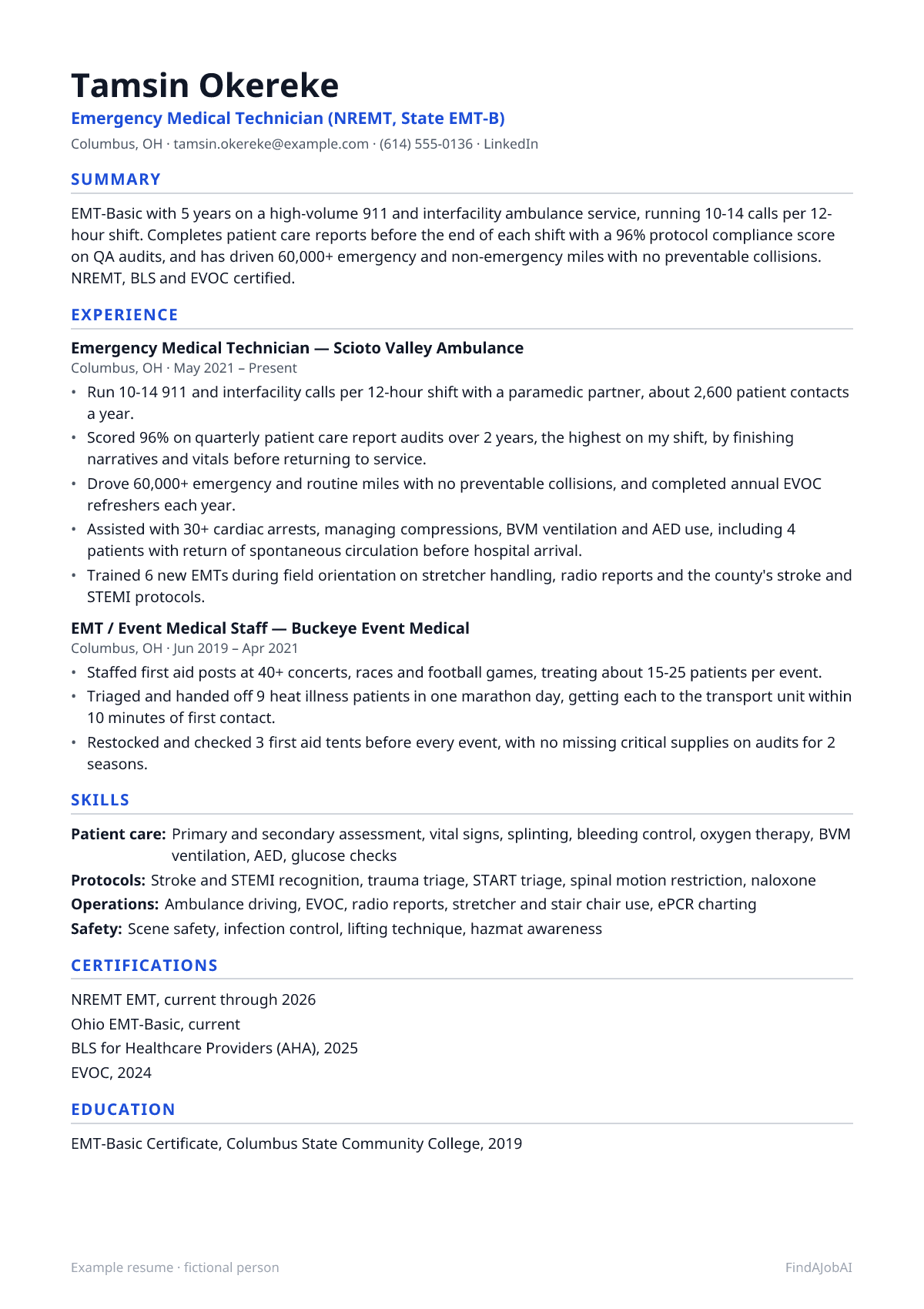
EMT resume template
This example as a one-page template: one column, standard headings and plain text, the format applicant tracking systems read most reliably.
After you sign up, Create my CV builds your own resume in this same one-column layout, from your real experience.
Mid-level EMT resume example
A complete one-page example for a fictional EMT: every bullet pairs an action with what changed because of it.
Example resume · fictional person
Tamsin Okereke
Emergency Medical Technician (NREMT, State EMT-B)
Columbus, OH · [email protected] · (614) 555-0136 · LinkedIn
Summary
EMT-Basic with 5 years on a high-volume 911 and interfacility ambulance service, running 10-14 calls per 12-hour shift. Completes patient care reports before the end of each shift with a 96% protocol compliance score on QA audits, and has driven 60,000+ emergency and non-emergency miles with no preventable collisions. NREMT, BLS and EVOC certified.
Experience
Emergency Medical Technician, Scioto Valley Ambulance
Columbus, OH · May 2021 – Present
- Run 10-14 911 and interfacility calls per 12-hour shift with a paramedic partner, about 2,600 patient contacts a year.
- Scored 96% on quarterly patient care report audits over 2 years, the highest on my shift, by finishing narratives and vitals before returning to service.
- Drove 60,000+ emergency and routine miles with no preventable collisions, and completed annual EVOC refreshers each year.
- Assisted with 30+ cardiac arrests, managing compressions, BVM ventilation and AED use, including 4 patients with return of spontaneous circulation before hospital arrival.
- Trained 6 new EMTs during field orientation on stretcher handling, radio reports and the county's stroke and STEMI protocols.
EMT / Event Medical Staff, Buckeye Event Medical
Columbus, OH · Jun 2019 – Apr 2021
- Staffed first aid posts at 40+ concerts, races and football games, treating about 15-25 patients per event.
- Triaged and handed off 9 heat illness patients in one marathon day, getting each to the transport unit within 10 minutes of first contact.
- Restocked and checked 3 first aid tents before every event, with no missing critical supplies on audits for 2 seasons.
Skills
- Patient care: Primary and secondary assessment, vital signs, splinting, bleeding control, oxygen therapy, BVM ventilation, AED, glucose checks
- Protocols: Stroke and STEMI recognition, trauma triage, START triage, spinal motion restriction, naloxone
- Operations: Ambulance driving, EVOC, radio reports, stretcher and stair chair use, ePCR charting
- Safety: Scene safety, infection control, lifting technique, hazmat awareness
Certifications
- NREMT EMT, current through 2026
- Ohio EMT-Basic, current
- BLS for Healthcare Providers (AHA), 2025
- EVOC, 2024
Education
- EMT-Basic Certificate, Columbus State Community College, 2019
Fictional example by the FindAJobAI team: the person, employers and numbers are invented. Keep the structure; use your own work and numbers you can explain in an interview.
Entry-level EMT resume example
A newly certified EMT who spent three summers lifeguarding. Certifications and training come first, and the bullets count clinical hours, ride-alongs and first aid incidents, since she has no paid ambulance work yet.
Entry-level example resume · fictional person
Summary
Newly certified EMT with NREMT and Washington EMT cards, 48 hours of ambulance ride time and 24 hours of emergency department clinicals. Lifeguard for 3 summers, handling first aid and water rescues at a busy public pool. BLS and first aid instructor certified.
Education
- EMT Certificate, Inland Northwest EMS Academy, 2025
Experience
EMT Student (Clinical and Field Rotations), Inland Northwest EMS Academy
Spokane, WA · Jan 2025 – May 2025
- Completed 48 hours of ambulance ride time across 22 calls, taking vitals and histories on 15 patients under a preceptor.
- Logged 24 hours in a hospital emergency department, practising assessments on 30+ patients.
- Passed the NREMT cognitive exam on the first attempt and all psychomotor stations in the course practical.
Lifeguard, Riverside Aquatic Center
Spokane, WA · Jun 2022 – Aug 2024
- Supervised a pool with up to 300 daily swimmers over 3 summers, performing 7 water rescues with no serious injuries.
- Gave first aid for 50+ minor injuries and wrote incident reports for each the same day.
Skills
- Patient care: Patient assessment, vital signs, CPR and AED, bleeding control, splinting, oxygen administration
- Operations: Radio communication basics, stretcher handling, incident reports
- Other: Water rescue, first aid instruction, calm communication with families
Certifications
- NREMT EMT, 2025
- Washington State EMT, 2025
- BLS for Healthcare Providers, 2025
- Lifeguard and First Aid Instructor, 2023
Senior EMT resume example
An EMT field training officer twelve years into EMS who supervises a shift but chose to stay at the EMT level. The bullets move from his own calls to training, chart review and shift operations.
Senior example resume · fictional person
Desmond Ashworth-Lyle
EMT Field Training Officer / Shift Supervisor
Charlotte, NC · [email protected] · (704) 555-0158 · LinkedIn
Summary
EMT field training officer with 12 years in EMS and 5 years supervising a 14-unit shift at a private ambulance service. Runs new-hire orientation and skills checkoffs, reviews charts for QA, and works with dispatch on unit coverage. Cut late chart submissions on the shift from about 1 in 10 to under 1 in 50.
Experience
EMT Shift Supervisor / Field Training Officer, Piedmont Medical Transport
Charlotte, NC · Feb 2020 – Present
- Supervise 14 ambulance units and about 30 EMTs and paramedics per shift across 911 backup and interfacility contracts.
- Run a 3-week field orientation for new EMTs; 41 of 45 trainees cleared to work independently on schedule.
- Cut late patient care reports from about 1 in 10 to under 1 in 50 by adding mid-shift chart checks and a quick-fix list for common errors.
- Hold monthly skills sessions on spinal motion restriction, stair chair use and patient lifting, contributing to a drop in back-injury claims from 5 to 1 a year.
- Coordinate with dispatch on unit placement during peak hours, reducing interfacility pickup delays over 30 minutes by about a third.
Emergency Medical Technician, Mecklenburg Rescue Squad
Charlotte, NC · Mar 2016 – Jan 2020
- Ran 8-12 911 calls per 24-hour shift on a busy urban rescue unit.
- Served as crew lead on 200+ multi-patient vehicle collisions, coordinating triage until command arrived.
- Earned 2 unit commendations for scene management at mass-casualty drills.
EMT, Lakeside Volunteer Rescue
Mooresville, NC · Jun 2013 – Feb 2016
- Answered 300+ volunteer calls over 3 years in a rural district.
- Rebuilt the squad's equipment check sheet, ending repeated missing-item findings at county inspections.
Skills
- Supervision: Shift scheduling, field training, skills checkoffs, chart QA, incident review
- Patient care: Trauma and medical assessment, triage, airway adjuncts, CPR and AED, spinal motion restriction
- Operations: Dispatch coordination, unit coverage, ICS, EVOC instruction, fleet checks
- Safety: Safe lifting coaching, infection control, scene safety, hazmat awareness
Certifications
- NREMT EMT, current
- North Carolina EMT, current
- EVOC Instructor, 2021
- ICS-100, ICS-200 and ICS-700, 2018
Education
- EMT Certificate, Central Piedmont Community College, 2013
How to write an EMT resume
Five steps, in the order a recruiter reads the page. The format around them stays plain for every job: one column, standard headings, newest role first.
Header: name, target title and links
Put your level and certifications in the headline, like "EMT, NREMT and State EMT-B" or "EMT Field Training Officer," so a supervisor sees your scope and registry status before anything else.
Summary: what you do and your best proof
Give your years in EMS, type of service, call volume and one quality result, such as a chart audit score or driving record. Skip lines like "passionate about saving lives" that every applicant writes and nobody can check.
Experience: newest first, a result in every bullet
Begin each bullet with the call type or task, then the volume and your specific role, then a result a supervisor tracks: chart scores, response, safety records or trainees cleared. Describe team outcomes as team outcomes.
Skills: grouped, in the ad's words
Group skills into patient care, protocols, operations and safety. Name the tools and procedures you use, such as BVM, stair chair or stroke scale, rather than writing "emergency care."
Education and certifications
List your EMT program and year, then your NREMT and state certifications with expiry, BLS, EVOC and any ICS or hazmat courses. Add clinical and ride-along hours if you're newly certified.
Skills to put on an EMT resume
Hard skills are the tools and methods of the job; soft skills are how you work with people. Each comes with one way to prove it, because a skill named only in a list counts for little. Add the ones you really have.
Hard skills
- Patient assessment
- Mention the volume of patients you've assessed and the kinds of calls, medical and trauma.
- CPR and AED
- Give the number of arrests you've worked and your role, compressions, airway or AED, not the outcome alone.
- Airway management
- Name the adjuncts you use, such as OPA, NPA and BVM, and the settings where you used them.
- Trauma care
- Describe bleeding control, splinting or spinal motion restriction on real calls, with counts if you have them.
- Triage
- Point to a multi-patient incident or drill where you sorted patients with START or a similar system.
- Patient care reports
- Use a QA score, on-time completion rate or a charting improvement you led.
- Emergency vehicle operation
- Give your miles or years driving and your collision record, plus EVOC training.
- Stroke and STEMI recognition
- Name the screening tool or protocol you use and how quickly you notify the receiving hospital.
- Medication assistance
- List the medications you may give or assist with under your state's scope, such as aspirin, glucose or naloxone.
- Patient movement
- Mention stair chairs, power stretchers and lifting techniques, with injury-free records if true.
- Radio and handoff reports
- Describe the report format you use and how you hand over to ED staff.
Soft skills
- Calm under pressure
- Describe a chaotic scene where you kept your tasks in order and communicated clearly.
- Compassion
- Give an example of comforting a frightened patient or family member during a hard call.
- Teamwork
- Show how you work with your partner, fire crews and ED staff to move a patient smoothly.
- Situational awareness
- Mention a scene safety call you made, such as waiting for police or spotting a hazard.
- Reliability
- Point to attendance, shift coverage or chart timeliness over a long period.
- Clear communication
- Describe how you explain care to patients and give concise reports to hospital staff.
EMT resume bullet examples: weak vs strong
The same work, written two ways. The strong version names the tool, the scope and a result; the numbers are examples, yours must be real.
Weak: Responded to emergency calls.
Strong: Ran 10-14 911 and interfacility calls per 12-hour shift with a paramedic partner, about 2,600 patient contacts a year.
Volume tells a supervisor how much experience sits behind the certificate.
Weak: Wrote patient care reports.
Strong: Scored 96% on quarterly PCR audits over 2 years by finishing narratives and vitals before returning to service.
Shows charting quality with an audit score and the habit that produced it.
Weak: Drove the ambulance.
Strong: Drove 60,000+ emergency and routine miles with no preventable collisions and annual EVOC refreshers.
Driving safety is a hiring risk for services, and this proves a clean record.
Weak: Performed CPR.
Strong: Assisted with 30+ cardiac arrests, managing compressions, BVM and AED, including 4 patients with ROSC before arrival.
Gives the count and the specific tasks, without claiming credit for the whole team's result.
Weak: Worked at events.
Strong: Staffed first aid posts at 40+ concerts and races, treating 15-25 patients per event.
Turns a vague side job into measurable patient-contact experience.
Weak: Helped orient new EMTs.
Strong: Trained 6 new EMTs in field orientation on stretcher handling, radio reports and stroke and STEMI protocols.
Shows trust from the service and names what was taught.
15 more EMT resume bullet examples
Grouped by area of the job, so you can find the ones closest to your work. Keep the shape (action, scope, result) and replace the invented numbers with your own.
911 response and patient care
- Worked 3 multi-vehicle collisions with 5+ patients each, applying START triage tags before the second unit arrived.
- Applied tourniquets on 6 severe extremity bleeds, documenting application times for the trauma team on every one.
- Recognised 12 suspected strokes with a prehospital stroke scale and pre-alerted the receiving stroke center on each call.
- Gave naloxone on 20+ suspected opioid overdoses under protocol, monitoring airway and breathing until handoff.
Interfacility and transport
- Completed 1,500+ interfacility transfers between hospitals and nursing facilities with no patient falls.
- Moved 400+ patients down stairs with a stair chair in older apartment buildings without a lifting injury.
- Monitored oxygen and IV lines on 200+ long-distance transfers, keeping notes at 15-minute intervals.
Documentation and quality
- Closed 99% of patient care reports within 2 hours of the call over a full year of shifts.
- Found and reported 3 recurring ePCR template errors to QA, which were fixed in the next software update.
- Collected refusal signatures with full risk explanations on 80+ patients, all passing medical director review.
- Logged vehicle and equipment checks at every shift start for 3 years with no missed critical items on inspection.
Community and training
- Taught hands-only CPR to 350+ residents at 12 community events with the local fire department.
- Served as a mock patient coordinator for 4 regional mass-casualty drills involving 60+ responders.
- Mentored 3 EMT students through their ride-along hours, completing their skill sign-off forms on schedule.
- Helped write the service's bariatric transport checklist, used on 70+ calls in its first year.
EMT resume summary examples
Two or three lines on what you do and your strongest proof. Start from the one closest to your level and use your own facts.
Newly certified EMT with NREMT and state EMT-B cards, 48 hours of ambulance ride time and 24 hours of emergency department clinicals. Former lifeguard with 3 summers of first aid and water rescue experience. Looking for a 911 or interfacility service with a structured field training program.
EMT-Basic with 5 years on a high-volume 911 and interfacility service, running 10-14 calls per shift. Holds a 96% PCR audit score and a clean driving record over 60,000+ miles.
EMT field training officer with 12 years in EMS and 5 years as a shift supervisor for a 14-unit private ambulance service. Runs EMT orientation and skills checkoffs, reviews charts for QA, and cut late chart submissions on the shift from about 1 in 10 to under 1 in 50.
Common EMT resume mistakes
Each one is easy to make and quick to fix before you apply.
NREMT and state cards hidden near the end
Many services screen on NREMT, state license and BLS first. Put them in the headline or right under the summary with expiry dates.
No call volume or service type
"Responded to emergencies" says nothing about your pace. Give calls per shift or per year and whether they were 911, interfacility or event work.
Claiming credit for team saves
Cardiac arrest outcomes belong to the whole crew and hospital. Describe your tasks and counts, and leave the outcome as a team result.
Ignoring documentation
Patient care reports matter for billing and medical review. Add an audit score, completion rate or charting improvement.
Leaving out driving and safety records
Services worry about collisions and lifting injuries. If your record is clean, say so with miles driven or years without injury.
ATS tips for an EMT resume
Applicant tracking systems turn your file into text that recruiters search, mostly for the skills and titles in the ad. They rarely reject a resume on their own; one that parses badly or misses the ad's words just doesn't come up.
- Put your certification level and registry in the headline, such as "EMT (NREMT, State EMT-B)," because many services filter applicants on it.
- Give call volume per shift or per year and the type of service, 911, interfacility or event, so the reader knows your pace.
- Show charting quality with QA audit scores or on-time completion, since PCRs drive billing and medical review.
- List a clean driving record and EVOC if you drive, because insurers and services check it.
- Describe your part in critical calls honestly, as a team member, rather than claiming outcomes the whole crew produced.
For the format itself, run the free ATS resume checklist.
Everything for EMTs
- EMT cover letter examplesThree example letters and a short email version
- EMT interview questions30 questions with sample answers
- EMT job descriptionDuties, skills and requirements
- How to tailor your resume without lying
Other resume examples
EMT resume FAQ
What certifications should an EMT resume list?
List your NREMT status and state EMT license with expiry, BLS or CPR card, and any EVOC, hazmat awareness or ICS courses. Put them near the top, since many services screen on them first.
How do I write an EMT resume with no experience?
Lead with your EMT course, clinical and ride-along hours and any certification you hold. Add jobs or volunteering with first aid, such as lifeguarding, ski patrol or event medical work, with counts where possible.
Should I put my call volume on an EMT resume?
Yes. Calls per shift or patient contacts per year tell a supervisor how much field experience you have. Keep the numbers honest and approximate if you don't have exact figures.
Is an EMT resume different for fire departments?
Yes. Fire departments also look for firefighter certifications, physical fitness, teamwork and community service, so add those sections and mention any fire academy or volunteer fire work.
How we built this page
The FindAJobAI team wrote the three example resumes, the bullets, the skills and the advice for EMT roles. The people, employers and numbers in the examples are invented; the structure, the tools and the way each bullet is built are the parts to copy.
Once we track enough live EMT job ads, this page also shows the skills they ask for most, counted the same way as our in-demand skills report.
Last reviewed on November 1, 2026.