Platform Engineer Resume Example (2026)
By FindAJobAI Team Updated How we built this page
Platform engineering job ads describe a team that builds the paved road other engineers drive on: clusters, pipelines, templates and self-service tools. Hiring managers want to know which parts of that road you built, how many teams used it and whether shipping got faster or safer as a result. A platform engineer resume should read like a product resume where the customers are developers.
The example below belongs to a platform engineer with seven years across a streaming media company and a logistics software firm. Each bullet names the platform piece, the number of teams or services on it, and a measured change in speed, cost or reliability.
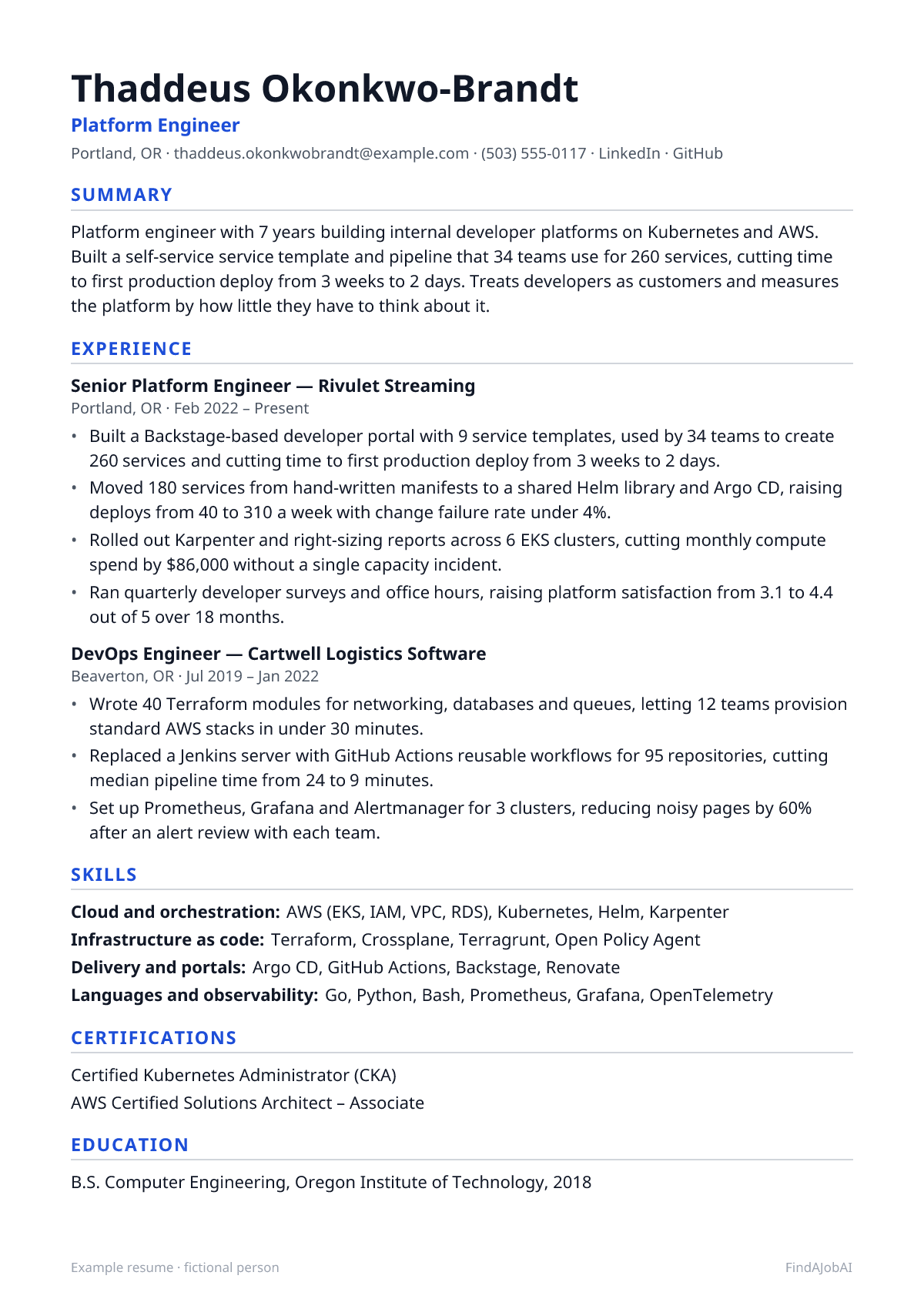
Platform Engineer resume template
This example as a one-page template: one column, standard headings and plain text, the format applicant tracking systems read most reliably.
After you sign up, Create my CV builds your own resume in this same one-column layout, from your real experience.
Mid-level platform engineer resume example
A complete one-page example for a fictional platform engineer: every bullet pairs an action with what changed because of it.
Example resume · fictional person
Thaddeus Okonkwo-Brandt
Platform Engineer
Portland, OR · [email protected] · (503) 555-0117 · LinkedIn · GitHub
Summary
Platform engineer with 7 years building internal developer platforms on Kubernetes and AWS. Built a self-service service template and pipeline that 34 teams use for 260 services, cutting time to first production deploy from 3 weeks to 2 days. Treats developers as customers and measures the platform by how little they have to think about it.
Experience
Senior Platform Engineer, Rivulet Streaming
Portland, OR · Feb 2022 – Present
- Built a Backstage-based developer portal with 9 service templates, used by 34 teams to create 260 services and cutting time to first production deploy from 3 weeks to 2 days.
- Moved 180 services from hand-written manifests to a shared Helm library and Argo CD, raising deploys from 40 to 310 a week with change failure rate under 4%.
- Rolled out Karpenter and right-sizing reports across 6 EKS clusters, cutting monthly compute spend by $86,000 without a single capacity incident.
- Ran quarterly developer surveys and office hours, raising platform satisfaction from 3.1 to 4.4 out of 5 over 18 months.
DevOps Engineer, Cartwell Logistics Software
Beaverton, OR · Jul 2019 – Jan 2022
- Wrote 40 Terraform modules for networking, databases and queues, letting 12 teams provision standard AWS stacks in under 30 minutes.
- Replaced a Jenkins server with GitHub Actions reusable workflows for 95 repositories, cutting median pipeline time from 24 to 9 minutes.
- Set up Prometheus, Grafana and Alertmanager for 3 clusters, reducing noisy pages by 60% after an alert review with each team.
Skills
- Cloud and orchestration: AWS (EKS, IAM, VPC, RDS), Kubernetes, Helm, Karpenter
- Infrastructure as code: Terraform, Crossplane, Terragrunt, Open Policy Agent
- Delivery and portals: Argo CD, GitHub Actions, Backstage, Renovate
- Languages and observability: Go, Python, Bash, Prometheus, Grafana, OpenTelemetry
Certifications
- Certified Kubernetes Administrator (CKA)
- AWS Certified Solutions Architect – Associate
Education
- B.S. Computer Engineering, Oregon Institute of Technology, 2018
Fictional example by the FindAJobAI team: the person, employers and numbers are invented. Keep the structure; use your own work and numbers you can explain in an interview.
Entry-level platform engineer resume example
A recent graduate with one infrastructure internship, so a home lab and a certification help fill the gap. Education sits under the summary, and each project says what it automates.
Entry-level example resume · fictional person
Leocadia Pemberton-Asante
Platform Engineer
Pittsburgh, PA · [email protected] · (412) 555-0161 · LinkedIn · GitHub
Summary
Entry-level platform engineer with a B.S. in Computer Science and an internship automating test environments with Terraform and GitHub Actions. Holds the CKAD and runs a small Kubernetes home lab with GitOps. Looking for a first role on an infrastructure or developer platform team.
Education
- B.S. Computer Science, University of Pittsburgh, 2026
Experience
Infrastructure Intern, Allegheny Freight Systems
Pittsburgh, PA · May 2026 – Aug 2026
- Wrote Terraform for 4 short-lived test environments, cutting setup from 2 days of tickets to 25 minutes.
- Added a GitHub Actions job that destroys idle environments after 48 hours, saving about $1,900 a month in AWS spend.
- Documented 12 common pipeline failures in a runbook that the team now links from every failed build.
Student Systems Administrator, Carnegie Mellon University Computing Services
Pittsburgh, PA · Sep 2024 – May 2026
- Patched and monitored 70 Linux lab machines with Ansible, cutting manual update time from 6 hours to 40 minutes a month.
- Answered about 25 student tickets a week on accounts, storage and remote access.
Skills
- Infrastructure: Kubernetes, k3s, Terraform, Ansible, AWS basics
- Delivery: GitHub Actions, Argo CD, Docker, Helm
- Languages: Go, Python, Bash, YAML
Certifications
- Certified Kubernetes Application Developer (CKAD)
Projects
- Home lab (k3s, Argo CD, Prometheus): 3 nodes running 8 self-hosted apps, all deployed from one Git repository.
- Preview environments CLI (Go): creates a namespace and database per pull request in about 90 seconds and cleans up on merge.
Senior platform engineer resume example
A principal engineer leading a platform group. Bullets cover strategy, organization-wide adoption, cost and reliability targets, and the summary states team size and engineering headcount served.
Senior example resume · fictional person
Cassius Vandermeer-Oyelaran
Principal Platform Engineer
New York, NY · [email protected] · (646) 555-0124 · LinkedIn · GitHub
Summary
Principal platform engineer with 14 years in infrastructure, leading a 9-person platform group at a fintech with 600 engineers. Defined the golden path for 900 services, cut cloud spend by 22% and introduced platform reliability targets. Known for running the platform like a product with a roadmap, users and support.
Experience
Principal Platform Engineer, Ledgerhaven Financial
New York, NY · Mar 2020 – Present
- Lead a 9-person platform group serving 600 engineers, with a roadmap set from quarterly surveys and support-ticket themes.
- Defined the golden path of templates, pipelines and policies now used by 900 services, cutting median lead time for changes from 5 days to 6 hours.
- Cut cloud spend by 22%, about $3.1 million a year, through spot capacity, autoscaling and team-level cost dashboards.
- Set 99.95% availability targets for the deploy pipeline and cluster APIs, and met them for 8 straight quarters.
Staff Infrastructure Engineer, Brightquay Media
New York, NY · Jun 2015 – Feb 2020
- Led the move of 300 services from virtual machines to Kubernetes over 2 years, retiring 1,100 servers.
- Built a multi-account AWS landing zone with Terraform for 40 accounts, passing a SOC 2 audit with no infrastructure findings.
- Created the incident review process for 14 teams, cutting repeat incidents by 35% in a year.
Systems Engineer, Hudsonvale Hosting
Jersey City, NJ · Aug 2011 – May 2015
- Managed 500 Linux servers across 2 data centers with Puppet, keeping patch compliance above 98%.
- Automated customer server provisioning, cutting delivery from 3 days to 4 hours.
Skills
- Platform: Kubernetes, AWS, Terraform, Crossplane, Argo CD, Backstage
- Reliability: SLOs, incident command, Prometheus, OpenTelemetry, chaos testing
- Languages: Go, Python, Bash
- Leadership: Platform roadmaps, team leadership, vendor evaluation, budgeting
Education
- B.S. Information Systems, Rutgers University, 2011
How to write a platform engineer resume
Five steps, in the order a recruiter reads the page. The format around them stays plain for every job: one column, standard headings, newest role first.
Header: name, target title and links
Use “Platform Engineer” as the headline, or “Platform Engineer (Kubernetes, AWS)” if the ad stresses a stack. Add GitHub only if it shows infrastructure code, operators or tools you wrote.
Summary: what you do and your best proof
Open with the platform you build and its users: how many teams, services or engineers. Follow with one outcome such as faster first deploys, lower cloud spend or fewer incidents. Avoid vague phrases like “infrastructure enthusiast”.
Experience: newest first, a result in every bullet
Write each bullet as platform piece, adoption, outcome: what you built, who used it and what changed for them. “Managed Kubernetes” says little; cluster count, deploy frequency and saved hours say a lot.
Skills: grouped, in the ad's words
Group skills into cloud and orchestration, infrastructure as code, delivery, and languages and observability. Spell out Kubernetes, Terraform and Argo CD exactly as job ads do.
Education and certifications
List the degree and year, then current certifications such as CKA, CKAD or a cloud associate. Without platform experience, add a home lab or open-source infrastructure project with a clear result.
Skills to put on a platform engineer resume
Hard skills are the tools and methods of the job; soft skills are how you work with people. Each comes with one way to prove it, because a skill named only in a list counts for little. Add the ones you really have.
Hard skills
- Kubernetes
- Give cluster count, workload count and one hard operation you ran, such as a version upgrade or network migration.
- Terraform
- Say how many modules you published, who consumed them and how you versioned and tested them.
- GitOps with Argo CD or Flux
- State how many services deploy through it and the change in deploy frequency or rollback time.
- CI systems
- Name the system, the number of repositories on shared workflows and the pipeline time you cut.
- Developer portals
- Mention Backstage or a similar tool, the templates you built and how many teams used them.
- Cloud providers
- List the services you ran yourself (EKS, IAM, VPC) and the account or region scale.
- Policy as code
- Describe the rules you enforced with Open Policy Agent or Kyverno and what they blocked.
- Observability
- Name the stack and one improvement, such as fewer noisy alerts or a faster diagnosis.
- Cost management
- Give dollar or percentage savings and the mechanism, like autoscaling or spot capacity.
- Go or Python
- Describe a tool, operator or CLI you wrote and the manual steps it removed.
- Secrets management
- Mention Vault or a cloud secrets service and how many services moved off plain configuration.
Soft skills
- Developer empathy
- Show how you gathered feedback, such as surveys or office hours, and what you changed because of it.
- Product thinking
- Describe a platform feature you prioritized based on user data and its adoption.
- Documentation
- Point to guides or runbooks you wrote and how they cut support questions.
- Influence without authority
- Explain how you got teams to adopt a new standard without forcing it.
- Incident leadership
- Mention incidents you led and a follow-up that prevented repeats.
- Prioritization
- Give an example of saying no to a custom request to protect the shared roadmap.
Platform Engineer resume bullet examples: weak vs strong
The same work, written two ways. The strong version names the tool, the scope and a result; the numbers are examples, yours must be real.
Weak: Maintained Kubernetes clusters.
Strong: Ran 6 EKS clusters hosting 420 workloads, upgrading Kubernetes through 4 minor versions with zero customer-facing downtime.
Gives scale, upgrade cadence and a reliability result.
Weak: Built CI/CD pipelines.
Strong: Built reusable GitHub Actions workflows adopted by 95 repositories, cutting median pipeline time from 24 to 9 minutes.
Shows adoption and a measurable speed gain.
Weak: Wrote Terraform.
Strong: Published 40 versioned Terraform modules that let 12 teams provision a standard service stack in under 30 minutes instead of filing tickets.
Turns code into self-service and removed toil.
Weak: Improved developer experience.
Strong: Launched a developer portal with service templates, cutting time to first production deploy for new services from 3 weeks to 2 days.
Defines developer experience with a concrete metric.
Weak: Reduced cloud costs.
Strong: Introduced node autoscaling and monthly right-sizing reports, cutting compute spend by $86,000 a month across 6 clusters.
Names the mechanism and the money.
Weak: Helped with security.
Strong: Added Open Policy Agent rules to 180 services, blocking 230 non-compliant deploys in the first quarter before they reached production.
Shows guardrails built into the platform rather than manual review.
15 more platform engineer resume bullet examples
Grouped by area of the job, so you can find the ones closest to your work. Keep the shape (action, scope, result) and replace the invented numbers with your own.
Self-service and golden paths
- Built 9 service templates covering web APIs, workers and scheduled jobs, used for 85% of new services within a year.
- Added one-click preview environments for pull requests, used by 22 teams and cutting review cycles by about a day.
- Created a self-service database request flow, replacing a 5-day ticket queue with a 15-minute automated process.
- Wrote a platform CLI in Go that 400 engineers use for logs, secrets and deploy status.
Clusters and infrastructure
- Upgraded 6 Kubernetes clusters through 4 minor versions using blue-green node pools, with zero downtime for 420 workloads.
- Migrated cluster networking to Cilium, cutting cross-node latency by 18% and adding network policies to 150 namespaces.
- Built a multi-region failover runbook and tested it twice a year, cutting recovery time in drills from 2 hours to 25 minutes.
- Standardized resource requests for 300 services, lifting average node utilization from 31% to 58%.
Delivery and guardrails
- Moved 180 services to Argo CD, so every production change is a reviewed Git commit with a 1-click rollback.
- Enforced image signing and vulnerability scanning in CI for 95 repositories, blocking 40 critical-vulnerability images in 6 months.
- Automated dependency updates with Renovate across 120 repositories, cutting average base-image age from 9 months to 3 weeks.
Support, cost and adoption
- Set up a platform support rotation and ticket tags, cutting median response time from 2 days to 3 hours.
- Published team-level cost dashboards for 34 teams, leading to $40,000 a month in voluntary cleanups.
- Ran 12 internal workshops on the golden path, attended by 260 engineers in a year.
- Wrote 30 platform guides, cutting repeat questions in the support channel by about 45%.
Platform Engineer resume summary examples
Two or three lines on what you do and your strongest proof. Start from the one closest to your level and use your own facts.
Computer science graduate with an infrastructure internship automating test environments with Terraform and GitHub Actions. Holds the CKAD, runs a 3-node home Kubernetes lab, and wrote a small CLI that spins up preview environments for pull requests.
Platform engineer with 7 years building internal platforms on Kubernetes and AWS. Built a service template and pipeline used by 34 teams for 260 services, cutting time to first deploy from 3 weeks to 2 days.
Principal platform engineer, 14 years in infrastructure, leading a 9-person platform group at a fintech with 600 engineers. Defined the golden path for 900 services, cut cloud spend by 22% and set platform reliability targets.
Common platform engineer resume mistakes
Each one is easy to make and quick to fix before you apply.
Listing tools without users
A platform matters because teams use it. Add adoption counts and what those teams gained.
Describing toil as achievement
Restarting pods and answering tickets is the work a platform should remove. Show what you automated so it stopped happening.
Cost claims with no mechanism
Give the savings and how you got them, such as autoscaling, spot capacity or right-sizing, so the figure is credible.
Ignoring security guardrails
Platform teams own policies and supply-chain checks. Mention the rules you enforced and what they caught.
Hiding the developer side
Surveys, office hours and documentation show you run the platform like a product. Include at least one of them.
ATS tips for a platform engineer resume
Applicant tracking systems turn your file into text that recruiters search, mostly for the skills and titles in the ad. They rarely reject a resume on their own; one that parses badly or misses the ad's words just doesn't come up.
- Describe the platform as a product: who used it, how many teams adopted it and what they no longer had to do by hand.
- Use delivery metrics such as deploy frequency, lead time and change failure rate, since platform teams are often judged on them.
- Name the self-service pieces you built, like templates, portals or Terraform modules, rather than only the clusters you maintained.
- Show cost work with dollar or percentage figures and the method, such as autoscaling, spot capacity or right-sizing.
- Keep certifications to those that match the stack in the ad, usually CKA, CKAD or a cloud associate certificate.
For the format itself, run the free ATS resume checklist.
Everything for Platform Engineers
- Platform Engineer cover letter examplesThree example letters and a short email version
- Platform Engineer interview questions30 questions with sample answers
- Platform Engineer job descriptionDuties, skills and requirements
- How to tailor your resume without lying
Other resume examples
Platform Engineer resume FAQ
What is the difference between a platform engineer and a DevOps engineer resume?
A DevOps resume often centers on pipelines and operations for specific apps. A platform engineer resume should show reusable, self-service tools used by many teams, with adoption numbers and the time or toil they saved.
Which skills matter most on a platform engineer resume?
Kubernetes, a major cloud provider, Terraform or another infrastructure-as-code tool, a GitOps or CI system, and at least one programming language such as Go or Python. Developer portals like Backstage are a growing plus.
How do I show platform adoption on a resume?
Count teams, services or repositories that use what you built, and pair the count with an outcome such as faster deploys or fewer tickets. Adoption without an outcome shows reach, not value.
How we built this page
The FindAJobAI team wrote the three example resumes, the bullets, the skills and the advice for platform engineer roles. The people, employers and numbers in the examples are invented; the structure, the tools and the way each bullet is built are the parts to copy.
Once we track enough live platform engineer job ads, this page also shows the skills they ask for most, counted the same way as our in-demand skills report.
Last reviewed on November 1, 2026.