Anesthesiologist Cover Letter Example (2026)
By FindAJobAI Team Updated How we built this page
Anesthesiology groups read cover letters to learn what kind of colleague you are on a hard day: how you handle a failed airway, a surgeon who wants to keep going, or a full board with too few CRNAs. Board status and case logs sit on the CV, so use the letter for one clinical or operational decision and the practice model you want to work in.
Anesthesiologist cover letter template
This letter as a one-page template: an opening that names the job and your strongest fact, proof that answers the ad, a reason for this employer and a short close.
After you sign up, FindAJobAI drafts your own letter for a real job from your CV in this format, and you edit it before you send it.
Example 1 · Experienced
Staff anesthesiologist applying to a care team group
Evander directs CRNAs in a community hospital and wants a group with a stronger regional service. The ad stresses blocks and teamwork.
Example letter · fictional
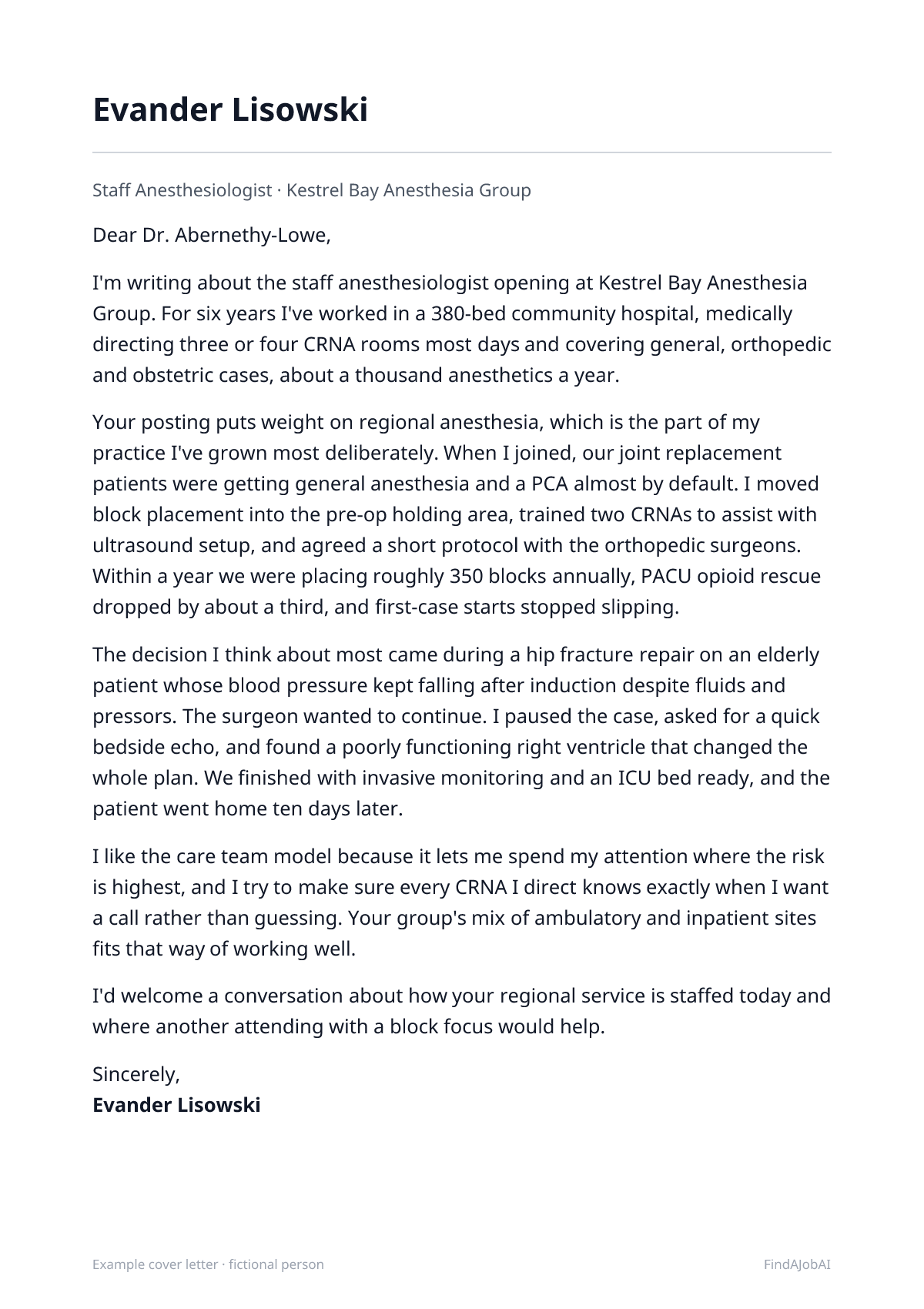
Dear Dr. Abernethy-Lowe,
I'm writing about the staff anesthesiologist opening at Kestrel Bay Anesthesia Group. For six years I've worked in a 380-bed community hospital, medically directing three or four CRNA rooms most days and covering general, orthopedic and obstetric cases, about a thousand anesthetics a year.
Your posting puts weight on regional anesthesia, which is the part of my practice I've grown most deliberately. When I joined, our joint replacement patients were getting general anesthesia and a PCA almost by default. I moved block placement into the pre-op holding area, trained two CRNAs to assist with ultrasound setup, and agreed a short protocol with the orthopedic surgeons. Within a year we were placing roughly 350 blocks annually, PACU opioid rescue dropped by about a third, and first-case starts stopped slipping.
The decision I think about most came during a hip fracture repair on an elderly patient whose blood pressure kept falling after induction despite fluids and pressors. The surgeon wanted to continue. I paused the case, asked for a quick bedside echo, and found a poorly functioning right ventricle that changed the whole plan. We finished with invasive monitoring and an ICU bed ready, and the patient went home ten days later.
I like the care team model because it lets me spend my attention where the risk is highest, and I try to make sure every CRNA I direct knows exactly when I want a call rather than guessing. Your group's mix of ambulatory and inpatient sites fits that way of working well.
I'd welcome a conversation about how your regional service is staffed today and where another attending with a block focus would help.
Sincerely,
Evander Lisowski
Example 2 · Entry level
Final-year resident applying for a first attending job
Marisol finishes residency in June with strong pediatric and obstetric numbers. The hospital wants new graduates willing to take OB call.
Example letter · fictional
Dear Dr. Vandersloot,
I'm applying for the anesthesiologist position at Tallgrass Regional Medical Center, starting after I complete residency at a university program in June. I'll be board eligible on graduation and have logged just over 1,300 cases, including 250 obstetric anesthetics and 180 pediatric cases.
You mention that new attendings will share in-house obstetric call, and that is work I actively want. During my last labor floor month we had a patient with severe preeclampsia and a low platelet count who was heading toward an urgent cesarean. Rather than waiting, I talked with the obstetric team about placing an epidural early while her count was still acceptable, checked it with my attending, and documented the reasoning in the chart so the night team understood the plan and the timing behind it. When the decision for surgery came two hours later, we used the catheter and avoided general anesthesia.
Beyond the numbers, I've learned to ask for help early. My attendings told me in my final review that my calls came at the right moment, before a problem grew, which is the habit I plan to keep once I'm the one taking the calls from residents and CRNAs on a busy night.
As chief resident for education this year, I rebuilt our weekly lectures and ran four airway simulation days for thirty-six residents. I'd be glad to help with teaching or simulation for your CRNAs and nursing staff if that would be useful.
I'll be in your area in late March and could meet in person then, or speak by phone sooner if that suits your schedule.
Kind regards,
Marisol Ekwueme
Example 3 · Senior or lead
Department chief applying to lead a hospital anesthesia service
Florian runs a 30-clinician group and is applying to lead a hospital's anesthesia service after it ended a staffing contract.
Example letter · fictional
Dear Ms. Pennywhistle,
I'm applying to lead anesthesia services at Marrowstone Regional Health. For the last seven years I've been chief of a group of twelve anesthesiologists and eighteen CRNAs covering two hospitals, and I still work two clinical days a week, mostly in vascular and thoracic cases.
Your posting is candid that the service is rebuilding after a staffing contract ended, with locum coverage filling the gaps. I faced a similar situation in 2021 when four of our physicians retired within a year. I rewrote the call model so CRNAs could cover more of the ambulatory schedule, recruited three attendings through residency program contacts, and negotiated a stipend with the hospital tied to clear on-time and coverage measures. Locum spending fell by about a million dollars over two years, and our first-case on-time rate rose from 64% to 85%. Surgeons noticed the change within a few months, and two of them now help us recruit.
I also care about the quality side. We built a monthly dashboard covering PONV, reintubations, unplanned ICU admissions and block complications, and we review it openly at the department meeting. People are more willing to report near misses when the numbers are shared rather than used against them.
I have not run a service where anesthesiologists are hospital employees rather than a private group, and I would want to understand how compensation and scheduling decisions are made at Marrowstone before proposing changes.
I'd value a conversation about your coverage gaps over the next twelve months and what the surgical chiefs most want from anesthesia leadership.
Sincerely,
Florian Haughey
All three letters, and the short version below, are fictional: the people, employers and numbers are invented. Borrow the structure, never the facts.
- Prefer to write it yourself? Use the free cover letter template.
- Check your CV against the job first: the free CV score shows the missing keywords.
Why the first letter works, paragraph by paragraph
Paragraph 1: Opening
States the hospital size, practice model, CRNA ratio and annual volume in two sentences, which is what a group chair needs to place the applicant.
Paragraph 2: Matching the ad's priority
Answers the posting's focus on regional anesthesia with a service the writer built, including the protocol, staff training and measured results.
Paragraph 3: A judgment call
Shows the writer pausing a case against a surgeon's wish, getting data, and changing the plan, with the patient outcome stated plainly.
Paragraph 4: How they work with CRNAs
Explains how the writer runs a care team day, which tells the reader what directing CRNAs alongside them would feel like.
Paragraph 5: Close
Asks a specific question about the group's regional staffing instead of a generic request for an interview.
What the entry-level letter does differently
The resident letter leans on one obstetric case with clear reasoning and an attending check, states case numbers and board eligibility plainly, and offers teaching help as a practical extra rather than claiming experience the writer does not yet have.
What the senior letter does differently
The chief's letter is about running a service: a staffing crisis, the call model change, recruiting and a hospital agreement, with money and on-time figures. It also names the gap in employed-model experience instead of hiding it.
Short anesthesiologist cover letter: an email-ready version
Many applications arrive as an email or a small text box, and a full page doesn't fit. This version runs 120 to 150 words and keeps only what a reader needs to decide whether to reply. An anesthesiologist replies by email to a surgery center's posting for a regional-focused attending, keeping it short for a busy medical director.
Short version · email · fictional125 words
Subject: Anesthesiologist, regional focus – Ysolde Marchbanks
Hi Dr. Szalay,
I'm interested in the anesthesiologist role at Pelham Ridge Surgery Center. I'm board certified with five years in a busy orthopedic practice, where I place roughly 400 ultrasound-guided blocks a year, mostly interscalene, adductor canal and popliteal, and I also cover general cases on the days the block list is light.
At my current center I set up a block room so placement happens while the previous case is closing. Turnover dropped by about nine minutes, and same-day discharge for shoulder cases rose because pain was controlled before patients left PACU.
My CV is attached. I can talk this week if your schedule allows, and I'm open to a shadow day so your surgeons can see how I work.
Best,
Ysolde Marchbanks
The short email keeps one operational result from the block room and the counts a surgery center cares about, and leaves out committee and teaching history that would only slow a quick read.
Opening lines that work for anesthesiologist cover letters
The first sentence decides whether the second gets read. Here are six openings, one for each situation you might be in. Pick the one that matches yours and swap in your own facts: every name and number below is invented.
1. You have a standout result
I paused a hip fracture case last spring when the numbers stopped making sense, and a bedside echo changed the plan. That kind of decision is why I'd like to talk about your staff opening.
2. The ad names a problem you've solved
Your posting mentions rebuilding the regional service, and building one from scratch is what I spent my last three years doing.
3. Someone referred you
Dr. Ingersoll, who trained me during my CA-2 cardiac rotation, suggested I write to you about the new cardiac anesthesia position.
4. You admire what they build
I finish residency in June with 250 obstetric anesthetics logged, and I'm looking for a group where in-house labor call is part of the job rather than an extra.
5. You're new to the field or switching into it
Most of my week is spent directing three or four CRNA rooms, and I'd like to bring that care team experience to a group that is growing its ambulatory sites.
6. You have senior scope or a specialism
After eight years as a staff attending, I'm applying for your associate chief role because I've started enjoying the schedule and quality problems as much as the cases.
How to write an anesthesiologist cover letter
Five steps, in the order you'd write them. The shape stays the same for every job (a short opening, proof, a reason for this employer, a close), and what goes into each part is what changes with the role.
Lead with your practice model and volume
Open with the hospital or surgery center type, your annual case count, and whether you medically direct CRNAs or personally perform cases. Groups often hire for a specific model, so this one sentence decides whether the reader keeps going.
Answer the ad's main clinical need
If the posting stresses OB call, pediatrics, cardiac or a regional service, give your counts in that area and one thing you built or improved there. Keep the full case log for the CV and pick the two numbers that answer the ad directly.
Tell one decision, not a list of cases
Choose a moment where you changed course: pausing a case, placing an early epidural, cancelling for safety. Say what you saw, what you did and how the patient did, without details that could identify them. One clear case story tells a chair more than a paragraph of adjectives.
Show how you work with the team
Mention how you brief CRNAs, residents or surgeons and when you want to be called. Chairs and medical directors are picking a colleague for long days in shared rooms, so a concrete habit tells them more than calling yourself a team player.
End on a question about their service
Ask about staffing, call, the regional service or the case mix you'd cover. A specific question shows you've read the posting and gives the reader an easy reason to reply and set up a call with the group.
Anesthesiologist cover letter do's and don'ts
Do
- Say whether you personally perform cases or medically direct, and at what ratio.
- Describe one intraoperative or labor floor decision in enough detail that a colleague can follow your reasoning.
- Match the ad's stated need, such as OB call, pediatrics or a regional service, with direct evidence.
Don't
- Don't repeat your full case log; give the two or three counts that matter for this job.
- Don't describe patients in a way that could identify them.
- Don't criticize surgeons or a former group, even when the story involves disagreement.
Common anesthesiologist cover letter mistakes
Each one is easy to make and quick to fix before you send the letter.
Restating the CV line by line
The CV already lists training, boards and case logs. Use the letter for the practice model you want and one decision that shows your judgment.
No mention of call or practice model
Say which call you'll take and whether you direct CRNAs, since these are often the deciding factors for a group with a fixed schedule.
Blaming a surgeon in a case story
Describe the disagreement neutrally and focus on the data you gathered and the plan you agreed, so the reader sees collaboration rather than conflict.
Vague quality claims
Replace "committed to patient safety" with the protocol you led and what changed, such as PONV rates, on-time starts or unplanned ICU admissions.
Identifiable patient details
Drop names, exact dates and rare combinations of facts. Keep the clinical reasoning precise but the patient anonymous, as you would in an M&M slide.
Email subject lines for anesthesiologist applications
Applying by email? Put the job title, any reference number and your name in the subject line.
- Staff Anesthesiologist application – regional focus, care team model – Evander Lisowski
- Anesthesiologist (new graduate, OB call) – Marisol Ekwueme
- Application: Chief of Anesthesia Services – Florian Haughey
Everything for Anesthesiologists
- Anesthesiologist resume exampleA full resume, plus bullet and summary examples
- Anesthesiologist interview questions30 questions with sample answers
- Anesthesiologist job descriptionDuties, skills and requirements
- Cover letter with no experience: templates
Other cover letter examples
Anesthesiologist cover letter FAQ
What should an anesthesiologist cover letter include?
Your practice setting, case volume and practice model, then one clinical or operational decision with its outcome, and a short note on why this group's case mix or model fits you.
Do residents need a cover letter for anesthesiology jobs?
Many groups still ask for one. Use it to give your case counts, board eligibility date and one case from training where your judgment showed, plus any call you are ready to take.
How long should an anesthesiologist cover letter be?
One page, usually four or five short paragraphs. Department chairs read quickly, so lead with the facts they need and keep the story to one example.
How we built this page
The FindAJobAI team wrote the three example letters, the short email version, the opening lines and the advice for anesthesiologist roles. The people, employers and numbers in the letters are invented; the structure, the kind of evidence and the order of the paragraphs are the parts to copy.
Once we track enough live anesthesiologist job ads, this page also shows the skills they ask for most, counted the same way as our in-demand skills report.
Last reviewed on November 1, 2026.