Embedded Software Engineer Cover Letter Example (2026)
By FindAJobAI team Updated How we built this page
Embedded roles get judged on what you've shipped to real hardware, not which languages are on your resume. A cover letter earns a read when it names the board, the constraint you hit, and how you proved the fix worked, not just that you 'wrote C for microcontrollers.'
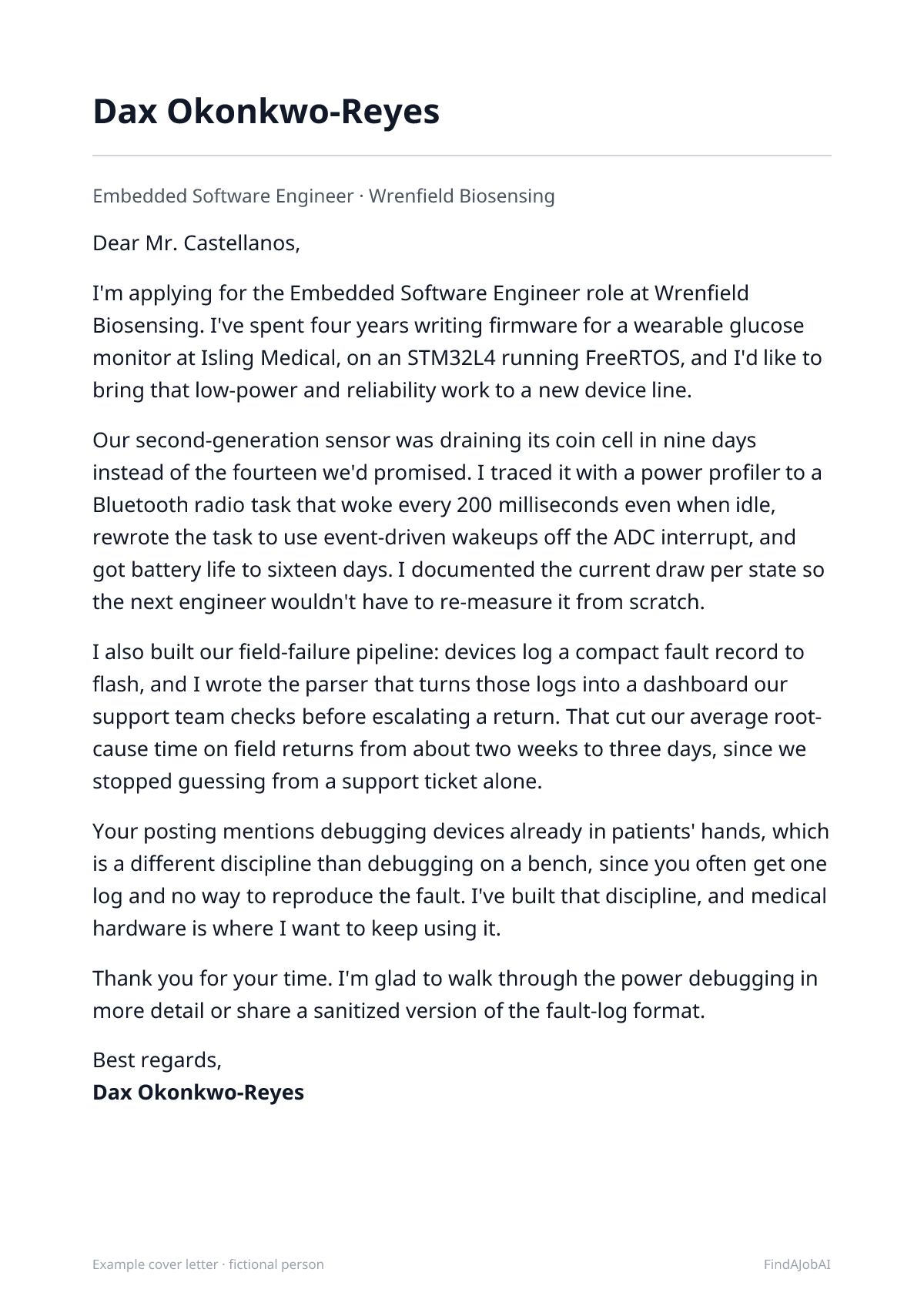
Embedded Software Engineer cover letter template
This letter as a one-page template: an opening that names the job and your strongest fact, proof that answers the ad, a reason for this employer and a short close.
After you sign up, FindAJobAI drafts your own letter for a real job from your CV in this format, and you edit it before you send it.
Example 1 · Experienced
Firmware engineer applying to a medical device maker
Dax writes firmware for a wearable glucose monitor. The ad asks for low-power RTOS work and field-failure debugging.
Example letter · fictional
Dear Mr. Castellanos,
I'm applying for the Embedded Software Engineer role at Wrenfield Biosensing. I've spent four years writing firmware for a wearable glucose monitor at Isling Medical, on an STM32L4 running FreeRTOS, and I'd like to bring that low-power and reliability work to a new device line.
Our second-generation sensor was draining its coin cell in nine days instead of the fourteen we'd promised. I traced it with a power profiler to a Bluetooth radio task that woke every 200 milliseconds even when idle, rewrote the task to use event-driven wakeups off the ADC interrupt, and got battery life to sixteen days. I documented the current draw per state so the next engineer wouldn't have to re-measure it from scratch.
I also built our field-failure pipeline: devices log a compact fault record to flash, and I wrote the parser that turns those logs into a dashboard our support team checks before escalating a return. That cut our average root-cause time on field returns from about two weeks to three days, since we stopped guessing from a support ticket alone.
Your posting mentions debugging devices already in patients' hands, which is a different discipline than debugging on a bench, since you often get one log and no way to reproduce the fault. I've built that discipline, and medical hardware is where I want to keep using it.
Thank you for your time. I'm glad to walk through the power debugging in more detail or share a sanitized version of the fault-log format.
Best regards,
Dax Okonkwo-Reyes
Example 2 · Career changer
Electrical engineer moving into firmware
Priya designed the board and then wrote its firmware herself after no one else was available. The ad wants bare-metal C and I2C/SPI experience.
Example letter · fictional
Dear Hiring Manager,
I'm applying for the Junior Embedded Software Engineer role at Austell Robotics. For three years I've worked as an electrical engineer at Corrin Instruments, designing sensor boards, and over the last year I've written the firmware for most of them myself because our firmware team was short-staffed.
The project I'm proudest of is a six-axis tilt sensor board I both designed and brought up. I wrote the bare-metal C driver for its I2C accelerometer on an ATmega328, built a ring buffer to smooth noisy readings, and got the sensor reporting stable orientation data within two weeks of first power-on. Because I knew the schematic, I could tell quickly whether a bad reading was a wiring issue or a firmware bug, which saved the team a few rounds of guessing.
Since then I've written SPI drivers for a flash chip and a display, picked up FreeRTOS on my own time through a side project that runs a small weather station, and I'm comfortable reading a datasheet's timing diagrams and matching them against a logic analyzer trace. I still have more to learn about RTOS scheduling under real contention, which I'd want to grow into on a team.
Your ad asks for someone comfortable with I2C and SPI and reading schematics, which is exactly the overlap between my EE background and the firmware work I've been doing. I'd bring both the hardware fluency and the drive to keep writing the software side full time.
Thank you for considering my application. I can bring the tilt sensor board to an interview if that's useful.
Sincerely,
Priya Vantongeren
Example 3 · Senior or lead
Firmware lead applying to run embedded for an industrial sensor startup
Soren leads four firmware engineers at a drone company. The ad is for a first firmware lead who will set up a real test process.
Example letter · fictional
Dear Ms. Oyelaran,
I'm applying for the Embedded Firmware Lead role at Marrow Industrial. For the past three years I've led a team of four firmware engineers at Halvorsen Aerial, a drone maker, and before that I spent six years as a senior firmware engineer. I'd like to build out a firmware practice from an early stage.
Your ad says releases currently go out tested only by hand on one unit. We had the same gap at Halvorsen: a flight controller update once passed on the bench and then caused a mid-flight reboot in the field because nobody had tested it under vibration. I set up a hardware-in-the-loop rig that replays recorded flight data through three physical units before any release, and built a regression suite covering our worst past failures. We haven't had a field reboot traced to firmware since, across eleven releases.
Trust in firmware comes from what breaks and how fast you find out, not from the feature list. When our motor controller started overheating under a new payload, I used our logging pipeline to isolate it to a PWM frequency that interacted badly with the new motor's inductance, and the fix shipped within a week instead of becoming a multi-month mystery. That incident is now a case study I use when onboarding new engineers.
I've hired two of my four engineers and run a weekly session where someone walks the team through a bug they fixed, which has made our postmortems calmer and more specific. I haven't yet worked with a dedicated hardware test lab, and at Marrow I'd expect to help define what that lab needs alongside your hardware team.
I'd welcome a conversation about which failure modes concern you most right now, and how releases get tested today.
Sincerely,
Soren Lindqvist-Abara
All three letters, and the short version below, are fictional: the people, employers and numbers are invented. Borrow the structure, never the facts.
- Prefer to write it yourself? Use the free cover letter template.
- Check your CV against the job first: the free CV score shows the missing keywords.
Why the first letter works, paragraph by paragraph
Paragraph 1: Opening
Names the specific hardware (STM32L4, FreeRTOS, a wearable sensor) and the years on it, so the reader knows this isn't generic embedded experience.
Paragraph 2: The power debugging story
States the exact symptom (nine days instead of fourteen), the tool used to find it, the fix, and the measured result, which is how embedded engineers actually talk to each other.
Paragraph 3: The field-failure pipeline
Shows the writer builds tools, not just features, and ties it to a business outcome (faster root cause on returns) that a device company's support team would recognize.
Paragraph 4: Why this company
Names the specific difficulty the ad implies (debugging from one log, no reproduction) and claims direct experience with it.
Paragraph 5: Close
Offers a concrete, low-friction next step that respects the current employer's confidentiality.
What the career changer's letter does differently
The career changer's letter leads with a hardware background and shows the writer already crossed into firmware out of necessity, with one project (the tilt sensor board) carrying the whole story from design through driver code. It names a real gap in RTOS experience instead of implying full fluency, and ties the EE background directly to the ad's stated requirements.
What the senior letter does differently
A firmware lead letter is judged on process, not a single bug: the hardware-in-the-loop rig, eleven clean releases, and a team habit (the weekly bug walkthrough) show organizational change. The overheating story proves the writer still debugs hands-on, and the lab gap is named plainly instead of glossed over.
Short embedded software engineer cover letter: an email-ready version
Many applications arrive as an email or a small text box, and a full page doesn't fit. This version runs 120 to 150 words and keeps only what a reader needs to decide whether to reply. A firmware engineer answers a hearables company's five-sentence 'why you' field, sent by email because the portal rejected the file size.
Short version · email · fictional123 words
Subject: Embedded Software Engineer (nRF52, BLE audio) – Teo Abramovitz
Hello Mx. Delacroix-Huang,
I'm applying for the Embedded Software Engineer role at Larkspur Audio. I have four years writing firmware on Nordic nRF52 chips for a hearing aid startup, focused on Bluetooth audio streaming and battery life.
My most useful project was fixing audio dropouts that only happened in crowded rooms. I traced it to Bluetooth connection interval renegotiation competing with our audio buffer, rewrote the buffering to tolerate the gap, and cut reported dropouts by roughly three quarters in the next firmware release.
Low-power BLE audio is a narrow, specific skill, and I'd like to keep building it on a product people wear daily. My resume is attached, and I can walk through the buffering fix on a call.
Best,
Teo Abramovitz
Five sentences force one story, so the short version keeps the dropout fix and its measured improvement instead of a list of chips and protocols. Naming the exact chip (nRF52) does more work than a paragraph of generic BLE experience.
Opening lines that work for embedded software engineer cover letters
The first sentence decides whether the second gets read. Here are six openings, one for each situation you might be in. Pick the one that matches yours and swap in your own facts: every name and number below is invented.
1. You have a standout result
One firmware fix I shipped last year cut a wearable device's reported audio dropouts by roughly three quarters. I'd like to bring that kind of debugging to your audio team.
2. The ad names a problem you've solved
Your ad mentions field devices that fail without a way to reproduce the bug on a bench. I built the fault-logging pipeline that turned exactly that problem from a two-week guess into a three-day fix at my current company.
3. Someone referred you
Your firmware lead, Ines Okafor-Lund, and I worked together on a sensor launch two years ago, from the hardware and firmware sides. She mentioned you're looking for someone who's comfortable owning a driver end to end, which is why I'm writing.
4. You admire what they build
I've taken apart three generations of your fitness tracker out of curiosity about how the sensor fusion holds up against cheaper boards, and I'd like to help build the next one.
5. You're new to the field or switching into it
I spent three years designing circuit boards before writing the firmware for most of them myself, out of necessity. I'd like to make that firmware work my full-time focus.
6. You have senior scope or a specialism
As the senior firmware engineer on a drone's flight controller for six years, I built the hardware-in-the-loop testing process the team still relies on. I'm looking for a role where I can set up that kind of process from the start.
How to write an embedded software engineer cover letter
Five steps, in the order you'd write them. The shape stays the same for every job (a short opening, proof, a reason for this employer, a close), and what goes into each part is what changes with the role.
Identify the hardware and constraint the ad implies
Embedded ads differ by what's scarce: battery life, real-time deadlines, memory, or field reliability. Read for the chip family, RTOS or bare-metal setup, and the buses named. Then pick a project of yours that hit a similar constraint, so the letter speaks to their actual board, not firmware in general.
Open with the bug or feature, not your tool list
State the symptom and what you found in one or two sentences before naming the microcontroller or RTOS. A reader who sees a real debugging story in the first paragraph keeps reading past the second. The tools matter more once they're attached to what you did with them.
Give a measured result, not just a shipped feature
Tie one fix to a number: battery life gained, dropout rate reduced, time-to-root-cause shortened. If you can't measure the end result, describe what changed operationally, such as a release process or a support escalation that got faster because of your work.
Name the chip, RTOS, and bus in context
Mention the specific microcontroller family, whether you worked bare-metal or on an RTOS, and which bus (I2C, SPI, CAN, UART) carried the data in your story. These specifics tell another engineer more in five words than a skills list does in five lines.
Show how you debug without a lab
Mention a time you worked from a log file, a field report, or a device you couldn't easily reproduce the fault on. This is the skill that separates engineers who've only worked on a bench from ones who've supported shipped hardware, and it's worth one direct sentence.
Embedded Software Engineer cover letter do's and don'ts
Do
- Name the microcontroller, RTOS or bare-metal setup, and bus (I2C, SPI, CAN) you actually worked with.
- Describe one bug by its symptom, how you found the root cause, and the fix, the way you'd explain it to another engineer.
- Mention how you debug without a lab: logs, a field report, or a device you can't easily reproduce the fault on.
Don't
- Don't list every protocol you've heard of; name the ones you've shipped and what you built with them.
- Don't say 'strong C skills' without a project; show a driver, an interrupt handler, or a memory constraint you worked around.
- Don't share your current employer's schematics or proprietary code; describe the problem and the fix in general terms.
Common embedded software engineer cover letter mistakes
Each one is easy to make and quick to fix before you send the letter.
Listing protocols without a project
A row of I2C, SPI, CAN and UART with no story behind any of them reads like a copied skills section. Name the one or two you actually built drivers for, and what the driver did.
Describing features shipped instead of bugs fixed
'Implemented BLE connectivity' says less than one dropout you traced and fixed. Hiring managers read cover letters to see how you think under a real constraint, not a changelog entry.
Vague claims about low-power work
'Optimized for battery life' without a before-and-after figure or a technique (sleep states, interrupt-driven wakeups, clock gating) sounds unverified. Name the specific change and what it bought you.
Skipping the hardware context entirely
A letter that reads like it was written for a web backend role, with no chip or board mentioned, signals the writer hasn't worked close to hardware. Name the board or product category you worked on.
Overstating RTOS depth
Claiming deep RTOS scheduling expertise when your real experience is bare-metal loops invites a hard technical interview question you can't back up. Say plainly what you've built and what you're still learning.
Email subject lines for embedded software engineer applications
Applying by email? Put the job title, any reference number and your name in the subject line.
- Embedded Software Engineer application – FreeRTOS, low-power – Dax Okonkwo-Reyes
- Junior Embedded Software Engineer – EE background, I2C/SPI firmware – Priya Vantongeren
- Application: Firmware Engineer, Sensors Team (Req. 2240) – Dax Okonkwo-Reyes
Everything for Embedded Software Engineers
- Embedded Software Engineer resume exampleA full resume, plus bullet and summary examples
- Embedded Software Engineer interview questions30 questions with sample answers
- Embedded Software Engineer job descriptionDuties, skills and requirements
- Career change cover letter: template + examples
Other cover letter examples
Embedded Software Engineer cover letter FAQ
What should I write in an embedded software engineer cover letter?
Pick one bug or feature tied to real hardware: the board or microcontroller, the symptom, how you traced it, and the fix. Name the RTOS or bare-metal setup and the bus protocols involved. Your resume already lists your tools; the letter should show how you used one of them under a real constraint.
How do I write an embedded cover letter with no professional firmware experience?
Lean on hardware-adjacent work: EE projects, hobby boards, or coursework where you wrote drivers or debugged with a logic analyzer. Name one project from first power-on to working output, and be upfront about which parts of the stack (RTOS internals, certain buses) you still want to grow into.
Should I mention specific debugging tools like a logic analyzer or power profiler?
Yes, but only attached to a story. Naming a tool without what you found with it reads like a resume line repeated in prose. Say what the tool showed you and what you changed because of it.
How technical should an embedded cover letter get?
Technical enough that another firmware engineer could follow it, but without reproducing register maps or full code. One well-explained bug, with the part number and the measured result, tells a hiring manager more than a list of specifications.
How we built this page
The FindAJobAI team wrote the three example letters, the short email version, the opening lines and the advice for embedded software engineer roles. The people, employers and numbers in the letters are invented; the structure, the kind of evidence and the order of the paragraphs are the parts to copy.
Once we track enough live embedded software engineer job ads, this page also shows the skills they ask for most, counted the same way as our in-demand skills report.
Last reviewed on November 1, 2026.