Investment Analyst Cover Letter Example (2026)
By FindAJobAI Team Updated How we built this page
Investment analyst postings all ask for modelling and valuation, so the letter has to show how you think: one idea you researched, the evidence that changed your mind or confirmed it, and what the people making decisions did with your work.
Investment Analyst cover letter template
This letter as a one-page template: an opening that names the job and your strongest fact, proof that answers the ad, a reason for this employer and a short close.
After you sign up, FindAJobAI drafts your own letter for a real job from your CV in this format, and you edit it before you send it.
Example 1 · Experienced
Advisory analyst applying to a buy-side fund
Cassius values mid-market companies at a corporate finance boutique. The ad is for an investment analyst covering consumer stocks at a long-only fund.
Example letter · fictional
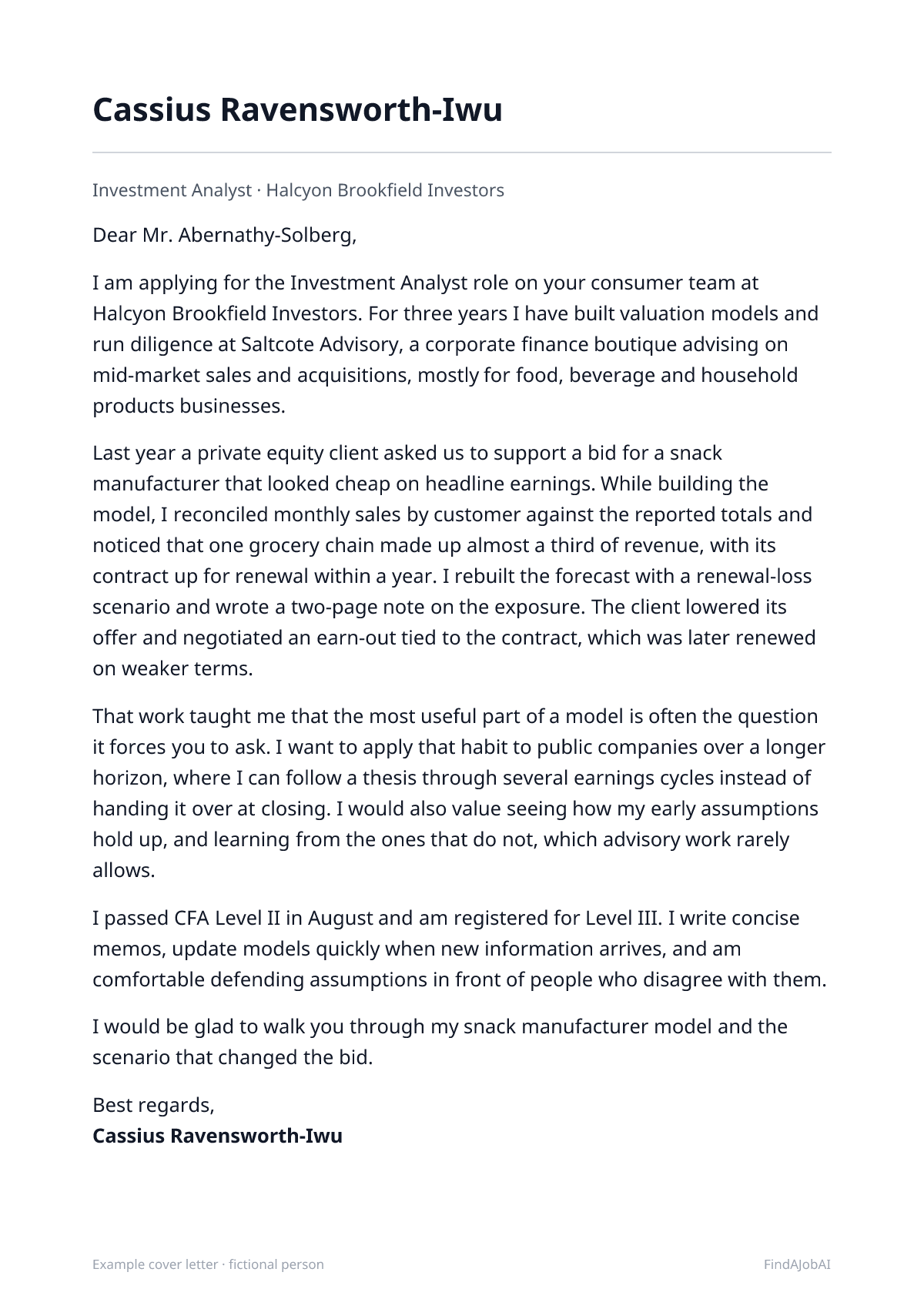
Dear Mr. Abernathy-Solberg,
I am applying for the Investment Analyst role on your consumer team at Halcyon Brookfield Investors. For three years I have built valuation models and run diligence at Saltcote Advisory, a corporate finance boutique advising on mid-market sales and acquisitions, mostly for food, beverage and household products businesses.
Last year a private equity client asked us to support a bid for a snack manufacturer that looked cheap on headline earnings. While building the model, I reconciled monthly sales by customer against the reported totals and noticed that one grocery chain made up almost a third of revenue, with its contract up for renewal within a year. I rebuilt the forecast with a renewal-loss scenario and wrote a two-page note on the exposure. The client lowered its offer and negotiated an earn-out tied to the contract, which was later renewed on weaker terms.
That work taught me that the most useful part of a model is often the question it forces you to ask. I want to apply that habit to public companies over a longer horizon, where I can follow a thesis through several earnings cycles instead of handing it over at closing. I would also value seeing how my early assumptions hold up, and learning from the ones that do not, which advisory work rarely allows.
I passed CFA Level II in August and am registered for Level III. I write concise memos, update models quickly when new information arrives, and am comfortable defending assumptions in front of people who disagree with them.
I would be glad to walk you through my snack manufacturer model and the scenario that changed the bid.
Best regards,
Cassius Ravensworth-Iwu
Example 2 · Entry level
Finance graduate applying for an entry-level investment analyst role
Henrietta has just finished a finance degree and a summer internship. The ad is for an entry-level analyst at a multi-asset wealth manager.
Example letter · fictional
Dear Ms. Ruvalcaba-Fenn,
I would like to be considered for the entry-level Investment Analyst position at Juniper Crest Wealth Partners. I graduated in May with a degree in finance, passed CFA Level I in the same month, and spent last summer interning with the research team at a regional wealth manager.
During the internship I was asked to check whether the dividends of fifteen income holdings were safe. Rather than rely only on payout ratios, I built a small model for each company comparing free cash flow after capital spending with dividends and debt repayments over five years. Two holdings looked stretched. I summarised the findings on a single page, and my manager used them in a client portfolio review where one position was reduced.
At university I led the consumer sector of our student investment fund, coordinating five analysts and presenting pitches to a faculty board. My favourite pitch was one we rejected: a retailer whose story sounded convincing until our store-level numbers showed new locations earning far less than old ones. Learning to drop an idea was more valuable than any win. Since graduating I have kept a simple journal of the stocks I follow, writing down my expectations before each earnings release and checking afterwards where my reasoning was right or wrong, which has made me more careful about confidence.
Your posting mentions supporting advisers with clear research for clients. I enjoy turning a detailed model into something a non-specialist can act on, and I would welcome training from an experienced team.
My dividend analysis and two stock pitches are attached, and I would appreciate the chance to discuss them.
Kind regards,
Henrietta Okafor-Blackwood
Example 3 · Senior or lead
Senior investment analyst applying to lead an industrials team
Ophelia covers industrials at a long-only manager. The ad is for a senior analyst to lead a sector team and co-manage a sleeve at a larger asset manager.
Example letter · fictional
Dear Dr. Lindgren-Obasi,
I am writing to apply for the Senior Investment Analyst role leading your industrials team at Stonewick Harbour Capital. I have spent ten years in equity research and investing, the last six covering capital goods and transport for a long-only fund at Pelham Rowe Investors.
When I joined Pelham Rowe, each analyst wrote memos in a different format and the investment committee often spent most of a meeting finding the assumptions that mattered. I proposed a two-page template that opens with the thesis, the three numbers that would prove it wrong and a sizing suggestion. I also started quarterly post-mortems on every idea we had owned for a year. Committee meetings became shorter and more focused, and the post-mortems showed we were consistently too optimistic about margin recovery, which changed how we model cyclical companies.
Over the last three years I have helped co-manage a sector sleeve, working with the portfolio manager on position sizes and risk limits. I enjoy training analysts and reviewing their models, and two people I trained now cover full sectors on their own. I ask every analyst to write a short pre-mortem before an idea reaches committee, listing how the investment could fail, and we revisit that list when results arrive. It has made our debates more honest, and it has helped junior colleagues speak up when they see a risk that senior people have overlooked.
I have less experience with the private credit side your posting mentions. I would want to learn how that team shares information with equity research before suggesting any changes.
I would welcome a conversation about how your industrials research feeds portfolio decisions today.
Sincerely,
Ophelia Nakashima-Grant
All three letters, and the short version below, are fictional: the people, employers and numbers are invented. Borrow the structure, never the facts.
- Prefer to write it yourself? Use the free cover letter template.
- Check your CV against the job first: the free CV score shows the missing keywords.
Why the first letter works, paragraph by paragraph
Paragraph 1: Opening
Gives Cassius's current work, the sectors he knows and the type of transactions, which maps directly onto a consumer-focused fund.
Paragraph 2: The diligence finding
One specific discovery, the scenario he built and the client's changed offer show investment judgement, not just modelling skill.
Paragraph 3: Why the buy side
Explains the move in terms of following a thesis through earnings cycles, a reason a fund manager finds credible.
Paragraph 4: Credentials and habits
CFA progress, memo writing and comfort with challenge answer the usual screening questions briefly.
Paragraph 5: Close
Offers to walk through a real model, an easy and relevant next step for an interviewer.
What the entry-level letter does differently
Henrietta's letter leads with real analysis from her internship and the decision it informed. Her rejected pitch shows she values evidence over a good story, which matters more than polish at entry level.
What the senior letter does differently
A senior letter focuses on improving how a team makes decisions: a memo template, post-mortems and a lesson about systematic bias. The gap in private credit is stated plainly with a careful first step.
Short investment analyst cover letter: an email-ready version
Many applications arrive as an email or a small text box, and a full page doesn't fit. This version runs 120 to 150 words and keeps only what a reader needs to decide whether to reply. An investment analyst replies to a recruiter at a family office who asked for a brief note before setting up a call.
Short version · email · fictional123 words
Subject: Investment Analyst – healthcare coverage, CFA charterholder – Rupert Adeyemi-Castellan
Hi Ms. Wojcik-Altamirano,
Thanks for contacting me about the Investment Analyst role at Wexford Pine Family Office. I cover healthcare equities at a mid-sized asset manager and earned my CFA charter this year.
My most useful recent work was a review of reimbursement risk across our medical device holdings. I mapped each company's revenue by payer type, modelled a lower reimbursement scenario and wrote a short memo for the portfolio managers. They trimmed the two most exposed positions before a policy announcement weighed on the group, and the framework is now part of our quarterly review. I also run around fifty management meetings a year.
I am free for a call on Monday or Thursday, and my resume is attached.
Best,
Rupert Adeyemi-Castellan
The email focuses on one piece of analysis, the decision it led to and a lasting process change. It stays brief because the recruiter only asked for a short note.
Opening lines that work for investment analyst cover letters
The first sentence decides whether the second gets read. Here are six openings, one for each situation you might be in. Pick the one that matches yours and swap in your own facts: every name and number below is invented.
1. You have a standout result
A snack maker looked cheap until I found one customer behind a third of its revenue; I would like to bring that kind of digging to your consumer team.
2. The ad names a problem you've solved
For three years I have valued mid-market businesses at an advisory boutique, and I now want to follow ideas through full earnings cycles on the buy side.
3. Someone referred you
Your portfolio manager, Augustin Pereira-Holm, heard my pitch at a regional CFA society event and encouraged me to apply.
4. You admire what they build
I have read your quarterly letters for two years, and your view on industrial capital cycles is the reason this role stands out to me.
5. You're new to the field or switching into it
My best pitch at university was one we rejected, and learning to drop a good story taught me more than any winning idea.
6. You have senior scope or a specialism
As the analyst who introduced memo templates and post-mortems at my fund, I am looking for a team where I can lead that kind of discipline.
How to write an investment analyst cover letter
Five steps, in the order you'd write them. The shape stays the same for every job (a short opening, proof, a reason for this employer, a close), and what goes into each part is what changes with the role.
Identify the investing style in the posting
Long-only equity, multi-asset wealth management, private equity and family offices each expect different strengths. Note the asset class, holding period and sector the employer describes, then choose one idea or deal from your own work that matches that setting most closely.
Lead with one idea and the evidence behind it
Describe a company you researched, the question that mattered and the data you used to answer it, such as customer concentration, margins or cash conversion. Readers want to see how you test a thesis, not a summary of your modelling courses.
Explain what decision-makers did with your work
Say whether the committee opened, sized, trimmed or rejected a position, or how a client changed an offer. Linking analysis to a decision shows you understand that research only matters when it helps someone allocate capital wisely.
Mention credentials and working habits briefly
One sentence on CFA, CAIA or FRM progress and one on how you handle earnings season or memo deadlines is enough. Long lists of software and exams add little once the reader has seen a real example of your thinking.
Offer a model or memo to discuss
Finish by offering to walk through a model, a stock pitch or a sanitised memo. Make sure nothing confidential is included, and pick the piece of work closest to the sector or style the employer invests in.
Investment Analyst cover letter do's and don'ts
Do
- Describe one investment idea or deal you analysed and what decision followed.
- Show how you test assumptions: scenarios, channel checks or accounting reviews.
- State your CFA, CAIA or FRM progress in one clear sentence.
Don't
- Don't claim personal credit for fund returns that came from a whole team.
- Don't share confidential client names, deal terms or non-public information.
- Don't fill the letter with market commentary unrelated to your own work.
Common investment analyst cover letter mistakes
Each one is easy to make and quick to fix before you send the letter.
Writing a market outlook instead of a letter
Hiring managers want your process, not your macro view. Use the space for one idea you analysed and its outcome.
Taking credit for team returns
Be clear about which ideas were yours and how performance was measured. Overclaiming is easy to spot in interviews.
Revealing confidential deal details
Describe deals by sector, size and issue. Naming private clients or terms suggests poor judgement with sensitive information.
Listing every exam and terminal function
Mention credentials once. Spend the rest of the letter on evidence of judgement and clear writing.
Ignoring the firm's style
A deep value fund and a growth fund want different stories. Read their letters or website and choose an example that fits.
Email subject lines for investment analyst applications
Applying by email? Put the job title, any reference number and your name in the subject line.
- Investment Analyst, Consumer – advisory analyst, CFA Level III candidate – Cassius Ravensworth-Iwu
- Entry-level Investment Analyst – finance graduate, CFA Level I – Henrietta Okafor-Blackwood
- Application: Senior Investment Analyst, Industrials (Ref. 8834) – Ophelia Nakashima-Grant
Everything for Investment Analysts
- Investment Analyst resume exampleA full resume, plus bullet and summary examples
- Investment Analyst interview questions30 questions with sample answers
- Investment Analyst job descriptionDuties, skills and requirements
- Cover letter with no experience: templates
Other cover letter examples
Investment Analyst cover letter FAQ
What should an investment analyst cover letter include?
One idea or deal you analysed, the evidence you used, what the decision-makers did with your work, and a line on your credentials and modelling approach.
How do I write an investment analyst cover letter with no experience?
Use a student fund role, an internship or a personal stock pitch. Explain your thesis, the numbers that supported it and what you learned, including ideas you rejected.
Should I mention returns in an investment analyst cover letter?
Only when you can explain the benchmark, the period and your share of the idea. A clear thought process usually impresses more than a single return figure.
How we built this page
The FindAJobAI team wrote the three example letters, the short email version, the opening lines and the advice for investment analyst roles. The people, employers and numbers in the letters are invented; the structure, the kind of evidence and the order of the paragraphs are the parts to copy.
Once we track enough live investment analyst job ads, this page also shows the skills they ask for most, counted the same way as our in-demand skills report.
Last reviewed on November 1, 2026.