Midwife Cover Letter Example (2026)
By FindAJobAI Team Updated How we built this page
Midwifery hiring managers already know your credential from the resume. The letter is where you show how you practice: how you support a long labor, when you call for backup, and what you have changed for the families on your unit.
Midwife cover letter template
This letter as a one-page template: an opening that names the job and your strongest fact, proof that answers the ad, a reason for this employer and a short close.
After you sign up, FindAJobAI drafts your own letter for a real job from your CV in this format, and you edit it before you send it.
Example 1 · Experienced
Certified nurse-midwife applying to a hospital midwifery service
Annika has five years as a CNM in a community hospital. The ad asks for a midwife to help lower the unit's cesarean rate.
Example letter · fictional
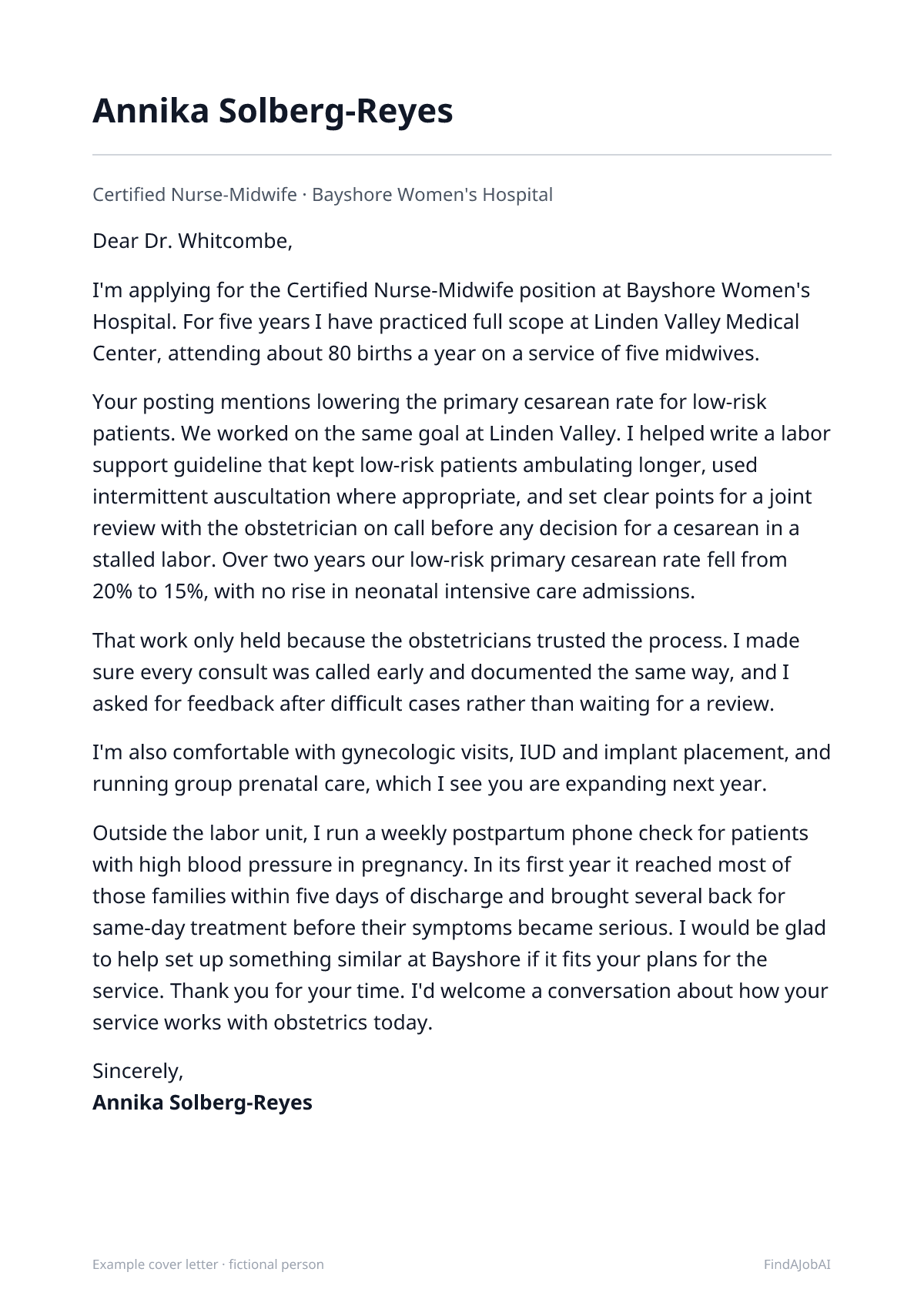
Dear Dr. Whitcombe,
I'm applying for the Certified Nurse-Midwife position at Bayshore Women's Hospital. For five years I have practiced full scope at Linden Valley Medical Center, attending about 80 births a year on a service of five midwives.
Your posting mentions lowering the primary cesarean rate for low-risk patients. We worked on the same goal at Linden Valley. I helped write a labor support guideline that kept low-risk patients ambulating longer, used intermittent auscultation where appropriate, and set clear points for a joint review with the obstetrician on call before any decision for a cesarean in a stalled labor. Over two years our low-risk primary cesarean rate fell from 20% to 15%, with no rise in neonatal intensive care admissions.
That work only held because the obstetricians trusted the process. I made sure every consult was called early and documented the same way, and I asked for feedback after difficult cases rather than waiting for a review.
I'm also comfortable with gynecologic visits, IUD and implant placement, and running group prenatal care, which I see you are expanding next year.
Outside the labor unit, I run a weekly postpartum phone check for patients with high blood pressure in pregnancy. In its first year it reached most of those families within five days of discharge and brought several back for same-day treatment before their symptoms became serious. I would be glad to help set up something similar at Bayshore if it fits your plans for the service. Thank you for your time. I'd welcome a conversation about how your service works with obstetrics today.
Sincerely,
Annika Solberg-Reyes
Example 2 · Career changer
Labor and delivery nurse applying for a first midwife role
Corinne has six years as a labor nurse and has just passed her AMCB exam. The ad welcomes new graduates with strong labor experience.
Example letter · fictional
Dear Ms. Larkfield,
I'm applying for the new graduate Certified Nurse-Midwife role at Cascade Midwifery Partners. I passed my AMCB exam this month after six years as a labor and delivery nurse at Riverside General, where I cared for laboring patients on a unit with about 2,000 births a year.
As a nurse, I learned to read a labor room: when a patient needs quiet, when a family needs an explanation, and when a tracing needs a provider now rather than later. During training I attended 58 births under supervision, including 10 water births, and completed about 280 prenatal and postpartum visits across a clinic and a birth center.
The part of midwifery I am most drawn to is continuity. On my clinic rotation I followed one patient from her first visit to her birth, and her trust made the difficult moments in labor much easier to work through together.
Your posting says new midwives start with a mentored caseload, which is the support I want while I build speed and judgment as the lead provider.
My nursing years also taught me the practical side of a busy unit: how to hand over clearly at shift change, how to work with anesthesia and pediatrics, and how to keep documentation complete when several patients need attention at once. I hold current NRP and BLS certification, my state license application is in process, and I can work nights, weekends and a full call schedule. Thank you for considering my application. I'd be glad to talk about my training or my nursing years.
Kind regards,
Corinne Abernathy
Example 3 · Senior or lead
Lead midwife applying to run a growing hospital service
Beatrix has led a seven-midwife team for four years. The ad is for a manager to grow the service and bring in-house call to 24 hours.
Example letter · fictional
Dear Mr. Haverford,
I'm applying for the Lead Midwife position at Summit Ridge Medical Center. For four years I have led a team of seven midwives at Eastgate Hospital, where our service attends about 900 births a year, and I still take call two nights a month.
Your posting says you plan to move from home call to 24-hour in-house coverage. We made the same change at Eastgate in 2023. I built the schedule with the team rather than for them, added a protected sleep room and a handoff checklist, and phased it in over six months. Time from triage arrival to midwife assessment at night fell from about 50 minutes to 15, and no midwife left during the change.
I also rewrote our consultation agreement with obstetrics after a year of disputes over when to call. The new version lists clear triggers and a shared review each month, and the disagreements logged in safety reports dropped from eleven to two the following year.
I have hired three midwives, but I haven't yet built a budget for a service this size, and I'd want to work closely with your finance team on that.
I still believe a lead midwife should practice. Taking call two nights a month keeps me close to what the team faces at three in the morning, and several of our best changes, including the handoff checklist, came from problems I saw myself on those shifts rather than from reports. I'd be glad to talk about your timeline for in-house call and the support your team needs.
Sincerely,
Beatrix Okonkwo-Lund
All three letters, and the short version below, are fictional: the people, employers and numbers are invented. Borrow the structure, never the facts.
- Prefer to write it yourself? Use the free cover letter template.
- Check your CV against the job first: the free CV score shows the missing keywords.
Why the first letter works, paragraph by paragraph
Paragraph 1: Opening
Gives the credential, setting and yearly births in two sentences, so the reader knows the scale of practice right away.
Paragraph 2: The cesarean work
Matches the ad's goal and shows method and a measured result, plus a safety check that the change didn't cause harm.
Paragraph 3: Working with obstetrics
Shows safe escalation and teamwork, which hospital services value as much as independence.
Paragraph 4: Extra scope
Mentions gynecology and group prenatal care tied to the employer's plans, not a generic list.
Paragraph 5: Close
Invites a talk about how the service works with obstetrics, a natural next step for both sides.
What the career changer's letter does differently
The new midwife's letter uses nursing years as proof of judgment in the labor room, then counts supervised births and visits from training. Naming the mentored caseload in the ad shows she knows what support she needs as a new provider.
What the senior letter does differently
A lead midwife letter is about the service, not single births: a call model changed with the team, a measured drop in night assessment time, and calmer work with obstetrics. Naming the budget gap honestly makes the rest more believable.
Short midwife cover letter: an email-ready version
Many applications arrive as an email or a small text box, and a full page doesn't fit. This version runs 120 to 150 words and keeps only what a reader needs to decide whether to reply. A CNM replies by email to a recruiter at a birth center who asked for a short note before a phone screen.
Short version · email · fictional123 words
Subject: Certified Nurse-Midwife – birth center experience – Henrietta Galloway
Hello Ms. Quintrell,
Thank you for reaching out about the Certified Nurse-Midwife role at Meadowlark Birth Center. I have four years at a freestanding birth center, attending about 60 births a year, many of them in water.
The part of the work I value most is a clear transfer plan. At my current center I helped update our transfer guideline with the local hospital, and every transfer in labor last year arrived with a written summary within 30 minutes of the decision.
I hold current NRP and BLS certification and an active license in your state, and I am comfortable with the on-call rotation described in the posting. My resume is attached. I'm free for a call most weekday afternoons.
Best,
Henrietta Galloway
The short email keeps one practical strength, safe transfers from a birth center, with a concrete timing result, and ends with availability for the phone screen.
Opening lines that work for midwife cover letters
The first sentence decides whether the second gets read. Here are six openings, one for each situation you might be in. Pick the one that matches yours and swap in your own facts: every name and number below is invented.
1. You have a standout result
Over two years our low-risk primary cesarean rate fell from 20% to 15% after a labor support guideline I helped write. Your posting names the same goal.
2. The ad names a problem you've solved
I have attended about 80 births a year for five years, and the thing I'm proudest of is how early and clearly our midwives call for obstetric backup.
3. Someone referred you
After six years as a labor nurse and 58 supervised births in training, I'm ready to step into a mentored caseload like the one your practice offers.
4. You admire what they build
Your midwife, Lorna Pettibone, precepted me during training and told me your service was moving to in-house call; I'd like to help with that change.
5. You're new to the field or switching into it
Group prenatal care raised attendance at my clinic, and I see you are starting it next year; I've run eight cohorts and would like to help build yours.
6. You have senior scope or a specialism
I lead a seven-midwife team covering 900 births a year, and I'm looking for a service ready to grow its in-house coverage.
How to write a midwife cover letter
Five steps, in the order you'd write them. The shape stays the same for every job (a short opening, proof, a reason for this employer, a close), and what goes into each part is what changes with the role.
Open with credential, setting and volume
Say your credential, the type of setting and roughly how many births you attend each year. That one sentence tells the reader how your experience fits their service before they read anything else in the letter.
Pick one practice change with a result
Choose a guideline, program or habit you helped introduce, such as group prenatal care or a postpartum phone check, and give a measured result for the unit. Make clear what your own part was and what the team did.
Show how you work with obstetrics
Hospital and birth center teams want to know you consult early and clearly. One concrete line about how you call for backup or handle transfers does more than any general claim of good teamwork in the letter.
Match the employer's plans
Read the ad for what the service is changing, such as in-house call, a new birth center or group visits, and tie one of your experiences directly to it. This shows you read the posting closely and understand where the service is heading.
Keep patient details private
Use rates and totals, not individual stories with dates or places. A short anonymous example is fine if nobody could recognize the family from it, including colleagues who worked that shift or the night shift with you.
Midwife cover letter do's and don'ts
Do
- Give yearly births, your setting and the size of your service in the first paragraph.
- Describe one change you helped make on your unit and its measured effect.
- Show when and how you consult obstetrics; it reassures every hiring team.
Don't
- Don't share any patient story with details that could identify a family.
- Don't claim outcomes for a whole unit as your personal results.
- Don't write only about a calling to birth work without any clinical evidence.
Common midwife cover letter mistakes
Each one is easy to make and quick to fix before you send the letter.
Writing only about a love of birth
Every applicant feels it. Follow any line about your motivation with a real example of your practice and its result.
Leaving out consultation and transfer
A letter that only stresses independence can worry a hiring team. Show how you escalate care safely.
Claiming unit results as your own
Say what you did inside a team effort, such as writing the guideline or training nurses, and credit the rest.
Copying the resume
Your certificates and job dates are already listed. Use the letter for one or two stories the resume can't tell.
Ignoring the call schedule
If the ad describes call or shift patterns, say plainly that you can work them or what you would need.
Email subject lines for midwife applications
Applying by email? Put the job title, any reference number and your name in the subject line.
- Certified Nurse-Midwife application – full scope, 80 births a year – Annika Solberg-Reyes
- New graduate CNM – six years of L&D nursing – Corinne Abernathy
- Application: Lead Midwife (Req. MW-214) – Beatrix Okonkwo-Lund
Everything for Midwifes
- Midwife resume exampleA full resume, plus bullet and summary examples
- Midwife interview questions30 questions with sample answers
- Midwife job descriptionDuties, skills and requirements
- Career change cover letter: template + examples
Other cover letter examples
Midwife cover letter FAQ
What should I write in a midwife cover letter?
Your credential, setting and yearly births, then one example of how you practice, such as a change you helped make on your unit or how you handle consultation with obstetrics.
How do I write a midwife cover letter as a new graduate?
Lead with your certification and your nursing or clinical background, count your supervised births and visits, and say what kind of mentoring you want in your first year.
Should a midwife cover letter mention birth philosophy?
Briefly, and tied to practice. One sentence on supporting informed choice is fine if the next sentence shows how you did it safely.
How long should a midwife cover letter be?
About 300 words: an opening that names your credential and setting, one or two clinical examples, and a short close.
How we built this page
The FindAJobAI team wrote the three example letters, the short email version, the opening lines and the advice for midwife roles. The people, employers and numbers in the letters are invented; the structure, the kind of evidence and the order of the paragraphs are the parts to copy.
Once we track enough live midwife job ads, this page also shows the skills they ask for most, counted the same way as our in-demand skills report.
Last reviewed on November 1, 2026.