Phlebotomist Cover Letter Example (2026)
By FindAJobAI team Updated How we built this page
Phlebotomist ads mostly list the same certification and a draw count, so applicants read alike on paper. The cover letter is where you show how you handle a hard stick, a frightened patient or a lab that needs samples fast, which is the part a certificate can't prove.
Phlebotomist cover letter template
This letter as a one-page template: an opening that names the job and your strongest fact, proof that answers the ad, a reason for this employer and a short close.
After you sign up, FindAJobAI drafts your own letter for a real job from your CV in this format, and you edit it before you send it.
Example 1 · Experienced
Hospital phlebotomist applying to a larger medical center
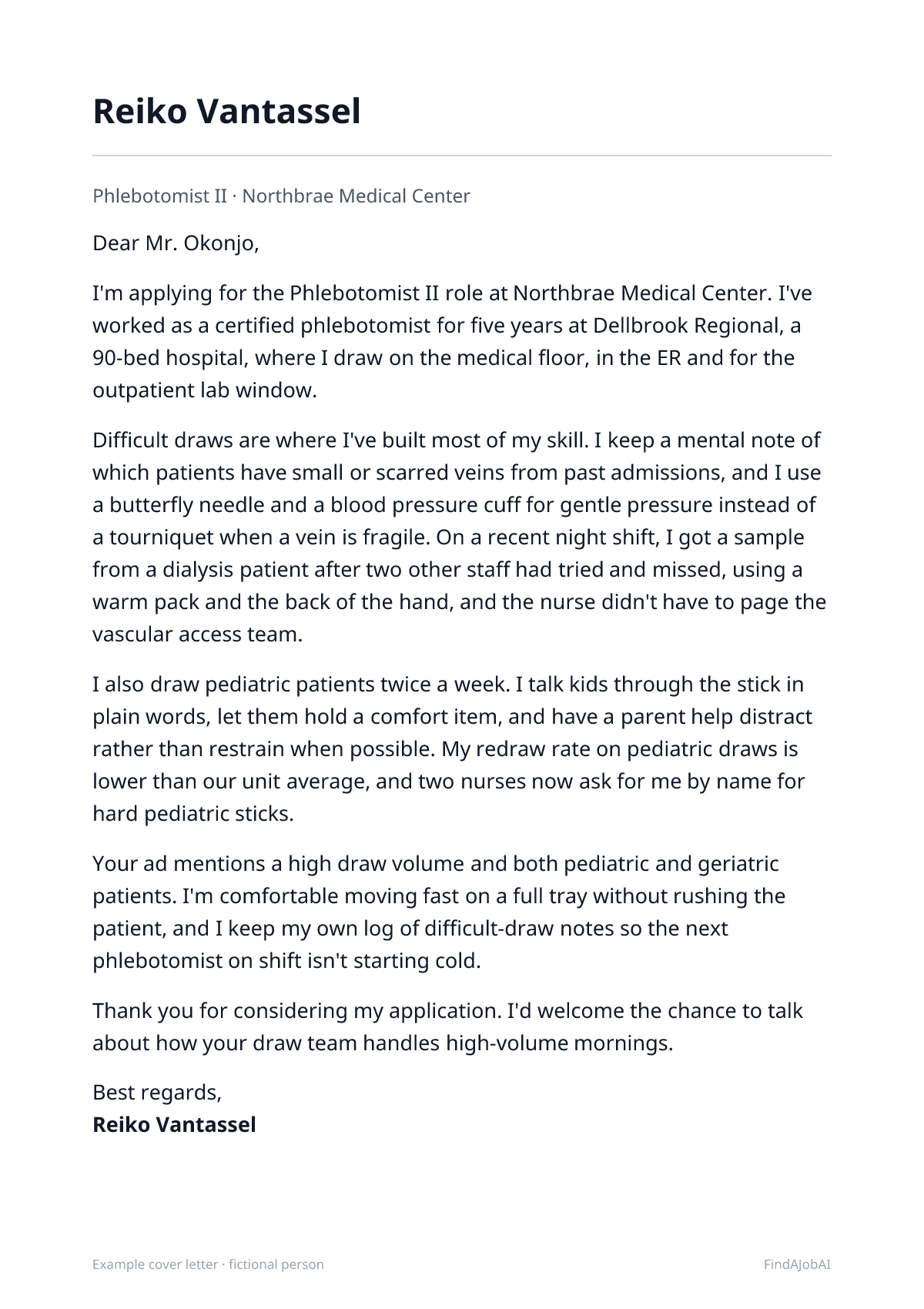
Reiko draws for a 90-bed hospital and wants a busier lab. The ad asks about pediatric and difficult draws.
Example letter · fictional
Dear Mr. Okonjo,
I'm applying for the Phlebotomist II role at Northbrae Medical Center. I've worked as a certified phlebotomist for five years at Dellbrook Regional, a 90-bed hospital, where I draw on the medical floor, in the ER and for the outpatient lab window.
Difficult draws are where I've built most of my skill. I keep a mental note of which patients have small or scarred veins from past admissions, and I use a butterfly needle and a blood pressure cuff for gentle pressure instead of a tourniquet when a vein is fragile. On a recent night shift, I got a sample from a dialysis patient after two other staff had tried and missed, using a warm pack and the back of the hand, and the nurse didn't have to page the vascular access team.
I also draw pediatric patients twice a week. I talk kids through the stick in plain words, let them hold a comfort item, and have a parent help distract rather than restrain when possible. My redraw rate on pediatric draws is lower than our unit average, and two nurses now ask for me by name for hard pediatric sticks.
Your ad mentions a high draw volume and both pediatric and geriatric patients. I'm comfortable moving fast on a full tray without rushing the patient, and I keep my own log of difficult-draw notes so the next phlebotomist on shift isn't starting cold.
Thank you for considering my application. I'd welcome the chance to talk about how your draw team handles high-volume mornings.
Best regards,
Reiko Vantassel
Example 2 · Career changer
Certified nursing assistant moving into phlebotomy
Dax is a CNA who finished phlebotomy certification and training draws. The ad wants comfort with anxious patients.
Example letter · fictional
Dear Hiring Manager,
I'm applying for the Phlebotomist role at Cressida Outpatient Lab. For three years I've worked as a certified nursing assistant at Marrow Creek Nursing Home, and I recently completed my phlebotomy certification through Ashgrove Community College, including 120 supervised draws.
As a CNA, I spent most of my shifts with residents who were anxious about any needle, after years of blood draws and IVs. I learned to explain each step before I did it, keep my voice steady, and let a resident set the pace rather than rushing to finish. That same approach carried into my training draws: my supervising phlebotomist noted that my patients stayed calmer than most students', and I completed my required draws without a single stick needing a second attempt once I passed my first twenty.
I also spent two years taking vitals and collecting basic specimens for residents, so I already understand chain of custody, labeling and why a mislabeled tube matters more than almost any other mistake in a lab. My training supervisor can confirm my technique and my recordkeeping.
Your posting mentions anxious patients and a fast-paced outpatient schedule. Calming a nervous patient without slowing down the line is exactly what I practiced daily as a CNA, and I'd bring that along with fresh, supervised draw technique. I'm also comfortable talking a patient through each step before the needle goes in, which keeps a nervous draw calm and quick.
Thank you for your time. I'm available for a working interview or a skills check whenever it suits your lab.
Kind regards,
Dax Ferreira
Example 3 · Senior or lead
Lead phlebotomist applying to oversee a hospital draw team
Petra leads six phlebotomists at a regional hospital. The ad is for a lead who trains new hires and cuts specimen rejections.
Example letter · fictional
Dear Ms. Varga,
I'm applying for the Lead Phlebotomist role at Aldercroft Regional Hospital. For the past two years I've led a team of six phlebotomists at Thistlewood General, and before that I spent five years drawing on the floor, in the ER and in outpatient services.
Your ad names specimen rejection and new-hire training as priorities, and those were the two problems I inherited at Thistlewood. Our rejection rate was high from hemolyzed samples and mislabeling during rushed morning rounds. I rewrote our draw order checklist, added a second label check at the bedside before leaving the room, and paired new hires with a trained phlebotomist for their first forty draws instead of ten. Rejections dropped enough that the lab stopped calling it their top complaint in monthly meetings, and our last two new hires passed their independent competency check on the first attempt.
I still draw two shifts a week myself, including the hardest sticks on the unit, because a lead who's lost touch with the needle loses the team's trust fast. When a nurse paged for a patient three phlebotomists had already missed, I found a usable vein behind the elbow using a tourniquet placed higher than usual and got the sample on the first try, then wrote up the technique for our team's shared notes.
I haven't yet managed scheduling across multiple hospital campuses, which I understand this role covers, and I'd want to learn your current rotation system closely in my first weeks rather than assume my single-site approach transfers directly.
I'd welcome a conversation about your specimen rejection numbers and how your new-hire training is currently structured.
Sincerely,
Petra Linnqvist
All three letters, and the short version below, are fictional: the people, employers and numbers are invented. Borrow the structure, never the facts.
- Prefer to write it yourself? Use the free cover letter template.
- Check your CV against the job first: the free CV score shows the missing keywords.
Why the first letter works, paragraph by paragraph
Paragraph 1: Opening
Names the current hospital's size and the three places the writer draws, which tells the reader the volume and variety of experience without listing years of duties.
Paragraph 2: Difficult draws
A specific technique (warm pack, back of the hand, blood pressure cuff) and one real outcome (avoiding a vascular access page) show judgment that a certification alone doesn't prove.
Paragraph 3: Pediatric draws
Names a concrete method for working with children and a result, a lower redraw rate, that a hiring manager can picture and trust.
Paragraph 4: Why this employer
Mirrors the ad's own language, pediatric and geriatric patients and high volume, and answers it directly instead of repeating a general strength.
Paragraph 5: Close
Invites a specific, relevant conversation rather than a generic thank-you, which signals real interest in how this particular lab runs.
What the career changer's letter does differently
The career changer's letter leads with the CNA work that already involved anxious patients and specimen handling, then adds the certification and supervised draw count as the new, formal piece. It offers a working interview, which matters most for a hands-on skill like venipuncture.
What the senior letter does differently
A lead phlebotomist letter reports a team's habits, not just one draw: a rewritten checklist, a longer new-hire training pairing, and a rejection rate that stopped being the lab's top complaint. It still proves the writer can draw the hardest sticks personally, and names the one gap, multi-campus scheduling, honestly.
Short phlebotomist cover letter: an email-ready version
Many applications arrive as an email or a small text box, and a full page doesn't fit. This version runs 120 to 150 words and keeps only what a reader needs to decide whether to reply. A phlebotomist answers a clinic's short online application form, sent as an email after the portal rejected a file attachment.
Short version · email · fictional123 words
Subject: Phlebotomist application (NHA certified) – Soren Baptiste
Hello Ms. Agyemang,
I'm applying for the Phlebotomist role at Wrenfield Family Clinic. I'm NHA certified with two years of experience at a busy urgent care clinic, where I draw for both walk-in patients and scheduled lab work.
Most of my patients are anxious about needles, so I talk through each step before I start and let nervous patients choose which arm to use. I've also handled several pediatric draws using a butterfly needle and a parent for distraction rather than restraint, and my redraw rate on those has stayed low.
I'm comfortable with a fast walk-in pace and careful specimen labeling. My resume is attached again as a PDF, and I'm glad to come in for a skills check.
Best,
Soren Baptiste
The short version keeps one concrete patient-comfort technique and the pediatric detail, since both answer what a small clinic worries about most, and drops the hospital-specific details that wouldn't transfer to urgent care.
Opening lines that work for phlebotomist cover letters
The first sentence decides whether the second gets read. Here are six openings, one for each situation you might be in. Pick the one that matches yours and swap in your own facts: every name and number below is invented.
1. You have a standout result
Last year I got a clean draw on a dialysis patient that two other staff had missed, using a warm pack and a vein behind the hand. I'd like to bring that kind of difficult-draw skill to your lab.
2. The ad names a problem you've solved
Your ad mentions a high daily draw volume. At my current clinic I handle a similarly full schedule while still taking the extra minute anxious patients need, and my redraw rate has stayed below our team average.
3. Someone referred you
Your lab supervisor, Imre Nagy, worked with me for a year on the overnight draw team. He mentioned you're looking for someone steady under a full queue, which is what prompted this application.
4. You admire what they build
I've been a patient at your clinic for years, and the phlebotomists there always explain each step clearly; I'd like to bring that same approach to your team as a colleague rather than a patient.
5. You're new to the field or switching into it
I spent three years as a CNA calming residents through daily blood draws and IVs, then completed my phlebotomy certification with 120 supervised sticks. I'd like to keep using that same patience in a dedicated draw role.
6. You have senior scope or a specialism
As lead phlebotomist for a six-person team, I cut our specimen rejection rate by rewriting our draw checklist and training process. I'm now looking for a lab where I can build that same structure from an earlier stage.
How to write a phlebotomist cover letter
Five steps, in the order you'd write them. The shape stays the same for every job (a short opening, proof, a reason for this employer, a close), and what goes into each part is what changes with the role.
Open with a draw, not a job title
Skip restating your resume and start with one specific draw: a hard stick, an anxious patient or a fast-paced shift you handled well. A reader who sees your hands-on skill in the first line keeps reading the rest of the letter.
Match the patient population the ad names
Pediatric, geriatric, dialysis or outpatient walk-ins each call for different technique and bedside manner. Read the ad for which population it mentions, then pick the story from your experience that answers that population specifically. One honest sentence about that setting is enough.
Name your certification and training source
State your certification (CPT, NHA, ASCP or similar) and, if you're newer, your supervised draw count and training program. Experienced applicants can mention this briefly; newer applicants should give it more space since it stands in for a track record.
Show you understand specimen integrity, not just needle skill
Mention labeling, chain of custody or avoiding hemolysis in the context of one habit or mistake you caught. Labs lose more time to rejected specimens than to slow draws, so this detail tells a hiring manager you think past the stick itself.
Close with availability for a working interview
Phlebotomy is a hands-on skill that's hard to judge from paper, so offer a working interview or skills check, especially if you're newer to the field. Add your shift flexibility if the ad mentions early mornings or rotating schedules.
Phlebotomist cover letter do's and don'ts
Do
- Describe one difficult draw and the technique you used, not just your total draw count.
- Name the certification you hold (CPT, NHA, ASCP) and where you trained if you're newer to the field.
- Mention how you handle anxious, pediatric or geriatric patients; most ads ask about at least one.
- Offer a working interview or skills check if you're newer; labs trust a demonstrated stick over a resume line.
Don't
- Don't just state a daily draw number without saying what setting it was in; volume varies hugely by site.
- Don't call yourself "great with people"; describe how you calmed one specific nervous patient.
- Don't skip chain-of-custody and labeling; a lab manager cares about this as much as needle technique.
Common phlebotomist cover letter mistakes
Each one is easy to make and quick to fix before you send the letter.
Listing a draw count with no setting
Forty draws a day means something different in a hospital ER than in a small outpatient clinic. Name the setting alongside any number, or replace the number with one specific draw and how you handled it.
Saying "good with needles" instead of describing technique
Any applicant can claim steady hands. Describe one method you use for a hard vein, such as a warm pack, a butterfly needle, or repositioning a tourniquet, and the outcome it led to.
Ignoring specimen handling entirely
A letter that's only about the needle misses half the job. Mention labeling at the bedside, order of draw, or how you prevent hemolysis, since lab managers care about rejected specimens as much as missed veins.
Treating pediatric or anxious patients as an afterthought
If the ad mentions these patients, give them a real sentence, not a passing phrase. Describe one technique, such as letting a child hold a comfort item or explaining each step before you start.
Forgetting to offer a working interview when you're new
A certification alone doesn't prove your hands are steady yet. Offering a skills check or working interview shows confidence and gives the employer an easy way to say yes without guessing.
Email subject lines for phlebotomist applications
Applying by email? Put the job title, any reference number and your name in the subject line.
- Phlebotomist II application – pediatric and difficult draws – Reiko Vantassel
- Phlebotomist – CNA with phlebotomy certification and 120 supervised draws – Dax Ferreira
- Application: Phlebotomist, Outpatient Lab (Req. 2240) – Reiko Vantassel
Everything for Phlebotomists
- Phlebotomist resume exampleA full resume, plus bullet and summary examples
- Phlebotomist interview questions30 questions with sample answers
- Phlebotomist job descriptionDuties, skills and requirements
- Career change cover letter: template + examples
Other cover letter examples
Phlebotomist cover letter FAQ
What should I write in a phlebotomist cover letter?
One story about a difficult draw: the patient, the technique you used, and the outcome. Then a sentence on how you handle anxious, pediatric or geriatric patients, since most ads ask about one of those. Your certification and draw count are already on your resume.
How do I write a phlebotomist cover letter with no experience?
Lead with your certification program and supervised draw count, and pull in related work such as CNA or medical assistant experience with specimens or anxious patients. Offer a working interview or skills check, since labs trust a demonstrated stick over a resume claim.
Should I mention my draw count or speed in a phlebotomist cover letter?
Only with context. A number from a slow outpatient clinic and a number from a busy ER mean different things, so name the setting alongside any count, or skip the number and describe a specific draw instead.
How we built this page
The FindAJobAI team wrote the three example letters, the short email version, the opening lines and the advice for phlebotomist roles. The people, employers and numbers in the letters are invented; the structure, the kind of evidence and the order of the paragraphs are the parts to copy.
Once we track enough live phlebotomist job ads, this page also shows the skills they ask for most, counted the same way as our in-demand skills report.
Last reviewed on November 1, 2026.