Site Reliability Engineer Cover Letter Example (2026)
By FindAJobAI team Updated How we built this page
SRE hiring managers read cover letters for outcomes: the service-level objectives you owned, the incidents you led, and the toil you removed. Tools matter less than evidence that you made a service measurably more reliable while letting the team ship faster.
Site Reliability Engineer cover letter template
This letter as a one-page template: an opening that names the job and your strongest fact, proof that answers the ad, a reason for this employer and a short close.
After you sign up, FindAJobAI drafts your own letter for a real job from your CV in this format, and you edit it before you send it.
Example 1 · Experienced
Senior SRE applying to a video streaming company
Marcus owns reliability for a platform at 30,000 requests per second. The ad mentions live events with sudden traffic spikes.
Example letter · fictional
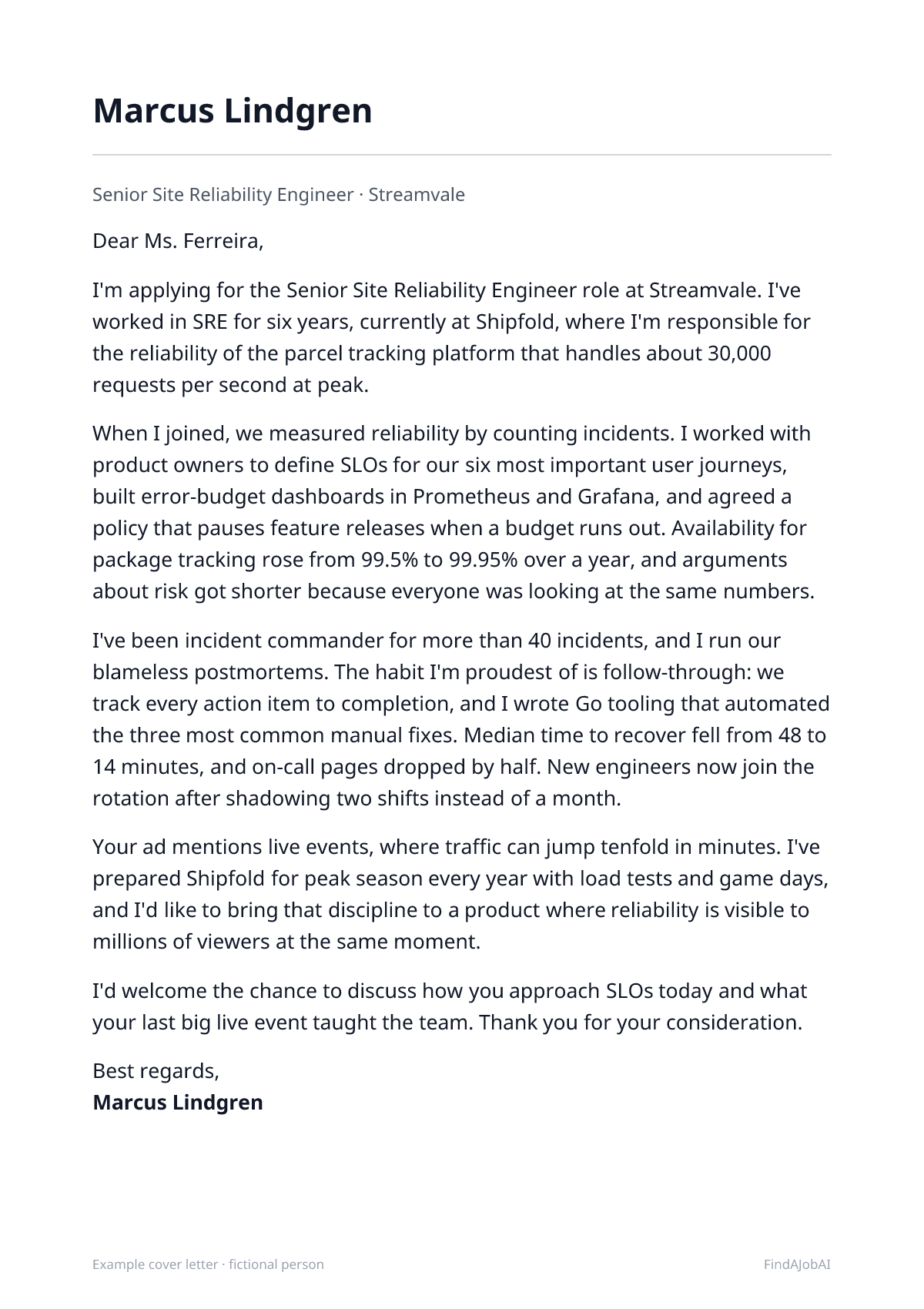
Dear Ms. Ferreira,
I'm applying for the Senior Site Reliability Engineer role at Streamvale. I've worked in SRE for six years, currently at Shipfold, where I'm responsible for the reliability of the parcel tracking platform that handles about 30,000 requests per second at peak.
When I joined, we measured reliability by counting incidents. I worked with product owners to define SLOs for our six most important user journeys, built error-budget dashboards in Prometheus and Grafana, and agreed a policy that pauses feature releases when a budget runs out. Availability for package tracking rose from 99.5% to 99.95% over a year, and arguments about risk got shorter because everyone was looking at the same numbers.
I've been incident commander for more than 40 incidents, and I run our blameless postmortems. The habit I'm proudest of is follow-through: we track every action item to completion, and I wrote Go tooling that automated the three most common manual fixes. Median time to recover fell from 48 to 14 minutes, and on-call pages dropped by half. New engineers now join the rotation after shadowing two shifts instead of a month.
Your ad mentions live events, where traffic can jump tenfold in minutes. I've prepared Shipfold for peak season every year with load tests and game days, and I'd like to bring that discipline to a product where reliability is visible to millions of viewers at the same moment.
I'd welcome the chance to discuss how you approach SLOs today and what your last big live event taught the team. Thank you for your consideration.
Best regards,
Marcus Lindgren
Example 2 · Career changer
Backend engineer moving into site reliability
Yuki led an alerting rebuild after an outage. The ad asks for strong coding, Linux and networking, and on-call experience.
Example letter · fictional
Dear Fernpath Hiring Team,
I'm applying for the Site Reliability Engineer role. For four years I've been a backend engineer in Python and Go at Corvista Media, and for the last year I've spent most of my time on our reliability work; I'd like to make that my full-time job.
After a bad outage last year, I volunteered to lead the follow-up. I added structured logging and tracing with OpenTelemetry to our five core services, rewrote our alerts around symptoms users actually feel (error rate and latency) instead of CPU, and cut the number of alerts from 120 to 35. The share of pages that needed no action fell from about 70% to 10%, and the team stopped muting the alert channel.
I've joined the on-call rotation, led three incident responses and written their postmortems. I also automated our database failover test, which used to be a half-day manual exercise and now runs every month in staging; it has already found a broken replica setting before it could matter. I haven't yet owned SLOs end to end with product teams, and that's the part of SRE I most want to learn from an experienced team.
Your ad asks for strong coding skills, Linux and networking, and experience on call. As a developer first, I'd bring empathy for the engineers whose services we'd support, and the ability to fix reliability problems in their code, not just around it.
Thank you for considering my application. I'd be glad to talk about the alerting rebuild and what it changed.
Kind regards,
Yuki Tanaka
Example 3 · Referral or internal move
SRE applying internally to the observability platform team
Lars has been on call for Gladwin's billing services for three years. The internal posting is for the platform team that owns tracing and alerting.
Example letter · fictional
Dear Ms. Szabo,
I'm applying for the Senior SRE role on the observability platform team. I've been an SRE at Gladwin for three years, on the billing services team, and my manager, Ola Berg, has agreed to release me if I'm selected. I'd like to explain why the move makes sense for both teams.
Observability has been my side of the job from the start. In March, a billing outage took 80 minutes to diagnose because three services logged request IDs differently. I wrote the proposal for shared trace context and built the first version into our service template. Mean time to diagnose on billing fell from 52 minutes to 14, and four other teams have since adopted the template.
Your roadmap lists moving alerting from thresholds to service-level objectives. I've done that for billing: I wrote eleven SLOs with product owners, replaced 140 noisy alerts with 19 that page only when the error budget burns quickly, and cut after-hours pages from 23 a month to 5. I've also spent two quarters as incident commander, so I know what a responder needs from the tools at 3 a.m.
As an internal candidate I know the pain of the teams you serve, because I've been one of them. What I haven't done is operate the observability stack itself at Gladwin's scale of about 2,000 services, so for the last month I've been taking shifts as a second responder on your team to learn it.
Which project would you want me to take first? I'd be glad to talk through your roadmap and make the case for one.
Thank you,
Lars Eriksen
All three letters, and the short version below, are fictional: the people, employers and numbers are invented. Borrow the structure, never the facts.
- Prefer to write it yourself? Use the free cover letter template.
- Check your CV against the job first: the free CV score shows the missing keywords.
Why the first letter works, paragraph by paragraph
Paragraph 1: Opening
Names the service and its peak load. SRE work is defined by scale, and 30,000 requests per second sets the context for everything that follows.
Paragraph 2: SLOs
Shows the SRE way of thinking: reliability defined with product owners, measured with error budgets and tied to a release policy, with an availability result and faster decisions.
Paragraph 3: Incidents and toil
Incident command, blameless postmortems and code that removes repeated fixes are the core of the job. Recovery time and pages make the impact concrete.
Paragraph 4: Why this company
Picks the hardest reliability problem in the ad, live-event spikes, and matches it with directly relevant preparation: load tests and game days.
Paragraph 5: Close
Asks about their current SLO practice, which shows the writer will understand before changing things.
What the career changer's letter does differently
The developer's letter frames the move around a real reliability project: observability, symptom-based alerts and a measurable drop in noise. It shows on-call experience and an automated failover test, and names an honest gap (owning SLOs with product teams) that the new job would fill.
What the referral letter does differently
The internal letter treats the writer's current team as evidence: an outage that exposed a platform gap, a template four teams adopted, alerts cut from 140 to 19. The writer is also already learning the target team's stack on shifts, which makes the move low-risk for the hiring manager.
Short site reliability engineer cover letter: an email-ready version
Many applications arrive as an email or a small text box, and a full page doesn't fit. This version runs 120 to 150 words and keeps only what a reader needs to decide whether to reply. A reply to an SRE manager who asked applicants to 'tell us about one incident you handled'. The note leads with that incident, in four sentences.
Short version · email · fictional129 words
Subject: Site Reliability Engineer – incident story and SLO work – Ines Carvalho
Hello Mr. Rahimi,
You asked for one incident, so here is mine. On a Saturday last October our checkout error rate climbed to 9% because a connection pool filled after a release. I rolled back in six minutes, then spent a week finding why our alerts hadn't paged us sooner.
The fix was an SLO on checkout success, with a burn-rate alert that now pages within five minutes of a real problem. I'm applying for the Site Reliability Engineer role with four years of on-call experience, the last two owning reliability for a ticket-sales platform.
Ticket releases are your hardest moment, and making those on-sale minutes uneventful is the work I'd like to do. Attached is my resume, and I can talk any day this week.
Best,
Ines Carvalho
When the ad asks for one incident, the short version answers exactly that: the symptom, the response time, the root cause and the change that followed. The role, years and a one-line reason for this company come after, in two sentences.
Opening lines that work for site reliability engineer cover letters
The first sentence decides whether the second gets read. Here are six openings, one for each situation you might be in. Pick the one that matches yours and swap in your own facts: every name and number below is invented.
1. You have a standout result
Defining service-level objectives with the product team took our checkout service from 99.5% to 99.95% availability in two quarters. I'd like to do that work for your streaming platform.
2. The ad names a problem you've solved
Alert fatigue and engineers who dread the pager are what your ad describes. I replaced 140 threshold alerts with 19 SLO-based ones last year, and after-hours pages fell by three quarters.
3. Someone referred you
Mina Park, your reliability lead, and I ran a joint incident review across our two companies after a shared provider outage. She said your team needs an engineer who writes tooling, so I'm applying.
4. You admire what they build
Your public postmortem on the certificate expiry is the most honest account I've read, and it describes a failure I once caused; I'd like to work somewhere that writes reviews like that.
5. You're new to the field or switching into it
Two years of carrying the pager as a backend developer, and a rewrite of our alerting after a bad outage, convinced me to make reliability my full-time work.
6. You have senior scope or a specialism
I've led reliability for a platform serving 30 million users for seven years, including a multi-region failover design that has run in production. I'm now looking for a principal-level role.
How to write a site reliability engineer cover letter
Five steps, in the order you'd write them. The shape stays the same for every job (a short opening, proof, a reason for this employer, a close), and what goes into each part is what changes with the role.
Open with the scale you keep reliable
State the title, your years on call and the size of what you keep running: requests per second, users, regions, the number of services you cover. Reliability is relative to load, so a hiring manager can't judge your results until they know the scale they came from.
Define the availability number or don't use it
If you quote an availability figure, say how it was measured: which user action, over what window. Better, describe the service-level objective you set and what the team did when the error budget ran low. A defined target persuades an SRE reader; a bare percentage invites questions.
Tell one incident the blameless way
Describe the symptom, how fast you responded, the root cause and what changed afterwards in systems or process. Keep the tone factual and credit the team. An incident story that names a person to blame, or ends with no change, reads poorly to SRE teams.
Show your on-call load and how you cut it
Say how many pages the rotation got and what you did to reduce them: fewer noisy alerts, runbooks, automation of a repeated fix. Reducing toil is central to SRE, and a number such as pages per week before and after speaks directly to the discipline.
Make the code visible and close on their hardest moment
SRE is software engineering for operations, so mention something you wrote: a tool, an operator, a deploy check. Then end with the company's hardest reliability moment, such as a launch or a peak season, and say how you'd like to prepare for it.
Keywords employers use for site reliability engineer roles
The skills named most often in the 440 newest site reliability engineer job ads we track (out of 1,047 live postings), with the share of ads that mention each:
- Incident management 74%
- Kubernetes 71%
- Observability 71%
- Python 64%
- CI/CD 61%
- AWS 60%
- Terraform 58%
- Infrastructure as Code 57%
Don't list them in your letter: pick the two or three the ad repeats and back each with one sentence of evidence. Full list: Site Reliability Engineer resume keywords.
From live job ads · updated November 2, 2026
Site Reliability Engineer cover letter do's and don'ts
Do
- Give reliability numbers: availability, error-budget burn, time to recover, alert volume or pages per week.
- Describe one incident you led and what changed afterwards, not just how you fixed it.
- Mention the code you write to remove toil, and the language you write it in.
Don't
- Don't present reliability as heroics; SRE managers want fewer incidents, not more all-night stories.
- Don't reduce SRE to operations; show you can change software, not just restart it.
- Don't promise perfect uptime; talk about error budgets and trade-offs instead.
Common site reliability engineer cover letter mistakes
Each one is easy to make and quick to fix before you send the letter.
Quoting uptime with no definition
'Four nines of uptime' means little until you say what was measured. Name the user-facing action, the window and who agreed the target. An SRE reader will ask anyway, and a defined number shows you think in objectives.
Listing monitoring tools instead of outcomes
Datadog, Prometheus and Grafana in a row describe a dashboard, not a result. Say what you detected sooner, which alerts you removed, or how much quicker incidents were diagnosed after your work.
Treating SRE as operations only
Teams hire SREs to write software that removes toil. Include something you built or changed in code, even a small deploy check or a capacity script, so the reader sees an engineer rather than an operator.
Telling an incident story that blames a person
Postmortems in SRE are blameless by default. Describe the conditions that allowed the failure and the safeguards you added, and keep names out of it. The way you tell the story shows how you'd run a review.
Leaving out the human cost of on-call
A letter that skips the pager suggests you haven't carried it. State how often you were paged, how you shared the load and how you improved it. Hiring managers are checking that you can sustain a rotation, not merely survive one.
Email subject lines for site reliability engineer applications
Applying by email? Put the job title, any reference number and your name in the subject line.
- Senior Site Reliability Engineer application – SLOs, incident command – Marcus Lindgren
- Site Reliability Engineer – backend engineer with on-call and observability work – Yuki Tanaka
- SRE application (Ref SRE-19) – 30k RPS platform experience – Marcus Lindgren
Everything for Site Reliability Engineers
- Site Reliability Engineer jobs1,047 open roles, updated hourly
- Site Reliability Engineer salary in the United StatesAdvertised pay in real job ads
- Site Reliability Engineer resume exampleA full resume, plus bullet and summary examples
- Site Reliability Engineer interview questions30 questions with sample answers
- Site Reliability Engineer resume keywordsThe skills job ads ask for most
- Site Reliability Engineer job descriptionDuties, skills and requirements
- Career change cover letter: template + examples
Other cover letter examples
Site Reliability Engineer cover letter FAQ
How is an SRE cover letter different from a DevOps one?
Both name tools, but an SRE letter centers on reliability outcomes: SLOs and error budgets, incident leadership, recovery time and toil removed through code. A DevOps letter usually leads with delivery: pipelines, infrastructure as code and developer self-service.
How do I become an SRE from software engineering?
Take on reliability work in your current job: observability, alert quality, on-call, postmortems, failover tests. Then lead your letter with one of those projects and its numbers. Coding ability is an advantage many SRE teams look for.
Should I mention on-call experience in a cover letter?
Yes. Say how long you've been on call, roughly how many incidents you handled or led, and one improvement you made to the rotation, such as fewer pages or better runbooks.
How we built this page
The FindAJobAI team wrote the three example letters, the short email version, the opening lines and the advice for site reliability engineer roles. The people, employers and numbers in the letters are invented; the structure, the kind of evidence and the order of the paragraphs are the parts to copy.
The live keyword section is based on 440 site reliability engineer job ads analysed, the newest we track, with the same deterministic skill matcher as our in-demand skills report: no AI model reads the postings. It was last computed on November 2, 2026 and refreshes daily.
Last reviewed on November 1, 2026.