SOC Analyst Cover Letter Example (2026)
By FindAJobAI Team Updated How we built this page
SOC analyst ads list the same tools and the same shift pattern, so most letters sound identical. What a SOC manager wants to see is how you think on a live queue: an alert you proved benign, an escalation the next tier could act on right away, or a noisy rule you fixed so the whole shift had more time.
SOC Analyst cover letter template
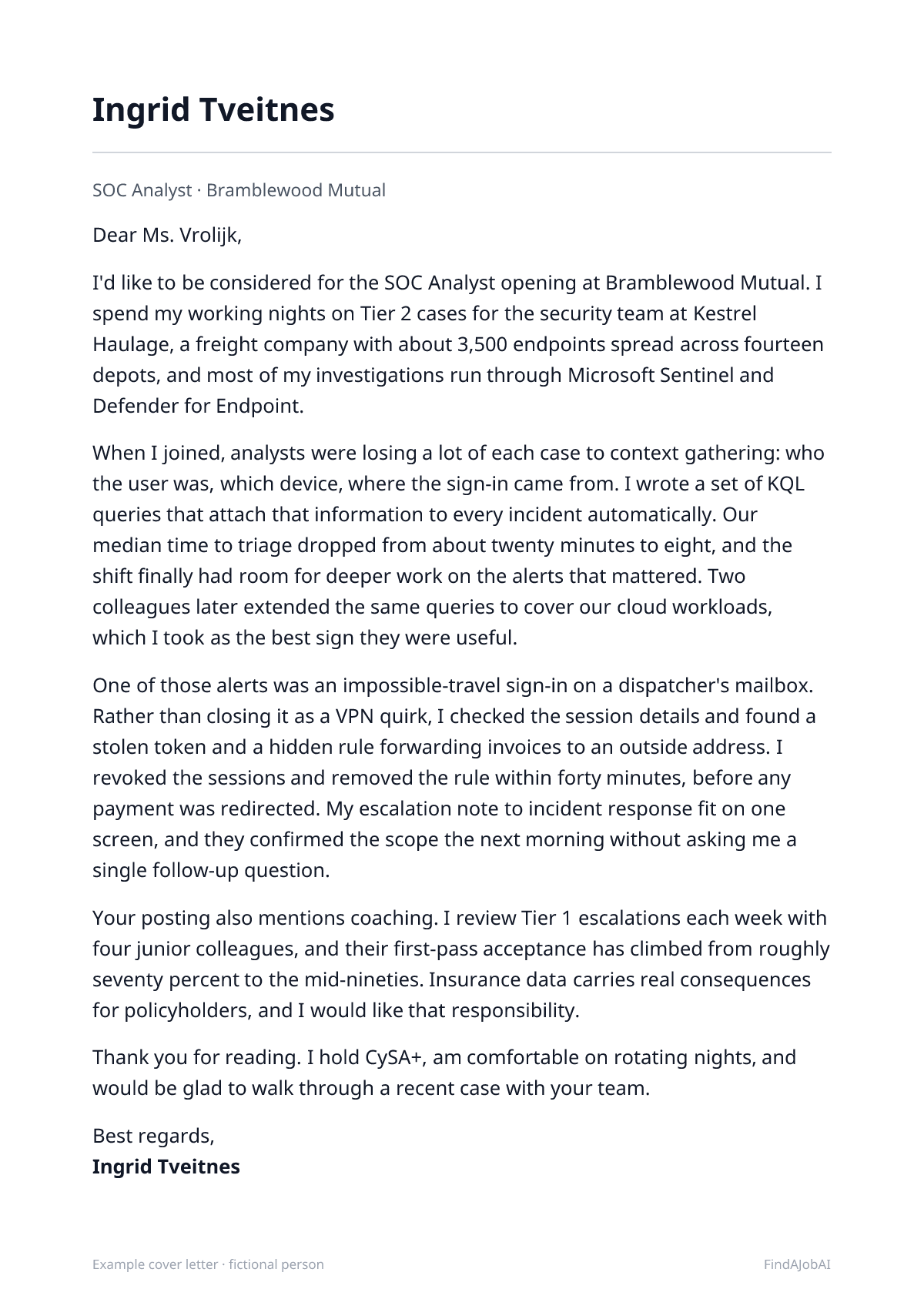
This letter as a one-page template: an opening that names the job and your strongest fact, proof that answers the ad, a reason for this employer and a short close.
After you sign up, FindAJobAI drafts your own letter for a real job from your CV in this format, and you edit it before you send it.
Example 1 · Experienced
Tier 2 SOC analyst applying to an insurer's in-house security operations center
Ingrid works Tier 2 cases at a logistics company's SOC. The ad asks for Sentinel, KQL and experience coaching Tier 1 analysts.
Example letter · fictional
Dear Ms. Vrolijk,
I'd like to be considered for the SOC Analyst opening at Bramblewood Mutual. I spend my working nights on Tier 2 cases for the security team at Kestrel Haulage, a freight company with about 3,500 endpoints spread across fourteen depots, and most of my investigations run through Microsoft Sentinel and Defender for Endpoint.
When I joined, analysts were losing a lot of each case to context gathering: who the user was, which device, where the sign-in came from. I wrote a set of KQL queries that attach that information to every incident automatically. Our median time to triage dropped from about twenty minutes to eight, and the shift finally had room for deeper work on the alerts that mattered. Two colleagues later extended the same queries to cover our cloud workloads, which I took as the best sign they were useful.
One of those alerts was an impossible-travel sign-in on a dispatcher's mailbox. Rather than closing it as a VPN quirk, I checked the session details and found a stolen token and a hidden rule forwarding invoices to an outside address. I revoked the sessions and removed the rule within forty minutes, before any payment was redirected. My escalation note to incident response fit on one screen, and they confirmed the scope the next morning without asking me a single follow-up question.
Your posting also mentions coaching. I review Tier 1 escalations each week with four junior colleagues, and their first-pass acceptance has climbed from roughly seventy percent to the mid-nineties. Insurance data carries real consequences for policyholders, and I would like that responsibility.
Thank you for reading. I hold CySA+, am comfortable on rotating nights, and would be glad to walk through a recent case with your team.
Best regards,
Ingrid Tveitnes
Example 2 · Career changer
Help desk technician moving into a Tier 1 SOC role
Rafael runs the service desk at a school district and handles its security tickets. The ad is for an entry-level SOC analyst at a managed security provider.
Example letter · fictional
Dear Cobaltgate Recruiting Team,
Please accept my application for the Tier 1 SOC Analyst position at Cobaltgate Security. For three years I have worked the service desk at Lindell Unified School District, which supports around 9,000 students and staff, and over time the security tickets have become the part of the job I care about most.
Last spring our staff were hit by a password-spray campaign. While resetting locked accounts I noticed the failed sign-ins came from a small cluster of foreign IP addresses, all hitting the same thirty accounts. I documented the pattern, sent it to our district security officer and suggested a conditional access block for those ranges. She applied it the same afternoon, and the lockouts stopped.
Since then I have prepared seriously for SOC work. I earned Security+ in January, completed Blue Team Level 1, and built a home lab with Wazuh and Sysmon where I write detection rules against simulated attacks. My write-ups for eight investigation challenges are public on GitHub, each with a timeline, the evidence I relied on and the indicators I would hand to a Tier 2 analyst.
Help desk taught me habits that carry straight into a queue: clear ticket notes, calm conversations with stressed users, and knowing when to hand something up instead of guessing. I have learned that a short, honest note saves the next person far more time than a long, uncertain one. Your ad mentions rotating twelve-hour shifts and many client environments, and I am ready for both.
Thank you for considering me. I would welcome a triage exercise or a conversation about how your analysts are trained in their first months.
Kind regards,
Rafael Quintero
Example 3 · Senior or lead
SOC shift lead applying to run a utility's overnight operations
Desmond leads a night shift at a hospital network's SOC. The ad is for a senior SOC analyst to lead nights and build SOAR playbooks.
Example letter · fictional
Dear Mr. Haugeland,
I'm writing about the Senior SOC Analyst role leading your overnight shift. For the past four years I have led nights for the security operations team at Harrowgate Health, a seven-hospital network, and I spent the three years before that on Tier 1 and Tier 2 queues at a managed provider.
When I took over nights, high-severity cases often sat for hours because every step was manual: enrich, ticket, notify, contain. I built fourteen playbooks in Splunk SOAR covering phishing, suspicious sign-ins and malware quarantine. Mean time to respond on high-severity cases fell from about four hours to under an hour, and my analysts now spend their time on judgment instead of copying data between tools.
The harder problem was continuity. Cases kept slipping between shifts because handoffs were spoken, not written. I introduced a short written template and reviewed every handoff myself for the first month. Dropped cases went from around nine a month to fewer than one, and day-shift colleagues began asking for the same format. I still read every handoff my analysts write, because it is the fastest way I know to spot who needs coaching.
Your posting mentions operational technology. I have monitored a segmented clinical device network, but I have not worked with water treatment control systems, and I would want time with your OT engineers early on to learn what normal looks like before tuning any alerts there.
I'd welcome a conversation about where your overnight coverage feels thinnest today and what you would want a new night lead to fix in the first ninety days.
Sincerely,
Desmond Achebe-Wright
All three letters, and the short version below, are fictional: the people, employers and numbers are invented. Borrow the structure, never the facts.
- Prefer to write it yourself? Use the free cover letter template.
- Check your CV against the job first: the free CV score shows the missing keywords.
Why the first letter works, paragraph by paragraph
Paragraph 1: Opening
States the tier, the environment size and the exact tools the ad names, so the reader knows within two sentences that the writer works the same stack.
Paragraph 2: A fix that helped the whole shift
Shows initiative beyond personal queue numbers: enrichment queries that cut triage time for everyone, with a before and after figure.
Paragraph 3: A real finding
The impossible-travel case shows judgment, refusing an easy closure, plus clear actions and a timing, which is what SOC managers probe in interviews.
Paragraph 4: Answering the coaching requirement
Answers the coaching requirement with a measurable change in junior analysts' escalation quality and adds a short, sector-specific reason for applying.
Paragraph 5: Close
Names the certification in one phrase and offers to discuss a case, which invites a practical conversation rather than a generic interview.
What the career changer's letter does differently
The help desk letter builds its case on a real security catch made from a non-security seat, then backs it with Security+, BTL1 and public lab write-ups. It translates help desk habits into SOC terms and addresses the shift pattern directly, which entry-level hiring managers often worry about.
What the senior letter does differently
A shift lead's letter is judged on what changed for the team: response time after SOAR playbooks, dropped cases after a handoff template. It also names a real gap, water-sector OT, and a sensible plan for it, which reads as honest experience rather than a weakness.
Short SOC analyst cover letter: an email-ready version
Many applications arrive as an email or a small text box, and a full page doesn't fit. This version runs 120 to 150 words and keeps only what a reader needs to decide whether to reply. A SOC analyst replies to a recruiter's message about a Tier 2 opening at a payments company, sending a short email with a resume attached.
Short version · email · fictional133 words
Subject: Tier 2 SOC Analyst – Splunk and CrowdStrike, MSSP background – Leilani Castellano
Hi Ms. Okafor,
Thank you for reaching out about the Tier 2 SOC Analyst role at Tidepool Payments. I have spent two and a half years at a managed security provider, triaging alerts for more than twenty clients in Splunk and CrowdStrike.
The case I am proudest of started as a quiet PowerShell alert on a client's server. I decoded the command, traced it to a scheduled task on three more hosts, and escalated with full process trees. The client contained it before any data left the network, and it now uses my write-up in its own analyst training.
Payments fraud and account takeover are areas I want to go deeper in. My resume is attached, and I am free for a call any weekday afternoon this week or next.
Thanks,
Leilani Castellano
A reply to a recruiter can be brief: one line on background, one specific case with a clear outcome, and an easy next step. The tools appear once, inside the context of real work.
Opening lines that work for SOC analyst cover letters
The first sentence decides whether the second gets read. Here are six openings, one for each situation you might be in. Pick the one that matches yours and swap in your own facts: every name and number below is invented.
1. You have a standout result
Last month I traced a routine impossible-travel alert to a stolen session token and removed a hidden invoice-forwarding rule before any payment moved. That is the kind of alert I want to keep catching on your team.
2. The ad names a problem you've solved
Your ad asks for someone who can cut alert noise without losing coverage. I rewrote twenty-seven noisy rules last year and lowered our weekly volume by about forty percent.
3. Someone referred you
Mira Castellanos, who leads your incident response team, worked alongside me at a managed provider and suggested I apply for this Tier 2 role.
4. You admire what they build
I have worked twelve-hour night rotations for three years, and the habit I value most from them is a written handoff that leaves the next shift nothing to guess.
5. You're new to the field or switching into it
I started on a school district help desk, where spotting a password-spray campaign in lockout tickets convinced me to move into security operations full time.
6. You have senior scope or a specialism
As a night-shift lead, I built SOAR playbooks that cut our high-severity response time from four hours to under one, and I'd like to bring that work to your SOC.
How to write a SOC analyst cover letter
Five steps, in the order you'd write them. The shape stays the same for every job (a short opening, proof, a reason for this employer, a close), and what goes into each part is what changes with the role.
Match the tier and the shift pattern first
Read whether the ad is Tier 1, Tier 2 or a lead role, and whether it runs 24/7. Open with your own tier and shift experience so the reader can place you immediately, then mention the SIEM and EDR named in the posting.
Tell one investigation from alert to verdict
Pick a case where your judgment mattered: an alert you proved benign with evidence, or one you followed to a real compromise. Give the trigger, what you checked, what you did and how many minutes or hours it took from first alert to closure.
Show you make the queue better for others
SOC managers hire people who reduce noise and improve handoffs. Mention a tuned rule, an enrichment query, a checklist or a template, with a before and after figure such as alert volume, triage time or the reopen rate.
Answer the ad's specific requirement in a real example
If the posting asks for KQL, coaching or phishing analysis, put that skill inside a short story rather than a list. A query you wrote or an analyst you coached is far more convincing than a tool name repeated from the job ad.
Offer a case walk-through or triage exercise
Offer to walk through a recent case or complete a triage exercise. It signals confidence and gives the reader an easy reason to invite you, instead of a generic request for an interview at their convenience.
SOC Analyst cover letter do's and don'ts
Do
- Describe one alert you investigated, the evidence you checked and how long it took.
- Name the SIEM, EDR and query language from the ad inside a real example, not in a list.
- Say plainly that you can work the shift pattern the posting describes.
Don't
- Don't open with "I have always been fascinated by hackers"; open with a case you worked.
- Don't paste internal hostnames, IP ranges or client names from a current employer.
- Don't list every certification you are studying for; mention the one that matters for this tier.
Common SOC analyst cover letter mistakes
Each one is easy to make and quick to fix before you send the letter.
Turning the letter into a tool inventory
Sentinel, Splunk, CrowdStrike, KQL and SOAR in one sentence tells the reader nothing new. Choose the two the ad stresses and show each one inside a case you actually worked.
Quoting alert counts with no outcome
"I review 150 alerts per shift" describes volume, not skill. Follow it with one alert that turned out to matter and what you did about it.
Ignoring the shift requirement
If the ad mentions nights or rotations and your letter does not, the manager has to wonder. One honest sentence about your availability settles it.
Sharing sensitive details from a current employer
Hostnames, client names and open vulnerabilities do not belong in a letter. Describe the type of attack and your response in general terms instead.
Sounding unsure about escalation
Phrases like "I would try to figure it out" worry SOC leads. Show a clear rule you follow for when to contain, when to escalate and what evidence goes with it.
Email subject lines for SOC analyst applications
Applying by email? Put the job title, any reference number and your name in the subject line.
- SOC Analyst application – Tier 2, Sentinel and KQL – Ingrid Tveitnes
- Tier 1 SOC Analyst – help desk lead with Security+ and BTL1 – Rafael Quintero
- Application: SOC Analyst, Night Shift (Req. 5528) – Ingrid Tveitnes
Everything for SOC Analysts
- SOC Analyst resume exampleA full resume, plus bullet and summary examples
- SOC Analyst interview questions30 questions with sample answers
- SOC Analyst job descriptionDuties, skills and requirements
- Career change cover letter: template + examples
Other cover letter examples
SOC Analyst cover letter FAQ
What should a SOC analyst cover letter focus on?
One investigation that shows your judgment: the alert, the evidence you checked, your verdict and how fast you acted. Add one line on shift availability and the tools from the ad. Leave long tool lists to your resume.
How do I write a SOC analyst cover letter with no security job yet?
Use security work from help desk, network or IT roles, such as spotting a password spray or cleaning up malware, and back it with a certification and a home lab or Blue Team write-ups you can link to.
Should I mention shift work in a SOC cover letter?
Yes, if the role runs 24/7. A short sentence confirming you can work nights, weekends or rotating twelve-hour shifts removes a common doubt for SOC managers.
How we built this page
The FindAJobAI team wrote the three example letters, the short email version, the opening lines and the advice for SOC analyst roles. The people, employers and numbers in the letters are invented; the structure, the kind of evidence and the order of the paragraphs are the parts to copy.
Once we track enough live SOC analyst job ads, this page also shows the skills they ask for most, counted the same way as our in-demand skills report.
Last reviewed on November 1, 2026.