Underwriter Cover Letter Example (2026)
By FindAJobAI team Updated How we built this page
Underwriting ads list the same guidelines and systems everywhere, so a cover letter has to show judgment: a file you approved, declined or sent back, and why that call protected the business without losing a good customer.
Underwriter cover letter template
This letter as a one-page template: an opening that names the job and your strongest fact, proof that answers the ad, a reason for this employer and a short close.
After you sign up, FindAJobAI drafts your own letter for a real job from your CV in this format, and you edit it before you send it.
Example 1 · Experienced
Mortgage underwriter applying to a regional credit union
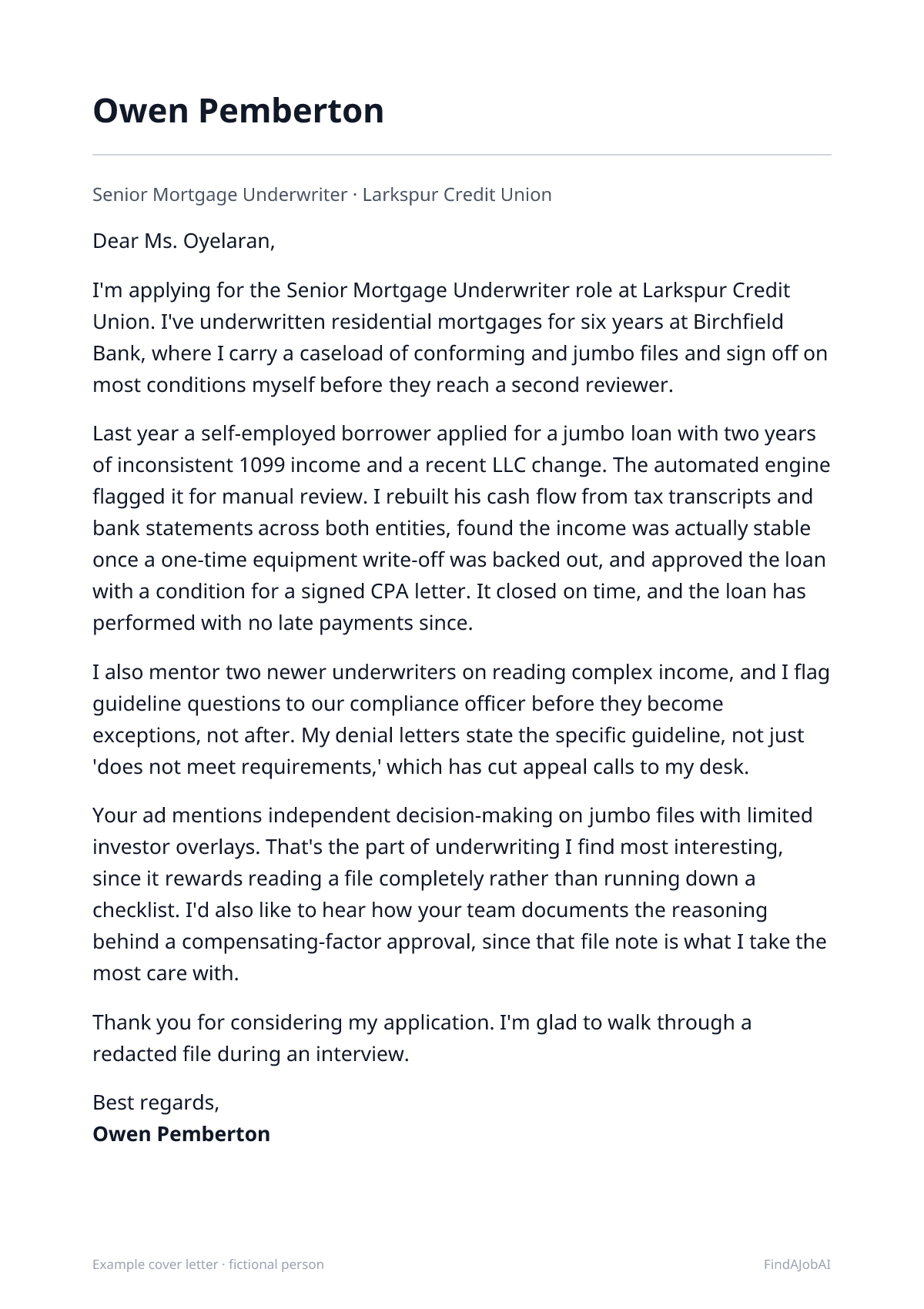
Owen clears his own conditions on most files at a bank. The ad asks for independent decisions on jumbo loans.
Example letter · fictional
Dear Ms. Oyelaran,
I'm applying for the Senior Mortgage Underwriter role at Larkspur Credit Union. I've underwritten residential mortgages for six years at Birchfield Bank, where I carry a caseload of conforming and jumbo files and sign off on most conditions myself before they reach a second reviewer.
Last year a self-employed borrower applied for a jumbo loan with two years of inconsistent 1099 income and a recent LLC change. The automated engine flagged it for manual review. I rebuilt his cash flow from tax transcripts and bank statements across both entities, found the income was actually stable once a one-time equipment write-off was backed out, and approved the loan with a condition for a signed CPA letter. It closed on time, and the loan has performed with no late payments since.
I also mentor two newer underwriters on reading complex income, and I flag guideline questions to our compliance officer before they become exceptions, not after. My denial letters state the specific guideline, not just 'does not meet requirements,' which has cut appeal calls to my desk.
Your ad mentions independent decision-making on jumbo files with limited investor overlays. That's the part of underwriting I find most interesting, since it rewards reading a file completely rather than running down a checklist. I'd also like to hear how your team documents the reasoning behind a compensating-factor approval, since that file note is what I take the most care with.
Thank you for considering my application. I'm glad to walk through a redacted file during an interview.
Best regards,
Owen Pemberton
Example 2 · Career changer
Claims adjuster moving into underwriting
Celeste evaluates risk on claims daily and wants to move upstream. The ad wants an entry-level commercial underwriter.
Example letter · fictional
Dear Hiring Manager,
I'm applying for the Associate Commercial Underwriter role at Thistlewood Insurance Group. For four years I've worked as a property claims adjuster, and reviewing why policies paid out or didn't made me want to work on the decisions that come before a claim exists.
Two years ago I noticed a pattern: a cluster of small restaurant clients kept filing water-damage claims from the same type of aging plumbing. I wrote up the pattern with claim frequency and average payout by building age, and our underwriting team used it to add an inspection requirement for restaurants over fifteen years old. The underwriter I worked with told me the change reduced that specific claim type on new policies within a year.
Since then I've completed an AINS designation and shadowed two underwriters on commercial property submissions, learning how they weigh loss history, construction type and occupancy against rate. I read a submission now and can usually guess where an underwriter will push back before they do.
Your posting asks for someone comfortable evaluating property and casualty risk from limited information. Claims work trained me to read between the lines of an application, and to ask the one question that changes a risk assessment. Today I keep a one-line note on every claim file about what I could not verify, and I would carry that habit into submission review so the senior underwriter sees my open questions first.
Thank you for your time. I'd welcome the chance to discuss how my claims background would carry into underwriting.
Kind regards,
Celeste Dhillon
Example 3 · Senior or lead
Chief underwriter applying to build a new commercial lines team
Casey leads underwriting standards for a regional insurer. The ad is for a chief underwriter to build authority levels and guidelines from scratch.
Example letter · fictional
Dear Ms. Carrington,
I'm applying for the Chief Underwriter role at Hollyvane Mutual. For the past five years I've set underwriting standards for commercial property and casualty at Garrow Insurance, managing a team of nine underwriters, and before that I spent seven years underwriting mid-market accounts myself.
Your ad says new underwriters currently learn authority limits from whoever trained them, with no written reference. Garrow had the same gap when I joined. I wrote an authority matrix by line and tenure, built a referral path for anything outside it, and paired every underwriter with a reviewer for their first six months. Time to bind a standard account fell from five days to two, and referrals that used to go to me personally now resolve with the right senior underwriter without my involvement.
Underwriting discipline shows up in loss ratio, not policy count. When our loss ratio on a construction segment crept up, I pulled two years of claims against the risk factors we'd been pricing on and found that a specific subcontractor class was underpriced relative to its claims history. We repriced that class and tightened eligibility, and the segment's loss ratio improved within three quarters without losing our best accounts in it.
I've built authority structures and mentored underwriters, but I haven't started a book of business from zero or hired an entire founding team, and at Hollyvane I'd want to work closely with your actuarial and claims leads to get the early pricing right.
A conversation about which segments you most want to grow first, and what's slowing new underwriters down today, would be a good place to start.
Sincerely,
Casey Blackwell
All three letters, and the short version below, are fictional: the people, employers and numbers are invented. Borrow the structure, never the facts.
- Prefer to write it yourself? Use the free cover letter template.
- Check your CV against the job first: the free CV score shows the missing keywords.
Why the first letter works, paragraph by paragraph
Paragraph 1: Opening
States the loan types and volume Owen already handles independently, which matches the ad's call for independent decisions on jumbo files.
Paragraph 2: The file that tested judgment
A specific borrower problem, the documents pulled to resolve it, the condition set and the outcome (on-time closing, no late payments), which shows sound risk judgment rather than rule-following.
Paragraph 3: How he works with others
Mentoring and clear denial letters are concrete signs of the communication and consistency a credit union's compliance team would value.
Paragraph 4: Why this company
Connects directly to language in the ad (independent decisions, limited overlays) and says why that appeals to him specifically.
Paragraph 5: Close
Offers a redacted file walkthrough, a low-cost next step that respects his current employer's privacy.
What the career changer's letter does differently
Celeste's letter starts from a pattern she noticed in claims data, not a job title, and names a measurable underwriting change that followed (an inspection requirement that reduced a specific claim type). The AINS designation and shadowing show she's already building the formal side of the skill, and the letter ties claims judgment directly to reading a submission.
What the senior letter does differently
A chief underwriter letter reports organizational habits, not individual files: an authority matrix, a referral path, time to bind cut from five days to two. The loss-ratio example shows pricing judgment at a portfolio level, and the gap, building a team from zero, is named directly.
Short underwriter cover letter: an email-ready version
Many applications arrive as an email or a small text box, and a full page doesn't fit. This version runs 120 to 150 words and keeps only what a reader needs to decide whether to reply. An underwriter answers a specialty insurer's short online application field after a recruiter mentioned the role closes applications early.
Short version · email · fictional122 words
Subject: Commercial Property Underwriter – mid-market, construction class – Farrukh Oyelaran
Hello Mr. Castellano,
I'm applying for the Commercial Property Underwriter role at Brindlewick Specialty. I have five years underwriting mid-market commercial property at a regional carrier, with a focus on construction and manufacturing risk.
My strongest recent decision involved a warehouse account with a prior fire claim that another underwriter had declined outright. I reviewed the updated sprinkler system and inspection report, priced it with a higher deductible and a sprinkler warranty endorsement, and the account has run three years with no claims.
Your book's construction concentration is close to what I underwrite now, and I'd like to bring that judgment to a specialty carrier. My resume is attached, and I can discuss specific accounts, generally, in an interview.
Best,
Farrukh Oyelaran
A short application field keeps one account that shows judgment under uncertainty (a declined risk re-evaluated and priced correctly), rather than a list of lines handled. Naming the book's overlap with the employer's focus does the targeting work in one sentence.
Opening lines that work for underwriter cover letters
The first sentence decides whether the second gets read. Here are six openings, one for each situation you might be in. Pick the one that matches yours and swap in your own facts: every name and number below is invented.
1. You have a standout result
A declined warehouse account I re-underwrote with a sprinkler warranty endorsement has run three years without a claim. I'd like to bring that kind of judgment to your commercial property book.
2. The ad names a problem you've solved
Your ad mentions referrals that bottleneck at a single senior underwriter. At my current company I built an authority matrix that let most referrals resolve without reaching me, and I'd like to solve that same problem here.
3. Someone referred you
Your claims director, Natasha Ferreira, and I have worked opposite sides of several large property files for two years. She mentioned you're building out a underwriting team, which prompted this application.
4. You admire what they build
I've renewed my own homeowner's policy with your company for six years, and the clarity of your renewal letters made me curious about the underwriting behind them.
5. You're new to the field or switching into it
I adjusted property claims for four years and kept seeing the same plumbing-related losses in older buildings. I'd like to work upstream, setting the guidelines that could catch that risk before a policy is written.
6. You have senior scope or a specialism
As the underwriter who set our current authority limits and referral path, I'm looking for a role where I can build that structure for a new team from its earliest stage.
How to write an underwriter cover letter
Five steps, in the order you'd write them. The shape stays the same for every job (a short opening, proof, a reason for this employer, a close), and what goes into each part is what changes with the role.
Identify the line and risk the ad is underwriting
Underwriting differs sharply by line: mortgage, commercial property, auto, life. Read the ad for the specific portfolio and authority level. Then choose a file or account from your own work that required similar judgment, at a similar authority level.
Open with the decision, not the process
Say what risk you evaluated and what you decided, in one or two sentences, before describing how you got there. A reader who sees a real underwriting call in your first paragraph will keep reading to see your reasoning.
Show the information you pulled to resolve uncertainty
Most underwriting stories worth telling involve a file that didn't fit a clean rule. Name the extra document, inspection or data you pulled, and how it changed the outcome. This shows judgment beyond following a checklist.
Tie the decision to a result that held up over time
A loan that closed and performed, a policy that ran without a claim, or a loss ratio that improved are the results underwriting managers care about. State the result and roughly how long it held, without inventing exact figures you can't support.
Show how you handle a decline or condition
One sentence on how you communicate a no or a condition, to a borrower, broker or agent, matters because it affects appeals and relationships. Close with a question about the employer's portfolio or guidelines you'd like to understand first.
Underwriter cover letter do's and don'ts
Do
- Describe one file where you had to weigh conflicting information, and the condition or decision you reached.
- Name the guideline or system the ad mentions (Fannie Mae, AU findings, a specific LOS) inside a real example.
- Show how you communicate a decline or condition, since clear reasoning reduces appeals and rework.
Don't
- Don't write "strong attention to detail"; show it with one file you caught something on.
- Don't count files processed; one file where your judgment mattered beats a high volume number.
- Don't share a real borrower's or client's identifying details; keep examples general or anonymized.
Common underwriter cover letter mistakes
Each one is easy to make and quick to fix before you send the letter.
Describing systems instead of decisions
Naming every automated underwriting system or policy system you've used says nothing about judgment. Describe one file where the system flagged something and explain what you decided and why.
Treating volume as a qualification
A high file count doesn't show skill by itself. Choose the one file that was hardest to decide and explain the reasoning, since that's what a hiring manager is actually screening for.
Leaving out how the decision held up
A decision with no outcome attached is unfinished. Say whether the loan performed, the policy ran claim-free, or the account's loss ratio changed, even in general terms, so the reader can judge the result.
Writing only about risk aversion
Underwriting isn't only about saying no. Include an example where you found a way to approve or price a risk that looked bad on the surface, which shows judgment rather than caution alone.
Omitting how declines are communicated
A decline letter with vague reasoning creates appeals and ill will. Mention how you state specific reasons for a condition or decline, since that communication is part of the job.
Email subject lines for underwriter applications
Applying by email? Put the job title, any reference number and your name in the subject line.
- Senior Mortgage Underwriter application – jumbo and conforming – Owen Pemberton
- Associate Commercial Underwriter – claims background, AINS designation – Celeste Dhillon
- Application: Underwriter, Commercial Lines (Req. 2240) – Owen Pemberton
Everything for Underwriters
- Underwriter resume exampleA full resume, plus bullet and summary examples
- Underwriter interview questions30 questions with sample answers
- Underwriter job descriptionDuties, skills and requirements
- Career change cover letter: template + examples
Other cover letter examples
Underwriter cover letter FAQ
What should I write in an underwriter cover letter?
One file where you had to weigh incomplete or conflicting information, what you pulled to resolve it, and the decision you reached. Then a sentence on how you communicate that decision to borrowers, brokers or agents. Your systems and designations belong on the resume.
How do I write an underwriter cover letter with no direct experience?
Use risk-adjacent work such as claims, loan processing or credit analysis, name a pattern or problem you spotted there, and add any designation coursework in progress. Say what you've learned shadowing or reviewing actual underwriting decisions.
Should I mention specific guidelines or investor overlays in the letter?
Only inside an example, such as a condition you set that satisfied a specific guideline. Listing agency names alone doesn't show judgment; the file and the reasoning do.
How we built this page
The FindAJobAI team wrote the three example letters, the short email version, the opening lines and the advice for underwriter roles. The people, employers and numbers in the letters are invented; the structure, the kind of evidence and the order of the paragraphs are the parts to copy.
Once we track enough live underwriter job ads, this page also shows the skills they ask for most, counted the same way as our in-demand skills report.
Last reviewed on November 1, 2026.