AI Engineer Resume Example (2026)
By FindAJobAI team Updated How we built this page
AI engineer ads blend software engineering with applied machine learning: Python, an ML framework, a cloud platform, and lately some mix of LLMs, embeddings and retrieval. What separates candidates is proof the system ran in production and did something measurable, not a list of frameworks. An AI engineer resume should name the model, the pipeline and the outcome for users or the business.
The example below is an AI engineer with five years split between a logistics startup and a customer support software company. Notice how each bullet names the model or technique, the data it worked on and what changed once it shipped, instead of just naming the stack.
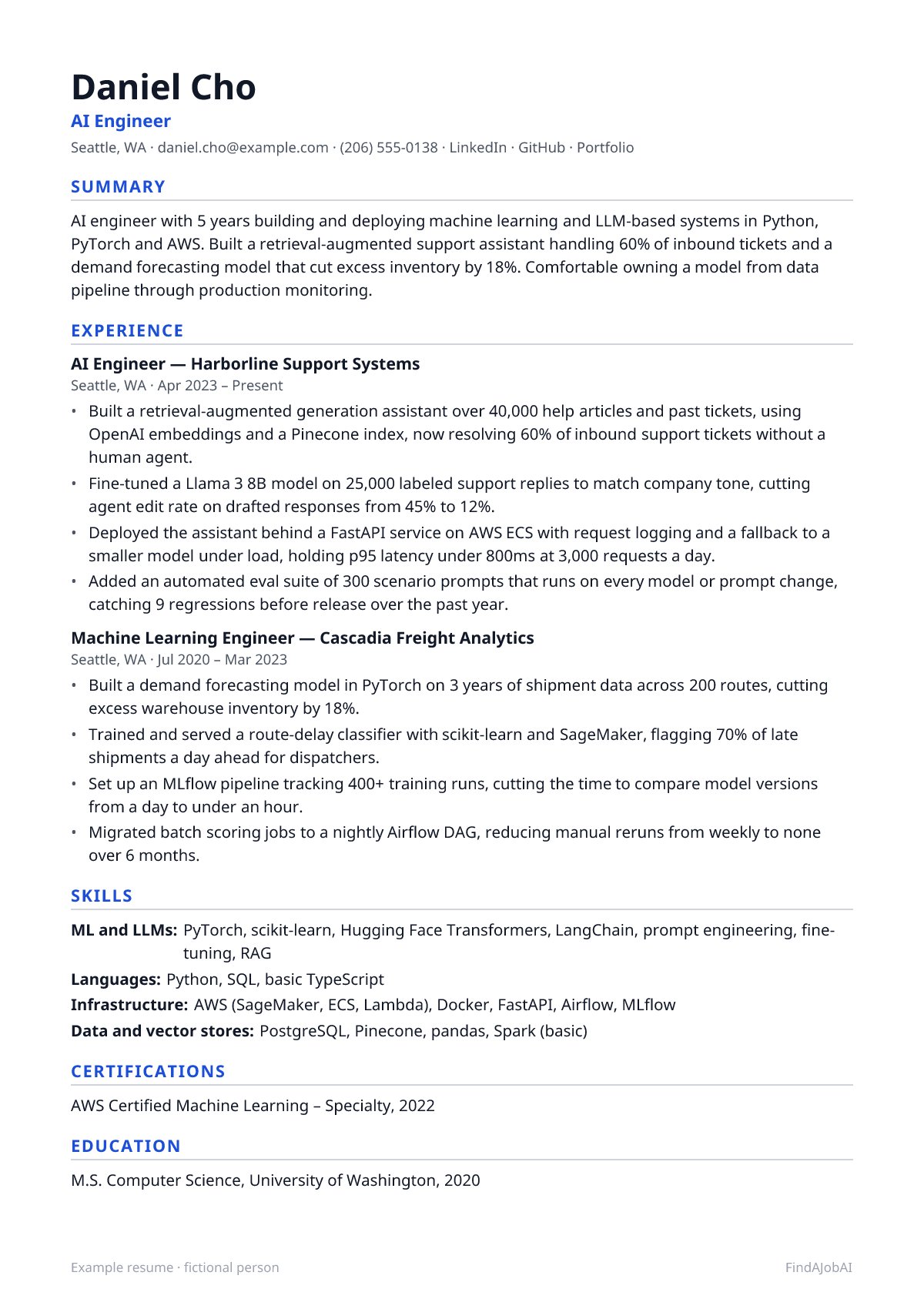
AI Engineer resume template
This example as a one-page template: one column, standard headings and plain text, the format applicant tracking systems read most reliably.
After you sign up, Create my CV builds your own resume in this same one-column layout, from your real experience.
Mid-level AI engineer resume example
A complete one-page example for a fictional AI engineer: every bullet pairs an action with what changed because of it.
Example resume · fictional person
Daniel Cho
AI Engineer
Seattle, WA · [email protected] · (206) 555-0138 · LinkedIn · GitHub · Portfolio
Summary
AI engineer with 5 years building and deploying machine learning and LLM-based systems in Python, PyTorch and AWS. Built a retrieval-augmented support assistant handling 60% of inbound tickets and a demand forecasting model that cut excess inventory by 18%. Comfortable owning a model from data pipeline through production monitoring.
Experience
AI Engineer, Harborline Support Systems
Seattle, WA · Apr 2023 – Present
- Built a retrieval-augmented generation assistant over 40,000 help articles and past tickets, using OpenAI embeddings and a Pinecone index, now resolving 60% of inbound support tickets without a human agent.
- Fine-tuned a Llama 3 8B model on 25,000 labeled support replies to match company tone, cutting agent edit rate on drafted responses from 45% to 12%.
- Deployed the assistant behind a FastAPI service on AWS ECS with request logging and a fallback to a smaller model under load, holding p95 latency under 800ms at 3,000 requests a day.
- Added an automated eval suite of 300 scenario prompts that runs on every model or prompt change, catching 9 regressions before release over the past year.
Machine Learning Engineer, Cascadia Freight Analytics
Seattle, WA · Jul 2020 – Mar 2023
- Built a demand forecasting model in PyTorch on 3 years of shipment data across 200 routes, cutting excess warehouse inventory by 18%.
- Trained and served a route-delay classifier with scikit-learn and SageMaker, flagging 70% of late shipments a day ahead for dispatchers.
- Set up an MLflow pipeline tracking 400+ training runs, cutting the time to compare model versions from a day to under an hour.
- Migrated batch scoring jobs to a nightly Airflow DAG, reducing manual reruns from weekly to none over 6 months.
Skills
- ML and LLMs: PyTorch, scikit-learn, Hugging Face Transformers, LangChain, prompt engineering, fine-tuning, RAG
- Languages: Python, SQL, basic TypeScript
- Infrastructure: AWS (SageMaker, ECS, Lambda), Docker, FastAPI, Airflow, MLflow
- Data and vector stores: PostgreSQL, Pinecone, pandas, Spark (basic)
Certifications
- AWS Certified Machine Learning – Specialty, 2022
Education
- M.S. Computer Science, University of Washington, 2020
Fictional example by the FindAJobAI team: the person, employers and numbers are invented. Keep the structure; use your own work and numbers you can explain in an interview.
Entry-level AI engineer resume example
A new CS graduate with one ML internship and a capstone project. Education sits right under the summary, and the capstone RAG project stands in for production experience, stated with an eval number rather than a feature list.
Entry-level example resume · fictional person
Summary
Entry-level AI engineer with a B.S. in Computer Science and a summer internship fine-tuning a text classifier at a logistics startup. Built a RAG chatbot over university course materials as a capstone, reaching 90% retrieval precision on a 100-question test set. Comfortable in Python, PyTorch and Hugging Face, looking for a first full-time AI or ML engineering role.
Education
- B.S. Computer Science, Carnegie Mellon University, 2025
Experience
Machine Learning Intern, Steeltown Logistics
Pittsburgh, PA · May 2025 – Aug 2025
- Fine-tuned a DistilBERT model on 8,000 labeled shipment notes to classify delay reasons, reaching 86% accuracy versus a 61% keyword baseline.
- Built a Streamlit demo so 5 operations staff could test the classifier on new notes before the team committed to a rollout.
- Wrote a data cleaning script removing 1,400 duplicate and malformed records from the training set, which raised validation accuracy by 6 points.
Teaching Assistant, Intro to Machine Learning, Carnegie Mellon University
Pittsburgh, PA · Jan 2025 – May 2025
- Graded and gave feedback on model code for 45 students across 3 assignments covering regression, classification and neural networks.
- Held weekly office hours that cut repeated questions about gradient descent debugging, based on student feedback surveys.
Skills
- ML and LLMs: PyTorch, Hugging Face Transformers, LangChain, FAISS, prompt engineering
- Languages: Python, SQL, Java (coursework)
- Tools: Git, Docker (basic), Jupyter, pandas, scikit-learn
Projects
- Course Q&A assistant (Python, LangChain, FAISS): built a RAG chatbot over 400 pages of lecture notes and syllabi, reaching 90% retrieval precision on a 100-question test set.
- Recipe recommender (PyTorch): trained a collaborative filtering model on 50,000 public recipe ratings, improving top-5 recommendation accuracy over a popularity baseline by 22%.
Senior AI engineer resume example
A senior engineer nine years in, now leading an ML platform team. The bullets move from building individual models to setting serving standards and owning budget-sized decisions, and the summary names the team size and the dollar figure the systems support.
Senior example resume · fictional person
Aaron Takahashi
Senior AI Engineer
Austin, TX · [email protected] · (512) 555-0191 · LinkedIn · GitHub
Summary
Senior AI engineer with 9 years building ML and LLM systems in fintech and e-commerce, leading a team of 4 engineers. Owns the model serving platform behind $40M in automated underwriting decisions and the RAG-based document review tool that cut manual review time by 65%. Sets evaluation and deployment standards adopted across 3 product teams.
Experience
Senior AI Engineer, Lonestar Credit Partners
Austin, TX · Feb 2021 – Present
- Lead a team of 4 engineers building and serving the models behind $40M a year in automated small-business loan decisions.
- Designed the model serving platform on Kubernetes and SageMaker, standardizing deployment across 12 models and cutting new-model launch time from 3 weeks to 4 days.
- Built a RAG-based document review tool over loan applications and supporting documents, cutting average manual review time per application by 65%.
- Set up a shared evaluation framework with golden datasets per model, adopted by 3 product teams, catching 14 regressions before release over the past year.
- Led the move from a single large fine-tuned model to a routed set of smaller task-specific models, cutting average inference cost by 35% with no drop in approval accuracy.
Machine Learning Engineer, Brightcart Commerce
Austin, TX · Jun 2017 – Jan 2021
- Built the product recommendation model serving 2M daily active users, raising click-through rate on recommended items by 11%.
- Owned the feature store feeding 6 production models, cutting feature computation duplication across teams by half.
- Trained and deployed a fraud detection model with scikit-learn and SageMaker, reducing confirmed fraud losses by $900K a year.
Data Scientist, Ferncroft Analytics
Dallas, TX · Aug 2015 – May 2017
- Built churn and LTV models in Python for 8 mid-market retail clients, directly informing their marketing budgets.
- Presented model findings and recommended actions to client executive teams on a monthly basis.
Skills
- ML and LLMs: PyTorch, Hugging Face, LangChain, fine-tuning, RAG, model routing
- Infrastructure: Kubernetes, AWS SageMaker, Docker, FastAPI, MLflow, feature stores
- Leadership: Hiring and mentoring engineers, evaluation standards, cross-team platform design
Education
- M.S. Computer Science, University of Texas at Austin, 2015
How to write an AI engineer resume
Five steps, in the order a recruiter reads the page. The format around them stays plain for every job: one column, standard headings, newest role first.
Header: name, target title and links
Use the title “AI Engineer” even if your title was Machine Learning Engineer or Applied Scientist if the work matches, and add a GitHub link as a plain URL so a hiring manager can see real code. Resume screens for this role look for production systems, not just research.
Summary: what you do and your best proof
Name your core stack (framework, LLM tooling, cloud platform), the kind of systems you build (RAG, forecasting, classification), and one shipped result with a number. Skip lines like “passionate about AI”; every applicant writes that.
Experience: newest first, a result in every bullet
Open each bullet with the system or model, then the data and technique, then the result: an accuracy number, a latency figure, or a business metric it moved. Listing frameworks with no outcome attached reads as a skills list, not experience.
Skills: grouped, in the ad's words
Group into ML/LLM frameworks, languages, infrastructure and data tools. Separate classical ML (scikit-learn, XGBoost) from LLM-specific tools (LangChain, vector databases) so a recruiter can match either emphasis in the posting.
Education and certifications
List your degree with the year; a master's helps but isn't required if your project and work bullets carry real depth. Without production experience, add a Projects section with one or two systems that each name their data, architecture and a measured result.
Skills to put on an AI engineer resume
Hard skills are the tools and methods of the job; soft skills are how you work with people. Each comes with one way to prove it, because a skill named only in a list counts for little. Add the ones you really have.
Hard skills
- PyTorch
- Name the model type you trained (classifier, forecaster, embedding model) and a metric it reached.
- Hugging Face Transformers
- Say which pretrained model you fine-tuned and on how much labeled data.
- LangChain / RAG
- Describe the document set you indexed, the retrieval setup and a result like accuracy or time saved.
- Prompt engineering
- Give a before-and-after accuracy or satisfaction number from a prompt change, not just that you wrote prompts.
- Fine-tuning
- Name the base model, the dataset size, and what improved versus the base model or a simpler approach.
- Model serving (FastAPI, SageMaker, ECS)
- State request volume and latency, since ads want proof the system ran in production, not just a notebook.
- MLOps (MLflow, Airflow)
- Mention the number of runs tracked or the manual process it replaced.
- Evaluation and monitoring
- Describe an eval set or drift check you built and a regression or incident it caught.
- Vector databases (Pinecone, FAISS)
- Name the index size and a retrieval metric like precision or recall.
- SQL
- Use it to show how you pulled or validated training data, not as a standalone line.
- Python
- Treat as a given; let the bullets and other tools carry the depth instead of repeating "strong Python skills".
Soft skills
- Cross-functional communication
- Describe explaining a model's limitations or tradeoffs to a non-technical stakeholder before a launch decision.
- Judgment on model risk
- Give an example of flagging a model behavior (bias, hallucination, drift) before it caused a problem.
- Experimentation mindset
- Mention an A/B test or eval comparison you ran before choosing between two approaches.
- Ownership
- Point to a system you maintained end to end, from data pipeline through production monitoring.
- Mentoring
- Count engineers you trained or reviewed code for, especially on deployment or evaluation practices.
- Pragmatism
- Describe a case where you chose a simpler model or a smaller fine-tune over a fancier option, and why.
AI Engineer resume bullet examples: weak vs strong
The same work, written two ways. The strong version names the tool, the scope and a result; the numbers are examples, yours must be real.
Weak: Built machine learning models.
Strong: Built a PyTorch churn model on 18 months of usage data that flagged 2,200 at-risk accounts a month, lifting save-rate on retention outreach by 14%.
Names the framework, the data and the business metric moved.
Weak: Worked with LLMs.
Strong: Built a RAG pipeline over 15,000 internal documents with LangChain and a vector database, cutting average research time for analysts from 20 minutes to 4.
Shows the architecture and a concrete time saved.
Weak: Improved model accuracy.
Strong: Reworked feature engineering on a fraud model, raising recall from 71% to 89% while holding false positives flat.
Gives both metrics so the tradeoff is clear.
Weak: Deployed models to production.
Strong: Deployed a recommendation model behind a Lambda endpoint handling 1.2M requests a day with p99 latency under 150ms.
Scale and latency prove it was a real production system.
Weak: Did prompt engineering.
Strong: Rewrote the system prompt and added few-shot examples for a classification task, raising label accuracy from 78% to 94% on a 500-example eval set.
Turns a vague skill into a measured before-and-after.
Weak: Monitored models in production.
Strong: Built a drift monitoring dashboard that caught a feature pipeline break within 2 hours instead of the usual 3 days, before it reached customer-facing scores.
Shows ownership through an incident it prevented.
15 more AI engineer resume bullet examples
Grouped by area of the job, so you can find the ones closest to your work. Keep the shape (action, scope, result) and replace the invented numbers with your own.
LLM and RAG systems
- Built a RAG pipeline over 80,000 internal wiki pages with hybrid search, raising answer relevance ratings from 3.1 to 4.4 out of 5 in user testing.
- Added a re-ranking step using a cross-encoder model, cutting irrelevant retrieved passages from 30% to 8% on a 200-query eval set.
- Migrated a chatbot from a single large model to a smaller fine-tuned model plus RAG, cutting per-query cost by 60% with equivalent user ratings.
- Built guardrails that blocked 95% of off-topic or unsafe prompts in testing before a customer-facing chatbot launch.
Model training and evaluation
- Trained a gradient-boosted model on 500,000 transactions to flag fraud, improving precision at fixed recall from 62% to 81%.
- Built a held-out evaluation set of 1,000 labeled examples refreshed quarterly, catching 2 silent model regressions missed by automated metrics.
- Ran a bake-off between 3 candidate embedding models on a company-specific retrieval task, choosing the one with 15% higher recall at the same cost.
- Reduced training time for a vision model from 14 hours to 4 by switching to mixed-precision training and a larger batch size.
Deployment and infrastructure
- Containerized a model serving API with Docker and deployed it on Kubernetes with autoscaling, handling traffic spikes up to 5x baseline without downtime.
- Set up canary deployments for model updates, catching a latency regression affecting 1 in 20 requests before full rollout.
- Built a feature store serving 8 models, cutting duplicate feature computation and reducing serving latency by 120ms on average.
Cross-team impact
- Partnered with a product manager to define success metrics for an AI feature before build, avoiding a launch delay from undefined acceptance criteria.
- Trained 10 support engineers to read model confidence scores and logs, cutting escalations to the ML team by a third.
- Documented model limitations and failure modes in a one-page card used by 3 teams deciding where to apply the model.
- Ran a 2-hour workshop for 12 analysts on writing prompts and checking outputs, cutting rework requests to the ML team from 15 a month to 6.
AI Engineer resume summary examples
Two or three lines on what you do and your strongest proof. Start from the one closest to your level and use your own facts.
AI engineer with a computer science degree and two internships applying PyTorch and Hugging Face models to text classification. Built a RAG chatbot over course materials as a capstone project, retrieving relevant sections with 90% precision on a 100-question test set. Strong in Python and comfortable reading ML papers.
AI engineer with 4 years building NLP and recommendation systems for a media company, working in PyTorch, Hugging Face and AWS SageMaker. Built the content-tagging model used across 50,000 articles and a recommendation service that raised click-through rate by 9%.
Senior AI engineer with 9 years leading applied ML teams, including 3 years building LLM products at a fintech company. Owns the model serving platform behind $40M in automated underwriting decisions and mentors 4 engineers in deployment and evaluation practices.
Common AI engineer resume mistakes
Each one is easy to make and quick to fix before you apply.
Listing every model and framework name with no result
A long list of PyTorch, TensorFlow, LangChain, Hugging Face and five others says nothing about skill level. Pick the ones you actually used in shipped work and attach a result to each in a bullet.
No evaluation numbers
"Built a classification model" leaves out whether it worked. State accuracy, precision, recall or a business metric, and the baseline it beat.
Confusing a notebook project with a production system
A Jupyter notebook that trains a model once is different from a system serving live traffic. Say clearly whether something shipped, and at what scale, rather than implying both are the same.
Treating all LLM work as one skill
Prompting, fine-tuning and RAG are different skills that different ads ask for by name. Be specific about which one you did and on what data.
ATS tips for an AI engineer resume
Applicant tracking systems turn your file into text that recruiters search, mostly for the skills and titles in the ad. They rarely reject a resume on their own; one that parses badly or misses the ad's words just doesn't come up.
- Name the model or technique (fine-tuning, RAG, a specific architecture), not just "machine learning" or "AI".
- State how the system was deployed (API, batch job, embedded) and at what scale, since ads often care more about production experience than research depth.
- Give at least one evaluation number per bullet: accuracy, latency, precision, or a business metric the model moved.
- If you worked with LLMs, distinguish prompting, fine-tuning and RAG; these are different skills and ads often ask for a specific one.
- Mention MLOps tools (MLflow, Airflow, monitoring) if you have them; they signal you can own a model past the first deployment.
For the format itself, run the free ATS resume checklist.
Everything for AI Engineers
- AI Engineer cover letter examplesThree example letters and a short email version
- AI Engineer interview questions30 questions with sample answers
- AI Engineer job descriptionDuties, skills and requirements
- How to tailor your resume without lying
Other resume examples
AI Engineer resume FAQ
What is the difference between an AI engineer and a machine learning engineer resume?
They overlap heavily. AI engineer postings lean more toward LLMs, prompting and RAG systems; machine learning engineer postings lean more toward classical ML pipelines and model training infrastructure. Match the bullets and vocabulary to the posting's emphasis.
Do I need a PhD to get an AI engineer job?
Most AI engineer roles are engineering-heavy, not research roles, and want production experience with models more than a research degree. A bachelor's or master's with shipped projects is usually enough; research scientist roles are a different track.
Should I include personal LLM projects on my resume?
Yes, especially early in your career: a RAG project, a fine-tuned model, or an agent you built shows hands-on skill. State the data, the architecture and a measured result, the same as a work bullet.
How we built this page
The FindAJobAI team wrote the three example resumes, the bullets, the skills and the advice for AI engineer roles. The people, employers and numbers in the examples are invented; the structure, the tools and the way each bullet is built are the parts to copy.
Once we track enough live AI engineer job ads, this page also shows the skills they ask for most, counted the same way as our in-demand skills report.
Last reviewed on November 1, 2026.