Biologist Resume Example (2026)
By FindAJobAI Team Updated How we built this page
Hiring managers read biologist resumes for evidence that your data can be trusted: how many sites or samples you handled, which methods you ran without help, how you analyzed the results and where the work ended up, whether in a permit report, a grant or a paper. “Conducted biological research” tells them none of that.
The example below belongs to a biologist with five years in environmental consulting and a state wildlife agency. Every bullet gives a survey size, a sample count, a method or an outcome, so a reader can see the scale and the care behind the work.
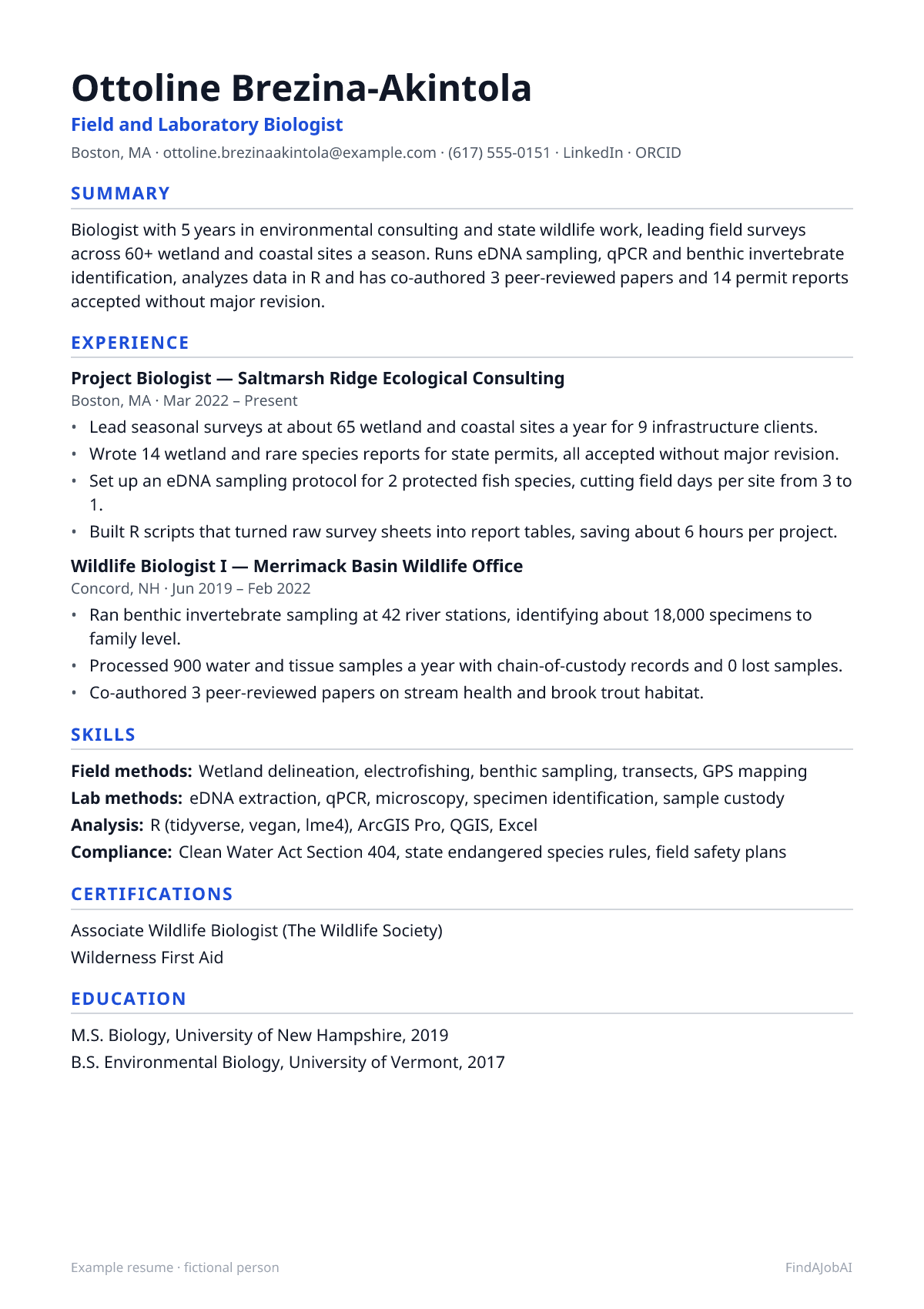
Biologist resume template
This example as a one-page template: one column, standard headings and plain text, the format applicant tracking systems read most reliably.
After you sign up, Create my CV builds your own resume in this same one-column layout, from your real experience.
Mid-level biologist resume example
A complete one-page example for a fictional biologist: every bullet pairs an action with what changed because of it.
Example resume · fictional person
Ottoline Brezina-Akintola
Field and Laboratory Biologist
Boston, MA · [email protected] · (617) 555-0151 · LinkedIn · ORCID
Summary
Biologist with 5 years in environmental consulting and state wildlife work, leading field surveys across 60+ wetland and coastal sites a season. Runs eDNA sampling, qPCR and benthic invertebrate identification, analyzes data in R and has co-authored 3 peer-reviewed papers and 14 permit reports accepted without major revision.
Experience
Project Biologist, Saltmarsh Ridge Ecological Consulting
Boston, MA · Mar 2022 – Present
- Lead seasonal surveys at about 65 wetland and coastal sites a year for 9 infrastructure clients.
- Wrote 14 wetland and rare species reports for state permits, all accepted without major revision.
- Set up an eDNA sampling protocol for 2 protected fish species, cutting field days per site from 3 to 1.
- Built R scripts that turned raw survey sheets into report tables, saving about 6 hours per project.
Wildlife Biologist I, Merrimack Basin Wildlife Office
Concord, NH · Jun 2019 – Feb 2022
- Ran benthic invertebrate sampling at 42 river stations, identifying about 18,000 specimens to family level.
- Processed 900 water and tissue samples a year with chain-of-custody records and 0 lost samples.
- Co-authored 3 peer-reviewed papers on stream health and brook trout habitat.
Skills
- Field methods: Wetland delineation, electrofishing, benthic sampling, transects, GPS mapping
- Lab methods: eDNA extraction, qPCR, microscopy, specimen identification, sample custody
- Analysis: R (tidyverse, vegan, lme4), ArcGIS Pro, QGIS, Excel
- Compliance: Clean Water Act Section 404, state endangered species rules, field safety plans
Certifications
- Associate Wildlife Biologist (The Wildlife Society)
- Wilderness First Aid
Education
- M.S. Biology, University of New Hampshire, 2019
- B.S. Environmental Biology, University of Vermont, 2017
Fictional example by the FindAJobAI team: the person, employers and numbers are invented. Keep the structure; use your own work and numbers you can explain in an interview.
Entry-level biologist resume example
A new biology graduate whose thesis and seasonal field work carry the page. Education comes first, and each bullet gives plot counts, sample numbers or methods at a student scale.
Entry-level example resume · fictional person
Thaddeus Okonkwo-Vellacourt
Biologist, Field and Lab
Providence, RI · [email protected] · (617) 555-0157 · LinkedIn
Summary
Entry-level biologist with a B.S. in Biology, 2 seasons as a field technician and a thesis on pollinator diversity across 24 meadow plots. Trained in transect surveys, insect and plant identification, DNA extraction and data cleaning in R, and ready for a field or lab technician role.
Education
- B.S. Biology, Brown University, 2025
Experience
Seasonal Field Technician, Narragansett Bay Habitat Alliance
Bristol, RI · May 2024 – Aug 2025
- Surveyed 30 salt marsh plots over 2 summers, recording vegetation cover and crab burrow density.
- Entered 4,500 field records into a shared database with a double-check that found 0 errors at audit.
- Collected 220 sediment cores following a written chain-of-custody procedure.
Skills
- Field: Transects, quadrats, insect netting, plant identification, GPS
- Lab: DNA extraction, PCR basics, microscopy, specimen pinning
- Data: R, Excel, QGIS
Thesis and coursework
- Senior thesis: compared bee diversity in 24 mown and unmown meadow plots, presented at 1 regional conference.
- Courses: ecology, genetics, molecular biology, biostatistics in R and GIS for natural resources.
Senior biologist resume example
A senior biologist who runs a monitoring program. The bullets move from collecting data to designing programs, managing staff and budgets and winning funding.
Senior example resume · fictional person
Ingeborg Achebe-Rosenquist
Senior Fisheries Biologist
Portland, ME · [email protected] · (617) 555-0162 · LinkedIn · ORCID
Summary
Senior fisheries biologist with 13 years in monitoring and habitat restoration, leading a team of 7 and a $1.4M annual program. Designed monitoring at 120 river stations, secured 5 federal grants and led recovery planning for 2 listed species with state and tribal partners.
Experience
Senior Fisheries Biologist, Penobscot Watershed Restoration Trust
Portland, ME · Jan 2019 – Present
- Lead a team of 4 biologists and 3 technicians running a $1.4M monitoring and restoration program.
- Redesigned sampling at 120 river stations, cutting field costs by 18% with no loss of statistical power.
- Won 5 federal grants worth $3.2M for dam removal and fish passage monitoring.
- Co-led recovery planning for 2 listed fish species with 4 state and tribal partners.
Fisheries Biologist, Downeast Rivers Field Station
Machias, ME · Jun 2013 – Dec 2018
- Ran smolt trapping and PIT-tag studies at 6 sites, tagging about 9,000 fish over 5 seasons.
- Published 6 peer-reviewed papers on juvenile salmon survival and habitat use.
- Built a shared database that replaced 40 separate spreadsheets for station data.
Skills
- Program leadership: Team management, budgets, grant writing, partner coordination
- Methods: PIT tagging, smolt trapping, electrofishing, habitat assessment, eDNA
- Analysis: R, mark-recapture models, power analysis, ArcGIS Pro
- Policy: Endangered Species Act consultation, recovery plans, federal grant reporting
Certifications
- Certified Fisheries Professional (American Fisheries Society)
Education
- Ph.D. Biology, University of Maine, 2013
- B.S. Zoology, University of Rhode Island, 2007
How to write a biologist resume
Five steps, in the order a recruiter reads the page. The format around them stays plain for every job: one column, standard headings, newest role first.
Header: name, target title and links
Use “Biologist” with your specialty, such as “Wildlife Biologist” or “Molecular Biologist”, to match the posting. Add your city, LinkedIn and ORCID if you publish.
Summary: what you do and your best proof
Open with your specialty and years, then the scale of your surveys or sample work. Name two or three core methods and one outcome such as approved reports, grants or papers.
Experience: newest first, a result in every bullet
Write each bullet as the scale, the method and the result: sites surveyed, samples processed, models fit or reports approved. “Collected data” alone hides both the volume and the quality.
Skills: grouped, in the ad's words
Group skills into field methods, lab methods, analysis and compliance. Name software such as R or ArcGIS and list only methods you can run without supervision.
Education and certifications
List degrees with the year and thesis topic if relevant. Add certifications such as Associate Wildlife Biologist, plus first aid or boating safety for field roles.
Skills to put on a biologist resume
Hard skills are the tools and methods of the job; soft skills are how you work with people. Each comes with one way to prove it, because a skill named only in a list counts for little. Add the ones you really have.
Hard skills
- Field survey design
- Give the number of sites or plots and how you chose them.
- Species identification
- Name the groups you identify and the number of specimens.
- Molecular methods
- List methods such as eDNA, PCR or sequencing with sample volumes.
- Statistical analysis
- Name the models and software you use and what they showed.
- GIS mapping
- Mention ArcGIS or QGIS and the maps or layers you produced.
- Sample custody
- Show how many samples you tracked and any loss or error rate.
- Regulatory reporting
- Name the permits or rules and how many reports you wrote.
- Grant writing
- Give the number and value of grants you helped win.
- Scientific writing
- Count papers, posters or reports and your role in each.
- Lab safety
- Mention biosafety level, chemical handling and training completed.
- Data management
- Describe databases or scripts you built and the time they saved.
Soft skills
- Attention to detail
- Describe an identification or data error you caught before reporting.
- Field leadership
- Give crew sizes you led and safety records.
- Clear communication
- Mention explaining results to clients, regulators or landowners.
- Adaptability
- Describe changing a plan because of weather, access or low counts.
- Collaboration
- Name the partners or labs you worked with on shared projects.
- Persistence
- Show long seasons or multi-year studies you saw through.
- Integrity
- Explain how you reported results that did not suit a client.
Biologist resume bullet examples: weak vs strong
The same work, written two ways. The strong version names the tool, the scope and a result; the numbers are examples, yours must be real.
Weak: Did field work.
Strong: Surveyed 50 wetland sites in one season with a 3-person crew, finishing 2 weeks before the permit deadline.
Shows scale, team and timing in one line.
Weak: Ran lab tests on water samples.
Strong: Extracted and ran qPCR on 1,200 eDNA samples a year, with negative controls clean in 98% of plates.
Names the method, the volume and a quality figure.
Weak: Analyzed data.
Strong: Analyzed 6 years of trout counts with mixed models in R, showing that riparian shading explained the strongest share of variance.
Shows the tool, the dataset and what the analysis found.
Weak: Wrote reports for permits.
Strong: Authored 11 biological assessment reports for regulators, each approved on first submission.
Turns writing into an approval record.
Weak: Helped with research papers.
Strong: Co-authored 2 journal papers on amphibian disease, preparing the sampling design and all statistical figures.
Explains the actual contribution to publications.
Weak: Trained seasonal staff.
Strong: Trained 8 seasonal technicians in electrofishing safety and data entry, with 0 safety incidents over 3 seasons.
Adds a safety outcome to the training claim.
15 more biologist resume bullet examples
Grouped by area of the job, so you can find the ones closest to your work. Keep the shape (action, scope, result) and replace the invented numbers with your own.
Field work
- Delineated 35 wetlands for development projects, with boundaries confirmed by 2 agency site visits.
- Ran night amphibian call surveys at 18 ponds across 3 seasons.
- Electrofished 25 stream reaches a summer while leading a 4-person crew safely.
- Mapped invasive plant cover on 600 acres using GPS and drone imagery.
Lab and analysis
- Ran qPCR assays on 800 eDNA filters with 2 field blanks per site.
- Identified 12,000 aquatic insects to genus with 95% agreement on a blind recheck.
- Fit occupancy models in R for 4 bird species across 70 survey points.
- Cleaned and merged 10 years of monitoring data into 1 documented dataset.
Reporting and funding
- Wrote 9 biological assessments for highway projects, all approved on first review.
- Helped secure 3 state grants worth $420,000 for habitat restoration.
- Presented results at 4 regional conferences and 2 public hearings.
- Co-authored 2 papers on wetland plant recovery after restoration.
Team and safety
- Trained 10 seasonal technicians on survey protocols and data entry.
- Wrote 5 field safety plans covering boats, waders and remote sites.
- Coordinated equipment for 3 field crews with 0 missed survey days from gear problems.
Biologist resume summary examples
Two or three lines on what you do and your strongest proof. Start from the one closest to your level and use your own facts.
Entry-level biologist with a B.S. in Biology, 2 summers as a field technician and a senior thesis on pollinator diversity across 24 meadow plots. Comfortable with transect surveys, plant and insect identification, basic PCR and data cleaning in R, and ready for a field or lab technician role.
Biologist with 5 years in consulting and state wildlife work, leading surveys at 65 sites a year. Runs eDNA and benthic sampling, analyzes data in R and writes permit reports that regulators approve without major revision.
Senior biologist with 13 years in fisheries and habitat restoration, managing a team of 7 and a $1.4M annual program budget. Designed long-term monitoring at 120 stations, secured 5 federal grants and led recovery planning for 2 listed species with state and tribal partners.
Common biologist resume mistakes
Each one is easy to make and quick to fix before you apply.
Describing projects without scale
Readers need to judge the size of your work. Give the number of sites, samples or specimens for each project you list.
Hiding your analysis skills
Many biology roles are now data heavy. Name your software, models and the questions your analysis answered.
Listing publications only
Consulting and agency employers value reports and permits too. Show how your work was used by clients or regulators.
Skipping field safety
Field roles carry real risks. Mention crew leadership, safety plans and training such as first aid or boating.
ATS tips for a biologist resume
Applicant tracking systems turn your file into text that recruiters search, mostly for the skills and titles in the ad. They rarely reject a resume on their own; one that parses badly or misses the ad's words just doesn't come up.
- Give the number of sites, stations or samples for each role so readers can judge scale.
- Name the field and lab methods you run independently, such as eDNA, qPCR or electrofishing.
- Show how work was used: permit reports accepted, grants won or papers published.
- List analysis tools like R, GIS and statistical models, since many biology roles are data heavy.
- Add permits, safety training and certifications that employers need in the field.
For the format itself, run the free ATS resume checklist.
Everything for Biologists
- Biologist cover letter examplesThree example letters and a short email version
- Biologist interview questions30 questions with sample answers
- Biologist job descriptionDuties, skills and requirements
- How to tailor your resume without lying
Other resume examples
Biologist resume FAQ
What should a biologist resume include?
Your specialty, field and lab methods, number of sites or samples handled, analysis tools, reports or publications and any certifications. Outcomes such as permits approved or grants won show that your work was used.
Should I list publications on a biologist resume?
Yes, briefly. Mention the count in your summary and list key papers in a short section or link to ORCID. For industry and consulting jobs, reports and project outcomes matter as much as papers.
How do I write a biologist resume with no experience?
Lead with your degree, thesis or capstone, and any seasonal field or lab technician work. Give plot counts, sample numbers and methods you learned, and include volunteer surveys or citizen science projects.
How we built this page
The FindAJobAI team wrote the three example resumes, the bullets, the skills and the advice for biologist roles. The people, employers and numbers in the examples are invented; the structure, the tools and the way each bullet is built are the parts to copy.
Once we track enough live biologist job ads, this page also shows the skills they ask for most, counted the same way as our in-demand skills report.
Last reviewed on November 1, 2026.