Occupational Therapy Assistant Cover Letter Example (2026)
By FindAJobAI Team Updated How we built this page
A rehab director reading COTA applications is usually checking a few practical points: is the credential current, does this person know our kind of unit, and do their patients end up doing more for themselves? Build your letter around one everyday activity, such as getting dressed or showering, and the change you saw, and credit the OT for the plan.
Occupational Therapy Assistant cover letter template
This letter as a one-page template: an opening that names the job and your strongest fact, proof that answers the ad, a reason for this employer and a short close.
After you sign up, FindAJobAI drafts your own letter for a real job from your CV in this format, and you edit it before you send it.
Example 1 · Experienced
Skilled nursing COTA applying to an inpatient rehab hospital
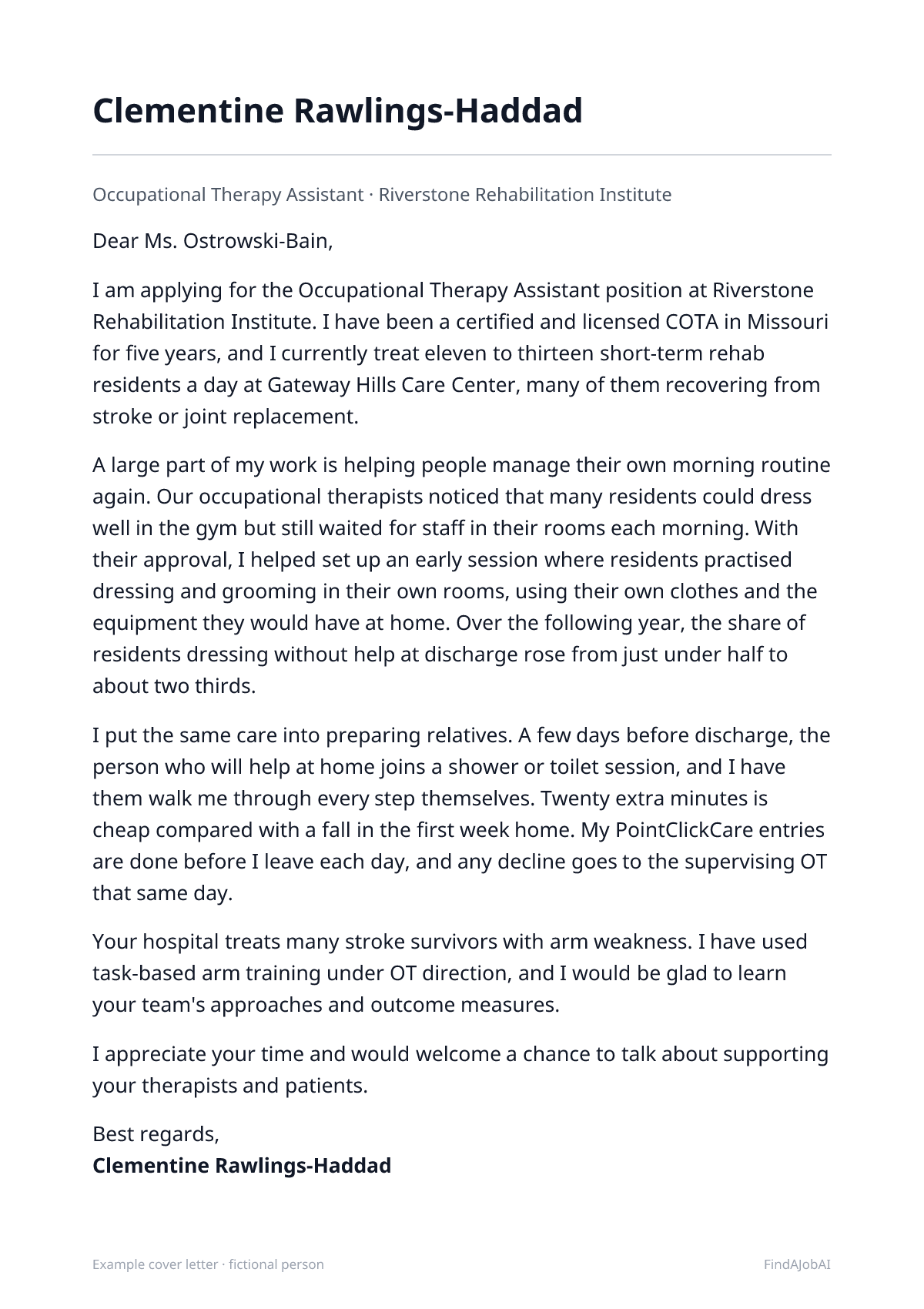
Clementine treats short-term rehab residents in skilled nursing. The ad asks for a COTA with stroke experience and strong family teaching.
Example letter · fictional
Dear Ms. Ostrowski-Bain,
I am applying for the Occupational Therapy Assistant position at Riverstone Rehabilitation Institute. I have been a certified and licensed COTA in Missouri for five years, and I currently treat eleven to thirteen short-term rehab residents a day at Gateway Hills Care Center, many of them recovering from stroke or joint replacement.
A large part of my work is helping people manage their own morning routine again. Our occupational therapists noticed that many residents could dress well in the gym but still waited for staff in their rooms each morning. With their approval, I helped set up an early session where residents practised dressing and grooming in their own rooms, using their own clothes and the equipment they would have at home. Over the following year, the share of residents dressing without help at discharge rose from just under half to about two thirds.
I put the same care into preparing relatives. A few days before discharge, the person who will help at home joins a shower or toilet session, and I have them walk me through every step themselves. Twenty extra minutes is cheap compared with a fall in the first week home. My PointClickCare entries are done before I leave each day, and any decline goes to the supervising OT that same day.
Your hospital treats many stroke survivors with arm weakness. I have used task-based arm training under OT direction, and I would be glad to learn your team's approaches and outcome measures.
I appreciate your time and would welcome a chance to talk about supporting your therapists and patients.
Best regards,
Clementine Rawlings-Haddad
Example 2 · Entry level
New graduate applying for a first COTA role after nursing assistant work
Torvald spent two years as a CNA on a rehab floor and has just earned his COTA credential. This posting comes from a care center open to first-year assistants.
Example letter · fictional
Dear Mr. Kowalski-Fenn,
I am applying for the Occupational Therapy Assistant position at Ashbury Glen Health and Rehab. I passed the NBCOT certification exam last month, and my Michigan license arrived this week. For two years before and during my studies, I worked as a certified nursing assistant on a rehab unit, so the daily rhythm of skilled nursing already feels familiar.
As a nursing assistant, I helped residents bathe, dress and move safely, and I often followed the routines the occupational therapists set up. One resident with Parkinson's disease became upset every morning because buttoning his shirt took so long. I mentioned it to his therapist, who introduced a button hook and asked me to cue him the same way each day. Within a few weeks he was dressing himself with only light reminders, and his mornings became calmer for everyone.
That experience is a big reason I chose occupational therapy. During my Level II fieldwork in skilled nursing, I treated up to eight residents a day under supervision, focusing on dressing, bathing and transfers. My fieldwork educator commented on my safe guarding during transfers and my clear same-day notes, and she encouraged me to look for a role in a facility that values teamwork between nursing and therapy.
The orientation program in your ad appeals to me a great deal. In return, Ashbury Glen would get someone who already knows how a rehab floor runs, who is at ease with elderly residents and who checks with the therapist instead of guessing.
I appreciate you reading this and could meet on any day that works for you.
Kind regards,
Torvald Nakashima-Bell
Example 3 · Senior or lead
Senior COTA applying to lead a school-based therapy team
Philomena is a COTA of twelve years, eight of them in schools. The district wants a lead assistant to organize COTA coverage across its campuses.
Example letter · fictional
Dear Dr. Lindgren-Asante,
Please consider me for the Lead Occupational Therapy Assistant role with Harborview Unified School District. I have held a COTA license for twelve years, the last eight in school practice with Cedar Coast Schools, where I support students on IEPs at five elementary schools and organize the timetables of three fellow assistants.
When I took on scheduling, our assistants spent a surprising amount of time driving between schools, and some students missed sessions whenever a teacher moved a class period. I mapped every student's session against travel time and class timetables, then worked with the supervising therapists to group nearby schools by day. Missed sessions dropped noticeably over the next semester, and each assistant gained roughly an hour a week for direct work with students.
I also enjoy helping teachers. Many of the strategies we use, such as better seating, slant boards or pencil grips, only work if they continue in the classroom. I run short, practical lunchtime sessions for teachers each term and follow up with a one-page guide for each student. Teachers tell me these guides help them support students between our visits.
Your posting mentions starting a sensory room program at two schools. I have helped equip one sensory space, but I have not led a program across several sites. I would want to plan it with your therapists and special education staff, using what students, families and teachers actually need at each school.
I would enjoy hearing what your team hopes to achieve this school year and how a lead assistant could help.
Sincerely,
Philomena Udeh-Carrington
All three letters, and the short version below, are fictional: the people, employers and numbers are invented. Borrow the structure, never the facts.
- Prefer to write it yourself? Use the free cover letter template.
- Check your CV against the job first: the free CV score shows the missing keywords.
Why the first letter works, paragraph by paragraph
Paragraph 1: Opening
Gives certification, license, years of practice and daily caseload at once, which answers the rehab manager's first screening questions.
Paragraph 2: The morning routine story
A real gap between gym skills and daily life, an idea approved by the OTs and a measured result show initiative within OTA scope.
Paragraph 3: Family teaching and notes
Having relatives demonstrate each step, finishing notes daily and flagging declines quickly are the habits a rehab director looks for, and the letter names all three.
Paragraph 4: Fit with stroke care
Linking arm training experience to the hospital's patients shows the writer read the posting, while offering to learn local methods.
Paragraph 5: Close
Two sentences that end on helping the OTs and their patients, which is how an assistant actually adds value on an inpatient unit.
What the entry-level letter does differently
Torvald opens with his fresh NBCOT pass and license, then draws on CNA shifts to prove he is comfortable with hands-on care. The button hook episode shows he notices problems and brings them to the therapist, and picking out the orientation program ties the letter to this employer.
What the senior letter does differently
The senior letter shows leadership through one practical change, smarter scheduling that cut missed sessions and freed time for students. The writer adds teacher training as wider impact and is honest that a multi-site sensory program would be new.
Short occupational therapy assistant cover letter: an email-ready version
Many applications arrive as an email or a small text box, and a full page doesn't fit. This version runs 120 to 150 words and keeps only what a reader needs to decide whether to reply. A COTA replies by email to a home health agency recruiter who posted a part-time opening on a local job board.
Short version · email · fictional121 words
Subject: Part-time COTA, home health – licensed in Georgia, own car, 3 days a week – Octavian Brisbois-Kaur
Hi Ms. Delacourt,
I am interested in the part-time Occupational Therapy Assistant role with Hearthside Home Health Partners. I have been a licensed COTA in Georgia for four years, including eighteen months of home visits for an agency covering two counties.
Most days I visit five people, usually older adults home from hospital or a new knee or hip. I rework washing, dressing and kitchen tasks around each home, point out easy safety fixes and call the supervising OT the same day if someone is slipping. Notes go into my tablet before I pull away.
My car is dependable, and Monday, Wednesday and Friday suit me well. I have attached my resume, along with my license number.
Thank you,
Octavian Brisbois-Kaur
The short version answers a home health recruiter's practical questions first, license, travel and days available, then adds one sentence on how the writer adapts care and handles notes in patients' homes.
Opening lines that work for occupational therapy assistant cover letters
The first sentence decides whether the second gets read. Here are six openings, one for each situation you might be in. Pick the one that matches yours and swap in your own facts: every name and number below is invented.
1. You have a standout result
Our residents could dress well in the gym but still waited for help each morning. Practising in their own rooms changed that for about two thirds of them by discharge.
2. The ad names a problem you've solved
I passed the NBCOT exam last month after two years as a nursing assistant on a rehab unit, so your new graduate COTA opening feels like the right next step.
3. Someone referred you
Imogen Farraday, an occupational therapist on your team, supervised part of my fieldwork and encouraged me to apply for this role.
4. You admire what they build
A button hook and the same daily cue helped one resident dress himself again, and that moment is why I became an occupational therapy assistant.
5. You're new to the field or switching into it
I coordinate schedules for four school-based assistants across five schools, which is close to the lead COTA role you describe.
6. You have senior scope or a specialism
Five home visits a day across two counties is my normal routine, so your part-time days and area line up well.
How to write an occupational therapy assistant cover letter
Five steps, in the order you'd write them. The shape stays the same for every job (a short opening, proof, a reason for this employer, a close), and what goes into each part is what changes with the role.
Lead with certification and setting
Say up front that you are a COTA, which states license you, how long you have practised and where. Rehab directors filter on exactly those points, so putting them in the first lines buys a careful read of everything after.
Tell a daily living story
Pick one routine, like getting dressed, showering or making a snack, and a group of people who struggled with it. Describe what you spotted, what you tried once the OT agreed and what those people could manage afterwards, ideally with a figure the unit already records.
Show family teaching and safety
Describe how you teach caregivers safe transfers or bathing routines and how you check they understood, such as teach-back. Add how quickly you report changes in function to the supervising therapist, since that protects patients.
Respect OTA scope
Pick verbs such as practised, adapted, coached and flagged, and avoid assessed or planned goals. Give the OT credit for the plan when you describe progress, which signals you know how an OT team divides the work.
Match the employer's patients
Look at who the employer serves: stroke survivors, children in class, or older adults living alone. Connect one concrete detail from your own work to that group, and finish by offering a conversation about the role.
Occupational Therapy Assistant cover letter do's and don'ts
Do
- State your COTA certification and license states in the first paragraph.
- Tell one story about a daily task patients learned to do again, with a result.
- Mention how fast you flag a decline to the OT and when your notes get done.
Don't
- Don't describe evaluating patients or setting goals; that belongs to the OT.
- Don't combine age, diagnosis and place in a way that points to one resident.
- Don't rely on general lines about loving to help people without a real example.
Common occupational therapy assistant cover letter mistakes
Each one is easy to make and quick to fix before you send the letter.
Claiming evaluation or goal-setting work
These belong to the occupational therapist. Describe the treatment you carried out and adjusted under the plan of care.
Leaving your COTA license until the end
Managers screen for certification first. State COTA/L and your license states in the opening paragraph.
Identifying a patient by accident
A diagnosis plus an age plus a town can point to one person. Talk about groups or keep details vague.
Talking about therapy without daily tasks
Occupational therapy is about everyday function. Say what patients could do after your sessions, like dressing or cooking.
Ignoring the setting in the posting
A school caseload looks nothing like a hand clinic or a rehab floor. Name the setting you know and why it transfers here.
Email subject lines for occupational therapy assistant applications
Applying by email? Put the job title, any reference number and your name in the subject line.
- COTA application – Missouri license, stroke and joint rehab – Clementine Rawlings-Haddad
- COTA application – newly certified, 2 years as rehab unit CNA – Torvald Nakashima-Bell
- Application: Occupational Therapy Assistant, PRN (Req. 5520) – Clementine Rawlings-Haddad
Everything for Occupational Therapy Assistants
- Occupational Therapy Assistant resume exampleA full resume, plus bullet and summary examples
- Occupational Therapy Assistant interview questions30 questions with sample answers
- Occupational Therapy Assistant job descriptionDuties, skills and requirements
- Cover letter with no experience: templates
Other cover letter examples
Occupational Therapy Assistant cover letter FAQ
What should an occupational therapy assistant cover letter include?
Your certification and license, your setting and caseload, and one story about patients becoming more independent in a daily task. Mention family teaching, timely notes and working under the OT's plan of care.
What should a newly certified COTA put in a first cover letter?
Start with the NBCOT pass and the license, then summarize Level II placements: where they were and how many people you saw daily. CNA, aide or caregiver jobs count for a lot, more so when they were on the same kind of unit.
Can an OTA cover letter describe patient progress?
Yes, as long as no one can be identified. Use group results or daily tasks, such as residents dressing independently, and credit the occupational therapist's plan.
How we built this page
The FindAJobAI team wrote the three example letters, the short email version, the opening lines and the advice for occupational therapy assistant roles. The people, employers and numbers in the letters are invented; the structure, the kind of evidence and the order of the paragraphs are the parts to copy.
Once we track enough live occupational therapy assistant job ads, this page also shows the skills they ask for most, counted the same way as our in-demand skills report.
Last reviewed on November 1, 2026.